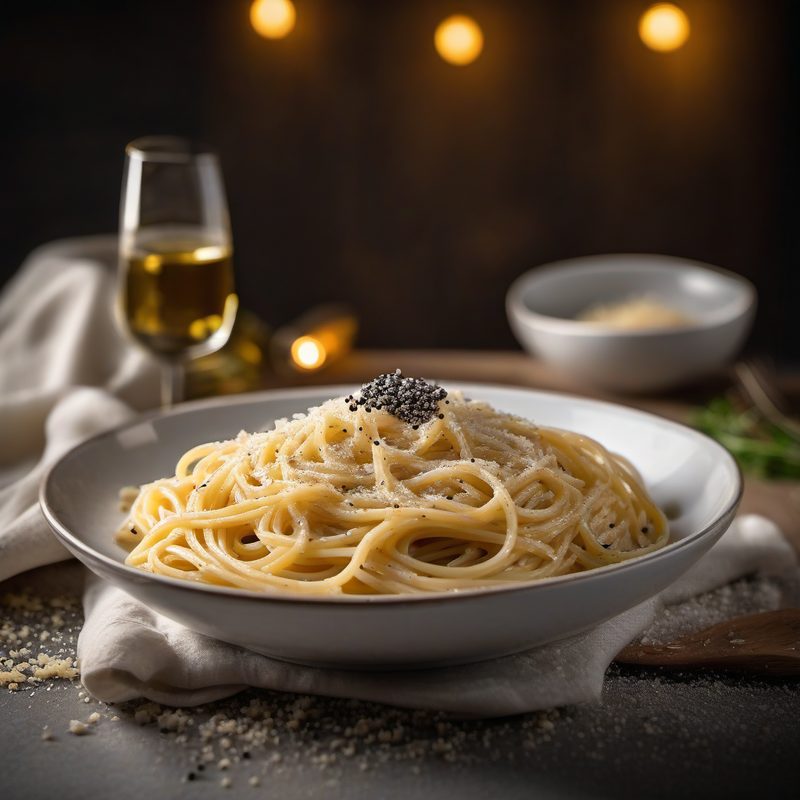
Spaghetti Cacio e Pepe
The quintessential Roman pasta — just four ingredients, one perfect emulsion. Master the technique and you'll understand why this is one of Italy's greatest dishes.
What Is Cacio e Pepe?
Cacio e pepe, literally “cheese and pepper,” is a Roman pasta made with just four ingredients: pasta, Pecorino Romano, freshly ground black pepper and starchy pasta water. Its genius is the emulsion: pepper toasted in the pan, then cheese melted with reserved pasta water until it becomes a creamy sauce that clings to every strand. No cream, no butter — technique does all the work.
| Amount | Ingredient |
|---|---|
| 350 g | Spaghetti (preferably bronze-drawn) |
| 200 g | Pecorino Romano, finely grated (preferably on a Microplane) |
| 2 tbsp | Whole black peppercorns |
| As needed | Salt (for pasta water) |
> Note: The difficulty here is not in the ingredients but the technique — the cheese-water emulsion is deceptively tricky. Read the full instructions before starting.
🥘 Equipment
- Large pot (6-qt) for pasta
- Dry skillet or frying pan (for toasting peppercorns)
- Mortar and pestle or spice grinder
- Large mixing bowl (wide enough to toss pasta)
- Microplane or finest grater (for Pecorino)
- Colander
- Tongs (for tossing)
- Measuring cup (for pasta water)
📋 Preparation
Step 1: Toast and Grind the Pepper
Place the whole black peppercorns in a dry skillet over medium heat. Toast, shaking the pan frequently, until fragrant and you hear a few pops — about 2 minutes. Do not burn.
Transfer to a mortar and pestle or spice grinder. Coarsely grind — you want a mix of fine powder and small crunchy bits. Set aside.
Why toast? Toasting releases volatile oils in the peppercorns, deepening their flavor from sharp and one-dimensional to warm, complex, and aromatic.
Step 2: Cook the Pasta
Bring a large pot of water to a rolling boil. Salt generously — the water should taste like the sea. Add the spaghetti and cook until very al dente (about 1–2 minutes less than the package's al dente time). The pasta will finish cooking in the sauce.
Critical: Reserve 2 cups of starchy pasta water just before draining. Do not drain without reserving this water — it is the foundation of the emulsion.
Step 3: Prepare the Cheese Bowl
While the pasta cooks, place the finely grated Pecorino Romano (all 200 g) in a large, wide mixing bowl. You'll be tossing the pasta directly in this bowl, so size matters — it should be big enough to toss vigorously without spillage.
Pro tip: Have everything ready at this point. Cacio e Pepe comes together in under 2 minutes once the pasta is drained.
Step 4: Create the Emulsion (The Critical Step)
This is the moment that separates silky cacio e pepe from a clumpy mess. Work quickly and decisively.
Immediately after draining, transfer the hot spaghetti directly into the bowl with the grated Pecorino. Do not let the pasta cool.
Add ½ cup of the reserved hot pasta water. Using tongs (or two forks), toss vigorously — lift, twist, and turn the pasta repeatedly. The goal is to melt the cheese into the starchy water, creating a creamy, emulsified sauce that coats every strand.
As you toss, the mixture will go through phases:
- Clumpy phase — the cheese and water look separated and lumpy. Keep tossing.
- Coming together — the sauce starts to look creamy.
- Emulsion achieved — a smooth, velvety sauce clings to the pasta.
Continue tossing, adding more pasta water 1–2 tablespoons at a time as needed. You'll likely use ¾ to 1 cup total. Stop when the sauce is fluid and creamy but not watery — it should coat the pasta like a silky blanket.
The science: Hot pasta water contains starch molecules that act as emulsifiers, binding the fat in the cheese with the water. The heat from the freshly drained pasta and the hot water melts the Pecorino's fat without overheating it. Too hot and the cheese proteins seize into clumps; too cool and the cheese won't melt at all. The vigorous tossing provides the mechanical energy needed for emulsification.
Step 5: Finish and Serve
Sprinkle in half the toasted ground pepper and toss once more to distribute.
Divide immediately among warm bowls. Top each serving with the remaining ground pepper. Serve at once — this dish waits for no one.
🧑🍳 Chef's Tips
- Grind your own Pecorino: Pre-grated cheese contains anti-caking agents that sabotage the emulsion. Always grate Pecorino Romano fresh from a block.
- Microplane is best: The finest possible grate ensures the cheese melts instantly and evenly. A box grater's fine side works too, but pass it through twice.
- The water must be hot: Not warm, not boiling — just off the boil. If your pasta water has cooled, the cheese won't emulsify. Work immediately after draining.
- Pasta water ratio: Start with ½ cup and add more as you toss. Different brands of pasta release different amounts of starch, and Pecorino varies in moisture content. Trust your eyes, not a fixed measurement.
- Use bronze-drawn pasta: Bronze dies create a rough, porous surface that sauce clings to. Teflon-drawn pasta is too smooth and the sauce slides off.
- Don't rinse the pasta: Rinsing washes away the surface starch that is essential for the emulsion.
- Cold bowl, warm pasta: Cold ceramic or stainless steel helps prevent the cheese from overheating and clumping. A warm bowl works too — but a hot bowl can push the cheese past its breaking point.
❌ Common Mistakes
| Mistake | Why | Fix |
|---|---|---|
| Pre-grated Pecorino | Anti-caking agents prevent proper melting | Grate fresh from a block |
| Cheese bowl too hot | Cheese proteins seize and clump | Use a room-temperature or cool bowl, or let the pasta cool 10 seconds |
| Not enough pasta water | Dry, sticky, clumpy mess | Add water a tablespoon at a time while tossing |
| Too much pasta water | Thin, soupy sauce | Stop adding at the first sign of fluidity |
| Pasta too cold from draining | Cheese won't melt | Work immediately — have the bowl ready before you drain |
| Not tossing vigorously enough | Cheese doesn't emulsify | Use real arm effort; lift and spin the pasta |
| Using black pepper from a shaker | Flat, one-dimensional heat | Toast and crack whole peppercorns |
| Letting it sit before serving | Sauce tightens and becomes gluey | Serve the instant it's ready |
💡 Variations
- Cacio e Pepe with Butter — Add 1 tbsp cold butter during the emulsion phase for extra richness and stability (chefs' trick).
- Whole Wheat Cacio e Pepe — Substitute whole wheat spaghetti. The nuttier flavor complements the Pecorino beautifully. You may need slightly more pasta water.
- Spicy Cacio e Pepe — Add a pinch of red pepper flakes along with the black pepper.
- Cacio e Pepe with Zucchini — Sauté 1 thinly sliced zucchini in olive oil until golden. Toss into the pasta after the emulsion is formed.
- Cacio e Pepe Risotto-Style — Cook the spaghetti like risotto: toast dry pasta briefly in a pan, then add hot water in increments, stirring constantly. Finish with Pecorino and pepper off heat.
- Gluten-Free — Use a high-quality brown rice or chickpea spaghetti. Bronze-drawn gluten-free pasta works best.
❄️ Storage
Cacio e Pepe is best eaten immediately and does not keep well. The sauce tightens as it cools and cannot be reheated without breaking. If you absolutely must keep leftovers:
- Refrigerate in an airtight container for up to 1 day.
- To reheat: place in a pan with 2–3 tbsp hot water. Toss over low heat, adding water as needed to loosen the sauce. The texture will not be as creamy as fresh.
🍷 Wine Pairing
| Wine | Why |
|---|---|
| Frascati Superiore | From the hills outside Rome — citrusy, minerally, cuts through the cheese |
| Gavi di Gavi | Crisp, floral, with good acidity to balance the richness |
| Verdicchio dei Castelli di Jesi | Slightly nutty undertones mirror the Pecorino |
| Pinot Grigio (Alto Adige) | Clean, mineral-driven, won't overpower |
🍺 Beer Pairing
| Beer | Why |
|---|---|
| Peroni Nastro Azzurro | Crisp Italian lager — the classic Roman accompaniment |
| Pilsner Urquell | High carbonation and bitterness cut through the fat |
| IPA (West Coast) | Hoppy bitterness contrasts with the salty Pecorino |
🥗 Suggested Sides
- Simple arugula salad with lemon juice and Parmigiano shavings
- Roasted asparagus with olive oil and sea salt
- Focaccia or grissini for texture contrast
- Sautéed broccoli rabe with garlic and chili flakes
📊 Nutrition (per serving)
| Calories | Protein | Fat | Carbs | Fiber |
|---|---|---|---|---|
| 510 | 24 g | 18 g | 62 g | 3 g |
❓ FAQ
Why does my cheese clump instead of melting?
Three possible culprits: (1) the bowl was too hot — the cheese proteins seized; (2) the pasta water was not starchy enough — use less water or a more concentrated boil; (3) you didn't toss vigorously enough — the emulsion needs mechanical energy to form.
Can I use Parmigiano-Reggiano instead of Pecorino Romano?
Authentic cacio e pepe uses Pecorino Romano, a salty, sharp sheep's milk cheese. Parmigiano is cow's milk and less salty — the dish will be milder and less complex. A 50/50 blend is a common compromise.
What if I don't have a Microplane?
Use the finest holes on a box grater. For a truly fine grate, pass the cheese through twice. Pre-grated cheese is not recommended (see Common Mistakes above).
Can I make this with a different pasta shape?
Traditionally spaghetti, tonnarelli, or bucatini. The long, thin shape allows the sauce to coat evenly. Short shapes (penne, rigatoni) work but the emulsion clings less effectively.
Is there a way to reheat leftovers without breaking the sauce?
Not perfectly — the emulsion is fragile. The best method is low heat with added water, tossing constantly. Accept that reheated cacio e pepe will be less creamy but still delicious.
Do I need to use the full 200 g of Pecorino?
Yes, for 4 servings. The cheese is the entire sauce — skimping leaves you with bland pasta. Use the full amount and trust the technique.
How salty should the pasta water be?
About 1 tablespoon of salt per 4 quarts (4 liters) of water. The pasta absorbs this salt, seasoning it from within. Don't worry about over-salting — the water is mostly discarded.
🔗 Related Recipes
- Spaghetti Carbonara — The Roman Sister Dish
- Penne alla Vodka — Creamy, Tomatoey Cousin
- Lemon Spaghettini — Bright, Simple Summer Pasta
- Tagliatelle Cacio e Pepe (Richer Version)
- Gricia — The Ancestor of Cacio e Pepe (with Guanciale)
🏷️ Search Tags
Recipe from The Italian Kitchen by Vita Milanese — Volume 1 · Pasta Perfetto. Discover all volumes on the ebook page.