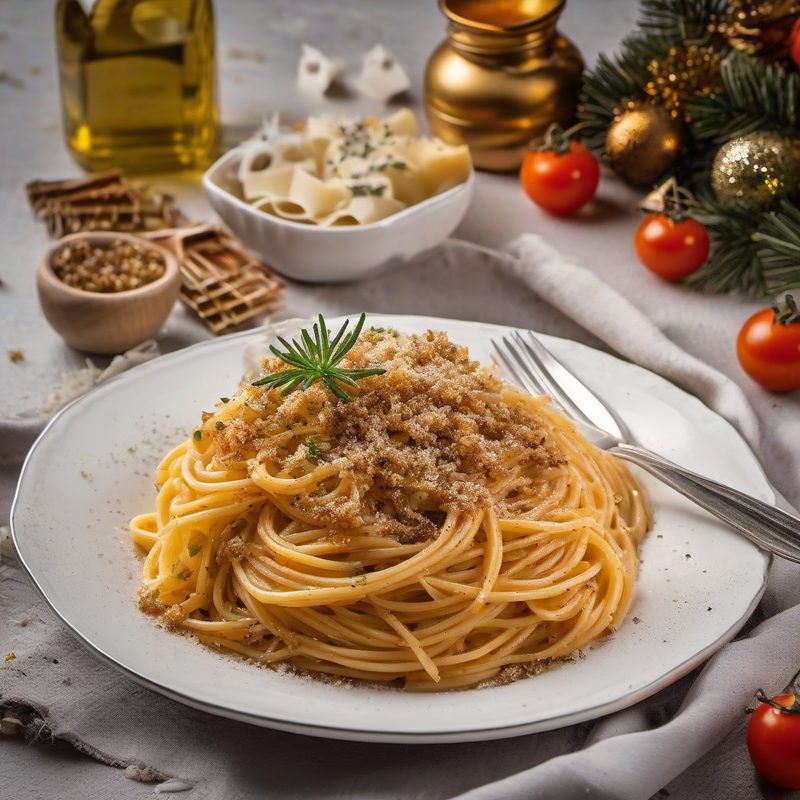
Spaghetti Befana
A rustic Puglian pasta that combines the briny depth of melted anchovies with the crunch of toasted walnuts and golden breadcrumbs — a cucina povera triumph named for the Epiphany witch, La Befana, who brings gifts to the children of Italy on January 6th.
| Amount | Ingredient |
|---|---|
| 350 g (12 oz) | Spaghetti (bronze-drawn preferred) |
| 6 | Anchovy fillets, oil-packed |
| 50 g (½ cup) | Fresh breadcrumbs (from crustless rustic bread) |
| 50 g (½ cup) | Walnut halves, roughly chopped |
| 3 | Garlic cloves, thinly sliced |
| 1 | Fresh red chili (or ½ tsp red pepper flakes) |
| 4 tbsp (60 ml) | Extra-virgin olive oil, divided |
| ¼ cup | Fresh flat-leaf parsley, finely chopped |
| — | Salt, for pasta water only |
This is a pasta of contrasts: silky spaghetti slicked with a savory anchovy-chili oil, topped with a scattering of toasted breadcrumbs and walnuts that provide textural counterpoint and nutty sweetness with every forkful. Named for the kindly witch of Italian folklore — La Befana, who flies on her broomstick on the night of January 6th, filling stockings with sweets and charcoal — this dish embodies the Puglian spirit of transforming humble pantry staples into something celebratory. The anchovies dissolve into a fragrant, rust-colored cream in the warm olive oil, while the garlic and chili infuse the base with gentle heat. The breadcrumbs and walnuts, toasted together until golden and aromatic, are sprinkled over the top rather than tossed through, so they stay resolutely crunchy and provide a crisp contrast to the tender pasta. It is an Epiphany tradition in Puglia, but it is also a brilliant weeknight pasta — ready in under 25 minutes, made entirely from shelf-stable ingredients, and deeply satisfying in that way only the best cucina povera cooking can be.
🥘 Equipment
- Large pot (6-qt) for pasta
- Large sauté pan or skillet (12-inch)
- Small skillet or sauté pan (8- to 10-inch)
- Chef's knife
- Cutting board
- Colander
- Wooden spoon or tongs
- Ladle
- Citrus juicer or reamer (not needed, but handy)
📋 Preparation
Step 1 — Prepare the Aromatics and Crumb Topping (5 min)
Thinly slice the garlic cloves into delicate rounds. Finely chop the fresh chili (remove seeds for milder heat). Roughly chop the walnut halves — you want visible pieces, not a powder, about the size of small peas. Finely chop the parsley.
Step 2 — Toast the Breadcrumbs and Walnuts (5 min)
Heat 1 tablespoon of the olive oil in a small skillet over medium heat. Add the breadcrumbs and chopped walnuts in an even layer. Cook, stirring frequently, until the breadcrumbs are deep golden brown and the walnuts are fragrant and lightly toasted — about 3 to 4 minutes. Season with a pinch of salt.
Transfer the breadcrumb-walnut mixture to a small plate or bowl and set aside. Wipe out the small skillet.
The toasting happens more quickly than you think — the residual heat of the pan continues to cook the crumbs even after you remove them from the heat, so stop when they are just a shade lighter than you want them. Over-toasted breadcrumbs taste bitter; perfectly toasted ones taste like buttered toast and nuts.
Step 3 — Infuse the Anchovy Oil (5 min)
In the large skillet, heat the remaining 3 tablespoons of olive oil over medium-low heat. Add the sliced garlic and chili. Sauté gently, shaking the pan occasionally, until the garlic is fragrant and just beginning to turn golden at the edges — about 1 to 2 minutes. Do not let the garlic brown.
Add the anchovy fillets to the pan. Stir continuously with a wooden spoon, breaking the fillets apart as they warm. They will dissolve into a fragrant, rust-colored cream in about 1 to 2 minutes. Reduce the heat to the lowest setting and keep warm.
Low heat is critical here. The anchovies dissolve like butter when the oil is warm but not hot. If the heat is too high, the garlic will burn (turning bitter) and the anchovies will seize rather than melt into a silky cream. Good-quality oil-packed anchovy fillets are essential — they should fall apart at the slightest encouragement. Lower-quality fillets are often too dry and salty, and may not dissolve properly.
Step 4 — Cook the Pasta (9 min)
While the anchovy oil infuses, bring a large pot of generously salted water (about 1½ tablespoons of salt per 4 quarts of water) to a rolling boil. Add the spaghetti and cook according to package directions until al dente.
Just before draining, reserve about 1 cup (240 ml) of the starchy pasta cooking water. Drain the spaghetti well — do not rinse.
The starchy pasta water is the bridge between the anchovy oil and the pasta. It loosens the concentrated anchovy cream and helps it cling to every strand without becoming greasy. Two cups reserved is insurance — you may not need all of it, but having it is better than needing more and having none.
Step 5 — Toss the Pasta with the Anchovy Oil (1 min)
Return the large skillet with the anchovy oil to low heat. Add the drained spaghetti directly to the skillet. Toss vigorously with tongs, adding a splash of the reserved pasta water — start with about ¼ cup (60 ml) — until a silky, emulsified sauce forms that coats every strand of spaghetti. Add more pasta water if needed, 1 tablespoon at a time, until the pasta is glossy and fluid but not watery.
Taste and adjust: the anchovies and pasta water should provide enough salt, but you may want a crack of black pepper.
Step 6 — Serve and Top (1 min)
Divide the spaghetti among warm shallow bowls. Scatter the toasted breadcrumb-walnut mixture evenly over each serving — this is a topping, not a toss-in, so the crumbs stay crunchy. Finish with a generous sprinkle of fresh parsley.
Serve immediately. Drizzle with a final thread of raw extra-virgin olive oil if desired.
The breadcrumbs and walnuts must be added at the very last moment, just before serving. If they sit on the hot pasta for more than a minute or two, they absorb moisture and lose their crunch. For the best texture, pass extra breadcrumb-walnut mixture at the table.
🧑🍳 Chef's Tips
- The breadcrumb-walnut ratio is flexible: The classic Puglian version uses roughly equal parts by volume. If you prefer more crunch, increase the breadcrumbs to 60 g (¾ cup) and reduce the walnuts to 30 g (¼ cup). If you want a more nutty, luxurious topping, reverse the proportions.
- Make your own breadcrumbs: For the best texture, tear the crust from a day-old rustic loaf and pulse the crumb in a food processor just until coarse crumbs form (about 5 to 6 pulses). Do not reduce to fine dust — the irregular, craggy pieces toast into a mix of textures that are far more satisfying than uniform commercial breadcrumbs. Panko works in a pinch but lacks the same rustic character.
- Stale bread is ideal: Bread that is 2 to 3 days old has dried out enough that it toasts crisp and golden rather than absorbing oil and turning greasy. If your bread is fresh, spread the crumbs on a baking sheet and dry them in a 300°F (150°C) oven for 5 to 8 minutes before toasting in the pan.
- Toast the walnuts separately if you prefer: Toasting the walnuts alongside the breadcrumbs infuses the crumbs with walnut flavor. If you want the walnuts to have a more assertive, separate crunch, toast them in a dry pan first (about 2 to 3 minutes), remove them, then toast the breadcrumbs in the same pan with the oil.
- Go easy on the salt: The anchovies are intensely salty. The pasta water is salted. Between these two sources, there is usually enough salt for the entire dish. Taste before adding any additional salt, and season the breadcrumb-walnut mixture very lightly.
- Fresh chili vs. dried flakes: Fresh chili provides a brighter, fruitier heat that complements the anchovies beautifully. Red pepper flakes work perfectly as a substitute — use ½ teaspoon and add them with the garlic. The heat level is adjustable; for a milder dish, remove the chili's seeds and membranes before slicing.
- Quality anchovies matter: This dish has few ingredients, so each one matters. Use the best oil-packed anchovy fillets you can find — look for jars or tins from Italy (brands like Agostino Recca, Ortiz, or Cento). Avoid anchovy paste, which has a harsh, one-note flavor and won't dissolve into the same silky cream.
❌ Common Mistakes
| Mistake | Why It Happens | How to Avoid |
|---|---|---|
| Bitter, harsh anchovy flavor | Anchovies burnt or garlic browned | Cook garlic and chili over low heat; add anchovies once garlic is fragrant, not brown |
| Breadcrumbs are greasy or soggy | Too much oil, or crumbs toasted too slowly | Use exactly 1 tbsp oil for the crumbs; toast over medium heat, stirring constantly |
| Breadcrumbs burn before walnuts are toasted | Walnuts take slightly longer to toast than fine crumbs | Add the walnuts to the pan 30 seconds before the breadcrumbs, or toast them separately |
| Sauce is greasy and slides off the pasta | Too much oil, not enough pasta water | Emulsify with starchy pasta water — start with ¼ cup and add more as needed |
| Pasta is dry and clumpy | Not enough pasta water added | The sauce should be fluid and glossy, not thick; add pasta water 1 tbsp at a time until it flows |
| Dish is too salty | Over-salted pasta water + salty anchovies | Use slightly less salt in pasta water than usual; the anchovies provide plenty of salt |
| Anchovies won't dissolve | Heat too low, or poor-quality fillets | Use good-quality fillets packed in oil; ensure the pan is warm enough for them to melt into a cream |
| Breadcrumbs lose their crunch | Added to the pasta too early | Sprinkle the topping on each serving at the last moment, or pass it at the table |
💡 Variations
- Spaghetti della Befana with Capers: Add 1 tablespoon of rinsed capers to the anchovy oil along with the anchovies. The briny, floral pop of capers complements the anchovies and adds another layer of Mediterranean flavor.
- Add lemon: A squeeze of fresh lemon juice and a pinch of lemon zest stirred into the finished pasta brightens the anchovy richness and adds a fresh, citrusy note that pairs beautifully with the walnuts.
- Go green: Stir a handful of fresh arugula or baby spinach into the pasta when you add the spaghetti — it will wilt from the residual heat, adding color and a peppery note.
- Make it cheesy: A dusting of finely grated Pecorino Romano or Parmigiano-Reggiano over the finished dish adds a savory, salty layer that plays well with the anchovies. This is not traditional for the Puglian version, but it is delicious.
- Use different pasta: Linguine, bucatini, or perciatelli all work beautifully. Short shapes like penne or rigatoni are less traditional but work in a pinch — the breadcrumb topping settles in the grooves.
- Spicy version: Double the chili, or use a hotter variety like bird's eye. The heat cuts through the anchovy richness beautifully.
- Herb-infused crumbs: Add 1 teaspoon of dried oregano or a tablespoon of finely chopped rosemary to the breadcrumb-walnut mixture during the last minute of toasting. The herbs perfume the crumbs and add depth.
- Add olives: A handful of pitted, chopped black olives (Gaeta or Taggiasca) added to the anchovy oil along with the anchovies adds a fruity, briny note that echoes the Puglian olive-growing tradition.
❄️ Storage
| Method | Details |
|---|---|
| Refrigerator | Store leftovers in an airtight container for up to 2 days. The breadcrumb topping will soften as it absorbs moisture from the pasta — this is unavoidable. |
| Reheating | Reheat in a skillet over medium-low heat with a splash of water or olive oil, tossing until just warmed through (about 2 to 3 minutes). To revive the crunch, sprinkle fresh separately toasted breadcrumbs and walnuts over the reheated pasta just before serving. |
| Freezing | Not recommended — the texture of both the pasta and the breadcrumb topping degrades significantly upon thawing. |
🍷 Wine Pairing
| Wine | Why |
|---|---|
| Verdeca (Puglia) | A crisp, mineral-driven white native to Puglia with green apple, citrus, and almond notes — a classic, place-based pairing that cuts through the anchovy richness and echoes the nutty breadcrumbs |
| Locorotondo DOC (Puglia) | A light, fresh white from the Itria Valley in Puglia, made from Verdeca and Bianco d'Alessano — floral, citrusy, and bright, with enough acidity to refresh the palate between bites |
| Vermentino di Sardegna | Bright acidity and a saline finish that mirrors the briny anchovies, with a subtle almond note that complements the toasted walnuts |
| Vernaccia di San Gimignano | A crisp, mineral-driven white from Tuscany with green apple and citrus notes — its clean profile lets the anchovy and garlic shine |
| Gavi di Gavi | Clean, precise, and elegant, with good acidity to balance the oil-based sauce without overpowering |
| Soave Classico | Light-bodied with almond and herbal notes that harmonize with the parsley and walnuts |
| Lambrusco Grasparossa (slightly chilled) | A rare red pairing for anchovy pasta — the bright acidity, gentle fizz, and berry fruit cut through the richness while the chill keeps things refreshing. Perfect if you prefer red wine |
🥗 Suggested Sides
- Simple arugula salad with lemon vinaigrette — Peppery arugula tossed with lemon juice, good olive oil, and flaky salt. The bright, sharp greens cut through the rich, savory pasta and provide a crisp, fresh contrast
- Roasted broccolini or asparagus with olive oil and sea salt — the slight bitterness of the broccolini balances the anchovy richness, and the char adds a smoky note
- Crostini with olive tapenade — A Puglian-inspired starter: toasted bread rubbed with garlic and topped with a coarse puree of black olives, capers, and olive oil. The briny, salty flavors preview the anchovy theme
- Fennel and orange salad — Thinly sliced raw fennel bulb with supremed orange segments, red onion, flaky salt, and olive oil. The crisp, citrusy freshness is a perfect counterpoint to the rich, umami pasta
- Grilled bread rubbed with garlic — For sopping up every last drop of anchovy oil from the bottom of the bowl. Serve with a small dish of good extra-virgin olive oil for dipping
📊 Nutrition (per serving)
| Calories | Protein | Fat | Carbs | Fiber |
|---|---|---|---|---|
| ~530 | 16 g | 22 g | 68 g | 3 g |
Nutritional values are estimates based on 4 servings with the specified quantities. Actual values will vary based on the specific brand of pasta, the type of olive oil, and the bread used for breadcrumbs. The dish provides complex carbohydrates from the spaghetti, heart-healthy monounsaturated fats from the olive oil, omega-3 fatty acids from the anchovies and walnuts, and a modest amount of protein. The breadcrumb-walnut topping adds fiber and texture. To reduce calories, use 3 tablespoons of olive oil total (2 tablespoons for the anchovy oil, 1 tablespoon for the breadcrumbs) instead of the full 4. To increase protein, serve alongside a side of white beans or grilled fish.
❓ FAQ
Who is La Befana, and why is this pasta named after her?
La Befana is a beloved figure in Italian folklore — a kindly old witch who flies on her broomstick on the night of January 5th (the eve of the Epiphany), delivering gifts and sweets to well-behaved children and coal (or dark candy) to those who've been naughty. She is celebrated throughout Italy, but especially in central and southern regions, including Puglia. This pasta, simple yet satisfying, represents the kind of rustic, warming dish you might eat on a cold January evening after the holiday festivities have wound down.
Can I make this with dried spaghetti, or do I need a specific brand?
Any good-quality dried spaghetti works beautifully. Bronze-drawn spaghetti (rough-textured from being extruded through bronze dies) is ideal because the sauce clings better to the rough surface. Look for brands like De Cecco, La Molisana, or Rustichella d'Abruzzo. The recipe is also excellent with linguine, bucatini, or perciatelli.
My anchovies won't dissolve — what am I doing wrong?
Two likely reasons: (1) the heat is too low — the oil needs to be warm enough to melt the fillets (medium-low is the sweet spot; not too hot, not too cool); or (2) you're using low-quality anchovies that are too dry or packed in salt rather than oil. Good anchovy fillets in oil should dissolve like butter in a warm pan. If using salt-packed anchovies, rinse them, fillet them, and soak them in a little warm water or milk for 10 minutes before using.
Can I skip the chili for a milder version?
Absolutely. The chili adds a gentle warmth, not overpowering heat, but it is not essential to the dish. Omit it entirely, or use a small pinch of red pepper flakes for a whisper of warmth. The dish will still be deeply flavorful from the anchovies, garlic, and walnuts.
What is the best bread to use for the breadcrumbs?
A day-old rustic country loaf or Italian bread is ideal — something with a firm crumb and a sturdy crust. Avoid soft, airy sandwich bread, which turns into a pasty mess when toasted. For the best texture, use the soft crumb only (discard the crust, or save it for another use like panzanella). The bread should be at least 1 day old; 2 to 3 days old is even better for toasting.
Why isn't the pasta water salted for the crumb-toasted version?
It is — but only for cooking the spaghetti. The anchovies provide ample salt, and the breadcrumbs and walnuts are seasoned very lightly (or not at all) during toasting. The salt in the pasta water seasons the spaghetti from within, which means the overall dish is well-seasoned without any one component being over-salted.
Can I use pre-grated breadcrumbs from a can?
You can, but the texture will suffer. Canned breadcrumbs are too fine and uniform — they toast into hard little pellets rather than craggy, crunchy pieces. If you must use them, toast them very briefly (about 1 to 2 minutes) and watch carefully to prevent burning. Fresh breadcrumbs made from day-old bread are so easy to make and so much better that they are worth the extra minute of effort.
Is there a way to make the breadcrumbs stay crunchy longer?
The crunchy window is about 5 to 10 minutes after topping. To extend it, you can: (1) pass the breadcrumb-walnut mixture at the table so each person adds their own; (2) keep the mixture warm in a 200°F (90°C) oven while the pasta finishes; or (3) toast the crumbs slightly darker than you think you should — the extra color provides a crunch buffer. Accept that the dish is at its absolute best in the first few minutes after plating, which is why it is served immediately.
Is this dish traditionally served on a specific day?
Yes — the Epiphany, January 6th, which marks the end of the Christmas season in Italy. In the Puglian tradition, families gather for a final holiday meal, and this simple, hearty spaghetti is a common choice. The combination of anchovies (a preserved pantry staple) and walnuts (a winter nut) reflects the practical, seasonal cooking of the region. It is also made throughout the winter months as a comforting, quick weeknight dinner.
🔗 Related Recipes
- Acciugata Spaghetti (#262) — Tuscan anchovy pasta, a close cousin with garlic, chili, and parsley but without the walnut-breadcrumb crunch
- Recommone Linguine (#206) — Campanian linguine with anchovies and walnuts, a regional variation from the neighboring region of Campania
- Faccia Gialla Spaghetti (#208) — Saffron and anchovy spaghetti from the Amalfi Coast, another anchovy-based pasta with a completely different flavor profile
- Pici with Crispy Breadcrumbs (#113) — Tuscan pici with a similar breadcrumb topping, without the anchovy base, showcasing the versatility of the briciole technique
- Ortigia Linguine (#188) — Sicilian linguine with anchovies, breadcrumbs, and saffron, bridging the gap between the Sicilian and Puglian anchovy pasta traditions
- Pasta with Anchovy Cream (#235) — A creamy, breadcrumb-based Sicilian anchovy sauce that takes a completely different approach to a similar ingredient set
- Poveriello Spaghetti (#187) — Another rustic Southern Italian spaghetti, this one with tomato, garlic, and basil; a study in how cucina povera transforms simple ingredients into entirely different dishes
- Pugliese Carbonara (#259) — The rich, eggy Puglian take on Roman carbonara, showing the region's love for generous, satisfying pasta dishes
🏷️ Search Tags
📸 Photo Reference
Photo reference: `vol1_449.png` — An overhead or slightly angled shot of a wide, shallow white ceramic bowl filled with spaghetti della Befana. The spaghetti is glossy and golden from the anchovy-chili oil emulsion, with visible flecks of red chili and green parsley throughout. A generous, uneven scattering of toasted breadcrumbs and chopped walnuts crowns the top — the crumbs are deep golden brown, the walnuts a warm, toasted tan. Some crumbs have fallen onto the rim of the bowl. A final drizzle of raw extra-virgin olive oil catches the light. Beside the bowl: a small rustic dish of extra anchovy fillets in oil, a head of garlic, a fresh red chili, a small handful of walnuts in their shells, a sprig of parsley, and a cruet of olive oil on a worn wooden Puglian farmhouse table. The lighting is warm and diffused, late afternoon winter sun streaming from the upper left. The overall mood is rustic, hearty, and deeply comforting — the kind of dish that warms you from the inside on a cold January evening.
Recipe from "The Italian Kitchen" by Vita Milanese — Volume 1: Pasta Perfetto 🧹
Recipe from The Italian Kitchen by Vita Milanese — Volume 1 · Pasta Perfetto. Discover all volumes on the ebook page.