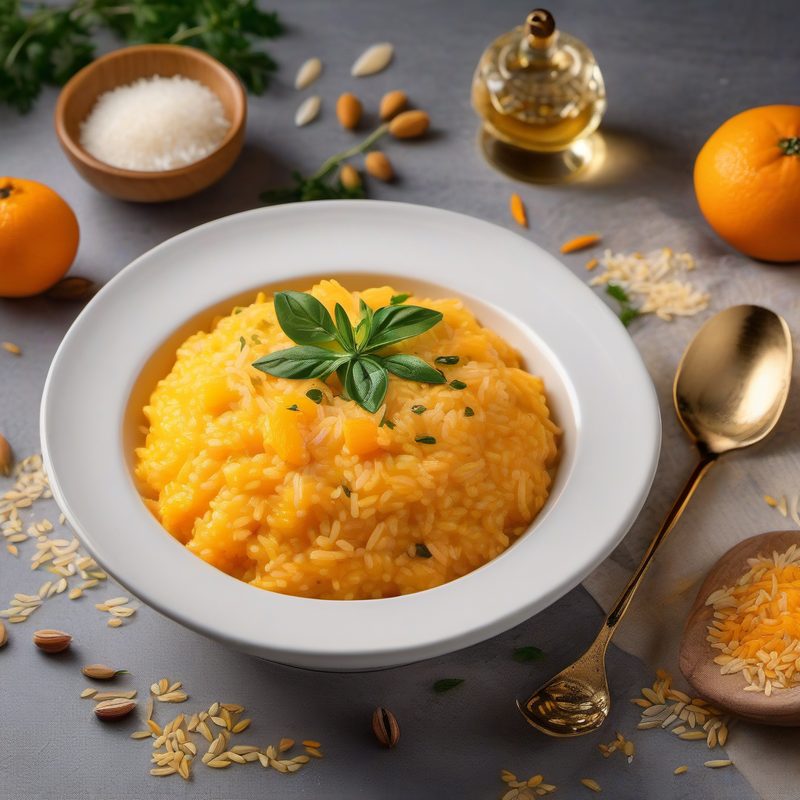
Orange Risotto
A sun-bright, creamy risotta where the floral sweetness and citric tang of fresh oranges meet the nutty richness of butter and Parmigiano-Reggiano — an unexpected but utterly harmonious Sicilian-inspired primo that proves citrus belongs in risotto as much as saffron or porcini.
| Amount | Ingredient |
|---|---|
| 1½ cups (320 g) | Arborio or Carnaroli rice |
| 2 | Medium navel oranges or blood oranges (see note) |
| 1 medium | Yellow onion, finely diced (about 1 cup / 150 g) |
| 4 cups (1 L) | Vegetable broth, homemade or low-sodium store-bought |
| ⅓ cup (80 ml) | Dry white wine (Pinot Grigio or Vermentino) |
| 3½ tbsp (50 g) | Unsalted butter, divided |
| 1 cup (80 g) | Parmigiano-Reggiano or Grana Padano, finely grated |
| to taste | Kosher salt |
| to taste | Freshly ground black pepper |
> In the coastal kitchens of Sicily and Campania, where lemon and orange trees grow in every garden, the marriage of citrus and creamy rice is a time-honored tradition. The acidity of fresh orange juice cuts through the butter and cheese like a bright beam of sunlight, while the fragrant zest — rich with volatile oils — perfumes every grain. The key is balance: enough orange to taste distinctly of the fruit, but not so much that the risotto turns tart or bitter. We found that two medium navel oranges (or, better yet, blood oranges when in season) provide the ideal ratio: the zest for aromatic depth, the juice for acidity and sweetness, all mellowed by the slow release of rice starch and the creamy mantecatura.
> Note: Have all ingredients measured and broth hot before you begin — risotto waits for no one. The orange juice and zest should be prepared just before cooking to preserve their volatile aromatics.
Use level tablespoons and standard US measuring cups. All produce is medium unless specified.
Orange Note: Navel oranges provide the best balance of sweetness and acidity with minimal bitterness. Blood oranges (when in season, December–April) add a gorgeous ruby hue and a more complex, berry-like citrus flavor. Do not use juice oranges or Valencia oranges — they lack the aromatic zest quality needed here. One medium orange yields about ⅓ cup (80 ml) juice and 2 teaspoons zest.
🥘 Equipment
- Large, heavy-bottomed pot or Dutch oven (5–6 quart / 5–6 liter)
- Medium saucepan for heating broth
- Chef's knife and cutting board
- Microplane or fine grater (for orange zest and cheese)
- Citrus juicer or reamer
- Wooden spoon or silicone spatula
- Ladle
- Fine-mesh strainer (if using fresh-squeezed juice with pulp or seeds)
- Serving bowls, warmed
📋 Preparation
Step 1 — Prepare the Oranges (5 minutes)
Wash the oranges thoroughly under warm water to remove any wax or residue. Using a Microplane or fine grater, zest both oranges, taking care to grate only the bright orange outer layer — the white pith underneath is intensely bitter. You should have about 4 teaspoons (packed) of zest.
Halve the oranges and squeeze the juice into a small bowl. You should have about ⅔ cup (160 ml) of fresh orange juice. Strain through a fine-mesh strainer to remove seeds and any pulp. Set the zest and juice aside separately.
The zest is added in two stages: a portion goes in early to infuse the rice as it toasts, and the remainder is stirred in at the end for a burst of fresh aromatics. The juice goes in only at the final mantecatura — adding it earlier causes the acidity to slow the rice's starch release and can toughen the grains.
Step 2 — Warm the Broth (5 minutes)
Pour the vegetable broth into a medium saucepan. Bring to a gentle simmer over medium heat, then reduce the heat to low and keep warm.
Unlike mushroom or asparagus risotto, we don't infuse the broth with the main ingredient — the orange flavor is concentrated in the zest and juice added directly to the risotto. Keep the broth neutral and well-seasoned.
Step 3 — Sauté the Aromatics (3 minutes)
Finely dice the onion. In a large, heavy-bottomed pot or Dutch oven, melt half the butter (1¾ tbsp / 25 g) over medium heat. Add the diced onion and cook, stirring frequently, until softened and translucent — about 3 minutes. Do not let the onion brown; browned onion will muddy the bright citrus character of the dish.
Step 4 — Toast the Rice with Orange Zest (2 minutes)
Add the rice and half the orange zest (about 2 teaspoons) to the pot. Stir to coat the grains in the butter. Cook, stirring constantly, until the rice is hot and the edges turn translucent — about 2 minutes. The zest will release its fragrant essential oils into the fat, perfuming every grain. A citrus-tinged, nutty aroma should develop. Do not let the rice brown.
Toasting the zest with the rice is the single most important technique in this recipe. The volatile oils in citrus zest are fat-soluble — by toasting them in butter, we extract their full aromatic potential and lock it into the starch coating of each grain.
Step 5 — Deglaze with Wine (1 minute)
Pour in the white wine and stir until fully absorbed — about 30 seconds. The sizzling sound signals the alcohol is evaporating, carrying the citrus aromatics with it.
Step 6 — Cook the Risotto, Stage by Stage (16–18 minutes)
Begin adding the warm broth one ladleful (about ½ cup / 120 ml) at a time, stirring frequently and waiting until each addition is almost fully absorbed before adding the next. Stir gently but constantly with a wooden spoon or silicone spatula — this friction releases starch from the rice, building creaminess.
Continue adding broth, one ladleful at a time, for 16–18 minutes. Total cooking time from first broth addition: 16–18 minutes. The risotto is done when the grains are tender with a slight resistance at the center (al dente) and the mixture is creamy but loose.
You may not use all the broth, or you may need a splash of hot water — use your eyes, not the clock. The texture should be all'onda ("like a wave"), spreading slowly but not pooling.
Step 7 — Mantecatura (The Creaming) (2 minutes)
Remove the pot from the heat. Add the remaining butter, the grated Parmigiano-Reggiano, the reserved orange juice, and the remaining orange zest. Stir vigorously in a figure-8 motion for 1 minute until the butter and cheese are fully emulsified and the risotto takes on a glossy, velvety sheen. The orange juice will loosen the risotto slightly before the starch and fat re-emulsify it into a creamy whole.
Adding the orange juice off the heat is critical: heat destroys the delicate floral notes of fresh citrus juice. The off-heat mantecatura preserves the juice's bright, just-squeezed character while the vigorous stirring incorporates it into the emulsion.
Step 8 — Rest and Serve (2 minutes)
Cover the pot and let the risotto rest for 2 minutes (no longer — it will continue to thicken). Taste and adjust salt and pepper. The orange adds natural sweetness, so you may need slightly less salt than you'd expect — but don't undersalt, as salt is what makes the citrus pop.
Serve immediately in warm shallow bowls. Garnish with a few extra gratings of Parmigiano-Reggiano, a light crack of black pepper, and — if desired — a few thin ribbons of orange zest (removed with a vegetable peeler and cut into fine julienne) for visual contrast.
🧑🍳 Chef's Tips
- Carnaroli is preferred, Arborio is fine: Carnaroli's firmer grain structure and higher starch content produce a creamier result with more distinct grains. Arborio works well too and is more widely available; the risotto will be slightly creamier but the grains slightly less defined.
- Zest first, squeeze later: Always zest your oranges before juicing them — a whole, firm orange is much easier to zest than a floppy, juiced half.
- Blood oranges make it spectacular: When blood oranges are in season (winter through early spring), their raspberry-citrus complexity elevates this dish to something truly special. The risotto takes on a pale coral-pink hue that is stunning on the plate.
- Don't skip the zest-toasting step: This is non-negotiable. Raw zest stirred in at the end has a harsh, one-dimensional citrus flavor. Toasting the zest in butter with the rice unlocks its full aromatic complexity.
- Serve immediately: Orange risotto, like all risotto, does not wait. The citrus brightness is at its peak the moment the dish is plated. If it sits, the flavors meld and the acidity mellows — still good, but not transcendent.
- Warm your bowls: Cold bowls kill the all'onda texture instantly. Warm them in a 200°F (90°C) oven or fill with hot water (then dry thoroughly) before plating.
- Grate your own cheese: Pre-shredded Parmigiano contains anti-caking agents (cellulose, potato starch) that prevent smooth melting. Grate fresh from a wedge for a silky, clump-free mantecatura.
❌ Common Mistakes
| Mistake | Why | Fix |
|---|---|---|
| Bitter risotto | Including the white pith when zesting, or using over-ripe oranges with bitter juice | Zest only the bright orange outer layer; taste the juice before adding and discard if bitter |
| Grainy, broken texture | Adding orange juice before removing from heat — heat denatures the juice's acids and can cause the dairy to curdle | Always add orange juice off the heat during mantecatura |
| Weak, watery orange flavor | Using only juice without zest, or adding the zest too late to infuse | Toast half the zest with the rice; save the rest for the final mantecatura |
| One-dimensional citrus taste | Using oranges that are too sour (Valencia) or too sweet (Cara Cara) without sufficient acidity | Use navel or blood oranges for the ideal sugar-acid balance |
| Gluey, gummy risotto | Over-stirring in the first half of cooking, or adding broth too aggressively in the beginning | Stir gently and frequently; aggressive stirring early on breaks the grains before they soften |
| Mushy, blown-out grains | Adding broth too fast or cooking on high heat | Add broth one ladle at a time; keep at a gentle simmer, not a rolling boil |
| Cheese clumps instead of melting | Adding cold cheese to hot risotto | Pull the cheese from the fridge 15 minutes before using |
💡 Variations
| Variation | How To |
|---|---|
| Orange & Saffron Risotto | Add a generous pinch of saffron threads steeped in 2 tablespoons warm broth at the halfway point — the golden color and honeyed aroma pair beautifully with orange |
| Orange & Thyme Risotto | Add 1 teaspoon fresh thyme leaves (from about 6 sprigs) with the onion in Step 3. The earthy, slightly floral notes of thyme are a classic partner to citrus |
| Orange & Fennel Risotto | Replace half the onion with ½ cup finely diced fennel bulb. Add 1 teaspoon fennel seeds, crushed, with the rice. The anise notes mirror and amplify the citrus character |
| Orange & Prosciutto Risotto | Top each bowl with 2–3 thin slices of Prosciutto di San Daniele just before serving. The salty, savory ham is a stunning contrast to the bright, sweet-tart risotto |
| Orange & Walnut Risotto | Toast ½ cup (60 g) walnut halves in a dry skillet until fragrant (3 minutes), roughly chop, and scatter over each bowl alongside a few shavings of Parmigiano |
| Orange & Shrimp Risotto | Sear 8 oz (225 g) peeled large shrimp in 1 tablespoon butter until just pink (2 minutes per side), set aside, and fold in just before serving alongside a final sprinkle of zest |
| Vegan Orange Risotto | Replace butter with 3 tablespoons (45 ml) extra-virgin olive oil (divided 1 tbsp for sautéing, 2 tbsp for mantecatura). Use 3 tablespoons nutritional yeast in place of cheese and stir in 1 teaspoon white miso paste dissolved in 2 tablespoons warm broth for umami depth. Squeeze of lemon at the end brightens it further |
❄️ Storage & Leftovers
| Method | Details |
|---|---|
| Refrigerator | Spread leftover risotto on a baking sheet to cool quickly, then transfer to an airtight container. Keeps for up to 2 days |
| Freezer | Not recommended — the creamy emulsion breaks down upon thawing and the citrus flavor fades significantly |
| Reheating | The best method: shape leftovers into patties and pan-fry in olive oil as risotto al salto (crispy rice cakes) — the orange flavor intensifies slightly and pairs beautifully with the crispy exterior. Alternatively, reheat gently in a skillet with a splash of broth or water, stirring constantly |
| Arancini | Leftover risotto can be rolled into balls, stuffed with a cube of mozzarella or a sliver of Taleggio, breaded, and fried. The orange notes make for an unexpectedly bright, fresh arancini |
🍷 Wine Pairing
| Wine | Why |
|---|---|
| Vermentino di Sardegna (Sardinia) | Citrus, green almond, and saline notes mirror the orange character while the bright acidity cuts through the butter and cheese |
| Soave Classico (Veneto) | Floral, almond-tinged, with a subtle bitter note that complements the citrus without competing |
| Gavi di Gavi (Piedmont) | Elegant, structured white with enough acidity and mineral backbone to stand up to the creamy, citrusy risotto |
| Franciacorta Brut (Lombardy, sparkling) | Bubbles and high acidity refresh the palate between creamy, cheesy, citrus-laced bites |
| Greco di Tufo (Campania) | Rich yet mineral-driven, with lemon zest and white peach notes — Southern Italian soulmates with this dish |
| Etna Bianco (Sicily) | Grown on volcanic slopes, with citrus, smoke, and sea-salt minerality — a spiritual pairing with this sun-bright risotto |
🍺 Beer Pairing
| Beer | Why |
|---|---|
| Italian Pilsner (e.g., Birra Moretti La Rossa or Baladin Nazionale) | Crisp, dry, with herbaceous hop notes that let the orange shine without overwhelming |
| Belgian Witbier (e.g., Hoegaarden) | Coriander and orange peel in the beer echo and amplify the citrus character of the risotto |
| Berliner Weisse | Tart, light, and refreshing — the sourness stands up to the citrus acidity and cuts through the creamy richness |
| Kölsch | Delicate, clean, subtly fruity — a respectful background player that won't compete with the orange |
🥗 Suggested Sides
- Arugula and shaved Parmigiano salad with a simple lemon vinaigrette — the peppery bite contrasts the creamy, sweet-tart risotto
- Fennel and orange salad — thin-shaved fennel bulb, segments of a third orange, a drizzle of olive oil, flaky salt, and black olives. A double-down on citrus that works beautifully
- Grilled radicchio wedges with balsamic glaze — the bitterness of radicchio is a classic foil for sweet-tart flavors
- Prosciutto-wrapped grissini — salty, crunchy breadsticks for scooping up the risotto, the salt cutting through the citrus sweetness
- Crusty ciabatta or sourdough — for sopping up every last creamy, orange-fragrant grain
🔗 Related Recipes
- Risotto alla Milanese — Saffron Risotto
- Lemon Risotto with Shrimp and Asparagus
- Risotto Primavera — Spring Vegetable Risotto
- Risotto al Limone — Creamy Lemon Risotto
- Risotto ai Funghi Porcini — Classic Porcini Mushroom Risotto
- Orange and Fennel Salad with Black Olives
- Risotto al Salto — Crispy Pan-Fried Risotto Cakes
📊 Nutrition (per serving)
| Calories | Protein | Fat | Saturated Fat | Carbohydrates | Fiber | Sugar | Sodium |
|---|---|---|---|---|---|---|---|
| ~470 | 13 g | 18 g | 11 g | 62 g | 2 g | 8 g | 720 mg |
Approximate values. Actual nutrition depends on specific brands, rice variety, orange size, and cheese quantity.
❓ FAQ
Can I use bottled orange juice?
No. Bottled orange juice is pasteurized, which destroys the delicate volatile aromatics that make this dish sing. It also often contains added sugar and preservatives. Fresh-squeezed juice and fresh zest are non-negotiable here.
What kind of oranges should I use?
Navel oranges are the best all-around choice: sweet, juicy, with excellent aromatic zest and low bitterness. Blood oranges (Tarocco, Moro, or Sanguinello varieties) are spectacular when in season (December–April), adding a gorgeous ruby tint and a more complex, berry-like citrus flavor. Avoid Valencia oranges (too tart, thin zest) and Cara Cara oranges (too sweet, not enough acidity to balance the richness).
Can I make this with lemons instead?
Absolutely — the same technique produces a wonderful Risotto al Limone. Use 2 large lemons instead of oranges. Lemon is more acidic, so reduce the juice slightly (to about ½ cup / 120 ml) and increase the butter by 1 tablespoon (14 g) to balance the acidity. Lemon risotto is a classic on its own or paired with shrimp, asparagus, or fresh herbs.
Is this recipe gluten-free?
Yes — risotto is naturally gluten-free (made entirely from rice, broth, cheese, and produce). Just verify that your vegetable broth and Parmigiano-Reggiano are certified gluten-free (some broths may contain wheat-derived ingredients, and some cheese may contain trace amounts from anti-caking agents).
Can I make this dairy-free or vegan?
Yes. See the Vegan variation above. The key substitutions: replace butter with extra-virgin olive oil, use nutritional yeast for umami and a splash of white miso for depth. The texture will be slightly less creamy but the citrus flavor will shine even brighter without the dairy to mute it.
Why does my risotto taste bitter?
Three likely causes: (1) you zested too deeply and included white pith; (2) your oranges were overripe or had begun to spoil; (3) you used a pan with reactive metal (aluminum or unseasoned cast iron) that reacted with the citrus acid. Use a stainless steel or enameled Dutch oven, zest lightly, and taste your oranges first.
Can I use Arborio instead of Carnaroli?
Yes, and it's what the ingredient list calls for. Arborio produces a slightly creamier, softer risotto with less distinct grains — perfectly delicious. If using Carnaroli, the grains will be firmer and more separate, with a slightly silkier overall texture. Either works; Arborio is more widely available in US supermarkets.
How do I know when the rice is perfectly cooked?
Scoop up a single grain on a spoon and bite through it. A tiny white dot (il cuore — "the heart") should remain at the center, about the size of a pinhead. The grain should be tender but offer a gentle resistance. Overcooked rice is mushy and splits open; undercooked is crunchy and chalky.
Is this recipe suitable for entertaining?
Absolutely — it's elegant, unexpected, and impressive. The vibrant orange color and aroma are showstoppers. Prep the oranges and measure all ingredients before guests arrive; the active cooking time is only about 22 minutes, so you can cook it while guests are at the table with a glass of wine. Serve as a first course (primo) before a simple fish or chicken main.
🏷️ Search Tags
Photo: `vol1_448.png` — A shallow white bowl of creamy orange risotto, the grains glossy and all'onda with a pale golden-orange hue, scattered with fine gratings of Parmigiano-Reggiano and a few thin ribbons of bright orange zest. A wooden spoon rests on the rim. Natural light, overhead shot, steam rising gently.
Recipe from "The Italian Kitchen" by Vita Milanese — Volume 1: Pasta Perfetto
Recipe from The Italian Kitchen by Vita Milanese — Volume 1 · Pasta Perfetto. Discover all volumes on the ebook page.