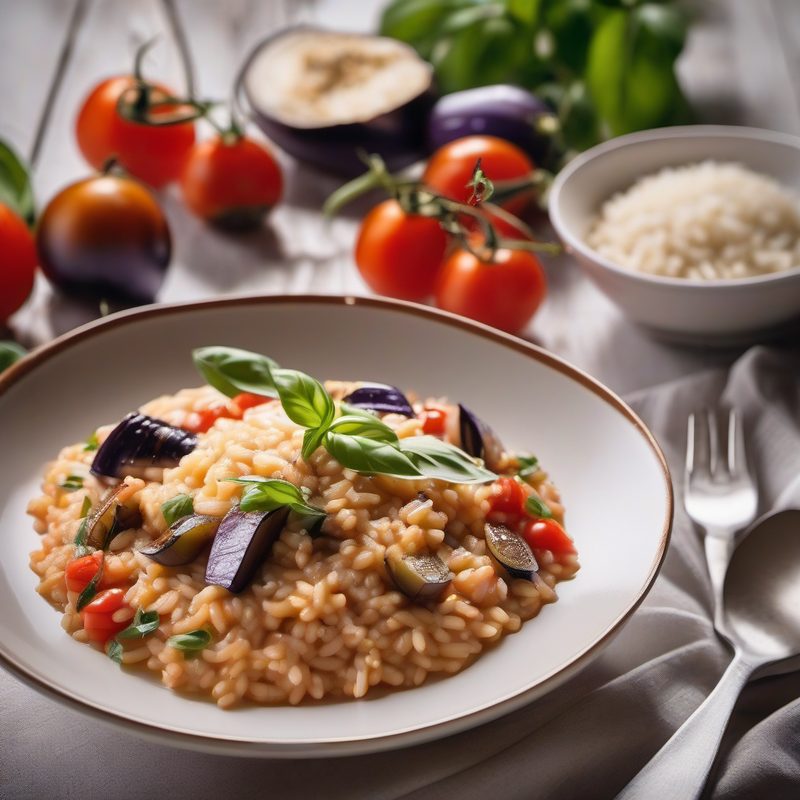
Risotto Norma
| Amount | Ingredient |
|---|---|
| Calories | 580 |
| Total Fat | 29 g |
| Saturated Fat | 10 g |
| Cholesterol | 40 mg |
| Sodium | 920 mg |
| Total Carbohydrate | 63 g |
| Dietary Fiber | 5 g |
| Sugars | 8 g |
| Protein | 14 g |
Category
Primi piatti — Risotti
Serves
4
Total Time
50 minutes
Why This Recipe Works
Risotto alla Norma brings the iconic flavors of Sicily's famous pasta dish — tender fried eggplant, bright tomato sauce, and salty ricotta salata — into the creamy, stirring-intensive world of risotto. The challenge is preventing the eggplant from turning sodden in the rice. Our solution: salt the eggplant cubes first to draw out excess moisture, then fry them in olive oil until deep golden and crisp. We set them aside and fold them in only at the very end, preserving their texture and concentrated flavor. The crushed tomatoes are warmed separately and added just before serving so their acidity stays bright against the rich, buttery risotto. A base of slowly softened onion, a splash of red wine for complexity, and gradual additions of vegetable broth build the classic creamy emulsion. The finishing touch — a generous shower of grated ricotta salata and torn fresh basil — ties the dish back to its Sicilian roots. This risotto is a complete meal: verdure, carb, and formaggio in every spoonful.
Equipment
- Large chef's knife and cutting board
- Vegetable peeler
- Box grater or Microplane (for ricotta salata)
- Colander
- Paper towels
- 12-inch nonstick skillet or frying pan
- Large, heavy-bottomed saucepan or Dutch oven (5–6 quart)
- Wooden spoon or silicone spatula
- Ladle
- Liquid measuring cup (4-cup)
- Kitchen scale
- Small saucepan (for warming tomatoes)
Eggplant: Choose a firm, glossy eggplant with no soft spots. Italian or globe eggplant works best; its spongy texture absorbs the salted moisture-drawing step well. Japanese eggplant is acceptable but will yield smaller cubes. Do not peel — the skin helps the cubes hold their shape during frying.
Rice: Arborio is traditional and widely available. Carnaroli or Vialone Nano, both superfino Italian varieties, can be substituted; they hold their shape slightly better and require the same cooking time. Do not use long-grain or parboiled rice.
Ricotta Salata: This firm, salty aged ricotta is indispensable. Do not substitute fresh ricotta — it is too soft and moist. Pecorino Romano can be used in a pinch but will be sharper and less creamy. Grate it on a Microplane or the fine side of a box grater just before serving; pre-grated versions clump and lose flavor.
Red Wine: A medium-bodied, dry Sicilian red like Nero d'Avola or Frappato is ideal. Alternatively, any dry red you would drink with the dish works. Avoid overly tannic or oaky wines.
Crushed Tomatoes: Passata (smooth tomato purée) can substitute for crushed tomatoes, though the texture will be slightly less rustic. Avoid whole peeled tomatoes without crushing them first.
Vegetable Broth: Homemade broth makes a noticeable difference. If using store-bought, choose a low-sodium brand and dilute it slightly (¾ cup broth + ¼ cup water per cup of broth) to avoid oversalting.
Prep (Mise en Place)
| Task | Timing |
|---|---|
| Cube eggplant, salt, and drain | 30 minutes before cooking |
| Dice onion and set aside uncovered | Anytime |
| Measure rice into a bowl | Before cooking begins |
| Grate ricotta salata into a small bowl | Before cooking (cover with plastic) |
| Warm broth in a saucepan over low heat | Start of cooking |
| Warm crushed tomatoes in a small saucepan | Last 5 minutes of risotto cooking |
| Tear basil leaves | Just before serving |
Step-by-Step Instructions
Step 1: Salt and Drain the Eggplant
- Place the cubed eggplant in a colander set over a bowl or in the sink.
- Toss with 1½ teaspoons (6 g) kosher salt.
- Let stand for 30 minutes. You will see beads of moisture form on the surface.
- Pat the cubes very dry with paper towels, pressing gently to extract as much moisture as possible. (This step is critical for good browning.)
Step 2: Fry the Eggplant
- In a 12-inch nonstick skillet, heat 4 tablespoons (60 ml) of the olive oil over medium-high heat until shimmering.
- Add the eggplant cubes in a single layer (work in two batches if necessary to avoid crowding).
- Cook, stirring occasionally, until deep golden brown on all sides, 5 to 7 minutes per batch.
- Transfer fried eggplant to a paper-towel-lined plate and season lightly with salt. Set aside. (The eggplant can be fried up to 1 hour ahead and kept at room temperature.)
Step 3: Sauté the Aromatics
- In a large, heavy-bottomed saucepan or Dutch oven, heat the remaining 2 tablespoons (30 ml) olive oil over medium heat.
- Add the finely diced onion and ¼ teaspoon (1 g) kosher salt.
- Cook, stirring frequently, until the onion is softened and translucent but not browned, about 4 to 5 minutes.
Step 4: Toast the Rice
- Add the Arborio rice to the pot with the onion.
- Stir with a wooden spoon to coat every grain in oil.
- Cook, stirring constantly, until the grains become translucent at the edges and emit a nutty aroma, about 2 minutes. (Do not let the rice brown.)
Step 5: Deglaze with Wine
- Pour in the red wine.
- Stir continuously until the wine is fully absorbed and the pot looks nearly dry, 1 to 2 minutes.
Step 6: Cook the Risotto (Gradual Broth Addition)
- Begin adding the warm vegetable broth one ladleful (about ½ cup / 120 ml) at a time.
- Stir frequently and wait until each addition is almost fully absorbed before adding the next. The risotto should always be visibly moist but never soupy.
- Adjust the heat as needed to maintain a steady, gentle simmer — not a rapid boil.
- After about 14 minutes, taste the rice. It should be approaching tenderness but still have a distinct bite at the center.
- Continue adding broth, stirring, and tasting. Total cooking time from the first broth addition is typically 16 to 18 minutes.
Step 7: Warm the Tomatoes
- About 5 minutes before the risotto is done, place the crushed tomatoes in a small saucepan over low heat.
- Warm gently, stirring occasionally, until hot. Do not boil. Set aside off heat.
Step 8: Finish the Risotto (Mantecatura)
- When the rice is al dente — tender with a firm center, and the risotto is loose and creamy (it should flow slowly when the pot is tilted) — remove the pot from the heat.
- Add the butter pieces and stir vigorously to emulsify (mantecare).
- Fold in the fried eggplant cubes and the warmed crushed tomatoes.
- If the risotto seems too thick, stir in an additional 2 to 4 tablespoons of warm broth or water to loosen it.
Step 9: Serve
- Divide the risotto immediately among warmed shallow bowls.
- Sprinkle generously with grated ricotta salata.
- Garnish with torn fresh basil leaves.
- Finish with a drizzle of extra-virgin olive oil and a few cracks of black pepper.
- Serve at once. Risotto waits for no one.
Troubleshooting
| Problem | Cause | Solution |
|---|---|---|
| Eggplant is greasy or soggy | Not drained properly or oil wasn't hot enough | Pat eggplant very dry after salting; ensure oil is shimmering before adding; don't overcrowd the pan |
| Rice is mushy | Overcooked or broth added too quickly | Check rice 2 minutes before estimated doneness; use gentle simmer, not vigorous boil |
| Risotto is too thick or stiff | Cooked too long without enough liquid, or rested before serving | Stir in extra warm broth or water before serving; finish at a looser consistency than desired |
| Risotto is soupy | Too much broth added at once or rice is undercooked | Wait for each addition to be nearly absorbed before adding more; cook until al dente |
| Lack of creamy texture | Not enough stirring or mantecatura was skipped | Stir frequently; finish with vigorous butter emulsion off heat |
Variations
Risotto alla Norma con Pomodorini: Substitute 250 g (2 cups) cherry or grape tomatoes, halved, for the crushed tomatoes. Sauté them cut-side down in 1 tablespoon olive oil over medium-high heat until blistered and softened, about 4 minutes, before folding into the risotto.
Risotto alla Norma con Zucchine e Melanzane: Add 1 medium zucchini (about 200 g), cut into ½-inch cubes and salted alongside the eggplant. Fry with the eggplant for a more abundant vegetable presence.
Risotto alla Norma Piccante: Add 1 small dried red chili (crushed) or ½ teaspoon red pepper flakes to the onion while it sweats. Finish with an extra grating of ricotta salata.
Wine Pairing
Nero d'Avola (Sicily): This is the classic match — medium-bodied with dark cherry and plum fruit, soft tannins, and a savory, earthy finish that echoes the eggplant and tomato. Serve slightly below room temperature (16–18°C / 60–65°F).
Alternative(s):
- Frappato (Sicily): Lighter, more perfumed, with bright red fruit and floral notes — a refreshing contrast to the rich risotto. Serve lightly chilled (14–16°C / 57–60°F).
- Cerasuolo di Vittoria (Sicily): A blend of Nero d'Avola and Frappato — the best of both worlds. Serve at 15–17°C / 59–63°F.
- Barbera d'Alba (Piedmont): If Sicilian wines are unavailable, Barbera's bright acidity and low tannins work well with the tomatoes and eggplant.
Conventions Used in This Recipe
- Kosher salt is assumed for all salting and seasoning. Diamond Crystal brand is preferred; if using Morton's, reduce salt quantities by roughly half by volume.
- Extra-virgin olive oil is used for both sautéing and finishing. A fruity, medium-intensity oil (not peppery) works best for the base; a more robust oil can be used for garnish.
- Butter is unsalted unless otherwise specified.
- Pepper is freshly ground black pepper.
- Herbs are fresh unless dried (or dry) is explicitly stated.
- Warm broth means broth held at a bare simmer (about 180°F / 82°C). Adding cold broth stops the cooking and extends the total time.
- All vegetable prep measurements (e.g., ½-inch cubes, finely diced) refer to dimensions after trimming but before cooking.
Make-Ahead Instructions
This risotto is best served immediately after cooking. However, the components can be prepped in advance:
- Fried eggplant: Up to 1 hour ahead, kept at room temperature spread on a tray. Re-crisp in a 200°F / 90°C oven for 5 minutes before folding in if desired.
- Diced onion: Up to 24 hours ahead, refrigerated in an airtight container.
- Grated ricotta salata: Up to 4 hours ahead, covered and refrigerated. Let come to room temperature before serving.
- Warm broth: Can be made up to 3 days ahead and refrigerated. Reheat before using.
- Do not partially cook the risotto and finish later — the texture will suffer.
Nutritional Information (per serving, approximate)
> Note: Nutritional values are estimates. Sodium content varies significantly based on the broth and ricotta salata used.
Recipe from The Italian Kitchen by Vita Milanese — Volume 1 · Pasta Perfetto. Discover all volumes on the ebook page.