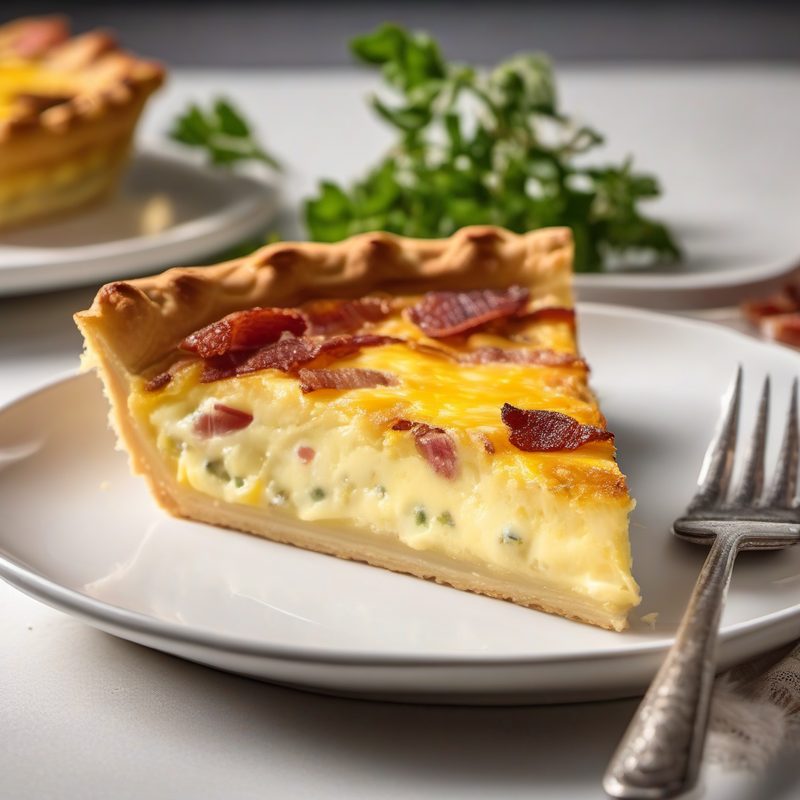
Quiche Lorraine
A timeless French classic — a buttery shortcrust shell cradles a silky, nutmeg-scented custard studded with crisp bacon, baked to golden, puffed perfection. The original quiche, and still the benchmark against which all others are measured.
| Amount | Ingredient |
|---|---|
| 1 (9-inch / 23 cm) | Shortcrust pastry shell, store-bought or homemade (see Chef's Tips for scratch recipe) |
| 200 g (about 7 oz) | Bacon lardons or thick-cut bacon, cut into ½-inch (1 cm) pieces |
| 3 large | Eggs |
| 200 ml (¾ cup + 1½ tbsp) | Heavy cream (at least 30% fat) |
| 100 ml (⅓ cup + 1½ tbsp) | Whole milk |
| ½ tsp | Fine sea salt |
| ¼ tsp | Freshly ground black pepper |
| ⅛ tsp | Freshly grated nutmeg (about 6–8 grates on a Microplane) |
There is a reason Quiche Lorraine has endured for centuries as one of the world's most beloved savory tarts. Born in the medieval duchy of Lorraine in northeastern France, it began as a simple bread-dough tart filled with eggs, cream, and smoked bacon — a humble farmhouse meal. Over time, the bread crust was replaced with a rich shortcrust pastry (pâte brisée), and the filling was refined into the impossibly silky custard we know today. What makes it so compelling is its elegant simplicity: just a handful of ingredients — eggs, cream, milk, bacon, and nutmeg — transformed by precise technique into something far greater than the sum of its parts.
The keys to success are few but critical. The shortcrust must be blind-baked until dry and golden, creating an impermeable barrier that stays crisp against the wet custard. The bacon must be cooked until deeply browned and crisp, adding smoky, savory pops throughout. And the custard — a delicate balance of eggs, cream, and milk — must be baked just until set, with a slight jiggle in the center that carries over to a velvety, never-rubby, texture. A whisper of freshly grated nutmeg is the traditional aromatic finish, its warm, subtle spice threading through the richness like a quiet melody. Serve it warm, at room temperature, or cold — Quiche Lorraine is a chameleon that adapts effortlessly to brunch, lunch, picnics, or a simple weeknight supper with a green salad.
> Note: Active work is about 20 minutes. The 30-minute rest for homemade shortcrust dough and the 15-minute post-bake rest are largely hands-off. A quality store-bought shortcrust shell eliminates the dough-making steps entirely. A homemade shell takes about 10 minutes of active work plus 30 minutes chilling.
If making a homemade shortcrust, you will need: 1¼ cups (160 g) all-purpose flour, ½ cup (1 stick / 113 g) cold unsalted butter, ¼ tsp salt, and 3–4 tbsp ice water. The shell can be prepared up to 2 days ahead and refrigerated.
🥘 Equipment
- 9-inch (23 cm) tart pan with removable bottom, or 9-inch pie dish
- Rolling pin (if making shortcrust from scratch)
- Large mixing bowl
- Medium skillet (10–12 inch / 25–30 cm)
- Whisk
- Liquid measuring cup
- Fork (for docking the crust)
- Parchment paper or aluminum foil
- Pie weights or dried beans (for blind baking)
- Baking sheet (to catch drips)
- Paper towels (for draining bacon)
- Wire cooling rack
- Microplane or fine grater (for nutmeg)
- Chef's knife and cutting board
📋 Preparation
Step 1 — Prepare the Shortcrust Shell (15 minutes + 30 minutes rest, if making from scratch)
If using a store-bought shortcrust shell, skip to Step 2.
If making from scratch: In a large mixing bowl, whisk together 160 g flour and ¼ tsp salt. Scatter the cold butter cubes over the flour. Using a pastry cutter, two knives, or your fingertips, work the butter into the flour until the mixture resembles coarse cornmeal with a few pea-sized butter bits remaining — those pockets of butter create flaky layers.
Sprinkle 3 tablespoons ice water over the mixture and stir with a fork until the dough begins to come together. If too dry to hold together when pinched, add the remaining tablespoon of water. Do not overwork.
Turn the dough out onto a sheet of plastic wrap, press into a 6-inch disc (about ¾ inch thick), wrap tightly, and refrigerate for at least 30 minutes (or up to 2 days).
Step 2 — Blind-Bake the Crust (10 minutes inactive)
Preheat your oven to 180°C (350°F) with a rack in the middle position.
If using homemade dough: On a lightly floured surface, roll the chilled dough into a 12-inch (30 cm) circle, about ⅛ inch (3 mm) thick. Transfer to your tart pan, gently pressing into the edges without stretching. Run the rolling pin over the top to trim excess. Prick the bottom all over with a fork (docking). Line with parchment and fill with pie weights or dried beans.
Blind bake for 10 minutes at 180°C (350°F). Remove the parchment and weights, then continue baking for 3 to 5 minutes more, until the bottom looks dry and the edges are very lightly golden. Set aside on a wire rack.
If using a store-bought shell, follow package directions for blind baking, or prick the bottom with a fork, line with parchment and weights, and bake at 180°C (350°F) for 10 minutes.
Keep the oven at 180°C (350°F) for the final bake.
Step 3 — Cook the Bacon (8 minutes)
While the crust bakes, place the 200 g bacon lardons (or diced bacon) in a medium skillet over medium heat. Cook, stirring occasionally, until the bacon is crisp and deeply browned, with all rendered fat pooling in the pan — about 6 to 8 minutes.
Use a slotted spoon to transfer the bacon to a plate lined with paper towels to drain. Let cool slightly. Reserve the rendered fat for another use (it's wonderful for roasting potatoes or sautéing greens).
Step 4 — Make the Custard (5 minutes)
In a large mixing bowl, whisk together the 3 eggs until smooth and uniform, about 30 seconds. Add the 200 ml heavy cream, 100 ml whole milk, ½ tsp salt, ¼ tsp pepper, and ⅛ tsp freshly grated nutmeg. Whisk until fully combined and smooth — about 30 seconds more. The mixture should be homogeneous and slightly thickened.
Taste a tiny droplet (yes, raw egg — just a touch on your finger) to check seasoning. The custard should taste well-seasoned; the bacon and crust will temper it slightly during baking. The nutmeg should be present but subtle — a warm background note, not a dominant flavor.
Step 5 — Assemble and Bake (5 minutes + 35–40 minutes baking)
Scatter the drained bacon lardons evenly across the bottom of the par-baked crust. Spread them in a single layer so every slice gets its share of smoky, meaty bites.
Slowly pour the custard over the bacon, filling to just below the rim of the crust. The custard should fill the shell completely while leaving about ⅛ inch (3 mm) of visible crust edge.
Place the tart pan on a baking sheet (to catch any drips) and transfer to the oven. Bake at 180°C (350°F) for 35 to 40 minutes, until the custard is just set: the center should jiggle very slightly when the pan is gently shaken, but not be liquid. A knife inserted near the center should come out clean. The surface should be puffed, golden, and lightly browned in spots — the visual hallmark of a properly baked quiche.
Let the quiche cool on a wire rack for at least 15 minutes — this is essential for the custard to finish setting and for clean slicing. Serve warm, at room temperature, or chilled.
🧑🍳 Chef's Tips
- The blind bake is non-negotiable: Pouring custard into a raw crust guarantees a soggy, undercooked bottom. The 10-minute blind bake with weights creates a dry, crisp barrier that stays firm even after the custard is added. Do not skip it.
- Use quality bacon: Thick-cut, smoked streaky bacon or authentic French lardons are ideal. Avoid pre-cooked bacon bits, which lack the fat needed to render properly and have a dusty, artificial flavor.
- Drain the bacon well: Excess bacon fat floating on top of the custard will create an oily layer on the surface of the quiche. Drain thoroughly on paper towels before adding to the shell.
- Grate fresh nutmeg: Pre-ground nutmeg has none of the volatile oils that make freshly grated nutmeg so aromatic and warm. Use a Microplane or a fine grater — just 6–8 passes is all you need.
- Room-temperature ingredients: For the smoothest, most homogeneous custard, bring the eggs, cream, and milk to room temperature before whisking. Cold cream seizes the fat; cold eggs create a lumpy custard.
- Don't over-whisk the custard: Whisk just until the eggs are incorporated and the mixture is smooth. Vigorous whisking incorporates too much air, which can cause the custard to puff excessively and then collapse.
- Let it rest before slicing: This is the hardest step to wait for, but the most important. A quiche sliced too early collapses into a puddle. Fifteen minutes minimum — thirty is even better for perfectly clean wedges.
- Serve warm or at room temperature: Quiche Lorraine is actually at its best slightly warm or at room temperature. The flavors meld and the texture becomes creamy rather than softly scrambled. If reheating, do so gently.
❌ Common Mistakes
| Mistake | Why It Hurts | The Fix |
|---|---|---|
| Skipping the blind bake | The custard soaks into the raw pastry, creating a soggy, undercooked bottom crust | Always blind bake for at least 10 minutes at 180°C (350°F) with weights |
| Not draining the bacon well | Excess fat rises to the surface, creating a greasy, unappetizing layer | Drain thoroughly on paper towels after cooking |
| Over-baking the quiche | Custard becomes rubbery, curdled, or weeps liquid on the surface | Bake until the center jiggles just slightly; carryover cooking finishes the set |
| Under-baking the quiche | Custard is runny and won't hold together when sliced | A knife inserted near the center should come out clean; the center should not be liquid |
| Slicing too soon | Custard runs out and the quiche collapses on the plate | Rest at least 15 minutes — 30 is better for clean slices |
| Using pre-ground nutmeg | Flat, dusty spice flavor instead of the warm, aromatic notes of fresh nutmeg | Always grate whole nutmeg just before using |
| Over-whisking the custard | Too much air creates a puffy, soufflé-like texture that deflates and cracks | Whisk just until smooth, about 30 seconds |
| Stretching the dough | The crust shrinks during blind baking, pulling away from the pan edges | Gently press the dough into the pan without pulling or stretching |
💡 Variations
- Add cheese: Scatter 50–100 g (½–1 cup) of grated Gruyère, Emmental, or Comté over the bacon before adding the custard. This is the French classic "Quiche Lorraine au Fromage" variant.
- Add onion: Thinly slice 1 small yellow or white onion and cook in the rendered bacon fat until soft and golden (about 8 minutes), then scatter over the bacon.
- Swap the bacon for ham: Use 150 g (5 oz) diced cooked ham instead of bacon. The flavor will be milder; compensate with an extra pinch of smoked paprika.
- Add fresh herbs: A tablespoon of chopped fresh chives, flat-leaf parsley, or thyme stirred into the custard adds aromatic freshness.
- Make it crustless: Omit the pastry shell entirely. Butter a 9-inch pie dish, pour in the bacon and custard, and bake at 180°C (350°F) for 25–30 minutes. This is essentially a bacon-and-egg bake — lower in carbs, faster to make, and just as delicious.
- Go dairy-free: Substitute the heavy cream with full-fat coconut cream (chilled, with the solid top scooped off) and the milk with unsweetened oat milk. The texture will be slightly less rich but still satisfying.
- Make mini quiches: Divide the bacon and custard among 12 greased muffin cups (using a 12-cup muffin tin) and bake at 180°C (350°F) for 18–22 minutes. Perfect for brunch buffets or party appetizers.
❄️ Storage & Leftovers
| Method | Details |
|---|---|
| Refrigerator | Store covered (plastic wrap or airtight container) for up to 3 days. The crust will soften slightly over time. |
| Freezer | Freeze whole or in individual slices: wrap tightly in plastic wrap, then in aluminum foil, for up to 1 month. Thaw overnight in the refrigerator. |
| Reheating | Reheat slices in a 160°C (325°F) oven for 10–12 minutes, or in a dry skillet over low heat, covered, for 5–7 minutes. Do not microwave — it turns the custard rubbery and the crust soggy. |
| Cold serving | Quiche Lorraine is also excellent straight from the refrigerator, served cold like a savory pie. Many French cooks prefer it this way with cornichons and mustard. |
🍷 Wine Pairing
| Wine | Why |
|---|---|
| Chardonnay (unoaked or lightly oaked, Chablis or Mâconnais) | Buttery texture mirrors the custard; subtle minerality cuts through the richness. The classic pairing for Quiche Lorraine. |
| Pinot Gris / Pinot Grigio (Alsace or Alto Adige) | Rich but crisp, with subtle spice notes that complement the nutmeg. A natural partner. |
| Riesling (dry, Alsace or Mosel) | High acidity and floral notes cut through the creamy custard and echo the bacon's smokiness. |
| Sauvignon Blanc (Loire Valley or New Zealand) | Zesty, herbaceous acidity provides a bright contrast to the rich, savory filling. |
| Crémant d'Alsace (sparkling) | Bubbles and bright acidity — the celebratory choice. Perfect for brunch. |
| Pinot Noir (light, Burgundy or Willamette Valley) | Earthy, fruity, low-tannin — the red wine lover's choice. The only red that truly works with quiche. |
🍺 Beer Pairing
| Beer | Why |
|---|---|
| Saison / Farmhouse Ale | Peppery, earthy yeast character complements the custard's nutmeg and the bacon's smokiness. |
| Belgian Blonde Ale | Malt sweetness and subtle spice play nicely with the creamy egg custard. |
| Pilsner (Czech or German) | Clean, crisp, highly carbonated — cuts through the richness like a palate cleanser. |
| Cider (dry, French or English) | Apple acidity and slight tannin provide a brilliant contrast to the savory, custard-heavy tart. |
🥗 Suggested Side Dishes
- Simple green salad with lemon-Dijon vinaigrette — the acidity cuts through the rich custard
- Mixed greens with shaved fennel and orange segments — bright, citrusy, and refreshing
- Cornichons and whole-grain mustard — the classic French accompaniment, adds crunch, acidity, and heat
- Lightly dressed watercress or arugula with a squeeze of lemon — peppery greens contrast beautifully with the silky custard
- Tomato and red onion salad with a simple vinaigrette — sweet, acidic, and fresh
- Roasted asparagus with olive oil and sea salt — a complementary spring vegetable that adds texture
- Chilled leek vinaigrette — a classic French bistro starter that pairs perfectly with quiche
📊 Nutrition (per serving, estimated)
| Calories | Protein | Fat | Carbs | Fiber |
|---|---|---|---|---|
| 380 | 14 g | 30 g | 15 g | 1 g |
Nutrition is estimated and will vary based on specific brands, bacon fat content, cream fat percentage, and whether you use a homemade or store-bought crust. A crustless version reduces calories by approximately 100–120 per serving.
❓ Frequently Asked Questions
What is the difference between Quiche Lorraine and other quiches?
Authentic Quiche Lorraine contains no cheese — only eggs, cream, milk, bacon (or lardons), and nutmeg. The addition of Gruyère, while common, technically makes it a "Quiche au Fromage" or "Quiche Lorraine au Fromage." If you want the pure, traditional version, leave the cheese out.
Do I have to blind bake the crust?
Yes — this is essential for any quiche. Pouring custard into a raw crust guarantees a soggy bottom. The blind bake creates a dry, crisp barrier that stays firm even after the custard is added and baked.
Can I use milk instead of cream?
You can, but the texture will be significantly less rich and silky. The custard relies on the high fat content of the cream to set properly without becoming watery. If you must substitute, use at least whole milk and consider adding an extra egg yolk for richness.
Can I make this ahead of time?
Absolutely. The quiche can be baked a full day ahead, cooled completely, covered, and refrigerated. Serve at room temperature or reheat gently in a low oven (160°C / 325°F for 10–12 minutes). The shortcrust dough can also be made up to 2 days ahead and refrigerated.
Can I freeze Quiche Lorraine?
Yes. Quiche freezes exceptionally well. Cool completely, wrap tightly in plastic wrap and then aluminum foil, and freeze for up to 1 month. Thaw overnight in the refrigerator and reheat in a low oven. Do not thaw at room temperature, which can cause condensation that softens the crust.
What is a lardon?
A lardon is a small strip or cube of fatback or bacon, typically about ¼ to ½ inch thick, used in French cuisine. They are generally thicker and meatier than American bacon bits. If you can't find lardons, thick-cut bacon cut into ½-inch pieces is an excellent substitute.
Why did my custard come out watery?
Three possible causes: (1) the cream was too low in fat (use at least 30% heavy cream), (2) the quiche was under-baked, or (3) the ratio of liquid to eggs was off. Next time, use the specified cream-to-egg ratio and make sure the center is just barely jiggly, not liquid, before pulling from the oven.
Can I add vegetables?
You can, but traditional Quiche Lorraine is defined by its simplicity — just bacon and custard. If you want a vegetable quiche, consider making one of the variations or a different quiche recipe. That said, sautéed mushrooms or leeks make excellent additions without overwhelming the classic character.
My crust shrank during blind baking. What happened?
This usually happens when the dough is stretched into the pan (rather than gently pressed), or when it wasn't chilled long enough before baking. The gluten in overworked or stretched dough tightens and contracts in the heat. Rest the lined pan for 30 minutes in the fridge before blind baking to relax the gluten.
🔗 Related Recipes
- 124 — Basic Shortcrust Pastry (Pasta Brisée) — The master recipe for homemade shortcrust
- 334 — Quiche ai Broccoli (Broccoli Quiche) — A vegetarian cousin with broccoli and Gruyère
- 62 — Quiche alla Zucca e Bieta (Pumpkin and Chard Quiche) — Cool-weather variation with roasted pumpkin and Swiss chard
- 423 — Quiche alla Zucca e Carne Secca (Pumpkin and Cured Meat Quiche) — A heartier, meatier take on vegetable quiche
- 344 — Cheese Tart (Torta al Formaggio) — A simple, rustic Italian cheese tart
- 345 — Tarte Flambée with Raclette and Pears — Alsatian flatbread cousin with a similar creamy, smoky profile
🏷️ Search Tags
📸 Photo Reference
Photo reference: `vol1_347.png` — A golden-brown Quiche Lorraine on a rustic wooden board, sliced into six wedges showing cross-sections of silky custard studded with crisp bacon bits and encased in a flaky shortcrust shell. The surface is gently puffed with patches of deep golden brown. A small ramekin of whole-grain mustard and a cluster of cornichons sit to the left. Natural overhead lighting from a nearby window. A crisp white linen napkin and a stem of green grapes provide a simple, elegant tableau. Shallow depth of field keeps the quiche in sharp focus while the background blurs into a warm kitchen scene with a glass of Chablis in the soft distance.
Recipe from "The Italian Kitchen" by Vita Milanese — Volume 1: Pasta Perfetto
Recipe from The Italian Kitchen by Vita Milanese — Volume 1 · Pasta Perfetto. Discover all volumes on the ebook page.