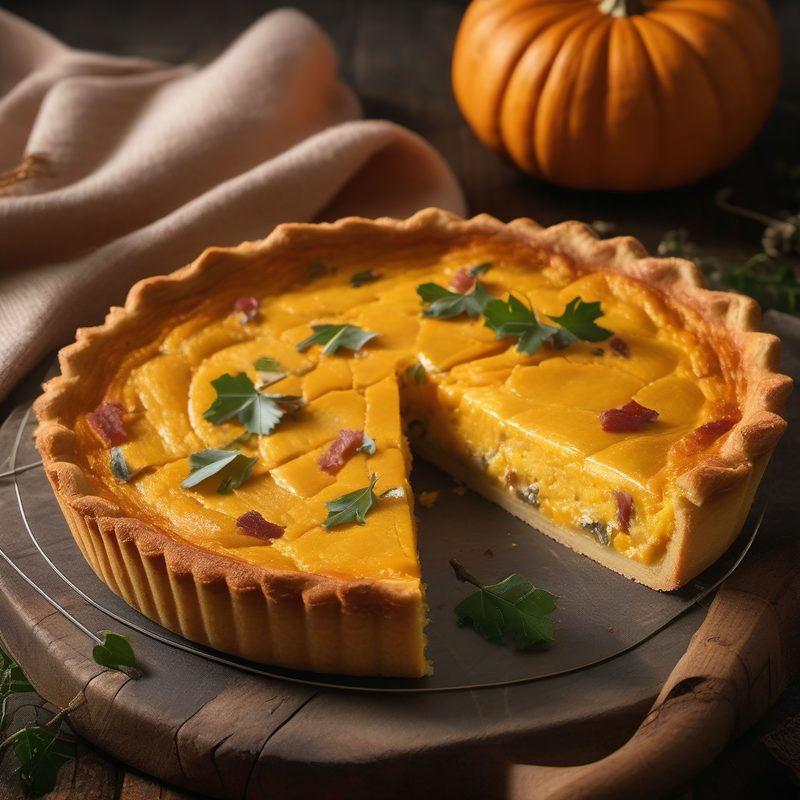
Pumpkin Cured Meat Quiche
A golden, custardy Italian quiche with sweet roasted pumpkin, savory cured meat, and nutty melted cheese in a buttery shortcrust shell — rustic enough for a weekday lunch, elegant enough for a dinner party.
| Amount | Ingredient |
|---|---|
| Freezer (baked quiche) | Cool completely, wrap tightly in plastic wrap, then in foil. Freeze for up to 2 months. Thaw overnight in the refrigerator before reheating |
| Reheating (individual slices) | Place slices on a baking sheet and reheat in a 350°F (180°C) oven for 10 to 12 minutes until warmed through. Do not use a microwave — it will make the pastry soggy and the custard rubbery |
| Reheating (whole quiche) | Place the unwrapped quiche on a baking sheet and reheat in a 350°F (180°C) oven for 15 to 20 minutes until the center is hot |
| Room temperature serving | Quiche is excellent at room temperature — ideal for picnics, packed lunches, and buffets. Let it sit at room temperature for 30 minutes after removing from the refrigerator before serving |
| Make-ahead (unbaked shell) | Prepare and blind-bake the pastry shell up to 2 days ahead. Cool, wrap in plastic, and keep at room temperature. Fill and bake the day of serving |
| Make-ahead (roasted pumpkin) | Roast the pumpkin cubes up to 3 days ahead. Cool, refrigerate in an airtight container, and bring to room temperature before assembling |
| Custard (a day ahead) | Whisk the eggs, cream, and seasonings up to 24 hours in advance. Refrigerate in a covered container. Whisk briefly before using |
There are quiches, and then there is this quiche. While the French may have invented the form, the Italians have made it their own — and this torta salata from the northern Italian tradition is a masterclass in simple, bold flavors. Sweet, creamy cubes of roasted pumpkin or butternut squash are layered with thinly sliced bresaola or speck (two of Italy's finest air-cured meats), then bathed in a velvety custard of eggs, cream, and nutty Gruyère or Parmigiano. The filling is cradled in a tender, buttery pasta frolla shell — a savory shortcrust that shatters with each bite.
What makes this quiche special is the way the ingredients build on each other: the pumpkin brings sweetness and earthiness, the cured meat adds salt and umami, the custard binds everything with silky richness, and the cheese creates a golden, bubbly crust on top. Bake it for a weekend brunch, pack it for a picnic, or serve it with a crisp green salad for a light dinner. It's equally delicious warm from the oven or at room temperature — and leftovers (if there are any) are just as good the next day.
> Includes 10 minutes of active blind-baking prep. The shortcrust dough (pasta frolla) can be made up to 3 days ahead.
For the Pastry Shell
> See the Savory Pasta Frolla variation under pos 124: reduce sugar to 1 tbsp (15 g), add 1 tsp dried herbs (rosemary or thyme), ½ tsp black pepper, and ½ cup (60 g) finely grated Parmigiano-Reggiano.
For the Filling
Use a dense, sweet variety of pumpkin like Delica, Hokkaido, or butternut squash — their firm flesh holds its shape during roasting and doesn't release excess water into the custard. Watery pumpkin varieties (like large carving pumpkins) will make the filling soggy. Bresaola (air-dried, salted beef) has a delicate, tender texture and mild flavor; speck (smoked, cured pork shoulder) is more assertive and smoky. Choose based on your preference — both work beautifully. For the cheese, Gruyère provides a nutty, meltier texture; Parmigiano adds sharper, saltier notes. A 50/50 blend is ideal.
🥘 Equipment
- 9-inch (23 cm) tart pan with removable bottom (fluted preferred)
- Baking sheet
- Mixing bowls (medium and small)
- Chef's knife
- Cutting board
- Fork or whisk
- Vegetable peeler
- Vegetable peeler or small knife (for pumpkin)
- Parchment paper or aluminum foil
- Pie weights or dried beans (for blind baking)
- Pastry brush (optional, for egg wash)
- Box grater or Microplane (for cheese)
- Wire rack (for cooling)
- Fine-mesh sieve (optional, for straining custard)
📋 Preparation
Step 1 — Prepare the Pastry Shell (20 minutes + 30 minutes chill)
Prepare the savory shortcrust pastry according to the instructions at position 124 (Basic Shortcrust Pastry) using the savory variation: reduce the sugar to 1 tablespoon, add 1 teaspoon of dried rosemary or thyme, ½ teaspoon of black pepper, and ½ cup (60 g) of finely grated Parmigiano-Reggiano to the dry ingredients.
Once the dough is made and chilled for at least 30 minutes, roll it out on a lightly floured surface to a ⅛-inch (3 mm) thickness — about 12 inches (30 cm) in diameter. Gently transfer the dough to the tart pan, pressing it into the fluted edges and trimming the excess. Prick the bottom all over with a fork (about 20 to 25 holes). Refrigerate the lined pan for 15 minutes while the oven preheats.
Using the savory variation of pasta frolla is important here — the herbs and cheese in the crust echo the filling's flavors, creating a cohesive, harmonious dish. The second chill (after lining the pan) is not optional: it relaxes the gluten and re-chills the butter, helping the shell hold its shape during blind baking.
Step 2 — Blind Bake the Shell (20–25 minutes)
Preheat the oven to 350°F (180°C) with a rack in the middle position.
Line the chilled tart shell with a sheet of parchment paper or foil, pressing it into the corners. Fill with pie weights or dried beans all the way to the rim. Bake for 10 minutes. Carefully remove the parchment and weights.
Return to the oven and bake for another 5 to 8 minutes, until the bottom is set, dry, and very pale golden — it should not be fully browned, as it will continue baking with the filling. Transfer to a wire rack and let cool slightly while you prepare the filling. Keep the oven on at 350°F (180°C).
The blind-baking time here is shorter than for a fully baked shell — we only need the crust to be par-baked (partially baked) since it will finish cooking with the custard filling. A fully baked shell would over-brown during the final bake. If the bottom puffs up despite docking, gently press it down with the back of a spoon when it comes out of the oven.
Step 3 — Roast the Pumpkin (25–30 minutes)
While the pastry chills and bakes, prepare the pumpkin. Peel the pumpkin with a vegetable peeler or sharp knife, cut it in half, remove the seeds and stringy fibers with a spoon, and cut the flesh into ½-inch (1 cm) cubes. You should have about 400 g (3 cups) of cubed pumpkin.
Toss the pumpkin cubes with 1 tablespoon of extra-virgin olive oil, ¼ teaspoon of salt, and a pinch of black pepper on a baking sheet. Spread in a single layer — overcrowding will steam the pumpkin instead of roasting it.
Roast at 350°F (180°C) for 25 to 30 minutes, until the cubes are tender, lightly caramelized, and golden at the edges. A fork should slide through easily with no resistance. Remove from the oven and let cool slightly on the baking sheet.
Roasting concentrates the pumpkin's natural sugars and drives off excess moisture — this is crucial. If you use raw or boiled pumpkin, the excess water will seep into the custard during baking, creating a watery, soggy quiche. The caramelization at the edges adds a deep, almost nutty sweetness that complements the salty cured meat and cheese beautifully. For butternut squash, the roasting time may be slightly shorter (20–25 minutes) due to its denser, less watery texture.
Step 4 — Prepare the Custard (5 minutes)
In a medium mixing bowl, whisk together 3 large eggs, 200 ml (¾ cup + 1 tbsp) heavy cream, ½ teaspoon salt, ¼ teaspoon black pepper, and ⅛ teaspoon freshly grated nutmeg until smooth and homogeneous.
Whisk in 100 g (1 cup) of grated cheese (Gruyère, Parmigiano, or a mix), reserving about 2 tablespoons for the top.
The nutmeg is not optional — it's the classic Italian pairing with pumpkin and cream, and it adds a warm, aromatic undertone that ties the filling together. Freshly grated nutmeg is far more fragrant than pre-ground; grate it directly from whole nutmeg using a Microplane. For an ultra-smooth custard, you can strain the mixture through a fine-mesh sieve to catch any bits of egg white that didn't fully incorporate — though this is not strictly necessary.
Step 5 — Dice the Cured Meat (3 minutes)
Stack the slices of bresaola or speck and cut them into ¼-inch (6 mm) dice. If using bresaola, the slices are typically quite thin and will separate easily; if using speck, trim away any tough outer rind before dicing.
Dicing the meat ensures it distributes evenly throughout the quiche rather than clumping in one spot. The small pieces also release their flavor more evenly into the custard during baking.
Step 6 — Assemble the Quiche (5 minutes)
Place the par-baked tart shell (still in its pan) on a baking sheet — this makes it easy to transfer in and out of the oven and catches any drips.
Layer the ingredients in the shell in this order:
- Roasted pumpkin cubes — spread evenly across the bottom
- Diced cured meat — scatter evenly over the pumpkin
- Pour the custard over the pumpkin and meat, filling the shell almost to the rim
- Sprinkle the reserved 2 tablespoons of grated cheese over the top
Gently tap the pan on the counter 2 to 3 times to release any air bubbles and ensure the custard settles evenly into all the crevices.
Layering the solid ingredients first, then pouring the custard over, ensures the pumpkin and meat are evenly distributed throughout the quiche rather than floating to the top. If you pour the custard first and then add the solids, they tend to sink and clump at the bottom.
Step 7 — Bake and Rest (40–45 minutes + 10 minutes rest)
Bake at 350°F (180°C) for 35 to 40 minutes, until the quiche is puffed, golden brown on top, and set in the center. To test for doneness: gently shake the pan — the center should jiggle slightly (like a firm custard) but not slosh. Alternatively, insert a thin knife or toothpick 1 inch from the center; it should come out clean. The internal temperature should reach 165°F (74°C) if using a thermometer.
Transfer to a wire rack and let rest for 10 minutes before slicing and serving. This resting period is essential — it allows the custard to finish setting and makes for cleaner slices.
The quiche will continue to cook from residual heat after it comes out of the oven, so don't overbake it. A slightly jiggly center is exactly what you want — it will firm up during the rest. If you bake until the center is completely firm and doesn't jiggle at all, the quiche will be overdone and the custard may curdle or weep. The top should be a deep golden brown with small bubbles of melted cheese — this is the hallmark of a perfectly baked quiche.
🧑🍳 Chef's Tips
- Choose the right pumpkin. Dense, sweet varieties like Delica, Hokkaido, Kabocha, or butternut squash are ideal. Avoid large, watery carving pumpkins (the kind used for Halloween jack-o'-lanterns) — they have a fibrous, stringy texture and high water content that will make your quiche soggy.
- Don't skip the blind bake. A par-baked shell is essential for a crisp bottom crust. Without it, the custard will soak into the raw pastry, resulting in a soggy, doughy base.
- Season progressively. Season the pumpkin with salt before roasting, season the custard separately, and remember that both the cured meat and cheese add significant salt. Taste your components and keep the overall salt level in mind — it's easier to add salt at the end than to fix an oversalted quiche.
- Room temperature ingredients. For the smoothest, most homogeneous custard, bring the eggs and cream to room temperature before whisking. Cold ingredients don't emulsify as well and can create a lumpy texture.
- Let it rest before slicing. This is the most commonly ignored step and the one that makes the biggest difference. A 10-minute rest transforms a messy, liquid-center quiche into a cleanly sliced, perfectly set masterpiece.
- Make it ahead. The quiche can be baked a day in advance, cooled completely, and refrigerated. Reheat individual slices in a 350°F (180°C) oven for 10 minutes, or serve at room temperature — it's delicious either way.
- Crimp the edges. If you're using a fluted tart pan (recommended), press the dough firmly into the grooves with a small ball of scrap dough. This prevents thick, uneven edges that burn before the filling is done.
- Line the baking sheet. Always place the tart pan on a baking sheet before adding the filling — this catches any spills and makes moving the quiche in and out of the oven much safer.
❌ Common Mistakes
| Mistake | Why It Hurts | The Fix |
|---|---|---|
| Using watery pumpkin | Excess moisture seeps into the custard, creating a watery, soggy quiche | Roast the pumpkin until caramelized to drive off moisture; use dense pumpkin varieties |
| Skipping the blind bake | Raw pastry absorbs the custard, resulting in a doughy, undercooked bottom crust | Always par-bake the shell for 10 minutes with weights, then 5 minutes without |
| Overbaking the quiche | Custard curdles, weeps, and becomes rubbery; the top burns | Bake until center is just set (slight jiggle) — it will finish setting during the rest |
| Not resting before slicing | The custard hasn't fully set — slices will be runny and messy | Let the quiche rest for at least 10 minutes after baking |
| Overcrowding the pumpkin on the roasting tray | Pumpkin steams instead of roasting, becoming soft and watery | Spread cubes in a single layer with space between them |
| Using pre-ground nutmeg | Flat, one-dimensional flavor that disappears into the custard | Grate fresh nutmeg directly into the custard — the difference is night and day |
| Cutting the cured meat too large | Large chunks sink to the bottom and create uneven bites | Dice into ¼-inch (6 mm) pieces for even distribution |
💡 Variations
| Variation | How To |
|---|---|
| Vegetarian version | Omit the cured meat entirely. Add 100 g (3½ oz) of sautéed mushrooms (cremini or porcini) for an earthy, umami-rich alternative. Sauté sliced mushrooms in butter until golden, then layer with the pumpkin |
| Spinach and pumpkin | Add 100 g (3½ oz) of fresh spinach, wilted in a pan with a clove of garlic, squeezed dry, and layered with the pumpkin. Omit the meat for a vegetarian version |
| Gorgonzola twist | Replace half the Gruyère/Parmigiano with 50 g (1¾ oz) of crumbled Gorgonzola dolce. The blue cheese adds tangy, creamy pockets that contrast beautifully with the sweet pumpkin |
| Herb and garlic infusion | Infuse the cream with 2 sprigs of fresh thyme and 1 crushed garlic clove over low heat for 10 minutes before whisking with eggs. Strain before using. The herbal notes elevate the pumpkin and meat pairing |
| Smoked salmon version | Replace the bresaola/speck with 100 g (3½ oz) of smoked salmon, cut into strips. Omit the nutmeg and add 1 tablespoon of fresh dill to the custard. A Nordic-Italian fusion |
| Pumpkin and caramelized onion | Add 1 large onion, thinly sliced and caramelized in butter for 20 minutes. Layer with the pumpkin and omit the meat for a deeply sweet, savory vegetarian quiche |
| Mini quiches (appetizer version) | Use a 12-cup muffin tin instead of a tart pan. Line each cup with a small round of pastry, fill with the same filling, and bake for 18–22 minutes. Perfect for parties and buffets |
❄️ Storage & Make-Ahead
| Method | Details |
|---|
🍷 Wine Pairing
| Wine | Why |
|---|---|
| Pinot Bianco (Alto Adige) | Crisp, mineral-driven, with subtle stone fruit notes that mirror the pumpkin's sweetness without overwhelming it |
| Tocai Friulano (Friuli) | Herbal, almond-scented, and medium-bodied — a classic pairing for savory Italian quiches and torte salate |
| Chardonnay (unoaked, Franciacorta) | Clean, fresh, and citrusy — the bright acidity cuts through the rich custard and cheese |
| Lagrein (Alto Adige) | A light, fruity red with soft tannins — the only red that pairs well with this quiche. Serve slightly chilled |
| Prosecco (Extra Dry) | Bubbles and acidity cleanse the palate between rich, custardy bites. Excellent for brunch or aperitivo |
🍺 Beer Pairing
| Beer | Why |
|---|---|
| Italian Blonde Ale | Clean, crisp, with low bitterness — won't compete with the delicate custard and pumpkin |
| Helles Lager | Malty-sweet with a soft finish, complementing the roasted pumpkin and nutty cheese |
| Saison | Spicy, fruity yeast notes echo the nutmeg and herbs in the filling |
🥗 Suggested Sides
- Mixed green salad with a sharp lemon vinaigrette — the acidity cuts through the rich custard
- Arugula, pear, and Parmigiano salad — the peppery arugula and sweet pear mirror the quiche's sweet-savory balance
- Roasted cherry tomatoes with garlic and basil — their bright acidity and concentrated sweetness complement the pumpkin
- Roasted fennel wedges with olive oil and lemon — anise notes harmonize with the nutmeg and herbs
- Sautéed spinach with garlic — simple, quick, and a natural partner for any egg-based dish
- Fennel and orange salad — thin slices of raw fennel with orange segments, olive oil, and black pepper; refreshing and bright
- Crusty bread (ciabatta or filone) — to mop up every last bit of custard and cheese
📊 Nutrition (per serving)
| Calories | Protein | Fat | Carbs | Fiber | Sugar |
|---|---|---|---|---|---|
| ~485 | 18 g | 34 g | 27 g | 3 g | 6 g |
Nutritional values are estimates based on 6 servings. The custard (eggs and cream) contributes the majority of the fat and protein; the shortcrust pastry contributes the majority of the carbohydrates. The pumpkin adds fiber, vitamin A (over 200% of the daily value per serving), and natural sugars. Using Parmigiano-Reggiano instead of Gruyère adds slightly more sodium but the same fat content. Bresaola is leaner than speck — if using bresaola, subtract approximately 2 g of fat per serving; if using speck, add approximately 2 g. For a lower-calorie version, replace the heavy cream with whole milk (reducing the total by approximately 80 calories and 10 g of fat per serving), though the custard will be less rich and may not set as firmly. This quiche is not suitable for low-carb or keto diets due to the shortcrust pastry, though the filling alone (without the crust) is relatively low in carbohydrates. A single serving provides roughly 25% of the daily recommended intake of calcium and 15% of iron.
❓ Frequently Asked Questions
Can I use store-bought pie crust instead of making pasta frolla?
Absolutely. A good-quality refrigerated or frozen pie crust (the kind you roll out yourself, not the pre-formed tin kind) works perfectly. Blind-bake it according to the package directions before filling. If using a frozen deep-dish pie shell, you may need to adjust the blind-baking time slightly. The homemade savory pasta frolla is worth the effort, but this quiche is forgiving enough to work with a shortcut crust.
Does this quiche work with other winter squashes?
Yes — butternut squash is the most common substitute, and it works beautifully. You can also use Kabocha, Delica, or Hokkaido squash with excellent results. Acorn squash is slightly more fibrous and less sweet, so it's not ideal. Zucchini and summer squash are too watery — avoid them.
My quiche turned out watery. What went wrong?
Three most likely causes: (1) the pumpkin wasn't roasted long enough — it released water into the custard during baking; (2) the custard was overbaked and the proteins curdled, squeezing out liquid; (3) the quiche wasn't rested before slicing. Fix by roasting the pumpkin until thoroughly caramelized, baking just until set (with a slight jiggle), and resting for 10 minutes before cutting.
Can I make this quiche gluten-free?
Yes. Use a gluten-free shortcrust pastry (see the gluten-free variation at position 124) or a gluten-free store-bought pie crust. Blind-bake as directed. The filling is naturally gluten-free, so the quiche should set properly. Check that your cured meat (especially speck) doesn't contain any gluten-based additives — most are gluten-free, but it's worth verifying.
Can I use milk instead of heavy cream?
You can, but the quiche will be noticeably less rich and the custard may be slightly less firm. Whole milk (full-fat) is your best substitute — use the same amount (200 ml). The quiche will have fewer calories but a less luxurious texture. Avoid skim or low-fat milk, which will result in a thin, watery custard that doesn't set properly.
What is bresaola? What is speck? Can I substitute them?
Bresaola is air-dried, salted beef aged for 2-3 months. It's lean, tender, and has a delicate, slightly sweet flavor. Speck is cured and smoked pork shoulder (similar to prosciutto but with a smoky finish). Both are Italian specialty meats available at well-stocked deli counters or Italian markets. Substitutes: prosciutto crudo (unsmoked, milder), coppa (spicier), pancetta (cured pork belly — render it first), or even good-quality deli ham in a pinch.
Why does the recipe call for nutmeg? Can I skip it?
Nutmeg is a classic pairing with pumpkin and cream in Italian cooking — it adds a warm, aromatic depth that elevates the custard from merely creamy to truly memorable. You can skip it if you don't have it, but the quiche will lose some of its characteristic Italian flavor. If you're not a fan of nutmeg, try a pinch of ground mace (made from the same spice, but milder) or ground cinnamon (for a sweeter, more autumnal profile).
How do I get clean slices without the quiche falling apart?
Three tips: (1) Let the quiche rest for at least 10 minutes after baking — this is the most important step. (2) Use a sharp, thin-bladed knife and wipe it clean between slices. (3) For the cleanest slices, let the quiche cool completely (about 1 hour) at room temperature, then refrigerate for 30 minutes before slicing — cold quiche cuts like a dream. Reheat individual slices after cutting.
Can I add other vegetables to the filling?
Absolutely. Sautéed mushrooms, wilted spinach, roasted red peppers, or caramelized onions all work well. Just make sure any vegetables with high water content (mushrooms, spinach, zucchini) are thoroughly cooked and squeezed of excess moisture before layering into the shell. The total volume of vegetables and meat should not exceed about 2½ cups — more than that and the custard won't have enough structure to set properly.
Is this quiche suitable for Thanksgiving or holiday entertaining?
Yes — this is an excellent addition to a holiday brunch or a vegetarian-friendly main for a Thanksgiving or Christmas spread. The colors (golden orange pumpkin, creamy custard, browned cheese top) are festive, and the quiche can be made a day ahead, making holiday hosting easier. Serve at room temperature with a bright, acidic salad on the side.
🔗 Related Recipes
- Basic Shortcrust Pastry (Pasta Frolla, #124) — The savory variation of this dough is the foundation of this quiche; master it and you'll make perfect quiches every time
- Puff Pastry with Cottage Cheese and Asparagus (#248) — Another elegant Italian savory pastry, perfect for spring when asparagus is at its peak
- Crostata di Marmellata (Jam Tart, #125) — The sweet sibling of this quiche, using the same pasta frolla dough with a bright fruit filling
- Torta della Nonna (Grandmother's Tart, #127) — A classic Tuscan custard-and-pine-nut tart that uses the same pastry and custard-making techniques
- Tarte Flambée with Raclette and Pears (#345) — A savory Alsatian tart that shares the same creamy, custard-like approach with a sweet-savory flavor profile
- Roasted Sweet Potatoes (#331) — Another roasted root vegetable side dish that pairs beautifully with the flavors in this quiche
- Mountain Pasta with Pumpkin (#342) — A northern Italian pasta dish that uses the same pumpkin-and-cheese flavor combination in a completely different format
🏷️ Search Tags
📸 Photo Reference
Photo reference: `vol1_423.png` — A slightly elevated, three-quarter-angle shot of the whole quiche resting on a rustic wooden board, photographed in warm natural daylight from a nearby window (left side). The quiche sits in its fluted 9-inch tart pan with removable bottom — the pastry edge is an even, deep golden brown with visible flaking along the crimped rim. The top of the quiche is a mosaic of colors: creamy, pale-gold custard studded with caramelized orange pumpkin cubes, small dark-red speckles of diced bresaola or speck, and a bubbled, melted-gold crust of Gruyère and Parmigiano. A few small steam wisps rise from a just-cut wedge, revealing the cross-section: a perfectly set, silky custard, distinct layers of pumpkin and meat suspended throughout, and a thin, crisp, buttery pastry shell holding everything together. Beside the quiche: a small ceramic bowl of coarse sea salt and a sprig of fresh rosemary. A green salad in a wooden bowl and a glass of Pinot Bianco sit in the soft-focused background. The mood is warm, rustic, and inviting — the kind of table setting that promises a leisurely autumn lunch.
Recipe from "The Italian Kitchen" by Vita Milanese — Volume 1: Pasta Perfetto 🥟
Recipe from The Italian Kitchen by Vita Milanese — Volume 1 · Pasta Perfetto. Discover all volumes on the ebook page.