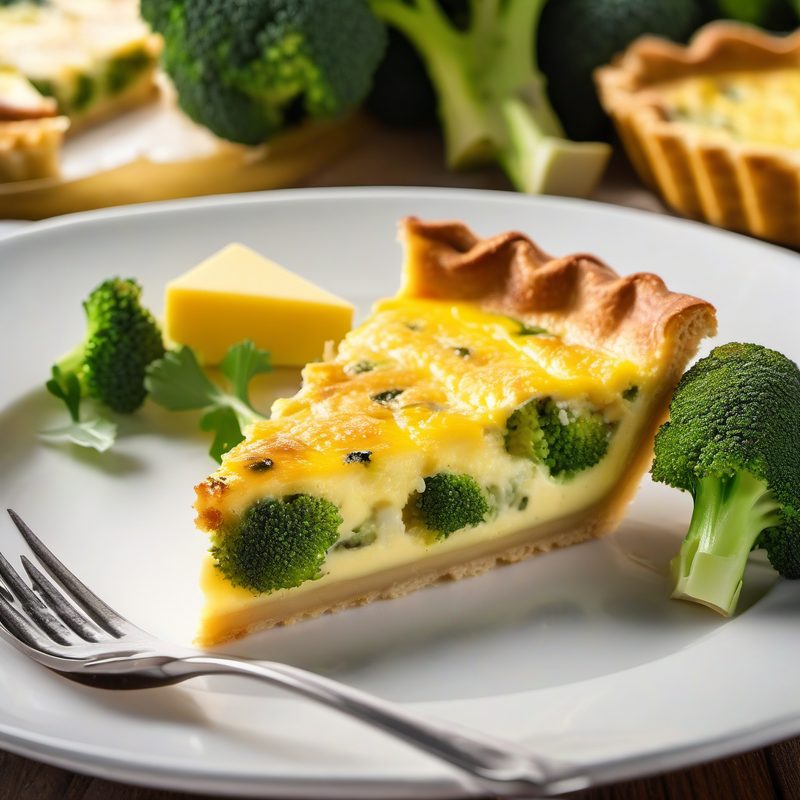
Broccoli Quiche
A creamy, golden-crusted quiche that transforms humble broccoli into a elegant centerpiece — tender florets and a whisper of garlic nestle in a silky Gruyère custard, all cradled by a buttery shortcrust shell that shatters at the touch of a knife.
| Amount | Ingredient |
|---|---|
| 1 (9-inch / 23 cm) | Shortcrust pastry shell, store-bought or homemade (see Chef's Tips) |
| 300 g (about 1 medium head) | Broccoli (about 3½ cups florets) |
| 3 large | Eggs |
| 200 ml (¾ cup + 1½ tbsp) | Heavy cream (or single/pouring cream) |
| 100 g (1 cup, lightly packed) | Gruyère cheese, grated (or sharp cheddar) |
| 1 clove | Garlic, peeled and very thinly sliced |
| ½ tsp | Fine sea salt |
| ¼ tsp | Freshly ground black pepper |
| ⅛ tsp | Freshly grated nutmeg (about 6–8 grates on a Microplane) |
This is the quiche that wins over even the most skeptical broccoli-eaters. The florets are blanched just long enough to lose their raw edge while retaining a pleasant bite, then arranged in a par-baked pastry shell and bathed in a velvety custard of eggs, cream, and nutmeg-scented Gruyère. The result is a pie that is at once rustic and refined, equally at home on a weekday lunch table or a Sunday brunch spread. The broccoli's subtle bitterness is tempered by the rich, nutty custard; the garlic adds a delicate aromatic hum without overwhelming; and the nutmeg — that classic custard spice — ties everything together with warmth and depth. While a homemade shortcrust is ideal, a quality store-bought shell works beautifully, making this recipe accessible for both ambitious cooks and weeknight pragmatists. The key is patience: a proper blind bake ensures a crisp, non-soggy crust, and the quiche must rest after baking to set the custard for clean, photogenic slices.
> Note: Active work is about 20 minutes. The 30-minute rest for the dough (if making from scratch) and 15-minute post-bake rest are largely hands-off. A store-bought shortcrust shell eliminates the dough-making steps entirely.
Use a kitchen scale for the broccoli and cheese for accuracy. If using a homemade shortcrust, you will need: 1¼ cups (160 g) all-purpose flour, ½ cup (1 stick / 113 g) cold unsalted butter, ¼ tsp salt, and 3–4 tbsp ice water. The shell can be prepared up to 2 days ahead and refrigerated.
🥘 Equipment
- 9-inch (23 cm) tart pan with removable bottom, or 9-inch pie dish
- Rolling pin (if making shortcrust from scratch)
- Large mixing bowl
- Medium saucepan (2-quart / 2 L)
- Large bowl of ice water (for shocking the broccoli)
- Colander or sieve
- Chef's knife and cutting board
- Whisk
- Liquid measuring cup
- Fork (for docking the crust)
- Parchment paper or aluminum foil
- Pie weights or dried beans (for blind baking)
- Baking sheet (to catch drips)
- Wire cooling rack
- Microplane or fine grater (for nutmeg)
📋 Preparation
Step 1 — Prepare the Shortcrust Shell (15 minutes + 30 minutes rest, if making from scratch)
If using a store-bought shortcrust shell, skip to Step 2.
If making from scratch: In a large mixing bowl, whisk together 160 g flour and ¼ tsp salt. Scatter the cold butter cubes over the flour. Using a pastry cutter, two knives, or your fingertips, work the butter into the flour until the mixture resembles coarse cornmeal with a few pea-sized butter bits remaining — those pockets of butter create flaky layers.
Sprinkle 3 tablespoons ice water over the mixture and stir with a fork until the dough begins to come together. If too dry to hold together when pinched, add the remaining tablespoon of water. Do not overwork.
Turn the dough out onto a sheet of plastic wrap, press into a 6-inch disc (about ¾ inch thick), wrap tightly, and refrigerate for at least 30 minutes (or up to 2 days).
Step 2 — Blind-Bake the Crust (15 minutes inactive + 10 minutes baking)
Preheat your oven to 180°C (350°F) with a rack in the middle position.
If using homemade dough: On a lightly floured surface, roll the chilled dough into a 12-inch circle, about ⅛ inch (3 mm) thick. Transfer to your tart pan, gently pressing into the edges without stretching. Run the rolling pin over the top to trim excess. Prick the bottom all over with a fork (docking). Line with parchment and fill with pie weights.
Blind bake for 10 minutes at 180°C (350°F). Remove the parchment and weights, then continue baking for 3 to 5 minutes more, until the bottom looks dry and the edges are very lightly golden. Set aside on a wire rack.
If using a store-bought shell, follow package directions for blind baking, or prick the bottom with a fork, line with parchment and weights, and bake at 180°C (350°F) for 10 minutes.
Reduce the oven temperature to 180°C (350°F) if it has drifted, or maintain it for the final bake.
Step 3 — Blanch the Broccoli (5 minutes)
While the crust bakes, prepare the broccoli. Trim the broccoli into small florets (about 1½ inches / 4 cm at the crown). Peel the stem, then slice it into ¼-inch (6 mm) thick coins — they cook at the same rate as the florets.
Bring a medium saucepan of generously salted water to a rolling boil. Add the broccoli and cook for 2 minutes — the florets should turn bright green and be just tender when pierced with a knife but still have some resistance. Do not overcook; the broccoli will finish cooking in the oven.
Immediately drain the broccoli and transfer to a bowl of ice water to stop the cooking and preserve the bright color. Let sit for 1 minute, then drain thoroughly and pat dry with a clean kitchen towel. Roughly chop any large florets into bite-sized pieces.
Step 4 — Make the Custard (5 minutes)
In a large mixing bowl, whisk together the 3 eggs until smooth and uniform, about 30 seconds. Add the 200 ml cream, 100 g grated Gruyère, ½ tsp salt, ¼ tsp pepper, and ⅛ tsp freshly grated nutmeg. Whisk until fully combined and smooth.
Taste the custard (yes, raw egg — just a tiny drop on your finger) — it should be well-seasoned, as the broccoli and crust will dilute the seasoning. The nutmeg should be present but not dominant, like a warm background note.
Step 5 — Assemble and Bake (5 minutes + 35–40 minutes baking)
Scatter the thinly sliced garlic across the bottom of the par-baked crust. Arrange the blanched broccoli florets and stem pieces evenly over the garlic — they should be in a single, even layer, not piled. Nestle them gently so they fill the shell without large gaps.
Slowly pour the custard over the broccoli, filling to just below the rim of the crust. The custard should come about three-quarters of the way up the broccoli — some florets may peek through, which makes for a beautiful presentation.
Place the tart pan on a baking sheet (to catch any drips) and transfer to the oven. Bake at 180°C (350°F) for 35 to 40 minutes, until the custard is just set: the center should jiggle very slightly when the pan is gently shaken, but not be liquid. A knife inserted near the center should come out clean. The top should be puffed, golden, and lightly browned in spots.
Let the quiche cool on a wire rack for at least 15 minutes — this is essential for the custard to finish setting and for clean slicing. Serve warm or at room temperature.
🧑🍳 Chef's Tips
- Broccoli prep matters: The 2-minute blanch is non-negotiable. Under-blanched broccoli stays crunchy and raw-tasting; over-blanched broccoli turns to mush in the oven. The ice bath stops the cooking instantly and locks in the vibrant green color.
- Dry the broccoli thoroughly: Any excess water clinging to the florets after blanching will leak into the custard and make it watery. Pat them very dry with a clean kitchen towel before arranging in the crust.
- Garlic placement is deliberate: Slicing the garlic thinly and placing it directly on the crust (rather than mixing it into the custard) prevents raw garlic pockets while ensuring every slice gets a gentle aromatic infusion from below.
- Grate your own cheese: Pre-shredded cheese contains anti-caking agents (cellulose, starch) that prevent smooth melting. A block of Gruyère grated fresh on a box grater melts into the custard seamlessly.
- Let it rest before slicing: This is the hardest step to wait for, but the most important. A quiche sliced too early collapses into a puddle. Fifteen minutes minimum — thirty is even better.
- Room temperature is ideal: Quiche is actually at its best served warm (not hot) or at room temperature. The flavors meld and the texture becomes creamy rather than softly scrambled.
❌ Common Mistakes
| Mistake | Why It Hurts | The Fix |
|---|---|---|
| Skipping the blind bake | The custard soaks into the raw pastry, creating a soggy, undercooked bottom crust | Always blind bake for at least 10 minutes at 180°C (350°F) |
| Over-blanching the broccoli | Broccoli turns mushy and releases excess water into the custard | Blanch for exactly 2 minutes, then shock in ice water |
| Not drying the broccoli | Water dilutes the custard and prevents it from setting properly | Pat florets thoroughly dry with a clean towel |
| Over-baking the quiche | Custard becomes rubbery, curdled, or weeps liquid | Bake until the center jiggles just slightly; carryover cooking finishes the set |
| Slicing too soon | Custard runs out and the quiche collapses | Rest at least 15 minutes — 30 is better |
| Using pre-shredded cheese | Uneven melting and a slightly grainy texture | Grate from a block for smooth, creamy results |
💡 Variations
- Add pancetta or bacon: Cook 100 g (3½ oz) diced pancetta or bacon until crisp, drain on paper towels, and scatter over the broccoli before adding the custard.
- Swap the cheese: Gruyère is classic, but sharp cheddar is a fantastic substitute that adds a different kind of punch. Emmental, Fontina, or a mix of Parmigiano and mozzarella also work well.
- Add onion: Thinly slice 1 small onion and sauté in butter until soft and golden (about 8 minutes), then layer over the garlic before adding the broccoli.
- Herb it up: A tablespoon of chopped fresh thyme, rosemary, or chives stirred into the custard adds another layer of aromatic complexity.
- Go crustless: Omit the pastry shell entirely. Butter a 9-inch pie dish, fill with broccoli and custard, and bake at 180°C (350°F) for 25–30 minutes. A crustless quiche is essentially a baked frittata — lower in carbs, faster to make.
- Add mushrooms: Sauté 150 g (5 oz) sliced cremini mushrooms in butter until golden and their liquid has evaporated, then layer with the broccoli.
- Make it spicy: Add a pinch of red pepper flakes to the custard or scatter a few thin slices of fresh chili alongside the garlic.
❄️ Storage & Leftovers
| Method | Details |
|---|---|
| Refrigerator | Store covered (plastic wrap or airtight container) for up to 3 days. The crust will soften slightly over time. |
| Freezer | Freeze whole or in individual slices: wrap tightly in plastic wrap, then in aluminum foil, for up to 1 month. Thaw overnight in the refrigerator. |
| Reheating | Reheat slices in a 160°C (325°F) oven for 10–12 minutes, or in a dry skillet over low heat, covered, for 5–7 minutes. Do not microwave — it turns the custard rubbery and the crust soggy. |
🍷 Wine Pairing
| Wine | Why |
|---|---|
| Sauvignon Blanc (dry, Loire or New Zealand) | Zesty, herbaceous acidity cuts through the rich custard and echoes the broccoli's green notes |
| Pinot Grigio (Alto Adige or Friuli) | Clean, mineral-driven, and crisp — a classic Italian pairing for vegetable tarts |
| Chardonnay (unoaked or lightly oaked, Chablis or Macon) | Buttery texture mirrors the custard; subtle oak complements the nutmeg |
| Grüner Veltliner (Austria) | White pepper and citrus notes are a surprisingly perfect match for broccoli and nutmeg |
| Dry Rosé (Provence or Côtes du Rhône) | Light, crisp, versatile — works with every element of the quiche |
| Pinot Noir (light, Burgundy or Willamette Valley) | Earthy, fruity, low-tannin — the red wine lover's choice for a vegetable quiche |
🍺 Beer Pairing
| Beer | Why |
|---|---|
| Saison / Farmhouse Ale | Peppery, earthy yeast character complements the nutmeg and Gruyère |
| Belgian Blonde Ale | Malt sweetness and subtle spice play nicely with the creamy custard |
| Pilsner (Czech or German) | Clean, crisp, highly carbonated — cuts through the richness like a palate cleanser |
🥗 Suggested Side Dishes
- Simple green salad with lemon-Dijon vinaigrette — the acidity cuts through the rich custard
- Arugula, cherry tomato, and shaved Parmigiano salad — peppery, sweet, and salty contrasts
- Roasted cherry tomatoes with garlic and basil — a bright, acidic counterpoint
- Lightly dressed watercress with a squeeze of lemon
- Radicchio and endive salad with balsamic glaze — the bitterness echoes the broccoli and adds complexity
- Roasted asparagus with olive oil and sea salt — a complementary green vegetable that extends the theme
📊 Nutrition (per serving, estimated)
| Calories | Protein | Fat | Carbs | Fiber |
|---|---|---|---|---|
| 340 | 13 g | 27 g | 14 g | 2 g |
Nutrition is estimated and will vary based on specific brands, cheese type (Gruyère vs. cheddar), and whether you use a homemade or store-bought crust.
❓ Frequently Asked Questions
Can I use frozen broccoli?
Frozen broccoli florets can be used in a pinch. Thaw them completely, pat them very dry (they hold more water than fresh), and skip the blanching step — they are already blanched before freezing. Reduce the initial bake time by 5 minutes if the florets are smaller.
Do I have to blind bake the crust?
Yes — this is essential for a quiche. Pouring custard into a raw crust guarantees a soggy bottom. The blind bake creates a dry, crisp barrier that stays firm even after the custard is added and baked.
Can I make this gluten-free?
Absolutely. Use a gluten-free shortcrust pastry (store-bought or homemade with a 1:1 gluten-free flour blend) and proceed exactly as written. The filling is naturally gluten-free.
Can I make this ahead of time?
Yes. The quiche can be baked a full day ahead, cooled completely, covered, and refrigerated. Serve at room temperature or reheat gently in a low oven (160°C / 325°F for 10–12 minutes). The shortcrust dough can also be made up to 2 days ahead.
What's the best cheese: Gruyère or cheddar?
Gruyère is the classic choice — it melts smoothly, has a nutty complexity that pairs beautifully with broccoli and nutmeg, and browns attractively on top. Sharp cheddar is a more accessible substitute with a bolder flavor. Both work; it's a matter of preference.
My custard came out watery. What went wrong?
Three possible causes: (1) the broccoli wasn't dried thoroughly after blanching, (2) the cream was too low in fat (use at least 30% fat), or (3) the quiche was under-baked. Next time, pat the broccoli very dry and make sure the center is just barely jiggly, not liquid, before pulling from the oven.
Can I add more vegetables?
Yes, but don't exceed about 400 g total vegetables. Too many vegetables crowd the custard, making it difficult to set. If adding watery vegetables like zucchini or mushrooms, sauté them first to evaporate excess moisture.
🔗 Related Recipes
- 62 — Quiche alla Zucca e Bieta (Pumpkin and Chard Quiche) — Cool-weather cousin with roasted pumpkin and Swiss chard
- 321 — Pasta Brisée (Shortcrust Pastry Dough) — The master recipe for homemade shortcrust
- 423 — Quiche alla Zucca e Carne Secca (Pumpkin and Cured Meat Quiche) — A heartier, meatier take on vegetable quiche
- Classic Quiche Lorraine — The bacon-and-egg original from the Lorraine region of France
- Torta di Bietole e Ricotta (Swiss Chard and Ricotta Tart) — An Italian savory tart with a ricotta-based filling
🏷️ Search Tags
📸 Photo Reference
Photo reference: `vol1_334.png` — A golden-brown broccoli quiche on a rustic wooden board, sliced into six wedges showing cross-sections of creamy custard studded with bright green broccoli florets and melted Gruyère. The shortcrust crust is visibly flaky and golden at the edges. Natural overhead lighting from a nearby window. A small side bowl of frisée salad with lemon vinaigrette sits to the left. Shallow depth of field keeps the quiche in sharp focus while the background blurs into a warm kitchen scene with a linen napkin and a glass of Pinot Grigio.
Recipe from "The Italian Kitchen" by Vita Milanese — Volume 1: Pasta Perfetto
Recipe from The Italian Kitchen by Vita Milanese — Volume 1 · Pasta Perfetto. Discover all volumes on the ebook page.