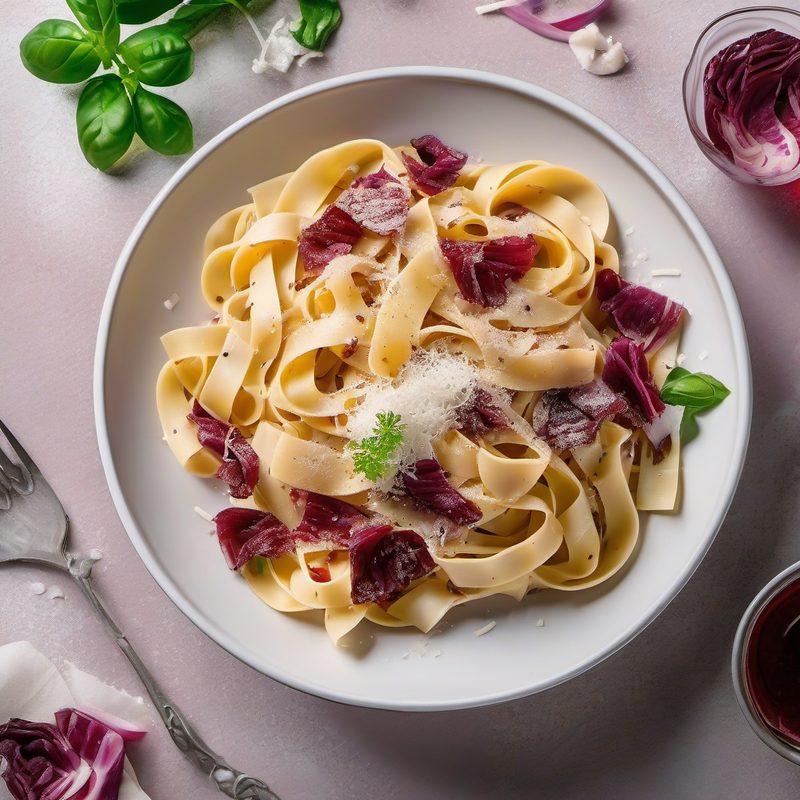
Tagliatelle Radicchio Speck
Category: Primi piatti
| Amount | Ingredient |
|---|---|
| 350 g (12 oz) | Dried tagliatelle or fettuccine Fresh tagliatelle works too; reduce cook time |
| 200 g (7 oz) | Radicchio (di Treviso preferred) About 1 large head; or use Chioggia radicchio |
| 150 g (5 oz) | Speck (smoked prosciutto) Cut into ¼-inch strips; sub: pancetta affumicata |
| 1 medium | Yellow onion (~150 g) Finely diced |
| 200 ml (¾ cup) | Heavy cream Do not use light cream or half-and-half |
| 50 g (½ cup) | Grated Parmigiano-Reggiano Plus extra for serving |
| 3 tbsp (45 ml) | Extra-virgin olive oil |
| ¼ tsp | Freshly grated nutmeg Or to taste |
| To taste | Kosher salt |
| To taste | Freshly ground black pepper |
Servings: 4
Total Time: 25 minutes
Active Time: 20 minutes
Level of Difficulty: Easy
1. WHY THIS RECIPE WORKS
Tagliatelle radicchio e speck is a textbook example of Northern Italian cucina di montagna — mountain cooking — where a handful of bold, assertive ingredients come together in minutes. Bitter radicchio di Treviso (the long, wine-red variety) meets salty, smoky speck (cold-smoked prosciutto from Alto Adige) in a cream-based sauce that balances all three elements: bitterness, smoke, and richness. Our version builds flavor by first rendering the speck until crisp, then wilting the radicchio just until softened but still retaining its bite, and finally simmering everything in cream that has been lightly perfumed with nutmeg. Tossing the tagliatelle directly into the skillet with a splash of pasta water emulsifies the cream into a silky, clinging sauce that coats every ribbon. The whole dish comes together in the time it takes to boil pasta — about 25 minutes from start to finish.
3. EQUIPMENT
- Large pot (6–8 qt / 6–8 L) for pasta
- Large skillet or sauté pan (12-inch / 30 cm)
- Chef's knife and cutting board
- Wooden spoon or silicone spatula
- Measuring cups and spoons
- Microplane or fine grater (for nutmeg and Parmigiano)
- Colander
- Ladle or tongs (for tossing pasta)
4. PREPARATION (Mise en Place)
- Prepare the radicchio: Halve the radicchio lengthwise, cut out the core, and slice crosswise into ½-inch (12 mm) ribbons. Set aside.
- Prepare the speck: Stack the slices, trim any hard rind, and cut into ¼-inch × 1-inch (6 mm × 25 mm) strips.
- Dice the onion: Finely dice into ¼-inch (6 mm) pieces.
- Grate the Parmigiano: Grate and measure 50 g (about ½ cup packed).
- Grate the nutmeg: Grate ¼ teaspoon of fresh nutmeg (about 6 passes on a Microplane).
5. COOK THE PASTA
Bring a large pot of generously salted water (about 1 tablespoon salt per 4 quarts water) to a rolling boil. Add the tagliatelle and cook until very al dente — about 1 minute less than the package directions (typically 7–8 minutes for dry, 1½–2 minutes for fresh). Reserve 1 cup (240 ml) of the starchy pasta water before draining. Drain the pasta — do not rinse.
Timing note: Start the sauce immediately in step 6 so both components finish at the same time.
6. RENDER THE SPECK
While the pasta cooks, heat 3 tablespoons olive oil in a large skillet over medium-high heat. Add the speck strips in a single layer. Cook, stirring occasionally, until the fat renders and the speck turns crisp and browned at the edges, 3–4 minutes. Do not drain the rendered fat — it carries all the smoky flavor.
Using a slotted spoon, transfer half the crisp speck to a small bowl and set aside for garnish.
7. SAUTÉ THE ONION
Reduce heat to medium. Add the diced onion to the skillet with the rendered speck and oil. Cook, stirring frequently, until the onion is softened and translucent but not browned, about 3 minutes. If the onion begins to take on color, reduce the heat.
8. WILT THE RADICCHIO
Add the sliced radicchio to the skillet along with a pinch of salt. Toss to coat in the rendered fat. Cook, stirring frequently, until the radicchio is just wilted but still retains some of its deep red color and structure, 2–3 minutes. The radicchio should soften and reduce in volume by about half — do not cook it to a brown mush.
9. ADD THE CREAM
Pour the heavy cream into the skillet over the wilted radicchio. Stir to combine, scraping up any browned bits from the bottom of the pan. Bring to a gentle simmer and cook until the cream thickens slightly and coats the back of a spoon, about 2 minutes. The sauce should be loose enough to coat pasta but not watery.
10. SEASON
Remove the skillet from heat. Stir in the grated nutmeg (¼ teaspoon) and a generous grind of black pepper (about ½ teaspoon). Taste and adjust salt — keep in mind that the speck and Parmigiano are both salty, so go easy on extra salt at this stage.
11. EMULSIFY & TOSS
Add the drained tagliatelle directly to the skillet with the sauce. Add the grated Parmigiano-Reggiano and ¼ cup (60 ml) of the reserved pasta water. Using tongs, toss vigorously over low heat for 30–45 seconds. The starches from the pasta water and the cheese will emulsify the cream into a silky, clingy sauce. If the sauce seems too thick, add more pasta water a tablespoon at a time until it reaches a flowing, nappe consistency.
12. TO SERVE
Divide among warmed shallow bowls. Top each portion with a generous scattering of the reserved crispy speck, an extra shower of grated Parmigiano, and a final crack of black pepper. Serve immediately — this dish waits for no one.
13. VARIATIONS
- Tagliolini al Radicchio e Gorgonzola: Stir in 60 g (2 oz) crumbled Gorgonzola dolce off the heat, just before adding the pasta. The creamy blue cheese deepens the dish's complexity.
- Without cream (lighter version): Omit the heavy cream. After wilting the radicchio, deglaze the skillet with ¼ cup (60 ml) dry white wine, let it reduce by half, then proceed with the emulsion step using only pasta water and Parmigiano. The result is lighter, less rich, but still satisfying.
- Pasta al forno (baked): After tossing, transfer everything to a buttered baking dish, top with 50 g (½ cup) mozzarella and extra Parmigiano, and bake at 200°C (400°F) for 15 minutes until bubbly and golden.
- Add pine nuts: Toast 30 g (¼ cup) pine nuts in the skillet before adding the radicchio. They add a buttery crunch that complements the bitter greens.
- Spicy kick: Add ½ teaspoon red pepper flakes along with the onion for a gentle heat that plays off the cream and speck.
14. MAKE AHEAD & STORAGE
- Make ahead (sauce only): Prepare the sauce through step 10 (cream simmered and seasoned). Let cool completely, then refrigerate in an airtight container for up to 2 days. Reheat gently in a skillet with a splash of water or cream before tossing with freshly cooked pasta.
- Leftovers: Refrigerate in an airtight container for up to 2 days. Reheat gently in a skillet over medium-low heat with a splash of milk or cream to restore the sauce's original consistency. Do not microwave — it will separate the cream and turn the radicchio bitter.
- Freezing: Not recommended. Cream-based sauces separate upon thawing, and the radicchio becomes unpleasantly bitter and soggy.
15. KEYS TO SUCCESS
- Cook the pasta very al dente — the pasta will continue to cook for 30–45 seconds when tossed with the hot sauce. Overcooked pasta turns soft and flabby.
- Reserve a full cup of pasta water — you may not use all of it, but running out mid-emulsion is a disaster. The starch is essential for creating a silky, cohesive sauce.
- Do not overcook the radicchio — it should be wilted but still retain some of its crimson color and a faint bitter edge. Overcooking turns it brown, slimy, and unpleasantly bitter.
- Add salt incrementally — speck and Parmigiano are both high in sodium. Taste before adding additional salt.
- Fresh nutmeg is non-negotiable — pre-ground nutmeg lacks the aromatic intensity that bridges the smoky speck and bitter radicchio. Grate it fresh directly into the sauce.
16. COMMON MISTAKES & HOW TO AVOID THEM
| Mistake | Why It Happens | Fix |
|---|---|---|
| Sauce is thin and watery | Not enough pasta water starch, or pasta under-drained | Use full ¼ cup pasta water; drain pasta thoroughly before adding |
| Sauce is greasy and separated | Cream overheated or added too aggressively | Simmer gently over medium-low heat; never boil cream aggressively |
| Radicchio is bitter and tough | Cooked too long or at too high heat | Wilt 2–3 minutes only over medium heat; remove from heat once softened |
| Radicchio turned brown/gray | Overcooked; all color compounds degraded | Remove radicchio from heat the moment it wilts — it should still be red |
| Pasta is mushy and clumping | Cooked to full tenderness in water before the sauce toss | Cook 1 minute less than package directions (very al dente) |
| Speck is chewy, not crisp | Not enough heat or crowded in the pan | Cook in a single layer over medium-high heat; don't overcrowd |
| Dish is too salty | Over-salted pasta water + salty speck + salty Parmigiano | Use 1 tbsp salt per 4 qt water max; add salt to sauce cautiously |
17. PLATING & GARNISH
- Use wide, shallow bowls to allow the pasta and sauce to spread rather than pile up.
- A single twirl of tagliatelle per serving — lift and twist with tongs, then lower into the center of the bowl.
- The reserved crisp speck should be scattered artfully over the top, not buried beneath the pasta.
- Finish with a generous grating of Parmigiano (not a timid sprinkle) and a final crack of coarse black pepper.
- For visual contrast, a small sprig of flat-leaf parsley adds a green accent, though it is not traditional.
- Serve immediately — the sauce continues to thicken and the radicchio continues to soften as the dish sits.
18. WINE PAIRING
- Red — Lagrein (Alto Adige): The natural pairing — Lagrein's dark berry fruit, moderate tannins, and Alto Adige provenance mirror the dish's mountain origins. Its earthy-spicy notes complement the smoked speck perfectly.
- Red — Teroldego Rotaliano: A bright, juicy red from Trentino with enough acidity to cut through the cream and a peppery finish that echoes the nutmeg.
- White — Vermentino di Sardegna: Mineral-driven and savory, with enough body to stand up to the cream and a citrus edge that counters the radicchio's bitterness.
- White — Friulano (Collio): Floral, almond-scented, and gently herbal — an elegant match that won't overpower the delicate tagliatelle.
19. COMPOSITION NOTES (for the cook)
Tagliatelle radicchio e speck is a model of proportional cooking — each ingredient has a distinct role, and the balance between them is critical.
Key ratios to remember:
- Pasta : Radicchio : Speck ≈ 7 : 4 : 3 (by weight) — the pasta dominates, but speck and radicchio are present in every bite
- Cream : Pasta ≈ 200 ml : 350 g — enough to coat every ribbon without pooling at the bottom of the bowl
- Pasta water : Cream ≈ 60 ml : 200 ml — the starch from the water emulsifies the cream into a sauce that clings rather than slides off
The role of each ingredient:
- Tagliatelle — the wide, flat ribbon (about 6–8 mm / ¼ inch wide) is designed to carry heavy, clingy sauces. Fresh egg pasta is traditional in Emilia-Romagna and the northern regions, but high-quality dried pasta works equally well.
- Radicchio di Treviso — the long, pointed variety (as opposed to the round Chioggia type) is preferred for its more elongated leaves, which wilt into elegant ribbons. Its bitterness is the dish's defining flavor note, acting as a counterpoint to the richness of the cream and the saltiness of the speck.
- Speck — unlike prosciutto crudo (dry-cured but unsmoked), speck is cold-smoked over juniper and beechwood, giving it a distinctive piney, woodsy aroma. This smokiness is what distinguishes this dish from a simple pasta with ham and cream.
- Cream — acts as the emulsifier and carrier for the other flavors. The fat content (at least 35%) is essential; lower-fat creams will break and leave a greasy, separated sauce.
- Nutmeg — the sleeper ingredient. A small amount bridges the bitterness of the radicchio and the smoky richness of the speck, adding a warm, aromatic top note that makes the dish taste complete. Without nutmeg, the flavors sit separately; with it, they unite.
Texture:
The final dish should be luxurious but not heavy. Each ribbon of pasta should be coated in a pale pink-cream sauce, with flecks of dark red radicchio and golden-brown speck visible throughout. The sauce should cling to the pasta, not pool at the bottom of the bowl. The pasta itself should be al dente — tender but with a distinct core of resistance.
20. REGIONAL ITALIAN CONTEXT
Tagliatelle radicchio e speck comes from the Trentino–Alto Adige / Südtirol region of northern Italy, where Italian and Austrian culinary traditions intermingle. This is Alpine territory — the air is crisp, the winters are long, and the cooking reflects a mountain sensibility: hearty, direct, and built around preserved meats and sturdy greens.
Alto Adige (South Tyrol), the northern half of the region, is home to speck production — the cold-smoked, juniper-scented ham that is the region's most famous export. Speck Alto Adige IGP is a protected designation, meaning the pork must be raised and processed locally according to traditional methods: dry-cured for several weeks, then cold-smoked over beechwood and juniper branches for slow, even penetration of smoke.
Radicchio di Treviso IGP, while originally from the Veneto (immediately south), is widely used throughout the Triveneto (Veneto, Friuli-Venezia Giulia, and Trentino–Alto Adige). Its forced growing method (the imbianchimento or blanching process) produces the characteristic tender, white-veined leaves with minimal bitterness.
This dish is a relatively modern classic — it rose to popularity in the 1980s and 1990s as radicchio evolved from a regional curiosity into a nationally appreciated ingredient. It is now a staple on menus across northern Italy, particularly in the winter months when radicchio is at its peak and hearty pasta dishes are most welcome.
21. ADAPTATIONS
- Gluten-free: Substitute gluten-free tagliatelle or fettuccine (rice- or legume-based). Cook according to package timing; gluten-free pasta releases less starch, so compensate by adding an extra tablespoon of pasta water and tossing for a full minute to build the emulsion.
- Lactose-free: Replace heavy cream with 200 ml lactose-free cream or full-fat coconut cream (unflavored). Omit the Parmigiano or use a lactose-free hard cheese. The nutmeg will help mask any coconut notes.
- Low-carb / Keto: Replace the tagliatelle with 400 g zucchini noodles (zoodles). Do not pre-cook them. After making the sauce, add the zoodles directly to the skillet and toss for 1–2 minutes until just warmed through. The cream and speck make this satisfyingly rich without the carbs.
- Dairy-free / Vegan: Replace heavy cream with 200 ml cashew cream (raw cashews blended with water) or unsweetened oat cream. Substitute the Parmigiano with 3 tablespoons nutritional yeast + 1 tablespoon white miso paste for umami. Omit the speck; use 150 g smoked tofu, cut into strips and crisped in oil, to replicate the smoky, chewy texture.
- Quick weeknight version: Use pre-shredded radicchio (some supermarkets carry it) and pre-diced speck. Skip the onion — use 1 teaspoon garlic powder added with the cream. Total time: 15 minutes.
- With fresh pasta: If using fresh egg tagliatelle, cook for 1½–2 minutes (just until they float and are tender). Reserve ½ cup pasta water instead of 1 cup — fresh pasta releases less starch. The rest of the recipe proceeds identically.
- Large batch (8 servings): Double all ingredients. Use a 14-inch (35 cm) skillet or a wide Dutch oven. Cook the speck in two batches to avoid overcrowding. Add the radicchio in two additions — it will wilt down quickly. Cook the pasta in two batches or use a very large pot.
Buon appetito!
Recipe from The Italian Kitchen by Vita Milanese — Volume 1 · Pasta Perfetto. Discover all volumes on the ebook page.