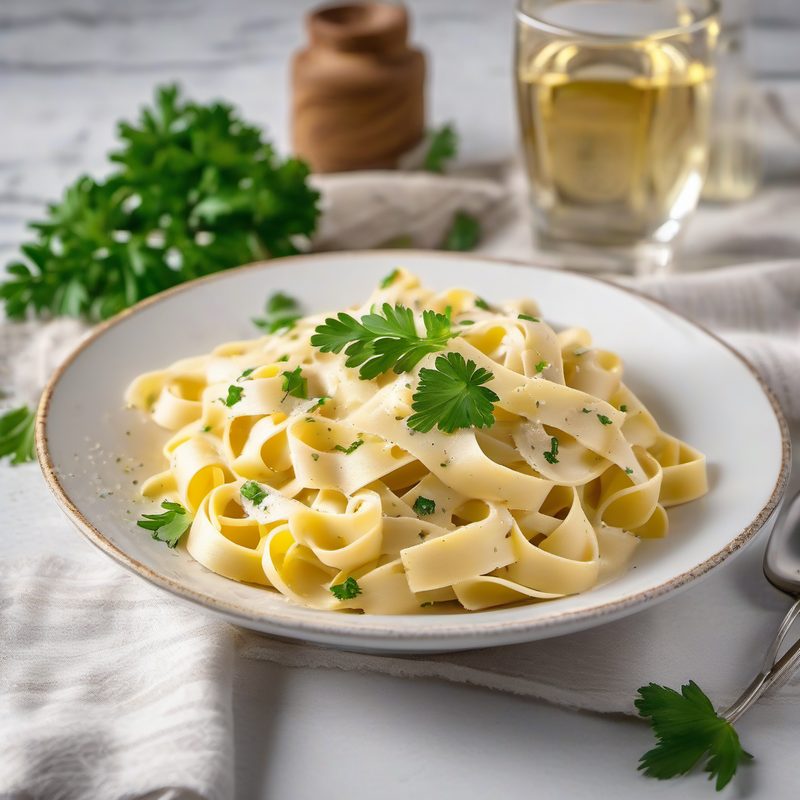
Tagliatelle Alfredo
| Amount | Ingredient |
|---|---|
| Calories | ~590 kcal |
| Fat | 32 g |
| Saturated Fat | 20 g |
| Cholesterol | 95 mg |
| Sodium | 880 mg |
| Carbohydrates | 55 g |
| Fiber | 2 g |
| Sugar | 1 g |
| Protein | 22 g |
Authentic Roman Alfredo — Butter and Parmigiano Only
| Category | Primi piatti |
| Servings | 4 |
| Active Time | 15 minutes |
| Total Time | 20 minutes |
Why This Recipe Works
The original Tagliatelle Alfredo bears almost no resemblance to the heavy cream-and-garlic pasta Americans know by the same name. This is the dish Alfredo di Lelio created in Rome in 1914 at his restaurant (now Il Vero Alfredo) — a deceptively simple preparation that relies entirely on technique, not cream, to achieve its signature silken richness. With only three core ingredients (pasta, butter, and Parmigiano-Reggiano), there is nowhere to hide. Success hinges on the proper formation of a crema — a warm emulsion of melted butter, freshly grated Parmigiano, and starchy pasta water that coats each strand in a velvety, clingy sauce without breaking or turning greasy. The key is temperature control: the serving bowl must be warm, the pasta must be drained al dente and still scorching hot, and the tossing must be vigorous and immediate to coax the cheese into emulsifying with the butter and water rather than clumping or stringing. Using a high proportion of grated Parmigiano (finely grated on a Microplane, not coarsely shredded) ensures maximum surface area for rapid melting and emulsion formation. The result is a luxurious, golden sauce that tastes intensely of nutty, salty cheese and sweet butter — far more than the sum of its parts.
- Parmigiano-Reggiano — Use only authentic Parmigiano-Reggiano imported from Italy, aged a minimum of 24 months. Younger cheeses (or domestic imitations labeled simply "Parmesan") lack the crystalline texture and deep umami needed for a proper emulsion. Grate it yourself from a whole wedge using a Microplane or the finest holes of a box grater. Pre-grated cheese contains anti-caking agents (cellulose, potato starch) that prevent proper melting and will produce a grainy, broken sauce. You need 100 g fineness-grated, which is about 2 lightly packed cups.
- Unsalted Butter — European-style butter (82% butterfat or higher, e.g., Plugrà, Kerrygold, or Président) is preferred for its richer flavor and lower water content, which helps the emulsion form more reliably. Cut it into small cubes and let it come to room temperature (about 65–68°F / 18–20°C) so it blends seamlessly into the sauce rather than seizing up. Do not substitute margarine or salted butter — the salt content of the cheese and pasta water is sufficient.
- Pasta — Fresh tagliatelle or fettuccine is traditional and yields the most tender, sauce-clinging result. If using dried pasta, choose a high-quality bronze-die extruded brand (e.g., De Cecco, Rustichella d'Abruzzo). Dried pasta will absorb more water, so you may need slightly more pasta water to achieve a silky consistency. Cooking the pasta in generously salted water (about 1½ tablespoons kosher salt per 4 quarts water) is critical — the pasta absorbs salt as it cooks, seasoning it from within.
- Nutmeg (optional) — A whisper-fresh grating of nutmeg just before serving is traditional in some Roman households. It should be barely perceptible — a subtle warmth that rounds out the dairy flavors, not a dominant spice note.
- Black Pepper — Use freshly ground black pepper, preferably medium-coarse. The pepper provides a gentle heat that cuts through the richness. In the original Alfredo di Lelio, pepper was often omitted or served on the side; adjust to taste.
Notes on Equipment
- Large skillet or sauté pan (12-inch / 30 cm) — Wide enough to toss the pasta freely so the sauce emulsifies evenly.
- Large pot (6–8 quart) — For boiling pasta with ample water.
- Microplane or fine grater — Essential for producing powdery-fine Parmigiano that melts instantly. A box grater's finest side works, but a Microplane is ideal.
- Large metal or ceramic serving bowl — Must be warmed (see Step 2) so the butter and cheese don't cool and seize on contact.
- Tongs — For tossing and coating pasta. Two large forks or a pasta spoon also work, but tongs give the best control for the vigorous tossing motion.
- Heatproof liquid measuring cup — For reserving pasta water.
Instructions
1. Prepare the cheese and butter
- Finely grate the Parmigiano-Reggiano using a Microplane or the finest side of a box grater. Measure 100 g (about 2 lightly packed cups). Set aside at room temperature.
- Cut the butter into ½-inch cubes and let it sit at room temperature until fully softened, about 15 minutes.
2. Warm the serving bowl
- About 5 minutes before the pasta finishes cooking, place a large metal or ceramic serving bowl (or the skillet you will toss in) in a 200°F (95°C) oven, or fill it with hot tap water and let it stand until warm. Dry thoroughly if using the water method.
3. Cook the pasta
- Bring 4 quarts (3.8 L) of water to a rolling boil in a large pot. Add 1½ tablespoons kosher salt (22 g).
- Add the tagliatelle or fettuccine and cook until al dente (typically 2–3 minutes for fresh pasta, 8–10 minutes for dried). Stir occasionally to prevent sticking.
- Reserve 1½ cups (355 ml) of the starchy pasta water just before draining. Use a heatproof liquid measuring cup.
4. Build the emulsion
- Transfer the warm serving bowl or skillet to the counter (use a towel to handle if hot).
- Place the softened butter cubes and the finely grated Parmigiano in the warm bowl.
- Immediately add about ½ cup (120 ml) of the reserved hot pasta water.
- Whisk vigorously with a fork or small whisk until the butter has fully melted and the cheese has dissolved into a smooth, creamy, pale-gold emulsion. This should take 30–45 seconds. If the mixture looks clumpy or separated, add another tablespoon of hot pasta water and continue whisking.
5. Combine and toss
- Drain the pasta well (do not rinse) and add it immediately to the bowl with the emulsion.
- Using tongs, toss the pasta vigorously, lifting and turning it repeatedly to coat every strand. The motion should be energetic — this mechanical action is what finishes the emulsion and builds the silky sauce.
- As you toss, add more reserved pasta water 1 tablespoon at a time if the sauce seems too thick or begins to clump. The final consistency should be glossy and fluid, coating the pasta like a light cream sauce, not pooling greasily at the bottom.
- Continue tossing for 45–60 seconds — the sauce will thicken and cling to the pasta as it cools slightly.
6. Finish and serve
- Season with a generous grind of black pepper and, if using, a whisper of freshly grated nutmeg.
- Taste and adjust with a pinch of salt only if needed (the Parmigiano and pasta water are already quite salty).
- Divide immediately among warmed individual bowls or plates, twirling each portion into a neat nest.
- Top each serving with a dusting of extra grated Parmigiano-Reggiano and an additional grind of black pepper.
- Serve at once — Alfredo waits for no one. The sauce will continue to thicken as it cools and will become stodgy if allowed to sit.
Troubleshooting
Emulsion breaks or looks greasy:
The most common cause is insufficient starch in the water or too-cool ingredients. Ensure the bowl is genuinely warm, the pasta is piping hot straight from the colander, and you've reserved at least 1½ cups of pasta water. If the sauce does break, try adding another tablespoon of hot pasta water and whisking/tossing vigorously — the starch can sometimes rescue a broken emulsion.
Cheese clumps into strings:
This happens when the cheese hits heat that is too intense or uneven. Make sure the Parmigiano is finely grated (not shredded) and that the butter and pasta water are warm but not boiling when combined. Always whisk the cheese into the liquid component, not the other way around.
Sauce is too thick or pasty:
Add more reserved pasta water, 1 tablespoon at a time, and toss energetically. The pasta will continue to absorb liquid, so err on the side of a slightly looser sauce at plating.
Variations
Vero Alfredo (with extra butter)
The original Alfredo di Lelio recipe used an even higher butter-to-cheese ratio: 100 g butter to 100 g Parmigiano for 350 g pasta. Follow the same method but increase butter to 100 g (full stick plus 1½ Tbsp). The resulting sauce is extraordinarily rich and glossy.
Tagliatelle Alfredo con Panna (American-style)
Note: This is NOT the authentic Roman version but is included for completeness.
Replace the butter with 1½ cups (355 ml) heavy cream. Simmer the cream in a skillet over medium heat until reduced by one-third, about 5 minutes. Add 100 g finely grated Parmigiano-Reggiano and stir until melted. Toss with cooked pasta, adding pasta water as needed to loosen. The result is a thicker, heavier sauce that lacks the delicacy of the original.
Serving Suggestions
- Tagliatelle Alfredo is a primo piatto (first course) in the Italian tradition. Serve as the pasta course before a simple main of roasted chicken, veal scaloppine, or grilled fish.
- Pair with a crisp, unoaked white wine such as a Gavi di Gavi, Verdicchio, or Franciacorta. The high acidity and minerality cut through the richness.
- A simple side salad of arugula with lemon vinaigrette provides a bright, peppery contrast.
- Serve with extra Parmigiano-Reggiano at the table and a pepper grinder for guests to adjust to their taste.
Behind the Recipe
Alfredo di Lelio created this dish in 1914 in Rome after his wife, Ines, lost her appetite following the birth of their son. To tempt her to eat, he devised a pasta tossed with extra butter and Parmigiano-Reggiano — a richer version of the standard pasta in bianco (white pasta) that Italian mothers made for convalescents. His restaurant, on Via della Scrofa, made the dish famous. When silent film stars Mary Pickford and Douglas Fairbanks dined there on their honeymoon in 1920, they loved it so much they brought the recipe — and the restaurant's golden forks and spoons — back to America, inadvertently launching the "Fettuccine Alfredo" craze. In Rome, however, the dish remains what it always was: a testament to the alchemy of starch, fat, and cheese, and the genius of doing almost nothing — but doing it perfectly.
Nutritional Information (per serving)
Note: Values are approximate and based on the authentic recipe using fresh tagliatelle, European-style butter, and Parmigiano-Reggiano.
Source: Adapted from the original Alfredo di Lelio recipe as documented by Il Vero Alfredo, Rome. ATK-style format.
Recipe from The Italian Kitchen by Vita Milanese — Volume 1 · Pasta Perfetto. Discover all volumes on the ebook page.