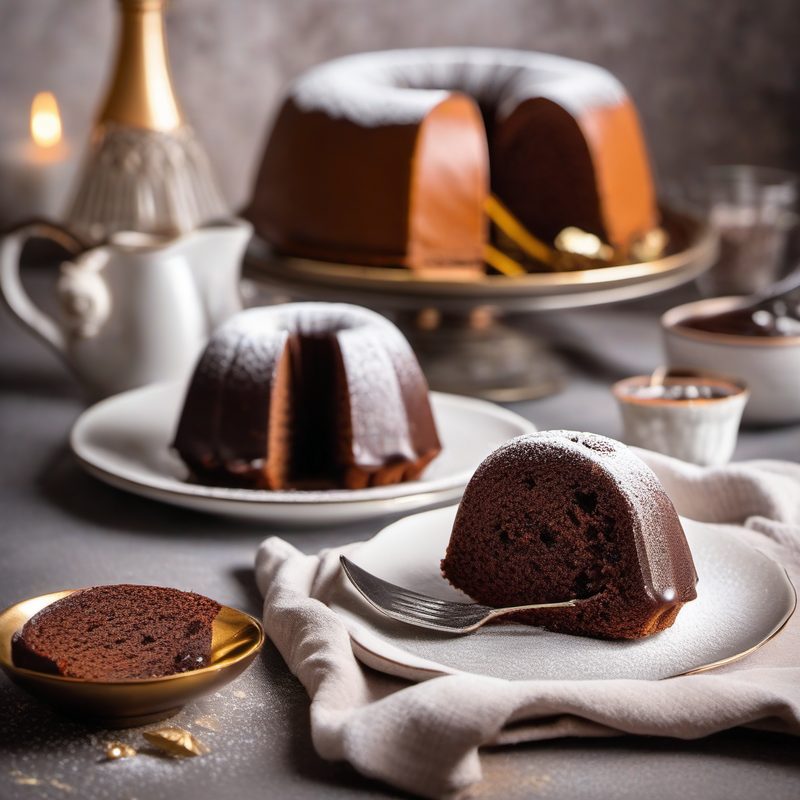
Chocolate Gugelhupf Rum
| Amount | Ingredient |
|---|---|
| Calories | ~490 kcal |
| Total Fat | 26 g |
| Saturated Fat | 16 g |
| Cholesterol | 145 mg |
| Sodium | 200 mg |
| Total Carbohydrates | 56 g |
| Dietary Fiber | 2 g |
| Total Sugars | 35 g |
| Protein | 7 g |
Gugelhopf al cioccolato imbevuto di sciroppo al rum
| Total Time | 1 hour 30 minutes (plus cooling) |
| Active Time | 30 minutes |
| Yield | 8 servings; one 10-inch (25 cm) bundt cake |
| Category | Dolci / Desserts — Austrian-Italian Cakes |
| Source | Recipe position 422, Regional Italian Dolci |
WHY THIS RECIPE WORKS
A true hybrid of Austrian and Italian baking traditions, this chocolate Gugelhupf combines the tender, fine-crumbed structure of a Viennese Gugelhupf with the bold, boozy warmth of an Italian dolce al rum. The key challenges — a dry crumb, uneven soaking, or a tough crust — are solved by three techniques. First, we cream the butter and sugar thoroughly to build enough air for a light, springy crumb that can absorb syrup without turning sodden. Second, we melt the dark chocolate and fold it in at the very end of the wet stage, ensuring even color and deep cocoa flavor without deflating the batter. Third, we apply a warm rum syrup while the cake is still warm — this mimics the bagna technique used in Italian rum babà, creating a graduated soak that penetrates the surface without pooling at the bottom. The result is a cake that is moist, tender, and aromatic, with a glossy, syrup-kissed crust and a gentle rum finish that lingers.
KEY EQUIPMENT
- 10-inch (25 cm) bundt pan or Gugelhupf mold (3 L capacity)
- Stand mixer with paddle attachment or hand mixer
- Rubber spatula
- Fine-mesh sieve
- Small saucepan (for syrup)
- Pastry brush (optional, for syrup application)
- Wire cooling rack
- Large mixing bowls
- Offset spatula
Cake
Rum Syrup
- Chocolate: Use a high-quality dark chocolate with 60–70% cacao. Avoid chocolate chips (they contain stabilizers that prevent smooth melting). Chop finely before melting for even, quick melting.
- Butter: European-style butter (82% butterfat) produces a more tender crumb. If using standard American butter, reduce the milk by 1 tablespoon.
- Rum: Aged or amber rum provides the best depth. Avoid spiced or flavored rums, which can clash with the chocolate. For a non-alcoholic version, substitute 50 ml strong brewed coffee mixed with ½ tsp rum extract.
- Eggs: Room-temperature eggs emulsify into the creamed butter more readily, reducing the risk of curdling.
- Milk: Whole milk gives the best texture. Low-fat or plant-based milks produce a denser, less tender cake.
PREP NOTES / MISE EN PLACE
- Position oven rack in the middle position. Preheat oven to 180°C (350°F).
- Grease and flour the bundt pan: Brush every crevice of the pan with softened butter (or melted butter), then dust with flour, tapping out the excess. Pay special attention to the centre tube and any decorative ridges. Place the prepared pan on a baking sheet for easy handling.
- Melt the chocolate: Finely chop 100 g dark chocolate and melt in a heatproof bowl set over a saucepan of barely simmering water (or microwave in 20-second bursts at 50% power, stirring between each). Let cool to lukewarm (about 35°C / 95°F).
- Sift dry ingredients: In a medium bowl, whisk together flour, baking powder, and salt. Sift once more to aerate.
- Prepare syrup ingredients: Measure water, sugar, and rum and set near the stove.
- Bring eggs and milk to room temperature by setting them out 30 minutes before starting.
INSTRUCTIONS
1. Cream the butter and sugar
In the bowl of a stand mixer fitted with the paddle attachment (or using a hand mixer), beat the softened butter and sugar on medium-high speed until pale, light, and fluffy — about 3 to 4 minutes. Scrape down the bowl and beater with a rubber spatula halfway through. The mixture should be noticeably paler in colour and increased in volume.
2. Add the eggs
Reduce speed to medium. Add the eggs one at a time, beating for about 30 seconds after each addition and scraping the bowl as needed. The batter should be smooth and glossy; if it looks curdled or separated, increase speed slightly and beat for an additional 30 seconds until re-emulsified. Beat in the vanilla extract with the last egg.
3. Incorporate the melted chocolate
With the mixer on low speed, slowly pour in the cooled melted chocolate. Mix until just combined — about 15 seconds. Scrape the bowl and fold once or twice with a spatula to ensure no streaks remain.
4. Alternate dry ingredients and milk
In three additions, add the sifted flour mixture, alternating with two additions of milk, beginning and ending with the flour. Mix on low speed between each addition just until the flour disappears — about 5 to 10 seconds each. After the final addition, stop the mixer and fold the batter gently with a rubber spatula, scraping the bottom of the bowl to incorporate any unblended pockets.
5. Fill the pan
Transfer the batter to the prepared bundt pan. Use a spatula to spread the batter evenly, filling the pan about two-thirds full. Gently tap the pan on the counter three or four times to release any large air bubbles.
6. Bake
Place the pan (on the baking sheet) on the middle oven rack. Bake at 180°C (350°F) for 45 to 50 minutes, rotating the pan halfway through the baking time. The cake is done when:
- A wooden skewer or cake tester inserted near the centre comes out clean or with a few moist crumbs attached.
- The top is deep golden brown and springs back lightly when pressed in the centre.
- The cake begins to pull away slightly from the sides of the pan.
7. Cool in pan (first cooling)
Transfer the pan to a wire rack and let the cake cool in the pan for 10 minutes. Do not exceed 15 minutes — the cake will stick if left too long, as the residual heat continues to steam the crust.
8. Make the rum syrup
While the cake is cooling, prepare the syrup. In a small saucepan, combine the water and sugar. Bring to a boil over medium-high heat, stirring occasionally until the sugar is completely dissolved. Boil for 1 minute, then remove from heat. Let cool for 2 minutes, then stir in the rum. Set aside.
9. Unmold
Place a wire rack upside down over the pan. Using oven mitts, hold the pan and rack together and invert. Lift the pan off carefully. If the cake resists, gently tap the bottom of the pan with the handle of a butter knife or rap the pan's edge against the counter.
10. Soak with warm syrup
Place the warm cake (still on the wire rack) over a rimmed baking sheet or a large plate to catch drips. Using a pastry brush, generously brush the warm rum syrup all over the top and sides of the warm cake, applying in thin coats. Brush especially over the decorative ridges and the centre hole, allowing each coat to absorb before applying the next. Alternatively, use a skewer to poke holes all over the cake before brushing, which encourages deeper penetration. Use all of the syrup — the cake should appear glossy and well-moistened.
11. Final cooling
Let the cake cool completely on the wire rack, about 1 to 2 hours. The syrup will tighten into a delicate, shiny glaze as it cools.
SUCCESS TIPS
- Mind the butter temperature: Butter should be cool-room-temperature (about 18–20°C / 65–68°F). If it's too warm (melty or oily), the creamed mixture won't hold air; if too cold, it won't cream properly.
- Don't rush the creaming: The 3–4 minute creaming step is non-negotiable — it creates the emulsion that gives this cake its tender but structured crumb.
- Alternate additions: Adding flour and milk in stages prevents the batter from separating and ensures a smooth, even crumb.
- Warm cake + warm syrup: This is the most critical rule. A cold cake won't absorb the syrup — it will run off. A hot cake straight from the oven absorbs too aggressively, becoming sticky and uneven. The 10-minute rest window (step 7) is ideal for both unmolding and soaking.
- Watch the rack placement: Position the rack in the middle of the oven — too low and the bottom darkens before the centre sets; too high and the top crusts over while the centre remains raw.
- Test with skewer, not touch: A Gugelhupf's decorative ridges brown more quickly than the centre. Rely on the skewer test, not surface colour.
TROUBLESHOOTING
| Problem | Likely Cause | Solution |
|---|---|---|
| Cake sticks to pan | Insufficient greasing; cooled too long in pan | Grease pan meticulously; invert within the 10-minute window; use a non-stick bundt pan |
| Dense, heavy crumb | Overmixing after adding flour; undermixing the creaming step | Mix flour on low just until combined; cream butter and sugar the full 4 minutes |
| Large tunnels or holes | Overmixing; too much baking powder | Fold gently; measure baking powder precisely (level teaspoon) |
| Syrup pools at bottom | Cake not warm enough when soaked; too much syrup applied at once | Soak within 15 minutes of unmolding; apply in thin, brushable layers |
| Dry cake | Overbaked; syrup not fully absorbed | Check at 45 minutes; brush syrup immediately; use all of the syrup |
| Chocolate tastes flat | Chocolate not quality enough; not enough salt | Use 60–70% cacao; don't skip the ¼ tsp salt |
| Crust too hard | Oven too hot; overbaked; syrup not applied to sides | Verify oven temp with an oven thermometer; brush syrup over all surfaces |
MAKE AHEAD / STORAGE
- Room Temperature: Wrap the soaked, cooled cake tightly in plastic wrap and store at room temperature for up to 3 days. The flavour deepens on day two as the rum and chocolate meld.
- Refrigerator: Not recommended — the cake stiffens and loses its tender crumb. If refrigerated (e.g., in hot weather), bring to room temperature before serving.
- Freezer (unsoaked): The unsoaked cake can be wrapped in plastic, then foil, and frozen for up to 1 month. Thaw at room temperature, then reheat gently in a 150°C (300°F) oven for 5–8 minutes before soaking with freshly made syrup.
- Freezer (soaked): Freeze the soaked cake for up to 2 weeks. Thaw at room temperature. The syrup may weep slightly on thawing; brush the surface with a little additional rum or simple syrup to refresh.
Day-ahead strategy: Bake the cake, soak with syrup, let cool completely, wrap, and rest overnight. The cake is at its best the day after baking.
SERVING SUGGESTIONS
- Serve at room temperature in thin slices to showcase the decorative spiral pattern.
- Dust lightly with confectioners' sugar just before serving for a snowy finish.
- Accompany with lightly sweetened whipped cream (1 cup heavy cream + 1 tbsp sugar + ½ tsp vanilla, whipped to soft peaks) — the un-sweetened cream balances the sweet, boozy cake.
- Serve with mascarpone crema: 200 g mascarpone, 2 tbsp powdered sugar, 1 tbsp rum, whisked until smooth.
- A dollop of crème fraîche or clotted cream cuts the sweetness beautifully.
- Pair with fresh berries (raspberries or sliced strawberries) for acidity and colour contrast.
- For a classic Italian dessert plate, accompany with espresso or affogato (vanilla gelato drowned in a shot of hot espresso).
THE SCIENCE OF GUGELHUPF
The Gugelhupf's distinctive tall, ringed shape is more than ornamental — it serves a structural purpose. The central tube conducts heat into the centre of the batter, allowing a dense cake to bake evenly without a raw core. The ratio of butter to flour (200 g butter to 250 g flour — 80% by weight) places this recipe in the pound-cake family, where the fat coats gluten strands, limiting their development and producing a tender, fine-grained crumb. The creaming method traps microscopic air bubbles in the butter-sugar matrix; these bubbles expand during baking, providing lift alongside the baking powder's carbon dioxide. The warm rum syrup acts as a bagna (Italian for "bath"), similar to the technique used in rum babà or tiramisù's coffee soak. The porous crumb created by the creaming method acts as a sponge, drawing the syrup in by capillary action, while the residual heat from the cake keeps the syrup fluid for even distribution.
VARIATIONS
Chocolate-Orange Gugelhupf
Add the finely grated zest of 1 orange to the butter-sugar mixture during creaming. Replace the rum in the syrup with 50 ml fresh orange juice and 1 tbsp Grand Marnier or Cointreau.
Mocha Gugelhupf
Dissolve 1 tbsp instant espresso powder in the milk before adding. Replace the rum in the syrup with 50 ml strong brewed espresso (reduce water to 80 ml and sugar to 60 g).
Spiced Chocolate Gugelhupf
Add ½ tsp ground cinnamon, ¼ tsp ground cardamom, and a pinch of freshly grated nutmeg to the flour mixture. Omit the vanilla if desired.
White Chocolate-Rum Variation
Replace the dark chocolate with 100 g white chocolate (melted gently). Increase rum to 60 ml and add 1 tsp vanilla bean paste. Reduce sugar to 120 g as white chocolate is sweeter.
Non-Alcoholic Version
Substitute the 50 ml rum with 50 ml strong brewed coffee (cooled) plus ¼ tsp rum extract. Add ½ tsp vanilla extract to the syrup for depth.
WINE & BEVERAGE PAIRING
| Beverage | Recommendation |
|---|---|
| Dessert Wine | Vin Santo (Tuscany) — its notes of dried fruit and nuts echo the rum and chocolate. Alternatively, a late-harvest Riesling or Sauternes. |
| Fortified Wine | Tawny Port (10-year) — caramel and nut notes complement the Gugelhupf's rum-soaked character. |
| Spirits | A small measure of aged rum (Appleton Estate 12-Year or Diplomatico Reserva) served neat or on a single large ice cube. |
| Coffee | Espresso, doppio, or a strong French press — the bitterness cuts the sweetness and cleanses the palate. |
| Tea | A smoky Lapsang Souchong or an Assam black tea with milk. |
NUTRITIONAL INFORMATION (per serving)
Values are estimates based on standard ingredients and 8 servings.
Converted to ATK-style format from "Gugelhopf al cioccolato imbevuto di sciroppo al rum" — Recipe position 422. Original source: Regional Italian Dolci collection.
Recipe from The Italian Kitchen by Vita Milanese — Volume 1 · Pasta Perfetto. Discover all volumes on the ebook page.