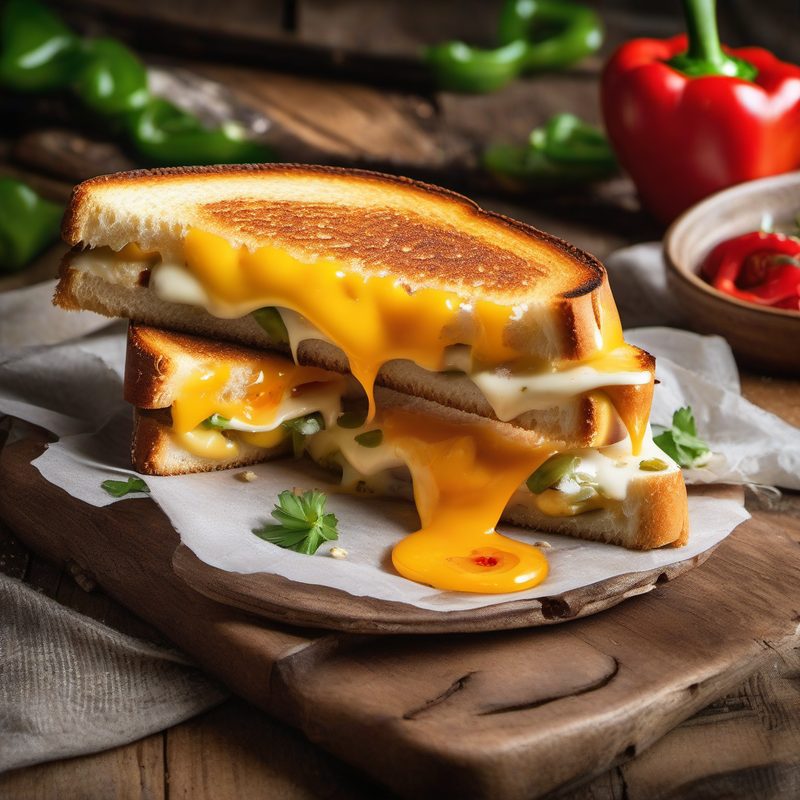
Grilled Cheese Seven Peppers
Position: 486 | Category: Antipasti | Serves: 4
| Amount | Ingredient |
|---|---|
| Calories | ~520 kcal |
| Total Fat | 30 g |
| Saturated Fat | 14 g |
| Cholesterol | 65 mg |
| Sodium | 890 mg |
| Total Carbohydrates | 35 g |
| Dietary Fiber | 3 g |
| Sugars | 2 g |
| Protein | 24 g |
1. Headnote
Grilled cheese is one of those rare dishes that spans every culture, every kitchen, every late-night craving. But the Italian peninsula — never content to leave well enough alone — elevates it with two obsessions: cacio (cheese in the Roman sense, meaning a blend of sharp, salty, aged wheels) and pepi (pepper, but in the plural, because one is never enough). This is Cacio e Sette Pepi alla Brace — "Cheese and Seven Peppers Cooked Over Embers" — a smoky, crusty, molten celebration of pepper's entire universe.
The "seven peppers" are a conceit, really: black, white, green, pink, Szechuan, long pepper, and cubeb. Each brings a different quality — black's piney heat, white's sharp bite, green's fresh grassiness, pink's floral sweetness, Szechuan's electric tingle, long pepper's cinnamon-like warmth, and cubeb's bitter-earthy musk. If you can't find all seven (cubeb and long pepper are specialist spice-drawer items), use what you have — the point is variety, not perfection. Toast the peppercorns before grinding; it unlocks volatile oils that perfume the whole kitchen and make the spice bloom.
The cheese blend nods to Rome's cacio e pepe tradition: Pecorino Romano for its salty tang, Parmigiano-Reggiano for its crystalline crunch, and Provolone (aged, not young) for its velvety melt and gentle smoke. Olive oil takes the place of butter — lighter, fruitier, more Italian — and the bread should be thick-cut, crusty, sturdy enough to hold its own against the molten interior. Think pane pugliese, ciabatta, or a good sourdough boule. Toast it on a grill or in a cast-iron pan; the goal is deep golden ridges that shatter when you bite, giving way to a creamy, peppery, almost spicy center.
Serve hot, cut on the bias, with a glass of something that can handle the heat: a chilled Lambrusco Grasparossa, a Nero d'Avola with some fruit, or even a crisp Pilsner. This is antipasti, not main course — though no one will stop you if you eat two.
2. Why This Recipe Works
- Toasted whole peppercorns are ground just before use, maximizing volatile oil release and giving a layered, fragrant heat no pre-ground pepper can match.
- Three-cheese blend balances salt (Pecorino), umami and crystalline texture (Parmesan), and stretchy melt (Provolone).
- Olive oil instead of butter provides a higher smoke point and a fruity counterpoint to the peppers' heat, while still crisping the bread beautifully.
- Grill or cast-iron pan replicates the brace (embers) effect: high, even heat that creates a shatteringly crisp crust before the cheese fully liquefies.
- Bread choice matters — thick, rustic slices with an open crumb hold the cheese without turning soggy and develop deep char in the crevices.
3. Before You Begin (Recipe Notes)
- Peppercorn sourcing: Black, white, green, and pink peppercorns are easy to find at most supermarkets. Szechuan peppercorns are common in Asian groceries. Long pepper (Piper longum) and cubeb (Piper cubeba) are available online or at specialty spice shops. If you cannot find all seven, use any combination of 4–7; the recipe is forgiving.
- Toasting peppercorns: Toast in a dry skillet over medium heat, shaking frequently, until fragrant and just beginning to smoke (1–2 minutes). Do not burn — burnt pepper is bitter.
- Grinding: Use a mortar and pestle or spice grinder. Aim for a coarse-cracked consistency, not a powder. Some texture is desirable.
- Cheese prep: Grate Pecorino and Parmesan on the fine holes of a box grater. Shred Provolone on the large holes. Toss together so the grated cheeses distribute evenly throughout the shredded base.
- Bread: Day-old bread is ideal — slightly dried slices absorb less oil and crisp better. If using fresh bread, let slices sit out uncovered for 30 minutes.
- Make ahead: The peppercorn blend can be toasted and ground up to 3 days ahead. Store in an airtight container in a cool, dark place.
- Gluten-free: Excellent with gluten-free sourdough or seeded bread. Check that all cheeses are labeled gluten-free (they generally are, but pre-shredded cheese may contain anti-caking agents with gluten).
4. Equipment
- Cast-iron skillet (12-inch) or outdoor grill
- Small dry skillet (for toasting peppercorns)
- Mortar and pestle or electric spice grinder
- Box grater (fine and large holes)
- Mixing bowls (small and medium)
- Chef's knife
- Cutting board
- Pastry brush
- Spatula (metal or heatproof silicone)
- Large plate or sheet pan (for assembled sandwiches)
- Measuring spoons
5. Key Equipment: Cast-Iron Skillet
The key to alla brace — "in the embers" style — is intense, even heat that sears the bread and melts the cheese in roughly the same amount of time. A cast-iron skillet is the indoor equivalent of a grill grate over coals. It retains heat superbly, develops a deep crust, and doesn't buckle under high heat. Avoid nonstick pans; they cannot get hot enough for the kind of crust you want, and the fond (the browned bits) that develops on cast iron adds flavor. If using an outdoor grill, set up a two-zone fire (medium-high direct heat) and place the sandwiches over the hotter side.
For the Seven-Pepper Blend
For the Cheese Blend
For Assembly
- Pecorino Romano: A hard, salty sheep's-milk cheese from Lazio and Sardinia. It is the foundational cheese of cacio e pepe and brings sharp, tangy notes that cut through the oil and pepper. Do not substitute Pecorino Toscano (too mild) or Pecorino Sardo (different character). Grana Padano can sub in a pinch but lacks the salt punch.
- Parmigiano-Reggiano: Aged a minimum of 12 months, ideally 24+. Its crumbly, granular texture provides pops of umami and a slight grittiness that contrasts with the stretchy Provolone. Buy block cheese and grate it yourself; pre-grated contains cellulose that inhibits melting.
- Aged Provolone: Unlike young, mild Provolone (often used on Italian subs), aged Provolone (Provolone Piccante or Provolone Dolce aged 6+ months) has a firmer texture, a slight smokiness, and an excellent melt. It acts as the structural backbone of the cheese layer. If unavailable, substitute low-moisture mozzarella or young Gouda.
- Olive oil: Use a fruity, medium-bodied extra-virgin olive oil — not a delicate finishing oil (it will burn) and not a harsh, bitter cooking oil. A Tuscan or Pugliese oil works well.
- Bread: Pane pugliese (Puglian bread with a hard crust and open crumb), ciabatta, or a round sourdough boule are ideal. Avoid fluffy sandwich bread — it turns to mush. Cut slices at least ½-inch thick for proper structure.
8. Pepper Guide: Understanding the Seven
| Pepper | Plant | Heat | Flavor Profile | Best For |
|---|---|---|---|---|
| Black | Piper nigrum (dried unripe berry) | Medium | Piney, resinous, sharp | Backbone heat |
| White | Piper nigrum (fermented, hulled) | Medium-high | Pungent, one-dimensional, earthy | Punch without visual speckling |
| Green | Piper nigrum (freeze-dried unripe) | Mild | Fresh, grassy, slightly vegetal | Brightness and freshness |
| Pink | Schinus molle (dried drupe) | Mild | Sweet, floral, fruity, resinous | Color and aromatic lift |
| Szechuan | Zanthoxylum simulans (dried husk) | Low (tingly) | Citrusy, numbing, electric | Mouthfeel and complexity |
| Long | Piper longum (dried catkin) | Mild-moderate | Cinnamon, nutmeg, warm | Sweet-spice depth |
| Cubeb | Piper cubeba (dried berry with tail) | Moderate | Bitter, camphor, earthy, musky | Back-end complexity |
9. Step-by-Step Instructions
Step 1: Toast the Peppercorns
Place all seven peppercorn varieties in a small dry skillet over medium heat. Toast, shaking the pan frequently, until fragrant and the black and white peppercorns begin to smoke slightly — about 1 to 2 minutes. Do not walk away; peppercorns go from toasted to burnt in seconds. Immediately transfer to a plate or mortar to stop the cooking.
Step 2: Grind the Pepper Blend
Grind the toasted peppercorns using a mortar and pestle or electric spice grinder. Aim for a coarse-cracked texture — some larger pieces should remain for textural contrast. Set aside in a small bowl.
Step 3: Prepare the Cheeses
Finely grate the Pecorino Romano and Parmigiano-Reggiano using the fine holes of a box grater. Coarsely shred the aged Provolone using the large holes. Place all three in a medium bowl and toss with your fingers to combine thoroughly.
Step 4: Prepare the Bread
Lay the 8 bread slices on a clean work surface. If using a boule or rustic loaf, trim slices to roughly uniform size. Using a pastry brush, lightly coat one side of each slice with extra-virgin olive oil. Flip the slices and brush the other side. (You want a thin, even coating — not a soak.)
Step 5: Assemble the Sandwiches
Place 4 bread slices oiled-side down on a clean work surface. Divide the cheese mixture evenly among the slices (about 2 oz / 55 g per sandwich), spreading it to within ¼ inch of the edges. Sprinkle about ½ teaspoon of the pepper blend evenly over the cheese on each sandwich. Top with the remaining 4 bread slices, oiled-side up. Gently press each sandwich to compact it.
Step 6: Heat the Pan or Grill
Place a 12-inch cast-iron skillet over medium-low heat and let it preheat for 3 minutes. (If using an outdoor grill, set up for medium-high direct heat — about 375–400°F.) The pan is ready when a drop of water sizzles and evaporates immediately.
Step 7: Cook the Sandwiches
Place 2 sandwiches in the skillet (work in batches if necessary — crowding lowers the pan temperature). Cook without moving for 3 to 4 minutes, until the bottom is deep golden brown and crisp. Using a spatula, carefully flip each sandwich. Cook the second side for another 3 to 4 minutes, until golden brown and the cheese is fully melted and beginning to ooze at the edges.
Step 8: Finish and Serve
Transfer the cooked sandwiches to a cutting board. Let rest for 1 minute — this allows the cheese to set slightly so it doesn't all gush out when cut. Sprinkle with a pinch of flaky sea salt and a light dusting of the remaining pepper blend. Cut each sandwich in half on the bias (diagonal cut). Serve immediately, while the cheese is still molten and the crust is shatteringly crisp.
10. Cooking Guide: Doneness Reference
| Doneness | Bottom Color | Cheese State | Internal Temp (est.) | Time per Side |
|---|---|---|---|---|
| Golden | Deep tan with brown spots | Barely melted, warm | 130–140°F | 3 minutes |
| Perfect | Deep golden brown with darker char spots | Fully melted, slightly oozing | 150–160°F | 3½–4 minutes |
| Well-Done | Dark brown, nearly mahogany | Very runny, escaping | 165°F+ | 4½–5 minutes |
| Burnt | Black patches, acrid smell | Dried out, leaking oil | 180°F+ | 5+ minutes |
Use an instant-read thermometer inserted through the side crust into the cheese center for accuracy.
11. Troubleshooting
| Problem | Cause | Solution |
|---|---|---|
| Bread burns before cheese melts | Pan too hot; cheese layer too thick | Reduce heat to medium-low; spread cheese more thinly and evenly |
| Cheese leaks out completely | Too much cheese; bread not pressed evenly | Use 2 oz cheese per sandwich; press gently before cooking; leave ¼-inch border |
| Sandwiches are greasy | Too much olive oil; pan not hot enough | Use a thin brushed coating; preheat pan fully before adding sandwiches |
| Peppercorn flavor is harsh or bitter | Peppercorns were over-toasted or ground too fine | Toast only until fragrant (1–2 minutes); grind coarsely |
| Sandwiches are soggy, not crisp | Pan temperature too low; bread too fresh | Preheat thoroughly; use day-old bread; increase oil slightly |
| Cheese doesn't melt fully | Heat too low; cheese pieces too large | Use medium-low heat; shred/grate cheese finely; cover pan for last minute |
| Szechuan "numbing" effect absent | Szechuan peppercorns not fresh | Replace Szechuan peppercorns if older than 6 months; the numbing compound (hydroxy-alpha-sanshool) degrades over time |
12. Variations
Classic Cacio e Pepe Grilled Cheese
Omit all specialty peppers. Use 2 tsp coarsely cracked black peppercorns only. Use 3 oz Pecorino Romano and 3 oz Parmigiano-Reggiano (no Provolone). Toss grated cheeses with 2 tbsp of the pepper before layering. Proceed as directed.
Smoky Chipotle-Cacio
Add 1 tsp ground chipotle powder to the pepper blend. Add 2 oz smoked mozzarella to the cheese blend (reduce Provolone to 2 oz). Finish with a squeeze of lime.
Herbed Spring Version
Replace Szechuan and cubeb with 1 tsp dried oregano and ½ tsp dried thyme, crushed. Use 3 oz fresh mozzarella + 3 oz Pecorino (omit Parmesan). Add a handful of fresh arugula between the cheese layers before grilling.
Vegan Adaptation
Substitute: 4 oz vegan mozzarella-style shreds (miyoko's or violife), 2 oz vegan parmesan-style, 2 oz cashew-based ricotta. Use vegan butter or olive oil. The pepper blend remains the same. Cook at slightly lower heat (medium-low) since vegan cheeses melt differently. Note that the texture will be creamier but less stretchy.
The "Five Pepper" Shortcut
Use only: black, white, pink, Szechuan, and green peppercorns (omit long pepper and cubeb). Double the black and white to compensate. This version trades some complexity for ease of sourcing.
13. Make Ahead
- Pepper blend: Toast and grind up to 3 days ahead. Store in an airtight container in a dark, cool place. The aroma will fade after day 2, so for best results, grind the day of cooking.
- Cheese blend: Grate and combine up to 2 days ahead. Keep tightly covered in the refrigerator. Let come to room temperature for 15 minutes before assembling.
- Bread: Slice and leave uncovered on a wire rack overnight. Staling the bread improves crust performance.
- Assembled sandwiches (unbaked): Can be assembled up to 4 hours ahead, wrapped tightly in plastic wrap, and refrigerated. Bring to room temperature before cooking. Do not brush with oil until just before grilling.
14. Science of the Perfect Grilled Cheese
Why Toasting Peppercorns Matters
Black peppercorns contain the volatile oil piperine (responsible for heat), along with terpenes like β-caryophyllene and limonene that give pepper its complexity. Toasting at 300–350°F (150–175°C) vaporizes some of the lighter terpenes while concentrating piperine, and initiates Maillard reactions on the peppercorn surface that create new toasted-note compounds. The result is a deeper, rounder heat with less raw "biting" quality.
Why Three Cheeses?
Each cheese plays a distinct structural role:
- Parmigiano-Reggiano has low moisture and high protein content; it browns beautifully and contributes crystalline tyrosine crystals that add crunch.
- Pecorino Romano is also low-moisture but higher in salt (sodium chloride acts as a melting point depressant, making it soften earlier).
- Aged Provolone has moderate moisture and a protein network that forms long, stretchy casein fibers when heated — the "pull" in grilled cheese.
Together, they create a melt that is simultaneously creamy (from the Provolone), salty (from the Pecorino), and crunchy (from the Parmesan crystals).
Why Olive Oil, Not Butter?
Butter contains about 15–20% water. When it hits a hot pan, that water steams and creates a barrier between the bread and the cooking surface, delaying crust formation. Olive oil is 100% fat, meaning immediate, uninterrupted heat transfer. It also has a higher smoke point (375–410°F for EVOO vs 325–350°F for butter), allowing a deeper, darker crust without burning the dairy solids.
15. Pairing Suggestions
Wine
| Wine | Why |
|---|---|
| Lambrusco Grasparossa (chilled) | Slightly sparkling, fruity, low tannin — cuts through the cheese fat and pepper heat |
| Nero d'Avola (Sicily) | Medium-bodied, dark-fruited, with enough structure to stand up to aged cheeses |
| Verdicchio dei Castelli di Jesi | Crisp, mineral-driven white with good acidity — a surprising but excellent match |
| Gavi di Gavi | Lean, floral, clean — refreshes the palate between bites |
| Barbera d'Alba | High-acid, low-tannin red that handles the pepper without fighting it |
Beer
| Beer | Why |
|---|---|
| Italian Pilsner (e.g., Birrificio Italiano Tipopils) | Clean, crisp bitterness balances the cheese richness |
| Saison | Peppery, spicy yeast notes harmonize with the pepper blend |
| Vienna Lager | Toasty malt complements the browned bread crust |
| West Coast IPA | High bitterness cuts cheese fat; citrus notes play off pink pepper |
Cocktail
| Cocktail | Why |
|---|---|
| Negroni Sbagliato | Prosecco-based; bubbles + bitter + sweet mirrors the pepper-cheese dynamic |
| Aperol Spritz | Low alcohol, bitter-herbal — a classic Italian apertivo alongside a classic antipasto |
| Dirty Martini | Briny, cold, bracing — a clean counterpoint to the richness |
Non-Alcoholic
| Drink | Why |
|---|---|
| Sparkling water with lemon | The simplest and possibly best: bubbles and acid cut through the cheese |
| Ginger-lemon shrub | Acidic, slightly sweet, gingery — plays the same game as the pepper |
| Chilled black tea (no sugar) | Tannins bind with fat and refresh the palate |
16. Shopping List
Spice Aisle
- [ ] Black peppercorns (1 tsp)
- [ ] White peppercorns (1 tsp)
- [ ] Green peppercorns, freeze-dried (1 tsp)
- [ ] Pink peppercorns (1 tsp)
- [ ] Szechuan peppercorns (1 tsp)
- [ ] Long pepper (½ tsp) — optional
- [ ] Cubeb pepper (½ tsp) — optional
Cheese Counter
- [ ] Pecorino Romano (2 oz wedge)
- [ ] Parmigiano-Reggiano (2 oz wedge)
- [ ] Aged Provolone (4 oz wedge)
Produce & Bakery
- [ ] Crusty rustic bread (8 slices, ½–¾ inch thick)
- [ ] Flaky sea salt (Maldon)
Pantry
- [ ] Extra-virgin olive oil
17. Nutritional Information
Per serving (1 sandwich, using approximately 2 tbsp olive oil total across all 4 sandwiches):
Note: Nutritional values are estimates. Actual values depend on specific brands, bread type, olive oil quantity, and cheese moisture content.
18. Recipe Timeline
| When | What |
|---|---|
| Up to 3 days before | Toast and grind peppercorn blend; store airtight |
| Up to 2 days before | Grate and combine cheeses; refrigerate covered |
| 1 day before | Slice bread and leave uncovered to stale slightly |
| Up to 4 hours before serving | Assemble sandwiches (without oil); wrap and refrigerate |
| 30 minutes before cooking | Remove cheeses from fridge; bring assemblies to room temp |
| 10 minutes before cooking | Brush sandwiches with olive oil |
| 0 minutes (cook time) | Cook in cast iron, 3–4 minutes per side |
| Serve immediately | Rest 1 minute, cut on bias, garnish with salt and extra pepper |
19. Variations (Regional)
Piemontese Style
Replace Szechuan and cubeb with ½ tsp white truffle salt mixed into the cheese. Use Fontina Val d'Aosta instead of Provolone. Cook in butter for a nuttier, richer crust.
Calabrese Style
Add 1 tsp dried chili flakes to the pepper blend. Replace Pecorino Romano with Pecorino Crotonese (if available) or use half Pecorino, half smoked Scamorza. Serve with a drizzle of hot honey.
Venetian Style
Replace the seven-pepper blend with 2 tsp pepe bianco (white pepper only — Venetians favor white pepper's clean heat). Use 4 oz Asiago Pressato (young, creamy) + 2 oz Grana Padano + 2 oz Pecorino. Drizzle with olio extravergine di Garda.
Roman Street-Food Style
Omit the seven-pepper blend entirely; use 1 tbsp coarsely ground black pepper. Cheese blend: 3 oz Pecorino Romano, 3 oz Parmigiano-Reggiano, 2 oz caciocavallo (instead of Provolone). Drizzle the cooked sandwiches with a thin ribbon of miele di castagno (chestnut honey).
"La semplicità è l'ultima sofisticazione." — Simplicity is the ultimate sophistication. (Leonardo da Vinci)
Recipe from The Italian Kitchen by Vita Milanese — Volume 1 · Pasta Perfetto. Discover all volumes on the ebook page.