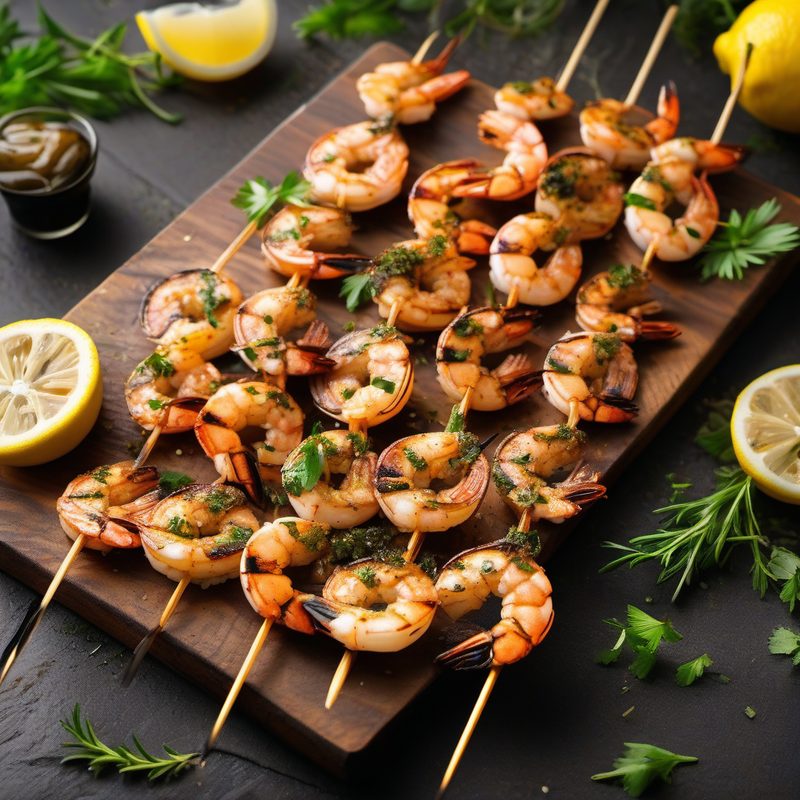
Grilled Shrimp Skewers
Category: Secondi piatti (Main Courses — Fish & Seafood), Antipasti (Starters)
| Amount | Ingredient |
|---|---|
| Large shrimp (prawns) | 500 g (1 lb 2 oz) Peeled, tails left on if desired, deveined |
| Extra-virgin olive oil | 3 tablespoons (45 ml) Divided: 2 tbsp for marinade, 1 tbsp for grilling |
| Garlic | 2 cloves Minced or pressed |
| Lemon | 1 large Juiced (about 2 tbsp) + wedges for serving |
| Fresh parsley | ¼ cup (15 g) Finely chopped, for garnish |
| Kosher salt | 1 teaspoon (5 g) Plus more to taste |
| Black pepper | ½ teaspoon (2.5 g) Freshly ground |
Original Title: Spiedini di gamberi alla griglia
English Title: Grilled Shrimp Skewers
Position: 377
Servings: 4 (as main) / 6–8 (as starter)
Prep Time: 20 minutes
Cook Time: 6 minutes
Marinating Time: 15 minutes
Total Time: 41 minutes
1. WHY THIS RECIPE WORKS
Grilled shrimp skewers are one of summer's greatest pleasures — succulent, briny-sweet shrimp with a light char and a whisper of garlic and lemon. Yet so often they turn out rubbery, bland, or stuck to the grill. This recipe solves all three problems with a straightforward technique. First, we marinate the shrimp briefly in olive oil, fresh garlic, lemon juice, salt, and pepper — just 15 minutes, long enough to season and tenderize without the acid beginning to "cook" the shrimp (which would turn them mealy). Second, we pat the shrimp dry after marinating and oil the grill grates well, ensuring a clean release and those desirable char marks. Finally, we grill over high heat for a scant 2–3 minutes per side, cooking just until the flesh turns pink and opaque with crispy, charred edges. The result is shrimp that are tender, juicy, and packed with bright Mediterranean flavor. Serve them straight from the grill with lemon wedges — as a main course, an antipasto platter, or even tucked into crusty bread for an impromptu sandwich.
3. EQUIPMENT
- Grill (gas or charcoal)
- 8–10 metal or wooden skewers (30 cm / 12 in)
- Large bowl (for marinating)
- Chef's knife
- Cutting board
- Paper towels
- Tongs
- Basting brush (for oiling grill grates)
- Instant-read thermometer (optional)
- Serving platter
If using wooden skewers: Soak in cold water for 30 minutes before grilling to prevent burning.
4. BEFORE YOU BEGIN
- Prepare the shrimp: If using frozen shrimp, thaw completely under cold running water and pat very dry with paper towels. Place the peeled, deveined shrimp in a large bowl.
- Make the marinade: In a small bowl, combine 2 tablespoons (30 ml) olive oil, the minced garlic, lemon juice, 1 teaspoon (5 g) salt, and ½ teaspoon (2.5 g) pepper. Whisk to emulsify.
- Marinate the shrimp: Pour the marinade over the shrimp and toss gently to coat. Cover and refrigerate for exactly 15 minutes (do not exceed 20 minutes — the acid will begin to denature the proteins and make the shrimp mealy).
- Prepare the grill: Clean the grill grates thoroughly with a wire brush. Light the grill and heat to high (230–260°C / 450–500°F for gas; wait until coals are covered with light grey ash for charcoal).
- Thread the skewers: Remove the shrimp from the marinade and pat them dry with paper towels (dry shrimp sear better). Thread 5–6 shrimp onto each skewer, pushing them close together but not so tight that they overlap. Leave a small gap between each shrimp for even cooking.
5. STEP-BY-STEP INSTRUCTIONS
Step 1: Oil the Grill Grates
- Dip a folded paper towel in the remaining 1 tablespoon (15 ml) olive oil. Using tongs, rub the oiled paper towel over the hot grill grates. This prevents sticking and promotes attractive grill marks.
- Watch for flare-ups: If the oil causes flames, let them subside before placing the skewers on the grill.
Step 2: Grill the Shrimp Skewers
- Place the skewers on the hottest part of the grill, arranging them perpendicular to the grates so they do not fall through.
- Cook for 2–3 minutes without moving them. The shrimp should sizzle immediately on contact.
- Using tongs, flip the skewers. Cook for another 2–3 minutes on the second side. The shrimp are done when they are pink and opaque throughout, with lightly charred edges and a firm (but not hard) feel when pressed.
- Check doneness: If using an instant-read thermometer, the thickest part of a large shrimp should register 50–52°C (122–125°F) . Alternatively, look for the classic "C" curling shape — shrimp that curl into a tight "O" are overcooked.
Step 3: Garnish and Serve
- Transfer the skewers to a serving platter. Sprinkle immediately with the chopped parsley.
- Serve with lemon wedges for squeezing over the shrimp at the table.
- Optional finishing touch: Drizzle with a final flourish of high-quality extra-virgin olive oil and a pinch of flaky sea salt (such as Maldon).
- Shrimp: Use large (21–25 count per 500 g / lb) or extra-large (16–20 count) shrimp. Smaller shrimp (31–40 count) cook too quickly and are harder to skewer. Tail-on shrimp look beautiful on the platter and provide a natural handle; tail-off is fine for easier eating. Avoid pre-cooked shrimp — they will turn rubbery on the grill.
- Extra-virgin olive oil: Use a good-quality but not excessively expensive oil for the marinade — the heat of the grill will burn off subtle flavors. Reserve your finest finishing oil for the final drizzle.
- Garlic: Fresh garlic is essential. Pre-minced jarred garlic contains preservatives that dull its flavor and can scorch more easily. For a milder garlic flavor, smash the cloves and remove them before grilling (leaving only the aromatic trace).
- Lemon: One large lemon yields about 2 tablespoons of juice, exactly what the marinade needs. Roll the lemon firmly on the counter before juicing to maximize yield. Do not use bottled lemon juice, which lacks brightness.
- Parsley: Flat-leaf (Italian) parsley is preferred for its clean, peppery flavor. Curly parsley can be used but is more decorative than flavorful.
- Salt: Kosher salt is measured by volume differently than table salt. If using table salt, reduce to ¾ teaspoon. Do not oversalt — the shrimp's natural brininess already contributes savoriness.
7. EQUIPMENT NOTES
- Grill type: A charcoal grill adds smoke flavor that beautifully complements the shrimp; a gas grill is more convenient and gives excellent results. Both should be preheated to high. A grill pan or cast-iron griddle on the stovetop works well if outdoor grilling is not an option — heat over high heat for 4–5 minutes before adding the skewers.
- Skewers: Metal skewers conduct heat, which helps cook the shrimp from the inside as well. If using wooden skewers, the 30-minute soak is mandatory — dry wood burns and can cause the skewer to snap. Flat-sided (not round) skewers prevent the shrimp from spinning when you flip them.
- Tongs: Spring-loaded tongs give you the best control for flipping multiple skewers at once. For small batches, a spatula also works.
8. TIMING & MAKE-AHEAD
- Shrimp prep: The shrimp can be peeled and deveined up to 1 day in advance. Store in an airtight container in the refrigerator on a bed of ice.
- Marinating: Do not marinate more than 20 minutes before grilling (see "Why This Recipe Works" for the acid concern). If you need to prep further ahead, marinate without the lemon juice and add the lemon just before the 15-minute marinating window.
- Skewering: The shrimp can be threaded onto skewers up to 1 hour ahead and refrigerated, covered with plastic wrap. Bring to room temperature for 10 minutes before grilling.
- Grilling: Shrimp must be served immediately after cooking — they do not hold well. Arrange your timing so the shrimp come off the grill just as your guests sit down.
9. STORING & REHEATING
- Refrigerator: Store leftover shrimp in an airtight container for up to 2 days. Remove from skewers first.
- Reheating: Reheat gently in a skillet over medium-low heat with a splash of water or white wine, covered, for 1–2 minutes. Do not microwave — it will make the shrimp tough and rubbery. Alternatively, enjoy leftover shrimp cold in a salad or on a sandwich.
- Freezing: Not recommended. Cooked shrimp become watery and mushy upon thawing.
10. WINE PAIRING
- White: A crisp, mineral-driven white is the classic match. Try Verdicchio dei Castelli di Jesi, Greco di Tufo, or a Fiano di Avellino — their bright acidity and subtle almond notes mirror the lemon and garlic.
- Rosé: A dry rosé from Salento (Negroamaro-based) or Provence bridges the gap between the lean shrimp and the smoky char from the grill.
- Sparkling: Franciacorta Brut or Prosecco Superiore — the bubbles cut through the olive oil and refresh the palate between bites.
- Light Red (chilled): A chillable Lambrusco di Sorbara or Frappato from Sicily — served lightly chilled (12–14°C / 54–57°F) — works surprisingly well with grilled seafood.
- Beer: An Italian pilsner (like Birrificio Italiano Tipopils) or a witbier with citrus notes is a perfect match.
11. REGIONAL VARIATIONS
- Sicilian (Gamberi alla griglia alla siciliana): Add 1 tablespoon chopped fresh oregano to the marinade. Serve with a sprinkle of breadcrumbs toasted in olive oil for texture.
- Pugliese: Replace the lemon juice with the juice of 1 small orange and 1 tablespoon red wine vinegar. Add 1 teaspoon dried oregano. The sweetness of the orange complements the char.
- Calabrian (spicy): Add ½ teaspoon Calabrian chili paste or 1 teaspoon red pepper flakes to the marinade. Serve with a wedge of lemon and a drizzle of chili-infused olive oil.
- Ligurian: Use a pesto-based marinade: 2 tablespoons pesto alla genovese + 1 tablespoon olive oil + 1 tablespoon lemon juice. Omit the garlic.
- Amalfi-style: After grilling, drizzle with a sauce made from 2 tablespoons extra-virgin olive oil, the juice of ½ lemon, 1 tablespoon capers (rinsed and chopped), and a pinch of dried oregano.
- Greek-style (Garides Souvlaki): Add ½ teaspoon dried oregano and 1 tablespoon red wine vinegar to the marinade. Serve with tzatziki sauce and warm pita bread.
- Spanish-style: (Pinchos de gambas): Add ½ teaspoon smoked paprika (pimentón) to the marinade. Serve with aioli and grilled lemon halves.
12. TROUBLESHOOTING
| Problem | Cause | Solution |
|---|---|---|
| Shrimp are rubbery and tough | Overcooked | Grill exactly 2–3 minutes per side; shrimp are done when they turn pink and form a loose "C" curl |
| Shrimp stick to the grill | Grill grates not clean or not oiled | Scrub grates with a wire brush before heating; oil thoroughly just before adding skewers |
| Shrimp taste bland | Under-seasoned; marinade not absorbed | Use 1 teaspoon salt per 500 g shrimp; pat dry before marinating so the seasoning clings |
| Shrimp are mealy or mushy | Marinated too long in acidic lemon juice | Do not exceed 15–20 minutes in the marinade; acid denatures proteins over time |
| Garlic burns on the grill | Garlic bits left clinging to shrimp | Pat shrimp dry after marinating to remove excess garlic pieces; or use whole smashed garlic cloves instead of minced |
| Shrimp are unevenly cooked | Skewers overcrowded or uneven heat | Leave small gaps between shrimp; arrange skewers perpendicular to grates; rotate skewers if one side of grill is hotter |
| Wooden skewers catch fire | Not soaked long enough | Soak wooden skewers for at least 30 minutes in cold water before use |
13. NUTRITIONAL INFORMATION
Per serving (based on 4 servings as main)
| Component | Value |
|---|---|
| Calories | 225 kcal |
| Protein | 31 g |
| Fat | 10 g |
| Saturated Fat | 1.5 g |
| Carbohydrates | 2 g |
| Fiber | 0 g |
| Sugar | 0.5 g |
| Sodium | 720 mg |
| Cholesterol | 240 mg |
14. SCALING & ADAPTATIONS
- For 8 servings (main) / 12 servings (starter): Double all ingredients. Use 2 batches of skewers or grill them on a larger surface. Keep the first batch warm in a 95°C (200°F) oven on a baking sheet while the second batch cooks. Do not overcrowd the grill.
- Alternative cooking methods:
- Stovetop (grill pan): Heat a cast-iron grill pan over high heat for 4 minutes. Oil the pan and cook skewers 2–3 minutes per side.
- Oven broiler: Place skewers on a foil-lined baking sheet. Broil on high, 10 cm (4 in) from the heating element, for 3–4 minutes per side.
- Air fryer: Cook at 200°C (400°F) for 6–8 minutes, flipping halfway through. Do not overcrowd the basket.
- Pescatarian / Seafood variation: Substitute scallops or cubes of firm white fish (such as halibut or swordfish) for the shrimp. Scallops need 2–3 minutes per side; fish cubes need 3–4 minutes per side.
- Vegetable skewers: Alternate shrimp with pieces of zucchini, bell pepper, red onion, or cherry tomatoes for a colorful mixed skewer. Vegetables may need 1–2 extra minutes on the grill.
- Low-sodium option: Reduce salt in marinade to ½ teaspoon. Add extra lemon juice and fresh herbs to compensate for lost flavor.
15. RECIPE TIPS & TECHNIQUES
- Don't skip the pat-dry step after marinating: Wet shrimp steam, not sear. Patting them dry ensures you get those beautiful caramelized, charred spots that are the hallmark of great grilled shrimp.
- Two skewers per batch: For really large shrimp, thread them onto two parallel skewers (about 2.5 cm / 1 in apart) to prevent them from spinning when you flip. This technique — called "double skewering" — is the trick used by professional grill cooks.
- Leave the tails on: The tail adds flavor during grilling (the shell protects the delicate meat) and gives your guests a built-in handle. If you prefer tail-off, be extra careful not to overcook — the exposed meat at the tail end will cook fastest.
- The "C" rule: Perfectly cooked shrimp curl into a loose "C" shape. If they curl into a tight "O," they are overdone. Watch the shape as a visual cue.
- Grill marks are not just for looks: The Maillard browning where the shrimp contacts the grill grates is where the concentrated flavor lives. Do not move the shrimp too early — let them sear undisturbed for a full 2 minutes before the first flip.
- Rest briefly: Let the skewers rest for 1 minute off the grill before serving. This allows the juices to settle — just like steak, but much faster.
- Rethink the plate: Serve skewers on a bed of lightly dressed arugula or over a simple salad of shaved fennel and orange segments for an elegant presentation.
16. GLOSSARY
| Term | Definition |
|---|---|
| Spiedini | Italian for "skewers" or "kebabs" — small pieces of meat, seafood, or vegetables threaded onto a stick and grilled or roasted. |
| Gamberi | Italian for "shrimp" or "prawns." In Italian cooking, gamberi are typically the larger variety. |
| Antipasti | The first course of an Italian meal — literally "before the meal." A selection of hot or cold appetizers. |
| Secondi piatti | The second (main) course in a traditional Italian meal, usually meat, fish, or poultry, served after the primo (pasta/risotto/soup). |
| Maillard reaction | The chemical reaction between amino acids and reducing sugars that creates browning and complex, savory flavors when food is cooked at high heat. |
| Denature (protein) | The process by which proteins unwind and lose their natural structure when exposed to heat or acid. In shrimp, over-marinating in acid or cooking too long causes the proteins to tighten excessively, squeezing out moisture and producing a tough texture. |
| Marinade | A seasoned liquid mixture (here oil, acid, garlic, herbs, and salt) in which food is soaked before cooking to add flavor and moisture. |
| Pescatarian | A diet that includes fish and seafood but no meat or poultry. This dish is naturally pescatarian-friendly. |
| Pinchos de gambas | Spanish-style grilled shrimp skewers, often seasoned with smoked paprika (pimentón) and served with aioli. |
17. PLATING & PRESENTATION
- Rustic family-style: Arrange the skewers on a large wooden board or platter. Scatter lemon wedges and fresh parsley around them. Serve with a bowl of lemon aioli or herbed olive oil for dipping.
- Antipasto platter: Remove the shrimp from the skewers and arrange them on a platter with grilled vegetables, marinated olives, sliced salumi, and crusty bread. A perfect starter for a summer dinner party.
- Individual plates: Fan the shrimp from two skewers across each plate in an arc. Tuck a lemon wedge at one end and a small pile of dressed arugula or watercress at the other. Drizzle with finishing oil.
- Skewer-free (deconstructed): For a more refined presentation, slide the grilled shrimp off the skewers onto a bed of creamy polenta or white bean purée. Spoon any accumulated juices over the top.
- As a main course: Serve 2 skewers per person alongside grilled zucchini and bell peppers, a crisp green salad, or herbed rice.
- Garnish ideas: A sprinkle of flaky sea salt (Maldon or fleur de sel), a pinch of Aleppo pepper for color and mild heat, a dusting of finely grated lemon zest, or a few micro-herbs (basil, mint, or chervil).
18. SCIENCE & TECHNIQUE
- Why acid-based marinades have a time limit: The acidic components in the marinade — lemon juice, vinegar, wine — lower the pH around the shrimp's proteins. Mild acid exposure (10–20 minutes) lightly denatures the outer protein layers, allowing salt and aromatics to penetrate more deeply. Prolonged exposure (30+ minutes) causes excessive denaturation, effectively "cooking" the shrimp's surface as the proteins tighten and expel moisture. The result is a mealy, mushy texture. This is the same principle behind ceviche, where acid is the sole cooking agent. For grilled shrimp, 15 minutes is the sweet spot: enough for flavor penetration, not enough for texture damage.
- The Maillard reaction on the grill: When the shrimp contact the hot metal grates at 230–260°C (450–500°F), the high heat triggers the Maillard reaction between sugars and amino acids in the shrimp's surface proteins. This begins around 140°C (285°F) but accelerates dramatically at grilling temperatures. The resulting browned compounds (melanoidins) are responsible for the savory, roasted, almost nutty flavor of well-grilled shrimp. The thin, dry surface of patted-dry shrimp reaches this temperature faster than a wet surface, which is why patting dry is critical.
- Shrimp curl and doneness: Shrimp are composed of segmented muscle bands. Raw, the proteins are relaxed and the shrimp is straight. As heat denatures the proteins, they contract — first gently (the "C" curve = perfect doneness at ~50–52°C / 122–125°F), then aggressively (the tight "O" curl = overcooked at ~55°C / 131°F+). The curling is a built-in doneness indicator that requires no thermometer.
- Why oil prevents sticking: Oil fills microscopic gaps in the metal of the grill grates, creating a non-stick surface. More importantly, oiling the shrimp (via the marinade) and the grates provides a layer of fat that undergoes its own Maillard reaction and vaporization, creating a steam cushion between the shrimp and the metal. This principle — called the Leidenfrost effect at the extreme — is why well-oiled food releases easily from hot surfaces.
- The "rest" for seafood: Although shrimp do not have the thick muscle fibers of steak, a 1-minute rest off the heat allows the proteins to relax slightly and the juices to redistribute evenly throughout each shrimp. Skipping this step means a drier first bite.
- Smoke absorption on charcoal: When shrimp cook over live charcoal, volatile organic compounds from the wood (guaiacol, syringol, cresol) adhere to the moist surface of the shrimp via the smoke. These compounds are what we perceive as "smoke flavor." Gas grills lack this; to approximate the effect, use a smoker box or foil packet of wood chips (hickory, mesquite, or applewood) on a gas grill.
19. FINAL NOTES
- This is a recipe that celebrates simplicity — the quality of the shrimp matters more than any technique. Buy the freshest shrimp you can find (wild-caught is preferable to farmed for both flavor and texture), and let them shine with just a few supporting ingredients.
- The recipe is naturally gluten-free, low-carb, keto-friendly, and pescatarian. It can easily be adapted for a Whole30 or paleo diet by ensuring all ingredients (including the oil) are compliant.
- These skewers are endlessly versatile — serve them over a salad for lunch, on a platter for a party, or as a quick weeknight dinner with a side of grilled vegetables and crusty bread.
- Cook's note: The most common mistake with grilled shrimp is overcooking. Because shrimp cook so quickly — often in under 6 minutes total — it is easy to get distracted and let them go a minute too long. Stay at the grill, watch the color change from grey to pink, observe the "C" curl, and pull them the moment they are opaque. Your patience (and vigilance) will be rewarded with the most succulent, flavorful grilled shrimp you have ever eaten.
Source: Adapted from Italian regional cookbook tradition. Originally titled "Spiedini di gamberi alla griglia" (Position 377 of 500 Mediterranean Classics).
Recipe from The Italian Kitchen by Vita Milanese — Volume 1 · Pasta Perfetto. Discover all volumes on the ebook page.