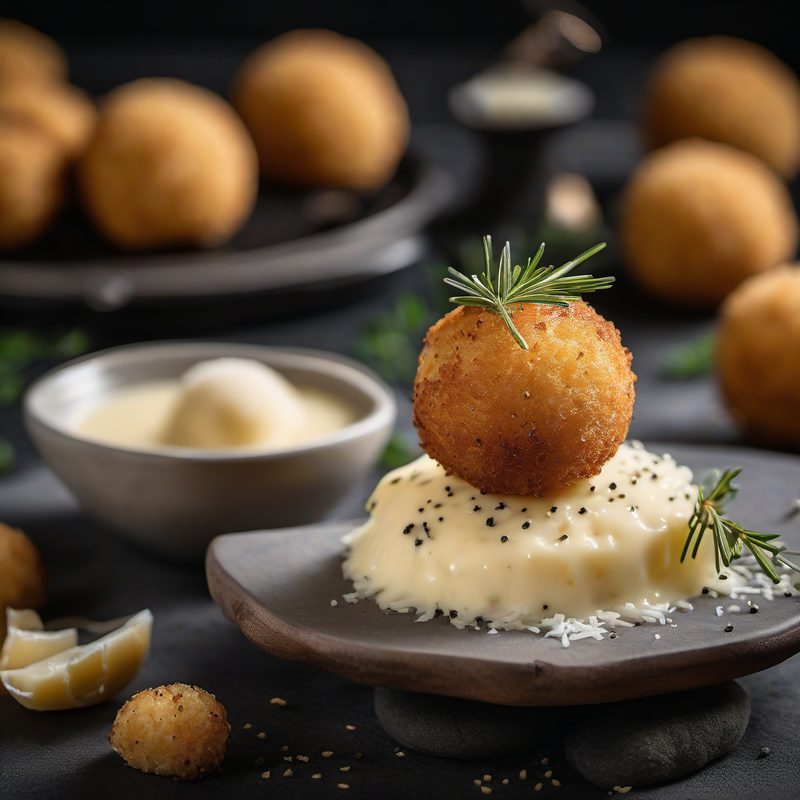
Cacio e Pepe Cheese Balls
Crispy, golden fried cheese balls that shatter when you bite into them—revealing a warm, cheesy, pillowy center that you dip into a silky two-ingredient Pecorino fondue. This Roman-inspired antipasto comes together in under 40 minutes with pantry staples and tastes like the best thing you've ever done with leftover bread.
These are not your average mozzarella sticks. Pallotte cacio e pepe are a glorious example of Italian cucina povera—the art of making something spectacular from humble ingredients. Stale bread gets soaked in milk, then bound with Pecorino Romano, eggs, and parsley to form a mixture that fries up into impossibly light, crunchy spheres. The name translates to "cheese and pepper balls," and that's exactly what you get: each bite delivers a sharp pecorino punch punctuated by cracked black pepper, all encased in a shatteringly crisp shell.
The accompanying Pecorino fondue takes the concept over the top—just warm cream and grated Pecorino stirred off the heat until they become a velvety, spoon-coating sauce that clings to every ball. It's the same genius simplicity as the classic cacio e pepe pasta, reimagined as a dippable appetizer. Serve these at a cocktail party or alongside a glass of something crisp, and watch people hover around the platter until every last crumb is gone.
For the Cheese Balls
For the Pecorino Fondue
Use level tablespoons and standard US measuring cups. All produce is medium unless specified.
🥘 Equipment
- Large mixing bowl
- Chef's knife and cutting board
- Dutch oven or deep, heavy-bottomed pot (4-quart)
- Deep-fry thermometer or instant-read thermometer
- Small saucepan (1-quart) for the fondue
- Whisk
- Slotted spoon or spider
- Rimmed baking sheet lined with paper towels
- Small, shallow bowl for serving
📋 Preparation
Step 1 — Soak the Bread (10 minutes)
Place the coarsely chopped stale bread in a large mixing bowl and pour the ½ cup whole milk over the top. Toss gently to coat all the pieces. Let sit for 10 minutes—the bread should absorb nearly all the milk and become soft and paste-like.
After soaking, pick up handfuls of the bread and squeeze firmly to remove excess milk. Discard the expressed milk and return the squeezed bread to the bowl. You want the bread moist but not dripping—squeezing removes just enough liquid to keep the mixture from being too wet to hold its shape.
Step 2 — Make the Cheese Ball Mixture (5 minutes)
To the squeezed bread, add 1 cup grated Pecorino Romano, 2 eggs, 2 tablespoons chopped parsley, ½ teaspoon kosher salt, and 2 teaspoons coarsely ground black pepper. Mix with your hands or a rubber spatula until completely homogeneous—it should look like a uniform, slightly tacky, green-flecked paste.
If the mixture feels too soft to hold a ball shape (it should just barely hold together when pressed), stir in ¼ cup plain breadcrumbs, 1 tablespoon at a time, until the mixture firms up. The Pecorino adds plenty of salt, so resist the urge to add more salt at this stage—taste a tiny bit raw if you must, but be prepared for it to be quite salty on its own.
Step 3 — Shape the Balls (5 minutes)
Lightly dampen your hands with water—this prevents the mixture from sticking to your palms. Scoop up about 1½ tablespoons of the mixture (roughly golf-ball-sized) and roll between your palms into a smooth sphere about 1½ inches (4 cm) in diameter.
Place each formed ball on a clean plate or baking sheet. You should end up with about 16 balls. Damp hands are the secret to clean, smooth balls—if the mixture starts sticking, re-wet your hands. Refrigerate the shaped balls for 15 minutes (this helps them hold together during frying), or up to 2 hours.
Step 4 — Heat the Oil and Fry (15 minutes)
Pour 4 cups vegetable oil into a Dutch oven or deep, heavy-bottomed pot—the oil should be at least 2 inches (5 cm) deep. Heat over medium-high heat until the oil reaches 340°F (170°C) on a deep-fry thermometer.
Working in batches of 6 to 8 balls (do not overcrowd), carefully lower the cheese balls into the hot oil using a slotted spoon. Fry until deep golden brown and crisp on all sides, 3 to 4 minutes, turning occasionally for even coloring.
Transfer the fried balls to a paper-towel-lined baking sheet to drain. Return the oil to 340°F (170°C) between batches. The cheese balls should be crunchy on the outside and soft, almost custard-like on the inside—if they're browning too quickly, the oil is too hot; if they're not crisping, it's too cool.
Step 5 — Make the Pecorino Fondue (3 minutes)
While the last batch fries, make the fondue. In a small saucepan, warm ½ cup heavy cream over medium heat until steaming but not boiling—about 2 minutes—stirring occasionally.
Remove the saucepan from the heat immediately. Add ½ cup grated Pecorino Romano and whisk constantly until the cheese is fully melted and the sauce is smooth and glossy, about 1 minute. Stir in 1 teaspoon coarsely ground black pepper. Do not let the cream boil, and do not add the cheese over heat—the residual warmth is enough to melt it perfectly. Overheating will cause the fondue to seize and turn grainy.
Step 6 — Serve (2 minutes)
Arrange the hot fried cheese balls on a serving platter or divide among individual small plates. Pour the Pecorino fondue into a small bowl alongside for dipping. Sprinkle the balls with a final crack of coarsely ground black pepper and scatter a few fresh parsley leaves over the top for color.
Serve immediately—these are at their absolute best within the first 10 minutes of frying, when the exterior is still audibly crunchy and the interior is warm and yielding.
🧑🍳 Chef's Tips
- Stale bread is not optional. Day-old or older crusty Italian bread (ciabatta, pugliese, or a simple baguette) soaks up milk without turning to mush. Fresh bread disintegrates. If all you have is fresh bread, cube it and toast it in a 300°F (150°C) oven for 10 minutes to dry it out before soaking.
- Pecorino Romano is not Parmesan. Don't substitute. Pecorino is saltier, sharper, and more pungent—its assertive personality is what makes these balls sing. Parmigiano-Reggiano is too mild and will produce bland, docile cheese balls.
- Coarse black pepper matters. Use coarsely ground black pepper (a crack of a pepper mill set to its widest setting, or a rough chop with a knife). Fine pre-ground pepper won't give you the same pops of heat and texture that define a proper cacio e pepe dish.
- Test-fry one ball first. Before committing a whole batch, drop a single test ball into the oil. If it falls apart, the mixture needs more breadcrumbs. If it's too dense, add a splash of milk. This one-ball insurance policy saves a batch every time.
- Keep the fondue warm. If the fondue thickens before you're ready to serve, add a splash of warm cream and whisk to loosen. It will thicken more as it sits.
❌ Common Mistakes
| Mistake | Why It Hurts | The Fix |
|---|---|---|
| Using fresh bread | Fresh bread soaks up too much milk and turns to mush, making the mixture impossible to form | Use day-old or intentionally dried bread; cube and toast at 300°F for 10 minutes if needed |
| Not squeezing the bread dry enough | Excess milk makes the mixture too wet → balls flatten or disintegrate in the oil | Squeeze firmly; the squeezed bread should feel moist but not release liquid when pressed |
| Frying at the wrong temperature | Oil too hot → burned exterior, raw interior. Oil too cool → greasy, heavy balls that absorb oil | Maintain 340°F (170°C) and use a thermometer—don't guess |
| Overcrowding the pot | Temperature drops → greasy, unevenly cooked balls | Fry in batches of 6–8, returning oil to temperature between batches |
| Making the fondue over direct heat | The cheese seizes and turns grainy or stringy | Remove the cream from heat before adding cheese; residual warmth is all you need |
| Making the balls too large | Larger than 1½ inches won't cook through before the exterior burns | Keep them golf-ball-sized (1½ tablespoons each) |
💡 Variations
| Variation | How To |
|---|---|
| Aged Provolone Twist | Replace half the Pecorino Romano with aged provolone, grated. The provolone adds a mellow, slightly smoky depth that balances the sharp pecorino. |
| Herb Garden | Add 1 teaspoon each of finely chopped fresh oregano and fresh thyme along with the parsley for a more herbal, Mediterranean flavor. |
| Spicy Calabrian | Fold in 1 tablespoon of finely chopped Calabrian chilies (or ½ teaspoon red pepper flakes) with the egg mixture for a spicy kick that cuts through the richness. |
| Smoked Paprika Balls | Add 1 teaspoon smoked paprika to the mixture for a subtle smoky flavor that pairs beautifully with the Pecorino fondue. |
❄️ Storage & Leftovers
| Method | Details |
|---|---|
| Refrigerator (uncooked) | Shape the balls, place on a parchment-lined baking sheet, cover tightly with plastic wrap, and refrigerate for up to 24 hours. Bring to room temperature (15 minutes on the counter) before frying. |
| Refrigerator (cooked) | Fried cheese balls kept in an airtight container for up to 2 days. Reheat in a 375°F (190°C) oven for 5–7 minutes to restore crispness—microwaving will make them soggy. |
| Freezer (uncooked) | Freeze shaped balls in a single layer on a baking sheet until solid (about 1 hour), then transfer to a zip-top freezer bag. Fry from frozen, adding 1 extra minute to the cooking time. Do not thaw. |
| Freezer (cooked) | Not recommended—the crisp exterior will not survive freezing and reheating. |
| Fondue | Pecorino fondue will keep in the refrigerator for up to 3 days. Reheat gently in a saucepan over low heat with a splash of cream, whisking constantly until smooth. |
🍷 Wine Pairing
| Wine | Why |
|---|---|
| Frascati Superiore (Lazio) | The local wine of Rome—light, crisp, with almond and citrus notes that cut through the rich fried exterior and the salty pecorino. A perfect match. |
| Verdicchio dei Castelli di Jesi (Marche) | Bright acidity with a subtle bitterness on the finish that stands up to the fried coating and complements the sharp cheese. |
| Gavi di Gavi (Piedmont) | Elegant, mineral-driven white with enough structure to handle the richness of the fondue without overpowering the delicate balls. |
| Franciacorta Brut (Lombardy) | Sparkling wine's bubbles and high acidity are the ultimate palate cleanser for fried foods—the brisk effervescence cuts through every crispy, cheesy bite. |
| Pale Ale or Pilsner (beer) | If you prefer beer, a crisp, hop-forward pale ale or a clean German-style pilsner provides the same palate-cleansing effect as sparkling wine, with a hint of bitterness that plays well with the Pecorino's saltiness. |
🥗 Suggested Side Dishes
- Shaved Fennel and Arugula Salad with Lemon Vinaigrette — Bright, peppery greens and licorice-sweet fennel balance the richness
- Marinated Olives and Roasted Red Peppers — Classic antipasto companions that need no preparation
- Prosciutto-Wrapped Melon or Figs — Sweet-salty contrast that complements the cheese balls beautifully
- Crispy Roasted Artichokes with Lemon Aioli — Double down on the fried appetizer theme with another crunchy vegetable
- Simple Celery and Carrot Sticks with Sea Salt — Clean, crunchy vegetables provide a refreshing palate cleanser between rich cheese balls
📊 Nutrition (per serving, estimated)
| Calories | Protein | Fat | Carbs | Fiber |
|---|---|---|---|---|
| 420 | 18 g | 32 g | 20 g | 1 g |
Nutrition is estimated and will vary based on specific brands and ingredient substitutions.
❓ Frequently Asked Questions
Can I bake these instead of frying?
You can, but the result won't be anywhere near as good. Baking produces a dense, pale sphere with a tough exterior rather than the shatteringly crisp, golden shell that makes these balls special. If you absolutely must bake: preheat the oven to 400°F (200°C), place the balls on a parchment-lined baking sheet, brush or spray generously with oil, and bake for 15–18 minutes, flipping halfway through. They will be edible but not transformative. Air-frying at 375°F (190°C) for 10–12 minutes, shaking the basket halfway, is a better alternative.
Can I use pre-shredded Pecorino Romano?
Avoid it. Pre-shredded cheeses are coated with anti-caking agents (cellulose, potato starch) that prevent them from melting smoothly. For the balls, this means a less cohesive mixture. For the fondue, it means a grainy, clumpy sauce. Grate your own from a block of Pecorino Romano—it takes two minutes and the difference is dramatic.
Why did my cheese balls fall apart in the oil?
This happens for one of three reasons: (1) the mixture was too wet from inadequately squeezed bread, (2) the balls were not chilled before frying, or (3) the oil wasn't hot enough when you added them, causing them to soak up oil and disintegrate. For next time: squeeze the bread more firmly, refrigerate the shaped balls for at least 15 minutes, and make sure your oil is at a steady 340°F (170°C).
Can I make these ahead for a party?
Absolutely. Shape the balls up to 24 hours in advance and refrigerate them on a baking sheet covered with plastic wrap. Fry them just before serving—they're at their peak within 10 minutes of coming out of the oil. You can also make the Pecorino fondue a day ahead and reheat it gently with a splash of cream.
What's the best oil for frying?
Use a neutral oil with a high smoke point. Vegetable, canola, peanut, or grapeseed oil all work perfectly. Olive oil is too flavorful and its smoke point (around 375°F) is too close to your frying temperature, risking off flavors. Do not use extra-virgin olive oil for deep frying.
Can I make the fondue with milk instead of cream?
You can, but the sauce will be thinner and less luxurious. Whole milk with an additional tablespoon of butter helps approximate the richness of cream, but the texture won't be as velvety. The fondue relies on the fat content of the cream to carry the Pecorino without seizing—skim or low-fat milk will produce a watery, disappointing sauce.
🔗 Related Recipes
- Classic Cacio e Pepe Pasta (Cacio e pepe)
- Roman-Style Fried Artichokes (Carciofi alla giudia)
- Suppli al Telefono (Roman Rice Balls with Mozzarella)
- Fried Sage Leaves with Pecorino (Fiori di salvia fritti)
- Pecorino and Black Pepper Biscuits (Biscotti al pecorino e pepe)
🏷️ Search Tags
Photo reference: `vol1_78.png` — A rustic ceramic platter piled with a dozen golden-brown fried cheese balls with a small bowl of creamy Pecorino fondue alongside, sprinkled with coarsely cracked black pepper and fresh parsley leaves, warm natural lighting, shallow depth of field with the platter in sharp focus against a wooden table surface, a linen napkin and a wedge of Pecorino on a small cutting board in the background, steam rising from the fondue bowl.
Recipe from "The Italian Kitchen" by Vita Milanese — Volume 1: Pasta Perfetto
Recipe from The Italian Kitchen by Vita Milanese — Volume 1 · Pasta Perfetto. Discover all volumes on the ebook page.