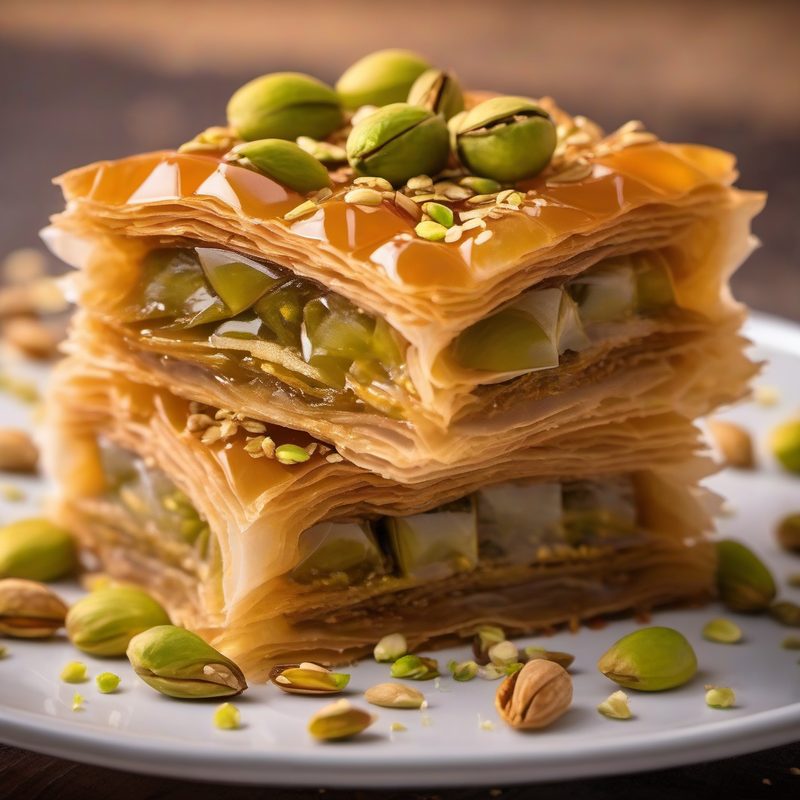
Baklava
Crispy, buttery layers of paper-thin phyllo wrapped around a fragrant spiced-nut filling, all bathed in a fragrant honey-lemon syrup — this is baklava at its most elemental and most perfect. Each bite shatters into a thousand flaky layers before giving way to a tender, syrup-soaked center that tastes of toasted nuts, warm cinnamon, and floral honey.
| Amount | Ingredient |
|---|---|
| Baking at too high a temperature | Above 175°C (350°F), the phyllo browns before the nuts have toasted and the butter has fully crisped the layers Bake at 160°C (325°F) — low and slow is the way |
| Refrigerating before serving | Cold baklava hardens; the syrup crystallizes and the crisp layers become chewy and tough Always serve at room temperature; store at room temperature covered loosely with foil |
| Soggy bottom layers | Can happen if the base has too few phyllo sheets (less than 6) or if the syrup is too thin and runs straight through Use at least 8 buttered sheets for the base; the syrup should be reduced enough to thicken slightly |
| Skimping on butter | Dry, unbuttered phyllo sheets don't crisp up; they remain pale, chewy, and taste like raw flour Every single sheet needs butter — no shortcuts |
Baklava is one of the world's great pastry traditions, stretching across the Middle East, the Balkans, the Eastern Mediterranean, and the Caucasus — a dessert so beloved that nearly every culture along the Silk Road claims it as its own. The Turkish word baklava entered the English lexicon in the 17th century, but the technique of layering unleavened bread dough with nuts and honey dates back to the Assyrian Empire, around the 8th century BCE. This version hews closely to the classic Turkish-style baklava: a generous filling of walnuts, pistachios, and almonds scented with cinnamon, sandwiched between twenty gossamer-thin sheets of phyllo, each brushed with melted butter until the stack is a golden, glistening brick. After a slow bake at modest heat, the pastry is baptized with a warm honey-lemon syrup that seeps into every crevice, transforming the crisp layers into something between a pastry and a confection — shatteringly crisp on the outside, tender and honeyed within. The key technique is patience: brushing every single sheet with butter, cutting the diamonds before baking (so the syrup finds its way in), and letting the finished baklava rest overnight for the syrup to fully penetrate. The result is a dessert that tastes even better the day after it's made.
For the Nut Filling
For the Phyllo Assembly
For the Honey Syrup
Use level tablespoons and standard measuring cups. All nuts are raw and unsalted unless specified.
🥘 Equipment
- 9×13-inch (23×33 cm) baking dish (metal or ceramic — see Tips)
- Pastry brush (preferably 2-inch wide, with natural bristles)
- Food processor (for chopping nuts — or sharp chef's knife)
- Medium saucepan (for syrup)
- Small bowl (for melted butter)
- Sharp chef's knife (for cutting diamonds)
- Plastic wrap or clean kitchen towel
- Wire rack (for cooling)
- Kitchen scale (recommended for accuracy with phyllo and nuts)
📋 Preparation
Step 1 — Prepare the Nut Filling (5 minutes)
In a food processor, combine the mixed nuts, sugar, cinnamon, and salt. Pulse in 1-second bursts until the nuts are finely chopped but not ground to a powder — the texture should be uneven, with pieces ranging from coarse sand to small pea-sized bits (about 8 to 12 pulses).
The texture matters: nuts that are too finely ground turn into paste and make the baklava dense and greasy; nuts that are too coarsely chopped create air pockets that prevent clean slicing. Aim for a mix where most pieces are about the size of breadcrumbs, with a few larger bits for texture.
Set the nut mixture aside in a bowl.
Step 2 — Prepare the Phyllo and Butter (10 minutes)
Remove the phyllo dough from its packaging and unroll the sheets flat on a clean work surface. Cover the stack with plastic wrap and a damp (not wet) kitchen towel on top. Phyllo dries out within minutes of exposure to air and becomes brittle and impossible to work with — the covered stack can sit for up to 30 minutes while you work.
If the phyllo sheets are larger than your baking dish, use a sharp knife or kitchen shears to trim the stack to size while still covered. Cut through the entire stack at once, then re-cover immediately.
Melt the butter in a small saucepan or microwave-safe bowl. Let it cool slightly — it should be warm enough to stay liquid but not hot enough to cook the phyllo.
Step 3 — Layer the Base (10 minutes)
Brush the bottom and sides of your baking dish with melted butter.
Uncover one sheet of phyllo and lay it flat in the dish, letting any overhang drape over the edges (you'll trim later). Using the pastry brush, lightly brush the entire surface of the sheet with melted butter, working from the center outward. Don't saturate — a thin, even coat is all you need.
The motion matters: use long, gentle strokes from the center to the edges, lifting the brush rather than dragging it. Pressing down can tear the delicate phyllo. If a sheet tears, don't worry — just cover the tear with the next sheet and brush as usual.
Repeat with 7 more phyllo sheets, brushing every single sheet with butter, for a total of 8 buttered layers on the bottom.
Eight layers is the sweet spot: enough to form a sturdy, buttery base that can support the weight of the nuts without becoming soggy, but not so many that the bottom layers remain raw and doughy.
Step 4 — Add the Nut Filling (2 minutes)
Spread the entire nut mixture evenly over the buttered phyllo base. Use your hands or a spatula to create a level, even layer that reaches all the way to the edges and corners.
Don't press the nuts down firmly — a gentle, level spread is enough. Pressing compacts the filling and prevents the syrup from flowing through the layers later.
Step 5 — Layer the Top (15 minutes)
Working one sheet at a time, layer the remaining 12 phyllo sheets (or however many remain in your package) on top of the nuts, brushing every single sheet generously with melted butter.
As you add each sheet, use your fingertips to gently press it down onto the nut layer, starting from the center and working outward to eliminate any air pockets. Air pockets cause the phyllo to puff unevenly during baking, creating hollow domes that don't hold syrup.
After all sheets are layered, brush the top sheet with a final, slightly heavier coat of butter. Reserve any remaining melted butter for brushing after cutting.
Step 6 — Cut into Diamonds (5 minutes)
Using a sharp chef's knife, cut the stacked phyllo into diamond shapes:
- First, make 5 evenly spaced lengthwise cuts (parallel to the long side), about 1½ inches (4 cm) apart.
- Then, make diagonal cuts across the dish at a 45-degree angle, spaced about 1½ inches (4 cm) apart, starting from one corner.
The diamond pattern is traditional for several reasons: it maximizes the number of syrup-absorbing cut edges (more edges = more syrup penetration), it creates pieces that are easy to lift without breaking, and the pointed tips catch the eye as a classic baklava hallmark.
Cut all the way through the phyllo layers to the bottom of the dish — not just through the top layers. Incomplete cuts cause the phyllo to lift and break apart after baking.
If you have any remaining melted butter, brush it into the cut lines — this helps the layers separate and brown evenly.
Step 7 — Bake (45 to 50 minutes)
Preheat your oven to 160°C (325°F) with the rack in the middle position.
Place the baking dish on a rimmed baking sheet (to catch any butter drips) and bake for 45 to 50 minutes, until the top is deep golden brown and the edges are slightly darker (but not burnt).
The moderate temperature is deliberate: 160°C (325°F) is low enough that the phyllo has time to dry out and crisp thoroughly without the butter burning, but high enough that the nuts toast gently inside their buttery cocoon. At 10-minute intervals, rotate the dish front-to-back for even browning. You're looking for a uniform, deep amber-gold across the entire surface — pale spots indicate under-baked areas that will be doughy rather than crisp.
Remove from the oven and place the dish on a wire rack.
Step 8 — Make the Syrup (10 minutes, while baklava bakes)
While the baklava is baking, make the syrup so it's ready to pour while everything is hot.
In a medium saucepan, combine sugar, water, honey, lemon juice, and the cinnamon stick. Stir gently to combine, then bring to a boil over medium-high heat, stirring occasionally until the sugar dissolves completely.
Don't stir once the syrup reaches a full boil — stirring at this point can introduce sugar crystals and make the syrup grainy. If sugar crystals form on the sides of the pan, wipe them away with a wet pastry brush.
Reduce heat to medium-low and simmer uncovered for 10 minutes, until the syrup has thickened slightly and reduced by about one-quarter. The syrup should be thin enough to pour easily but thick enough to coat the back of a spoon (about 230°F / 110°C on a candy thermometer).
Remove from heat, discard the cinnamon stick, and let the syrup cool for 5 minutes — it should be warm but not boiling when poured.
Step 9 — Syrup the Baklava (2 minutes)
Immediately after removing the baklava from the oven (while it is still piping hot), pour the warm syrup evenly over the entire surface, making sure it flows into every cut line and reaches the edges.
The temperature contrast matters: hot pastry absorbs cold syrup reluctantly, but a hot pastry meeting a warm syrup creates a gentle thermal gradient that pulls the liquid deep into every layer. Pour slowly, starting from the center and working outward in a spiral. You should hear a gentle sizzle as the syrup hits the hot butter — that's the sound of perfect absorption.
Let the baklava sit in the dish, undisturbed, for at least 4 hours (or overnight) at room temperature. Do not refrigerate during this time.
Patience is the hardest part. The first hour is forgiving — the syrup is still penetrating the top layers. By hour two, you'll see the syrup level drop as the phyllo drinks it up. By hour four, the layers have transformed: the top remains shatteringly crisp, the middle layers are tender and honeyed, and the bottom has absorbed just enough syrup to be soft without being soggy. Overnight is best — the difference between 4-hour baklava and 12-hour baklava is the difference between good and transcendent.
🧑🍳 Chef's Tips
- Thaw phyllo properly: Frozen phyllo must be thawed in the refrigerator overnight (at least 8 hours). Never thaw at room temperature — condensation makes the sheets sticky and prone to tearing. Once thawed, keep the stack covered at all times; phyllo dries out in under 2 minutes of exposure to air. If a sheet tears, layer it anyway — the butter and nuts will glue everything together.
- Use a metal or glass dish: Metal conducts heat best, giving the bottom layers a golden, crispy finish. Glass is fine but requires 5 extra minutes of baking. Avoid dark non-stick pans — they absorb too much heat and can burn the bottom layers before the top is done. Ceramic also works — it retains heat beautifully and keeps the baklava warm longer for syrup absorption.
- Cut diamonds — not squares: The diamond shape is not just aesthetic — it maximizes the number of exposed cut edges per piece, which means more surface area for syrup absorption. Each diamond has 6 cut edges (compared to a square's 4), and every cut edge acts as a capillary channel for the syrup.
- Warm syrup, hot pastry — the golden rule: The single most important rule of baklava is that the syrup must be warm and the baked pastry must be hot. Cold syrup on hot baklava: the syrup stays on top. Warm syrup on cold baklava: the syrup pools on the surface. Warm syrup on hot baklava: every layer gets soaked. There is no shortcut.
- Don't skimp on the butter: Each sheet must be brushed individually, no exceptions. Gaps in butter coverage create dry, crunchy patches that don't absorb syrup and are unpleasant to eat. Use the full 150 g (10½ tbsp) — the butter is what makes baklava luxurious instead of dry.
- Let it rest overnight: Baklava is one of the rare desserts that improves dramatically with rest. The overnight wait allows the syrup to distribute evenly through every layer, the flavors of the nuts and cinnamon to meld with the honey, and the top layers to maintain their crispness while the interior becomes tender. It's also much easier to cut and serve after resting — warm, freshly syruped baklava is a sticky, fragile mess that's hard to portion cleanly.
- Serve at room temperature: Refrigerated baklava is hard and the syrup crystallizes. Always bring it to room temperature before serving. If you must serve warm, reheat individual pieces in a 150°C (300°F) oven for 3–4 minutes — never microwave, which destroys the crisp layers.
❌ Common Mistakes
| Mistake | Why It Hurts | The Fix |
|---|---|---|
| Phyllo dried out before layering | Brittle, cracked phyllo shatters when brushed; the layers won't fuse properly | Keep phyllo covered with plastic wrap and a damp towel at all times; work quickly |
| Not cutting through all the layers | The top layers lift and break away from the base when serving, leaving a jagged, messy edge | Cut firmly through to the bottom of the dish; re-cut along the same lines if unsure |
| Syrup poured at the wrong temperature | Cold syrup sits on top of hot baklava without penetrating; hot syrup on cooled baklava pools and slides off | Warm syrup (about 5 minutes off the heat) must meet hot-from-the-oven pastry — this is non-negotiable |
💡 Variations
| Variation | How To |
|---|---|
| Classic Turkish Baklava | Use only pistachios (300 g / 3 cups), finely ground. Replace cinnamon with ¼ tsp ground cardamom. Use pistachio oil (2 tbsp) in the melted butter. Top with extra finely ground pistachios after syruping. |
| Greek Walnut Baklava (Karydopita-style) | Use only walnuts (300 g / 3 cups), coarsely chopped. Add ½ tsp ground cloves and ½ tsp ground nutmeg to the filling. Replace lemon juice in syrup with 1 tbsp orange blossom water. |
| Persian Baklava (Baghlava) | Use a mix of almonds (200 g / 2 cups) and pistachios (100 g / 1 cup). Add 1 tsp ground cardamom and 2 tbsp rose water to the nut mixture. Replace honey in syrup with 150 g sugar; add 2 tbsp rose water and ¼ tsp saffron threads (steeped in 1 tbsp hot water). |
| Lebanese Baklava with Ashta Cream | Make the classic version, but before adding the top phyllo layers, spread a thin layer of ashta cream (clotted cream or a quick stovetop cream made from milk, semolina, and rose water) on top of the nuts. Add 2 extra phyllo sheets to compensate for moisture. |
| Chocolate-Dipped Baklava | Make the classic version. After the baklava has rested and been cut, dip each diamond halfway in melted dark chocolate (70% cocoa) and let set on parchment paper. The chocolate adds a bitter counterpoint to the honey sweetness. |
| Spiced Pumpkin-Nut Baklava | Add ½ cup pumpkin purée (strained of excess liquid) mixed with 1 tbsp maple syrup to the nut filling. Increase cinnamon to 1½ tsp, add ½ tsp ground ginger and ¼ tsp ground nutmeg. Bake at 160°C (325°F) for 50–55 minutes (the moisture requires extra time). |
| Mini Baklava Cups | Instead of layering in a baking dish, use a mini muffin tin. Cut phyllo sheets into 4-inch squares. Layer 3 squares per cup, brushing each with butter, add 1 tbsp nut mixture, then top with 3 more buttered squares. Bake at 160°C (325°F) for 20–25 minutes. Syrup as directed. |
| Vegan Baklava | Replace melted butter with a mixture of 120 ml (½ cup) coconut oil (melted) and 60 ml (¼ cup) neutral vegetable oil. Use maple syrup instead of honey in the syrup (or use agave nectar). The texture is slightly less shatteringly crisp but still excellent. |
❄️ Storage & Leftovers
| Method | Details |
|---|---|
| Room temperature (best) | Store in the baking dish, tightly covered with foil or plastic wrap, at room temperature for up to 1 week. The baklava actually improves over the first 2–3 days as the syrup continues to distribute. Do not refrigerate — ever. |
| Freezer (unglazed, baked) | Bake the baklava without syrup, cool completely, wrap tightly in plastic wrap then foil, and freeze for up to 3 months. To serve: thaw at room temperature (still wrapped, 4 hours), then warm in a 150°C (300°F) oven for 10 minutes, then pour warm syrup over hot pastry as directed. Let rest 4 hours before serving. |
| Freezer (glazed, fully finished) | Baklava freezes surprisingly well even after syruping. Arrange pieces in a single layer in a freezer-safe container, separating layers with parchment paper. Freeze for up to 2 months. Thaw at room temperature (covered) for 2 hours. The texture is about 85% as good as fresh — the top layers lose a bit of shatter. |
| Reviving stale baklava | If baklava has been sitting for more than 5 days and the top layers have softened, place it in a 150°C (300°F) oven for 5–7 minutes to re-crisp. Let cool completely before serving. You can also drizzle with 1–2 tbsp of warm honey mixed with 1 tsp lemon juice for a refresh. |
| Leftover syrup | Store extra syrup in an airtight container in the refrigerator for up to 2 weeks. Use it to sweeten tea, drizzle over ice cream, or brush on cakes. Bring to room temperature before using. |
🍷 Wine & Beverage Pairing
| Drink | Why |
|---|---|
| Muscat de Samos (Greece) | A luscious, fortified sweet wine from the island of Samos — intense notes of dried apricots, orange blossom, and honey that mirror the baklava's syrup in a beautifully recursive way |
| Vin Santo del Chianti (Italy) | A rich amber dessert wine with notes of caramel, dried figs, and toasted almonds — the oxidative character complements the toasted nuts perfectly |
| Late Harvest Riesling (Germany or Alsace) | A botrytized Riesling with high acidity that cuts through the butter and honey, while its peach-and-honey flavors echo the syrup |
| Moscato d'Asti (Piedmont) | Lightly sparkling and low-alcohol — the gentle fizz cleanses the palate between rich, buttery bites, and the peach-blossom notes are a natural match |
| Rustic Napa Zinfandel (late harvest) | For chocolate-dipped baklava: a late-harvest Zinfandel with jammy blackberry, chocolate, and spice notes stands up to both the nuts and the dark chocolate |
| Strong Turkish Coffee | The classic companion — the bitter intensity of finely ground, unfiltered coffee is the perfect counterpoint to honeyed sweetness. Serve in small demitasse cups |
| Mint or Sage Tea | A hot, unsweetened herbal tea cleanses the palate and cuts through the richness. Fresh mint or sage steeped for 3–4 minutes is ideal |
| Cold Milk | Sometimes the simplest pairing is the best — a tall glass of cold milk cuts the sweetness and soothes the palate between syrupy bites |
🥗 Suggested Coffee & Tea Service
- Turkish coffee — the definitive pairing: finely ground coffee brewed with sugar in a cezve, served in a small demitasse cup with the foam on top and grounds settled at the bottom. The bitter, intense coffee contrasts with the sweet, nutty baklava.
- Sage tea (ada çayı) — a traditional Turkish herbal tea made from dried sage, served hot and unsweetened. Its earthy, slightly astringent character cuts through the honey and butter beautifully.
- Moroccan mint tea — green tea with fresh mint and sugar, poured from height to create foam. The mint's cooling freshness contrasts with the warm spice of the cinnamon.
- Earl Grey or bergamot black tea — the citrusy bergamot notes mirror the lemon in the syrup and brighten the overall flavor profile.
- Cold-brewed coffee with cardamom — steep coarse-ground coffee with a few crushed cardamom pods overnight in cold water. The cardamom-citrus notes are a Persian-inspired pairing that works brilliantly with any baklava.
📊 Nutrition (per serving, about 2 diamond-shaped pieces)
| Calories | Protein | Fat | Carbs | Fiber |
|---|---|---|---|---|
| 385 | 7 g | 22 g | 44 g | 3 g |
Nutrition information is an estimate and depends on the specific nut mix, butter absorption, and syrup quantity. The actual fat and calorie content will vary based on how generously each phyllo sheet is buttered and how much syrup is absorbed.
❓ FAQ
Can I use pre-chopped nuts from a store?
You can, but the texture won't be as good. Pre-chopped nuts are often unevenly chopped (some powdery, some too large) and may be stale. It's better to buy whole raw nuts and pulse them yourself in a food processor — you get exactly the texture you want and the nuts are fresher.
My baklava came out soggy — what went wrong?
Three possible culprits: (1) the syrup was too thin — it needed to simmer longer to reduce and thicken; (2) the syrup was poured too generously — you only need enough to coat the top and fill the cut lines, not drown the pastry; (3) the baklava was refrigerated before serving — always keep at room temperature.
My baklava is too dry and the layers are separating — what happened?
The most likely cause is insufficient butter. Each sheet needs a thorough, even brushing. If some sheets were skipped or under-buttered, they won't fuse properly and the layers will separate after cutting. The second possibility is that the phyllo wasn't pressed down gently between layers, leaving air pockets that expanded during baking.
Why did my syrup crystallize?
Sugar syrup crystallizes when sugar crystals form on the sides of the pan and fall back into the liquid, or when the syrup is stirred after it reaches a boil. To prevent this: dissolve the sugar completely before boiling, don't stir once boiling, and wipe down the sides of the pan with a wet pastry brush if crystals appear. A drop of lemon juice also helps prevent crystallization.
Can I add rose water or orange blossom water?
Absolutely. Add 1–2 tablespoons of rose water or orange blossom water to the syrup after removing it from the heat (off heat, so the delicate floral aromatics don't boil away). Rose water is classic in Persian and Lebanese baklava; orange blossom water is traditional in Greek versions.
Do I really need to cut the baklava before baking?
Yes — this is essential. Cutting before baking creates channels for the syrup to flow into. If you cut after baking, the crisp phyllo shatters and crumbles, and the syrup has no way to reach the center layers. The pre-baked cuts also help the baklava expand evenly as the phyllo puffs.
Can I use puff pastry instead of phyllo?
No — puff pastry and phyllo are fundamentally different. Puff pastry is leavened (it rises), layered with butter block, and bakes into tall, airy, hollow layers. Phyllo is unleavened, paper-thin, and bakes into crisp, flat, dense layers. Substituting puff pastry would produce a completely different dessert — more like a mille-feuille than a baklava.
How do I reheat baklava without ruining the texture?
Baklava is best at room temperature. If you must warm it, place individual pieces on a baking sheet in a 150°C (300°F) oven for 3–4 minutes. Do not microwave — the microwave makes the phyllo soft and chewy, destroying the crisp layers that are the hallmark of good baklava.
My phyllo keeps tearing — what am I doing wrong?
A few possible causes: (1) the phyllo is too cold — let it sit at room temperature (still covered) for 10 minutes after thawing; (2) the phyllo is too dry — it was left uncovered too long; (3) your brush is too stiff — use a soft natural-bristle brush; (4) you're brushing too aggressively — use light, gentle strokes. If a sheet tears badly, just layer it anyway and cover the tear with the next sheet; butter acts as glue and the torn area will fuse.
What's the best pan to use?
A light-colored metal baking pan (aluminum or steel) is ideal — it conducts heat evenly and creates a crispy bottom. Dark non-stick pans absorb too much heat and can burn the bottom. Glass or ceramic works well too but may need an extra 5 minutes of baking. Avoid disposable aluminum foil pans — they're too thin and the bottom burns while the top stays pale.
Can I reduce the sugar in the syrup?
You can, but the syrup won't have the same texture or preserving quality. The sugar in the syrup is what gives it the right viscosity and helps preserve the baklava at room temperature for a week. If you reduce sugar, reduce the water proportionally (e.g., 150 g sugar + 150 ml water) and add an extra tablespoon of honey for flavor. The baklava will still be sweet but may not keep as long.
🔗 Related Recipes
- Baklava Rolls (Cigar-Style) (Volume 1) — the same classic filling, but rolled into cigar-shaped phyllo logs and baked in a spiral; more surface area means more crispy edges
- Baklava with Kataifi Dough (Volume 3) — shredded phyllo (kataifi) creates a shaggy, nest-like texture that soaks up syrup differently, with more crunchy bits per bite
- Greek Galaktoboureko (Volume 3) — the custard-based cousin of baklava: phyllo wrapped around a silky semolina custard, soaked in the same honey-lemon syrup
- Turkish Şöbiyet (Volume 3) — baklava's cream-filled sibling: pistachio baklava with a layer of kaymak (clotted cream) hidden inside
- Persian Baghlava (Volume 3) — the Armenian-Persian version: almond-pistachio filling with cardamom and rose water, cut into small diamond shapes
- Lebanese Baklava Rolls with Ashta (Volume 3) — phyllo rolls stuffed with ashta cream and chopped pistachios, drenched in rose-scented syrup
- Struffoli (Neapolitan Honey Balls) (Volume 1) — tiny fried dough balls drenched in honey, Italy's answer to honey-soaked pastry
- Loukoumades (Greek Honey Donuts) (Volume 1) — crisp, puffy fried dough drizzled with honey and pistachios, the same sweet-spiced flavor palette in a different format
🏷️ Search Tags
Photo reference: `vol1_468.png` — A rectangular baking dish filled with neatly arranged diamond-shaped baklava pieces, deep golden brown and glossy with honey syrup, topped with finely chopped pistachios. The top layers show the characteristic crisp, flaky texture of buttered phyllo, and a small cut piece reveals the layered interior with the nut filling visible between sheets. A copper cezve and a small demitasse cup of Turkish coffee sit beside the dish, with whole cinnamon sticks and star anise scattered on the linen cloth as garnish.
Recipe from "The Italian Kitchen" by Vita Milanese — Volume 1: Pasta Perfetto
Recipe from The Italian Kitchen by Vita Milanese — Volume 1 · Pasta Perfetto. Discover all volumes on the ebook page.