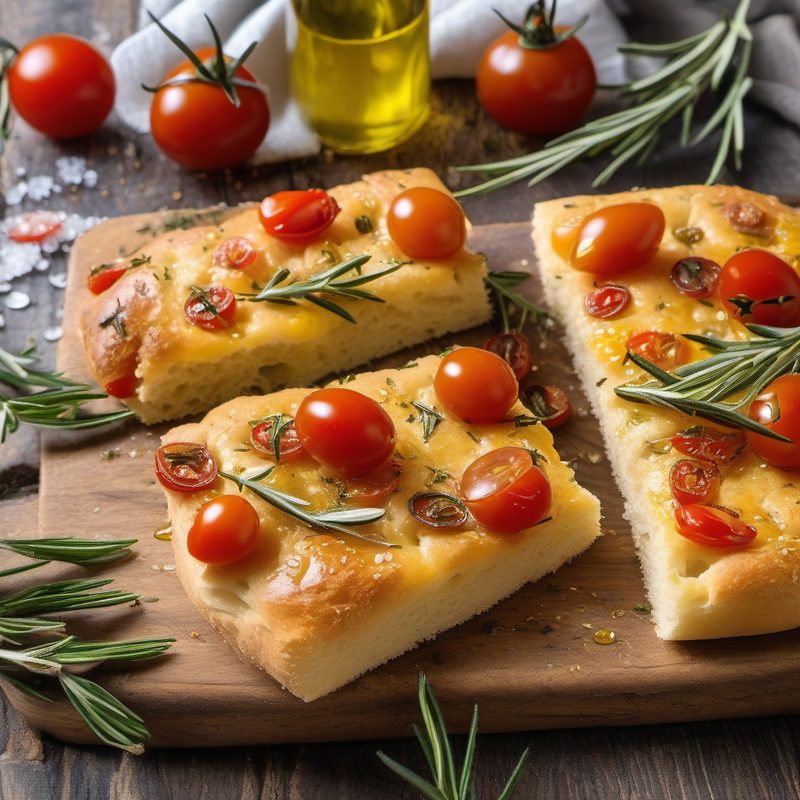
Mediterranean Focaccia
Category: Pane, Antipasti
| Amount | Ingredient |
|---|---|
| Calories | ~340 kcal |
| Protein | 8 g |
| Fat | 14 g |
| Carbohydrates | 46 g |
| Fiber | 2 g |
| Sodium | 590 mg |
Servings: 6–8
Total Time: 3 hours 15 minutes (20 minutes active, 2 hours rising, 20–25 minutes baking, 30 minutes cooling)
Source: Italian home-baking tradition — Liguria via the Mediterranean table
Why This Recipe Works
Focaccia is the bread of the Italian Riviera — a dimpled, olive-oil-drenched flatbread that bridges the gap between loaf and pie. This Mediterranean version builds on the classic Ligurian formula with a topping of sweet roasted cherry tomatoes, briny olives, and woodsy herbs that evoke the hillsides and coastlines of the south. Two keys deliver the hallmark focaccia texture: a high-hydration dough (70% water-to-flour ratio) that produces an airy, open crumb, and generous olive oil in the pan and on top, which fries the dough as it bakes to create a crackling-crisp bottom and golden, almost deep-fried edges. Dimpling the dough after the final proof — pressing fingertips firmly into the surface — traps pools of oil and moisture that become glistening wells of flavor during baking. Cherry tomatoes roast into sweet, concentrated gems; fresh rosemary and oregano perfume the crumb; brine-cured olives add a saline punch; and a final shower of coarse sea salt magnifies every element. Served warm from the oven, this focaccia works as antipasto, a bread basket centerpiece, or the foundation for a panzanella salad the next day.
Equipment
- Digital scale or dry measuring cups and spoons
- Large mixing bowl (stainless steel or ceramic)
- Wooden spoon or dough scraper
- Stand mixer with dough hook (optional, for kneading)
- Clean kitchen towel or plastic wrap
- Half-sheet pan (18 × 13 inches / 46 × 33 cm) or 9 × 13-inch baking dish
- Parchment paper
- Small bowl (for oil mixture)
- Chef's knife and cutting board
- Bench scraper
- Instant-read thermometer
- Wire cooling rack
Dough
Topping
Before You Begin
- Check yeast freshness. If using active dry yeast, proof it in a portion of the warm water with a pinch of sugar for 5–10 minutes until foamy. Instant yeast can be mixed directly with the flour.
- Warm the water to 110°F / 43°C — hotter will kill the yeast; cooler will slow rising significantly.
- Use a high-quality extra-virgin olive oil — this recipe leans heavily on olive oil for both texture and flavor. A fruity, peppery oil will shine in the finished bread.
- Have your toppings ready before the dough finishes its second rise — once the dough is dimpled and oiled, it should go into the oven promptly.
- Position an oven rack in the center and preheat only when the dough is nearly done rising.
- No stand mixer? This dough is wet and sticky by design — a wooden spoon and a few minutes of determined stirring will develop the gluten just fine. A dough scraper helps manage the tack.
Instructions
1. Bloom the Yeast (if using active dry)
In a large mixing bowl or the bowl of a stand mixer, combine the warm water. Sprinkle the yeast over the surface and let stand until foamy, about 5–10 minutes. (If using instant yeast, skip this step; whisk the yeast into the flour in step 2.)
2. Mix the Dough
Add the olive oil to the water-yeast mixture and stir briefly. In a separate bowl, whisk together the bread flour and salt. Add the dry ingredients to the wet mixture all at once. Stir with a wooden spoon or dough scraper until a shaggy, sticky mass forms and no dry flour remains, about 1–2 minutes. The dough will be wetter than a typical bread dough — this is correct.
3. Knead
Stand mixer: Attach the dough hook and knead on medium-low speed (speed 2 on a KitchenAid) for 8 minutes. The dough will clear the sides of the bowl but remain sticky and soft — resist the urge to add extra flour.
By hand: Turn the dough onto a lightly floured surface. The dough will be quite sticky; oil your hands lightly with olive oil to prevent sticking. Knead using a stretch-and-fold motion for 8–10 minutes, until the dough becomes smooth, elastic, and slightly less tacky. Use a bench scraper to gather and lift the dough as needed.
Windowpane test: Pinch off a small piece of dough and stretch it gently between your fingers. If it forms a thin, translucent membrane without tearing, it's ready. If it tears, knead 1–2 minutes more.
4. First Rise (Bulk Fermentation)
Lightly grease a clean bowl with olive oil. Shape the dough into a smooth ball and place it in the bowl, turning once to coat all sides. Cover tightly with plastic wrap or a damp kitchen towel. Let rise in a warm, draft-free spot (75–80°F / 24–27°C) until doubled in volume, about 1½ to 2 hours. The dough should be puffy and bubbly, and when you gently press it, the indentation should hold.
5. Prepare the Pan and Preheat
Generously coat a half-sheet pan or 9 × 13-inch baking dish with 2–3 tablespoons of olive oil — the bottom should be completely slicked. Spread the oil evenly with your fingers or a pastry brush. This generous oiling is essential for a crispy, golden crust.
About 30 minutes before the dough finishes rising, adjust an oven rack to the middle position and preheat to 220°C (425°F).
6. Transfer and Stretch
Turn the risen dough onto the oiled pan. Gently coax the dough toward the edges using your fingertips — don't force it; if it resists, let it rest for 10 minutes, then continue stretching. The dough should cover the pan in an even layer about ½ inch (1.3 cm) thick. If the dough is springy and shrinks back, cover it loosely with plastic wrap and let it rest for 10–15 minutes before trying again.
7. Second Rise (Proof)
Cover the pan loosely with plastic wrap or a clean kitchen towel. Let the dough rise for 30–45 minutes, until it becomes puffy and has risen slightly. It will not double in this stage — it should look airy and pillowy.
8. Dimple and Top
Uncover the dough. Lightly oil your fingertips, then press firmly and deeply into the dough, creating dimples across the entire surface. Press all the way down to the pan — these indentations will capture pools of oil and tomato juices during baking, creating the focaccia's signature flavor pockets.
Scatter the halved cherry tomatoes evenly across the surface, pressing them gently into the dimples. Distribute the olives, chopped rosemary, and oregano leaves over the top. Drizzle generously with 2–3 tablespoons of extra-virgin olive oil, letting it pool in the dimples. Sprinkle the coarse sea salt evenly over everything.
9. Bake
Bake for 20–25 minutes, rotating the pan halfway through, until the focaccia is deep golden brown on top and the bottom is crisp and browned when lifted with a spatula. The tomatoes should be blistered and softened, and the edges of the bread should be well-browned and caramelized. An instant-read thermometer inserted into the thickest part of the bread should register 200°F (93°C).
10. Cool and Serve
Remove the focaccia from the oven. Let it cool in the pan on a wire rack for 5 minutes, then carefully slide it out of the pan onto the rack. Let cool for at least 20–30 minutes before cutting — this allows the steam to redistribute and the crumb to set. Serve warm or at room temperature. Cut into squares or wedges.
Focaccia is best the day it's made, ideally within 2–3 hours of baking, when the crust is still crisp and the interior is pillowy.
Make Ahead and Storage
| Condition | Duration | Method |
|---|---|---|
| Room temperature | Up to 2 days | Wrapped in foil or in an airtight container; re-crisp in a 180°C (350°F) oven for 5 minutes |
| Refrigerator | Up to 4 days | Wrapped tightly in plastic wrap; reheat in oven, not microwave |
| Freezer | Up to 3 months | Wrap tightly in plastic wrap, then foil; thaw at room temperature, reheat at 180°C (350°F) for 8–10 minutes |
- Dough (pre-bake): After the first rise (step 4), punch down the dough, wrap tightly in oiled plastic wrap, and refrigerate for up to 24 hours. The next day, let it sit at room temperature for 30 minutes, then proceed with stretching into the pan. Cold fermentation will deepen the flavor.
- Storage tip: Never store focaccia in plastic while still warm — trapped steam will turn the crust soggy. Cool completely before wrapping.
- Reviving day-old focaccia: Mist lightly with water and reheat in a 200°C (400°F) oven for 5–7 minutes. The steam re-crisps the crust.
Chef's Notes
- Water temperature is critical. 110°F / 43°C is the sweet spot — hot enough to activate the yeast, cool enough not to kill it. If you don't have a thermometer, the water should feel like warm bathwater — pleasantly warm but not hot.
- High hydration = sticky dough. This recipe uses 70% hydration (350 ml water to 500 g flour), which is the focaccia sweet spot. Resist adding extra flour; the stickiness is what gives the bread its airy, open crumb. Oil your hands and your bench scraper to manage the dough.
- Dimpling is not optional. Those finger-deep wells serve two purposes: they trap olive oil for flavor and prevent large air bubbles from forming under the crust. Press firmly and confidently — you can't over-dimple.
- Tomato placement: Press cherry tomatoes cut-side up into the dimples so they roast rather than steam. Cut-side down, they'll release juices that make the dough soggy.
- Salt matters. Coarse sea salt (Maldon, fleur de sel, or Sicilian sea salt) is preferred over table salt for the topping — it provides bursts of salinity that contrast with the sweet tomatoes and fruity oil. The 2 tsp of salt in the dough is kosher/table salt dissolved into the flour; the final sprinkle is coarse finishing salt.
- Pan choice: A dark-colored pan will produce a browner, crispier bottom crust. If using a light-colored pan, you may need an extra 2–3 minutes of baking time.
- Scale your ingredients. Bread baking is chemistry — measuring flour by volume can vary by 20% or more. A digital scale ensures consistent results every time.
Variations
- Focaccia alle cipolle (Onion Focaccia): Omit tomatoes and olives. Thinly slice 2 large red or yellow onions and slowly caramelize in olive oil over medium-low heat for 30–40 minutes until deeply golden and sweet. Spread over the dimpled dough and bake as directed.
- Focaccia all'uva (Grape Focaccia — sweet): Omit savory toppings. Press halved red or black seedless grapes into the dimples. Sprinkle with coarse sugar instead of salt and a few fresh rosemary leaves. Drizzle with olive oil and bake — the grapes burst and caramelize.
- Rosemary and Sea Salt Focaccia (Classic Genovese): Omit tomatoes, olives, and oregano. Generously sprinkle the dimpled dough with fresh rosemary leaves and coarse sea salt. Drizzle olive oil and bake. This is the most traditional version.
- Whole Wheat Focaccia: Replace 200 g (1½ cups) of bread flour with whole wheat flour. Increase the water to 400 ml (1¾ cups) as whole wheat absorbs more moisture. Expect a denser, nuttier crumb.
- Herb and Garlic Focaccia: Add 4 cloves of minced garlic and ½ teaspoon dried oregano to the flour mixture. Top with fresh rosemary, thyme, and coarse salt before baking.
- Focaccia con formaggio (Cheese Focaccia): Scatter 150 g of cubed Taleggio, mozzarella, or fontina over the dough before dimpling. Top with herbs and bake — the cheese melts into the pockets.
- Gluten-Free Focaccia: Substitute a high-quality gluten-free bread flour blend (containing xanthan gum) for the bread flour. Increase water slightly (gluten-free doughs are typically wetter). Expect a smaller, denser crumb and a slightly different texture.
Common Mistakes
| Mistake | Why | Fix |
|---|---|---|
| Dense, heavy focaccia | Under-proofed dough — not enough rise time | Let the first rise go a full 1½–2 hours until doubled; don't rush it |
| Soggy, wet spots on top | Tomatoes placed cut-side down, steaming into the dough | Always place tomato halves cut-side up so they roast, not steam |
| Crust is pale, not golden | Oven not hot enough, or too little oil | Preheat fully to 220°C (425°F); be generous with olive oil on the pan and top |
| Bottom crust is soft, not crisp | Insufficient oil in the pan | The pan must be thoroughly coated — 2–3 tbsp of oil is the minimum |
| Dough springs back when stretched | Gluten is too elastic — needs a rest | Let the dough rest for 10–15 minutes, then stretch again; repeat if needed |
| Focaccia is oily/greasy | Too much oil pooled on the surface without being absorbed | Balance: 2–3 tbsp in the pan and 2–3 tbsp on top is the target |
| Yeast doesn't foam | Water too hot (killed the yeast) or yeast expired | Confirm water temperature with a thermometer (110°F / 43°C); always check expiration date |
| Tomatoes burn | Cherry tomatoes placed too high in the oven or baked too long | Position rack in the middle; check at 20 minutes; use a lighter-colored pan if needed |
FAQ
Can I use dried herbs instead of fresh?
Yes. Substitute 2 teaspoons of dried rosemary and 1 teaspoon of dried oregano for the fresh herbs. Sprinkle them over the dough before baking — they'll rehydrate in the olive oil. Fresh herbs provide brighter, more aromatic flavor, but dried work perfectly well in a pinch.
Do I have to use bread flour?
Bread flour (12–14% protein) is ideal for focaccia because its higher gluten content provides structure and chew in a high-hydration dough. All-purpose flour (10–12% protein) will work but will produce a softer, less chewy crumb with slightly less rise. If using all-purpose, reduce the water by 25 ml (2 tbsp) to account for lower absorption.
What if I don't have cherry tomatoes?
Grape tomatoes, Roma tomatoes (seeded and diced), or sun-dried tomatoes (rehydrated in warm water for 10 minutes, then drained) all work well. Jarred sun-dried tomatoes in oil can be used straight from the jar — just pat them dry first.
Can I skip the olives?
Absolutely. This is a focaccia mediterranea, but the classic Ligurian version uses just rosemary and salt. If olives aren't your preference, omit them entirely or substitute capers (rinsed, 2 tablespoons) for a similar burst of brine.
Why is my dough so sticky? Am I doing something wrong?
No — stickiness is correct! Focaccia dough is intentionally wet (70% hydration). This is what creates the large, irregular air holes and light, airy texture that distinguish great focaccia. Keep your hands and work surface oiled, use a bench scraper, and trust the process. The dough firms up slightly during the rise as the gluten network develops.
Can I make this in a cast-iron skillet?
Yes. A 12-inch cast-iron skillet or a 10 × 15-inch baking stone will work beautifully. Preheat the skillet in the oven, then add the olive oil and carefully stretch the dough into the hot pan. The preheated skillet gives the bottom crust an especially good sear.
Can I double the recipe?
Yes. Double all ingredients. Use a larger pan (a half-sheet pan works for a single batch; a full-sheet pan or two half-sheet pans for a double batch). Baking time may increase by 3–5 minutes due to the larger surface area.
Nutritional Information (per serving, based on 8 servings)
(Values are estimates. Actual values depend on specific ingredients and topping quantities used.)
Wine Pairing
| Wine | Why |
|---|---|
| Vermentino di Sardegna | Crisp, citrusy, and saline — mirrors the briny olives and herbal notes of the focaccia |
| Pigato (Liguria) | The classic pairing from the focaccia's home region; herbal and mineral-driven |
| Soave Classico | Light, almond-edged, and refreshing — won't overwhelm the bread's olive oil richness |
| Prosecco Brut | Bubbles and acidity cut through the olive oil; a festive antipasto pairing |
| Chianti Classico | Medium-bodied with enough structure for the roasted tomatoes and herbs; works as a red option |
Beer Pairing
| Beer | Why |
|---|---|
| Italian Pilsner (e.g., Birra Moretti, Peroni) | Clean, crisp, and unobtrusive — lets the focaccia's flavors lead |
| Blonde Ale | Light malt sweetness complements the caramelization from the olive oil |
| Saison | Peppery, fruity esters echo the herbaceous rosemary and oregano |
| Dry Hard Cider | Acidity and mild tannins stand up to the olive oil and tomatoes |
| Witbier | Coriander and orange peel notes play well with the Mediterranean herbs |
Suggested Sides
- Antipasto platter: Serve alongside cured meats (prosciutto, soppressata), marinated vegetables (artichokes, roasted peppers), and aged cheeses (Pecorino Romano, Parmigiano-Reggiano).
- Soups: A bowl of minestrone, ribollita, or tomato-basil soup makes the perfect companion — use the focaccia for dipping.
- Salads: Pair with a simple arugula salad dressed in lemon and olive oil, or a classic insalata caprese (tomato, mozzarella, basil).
- Bruschetta base: Day-old focaccia can be split horizontally, toasted, and topped with chopped tomatoes, basil, and a drizzle of balsamic glaze.
- Panzanella: Cube leftover focaccia and toss with ripe tomatoes, cucumbers, red onion, basil, and a red wine vinaigrette for a Tuscan bread salad.
Related Recipes
- Focaccia classica — Rosemary and Sea Salt Focaccia (classic Genovese)
- Focaccia alle cipolle — Caramelized Onion Focaccia
- Focaccia barese — Potato Focaccia from Bari
- Ligurian Focaccia al Formaggio (stuffed with crescenza/Stracchino)
- Grissini — Italian Breadsticks
- Pane Casareccio — Rustic Italian Country Bread
- Schiacciata all'olio — Tuscan Olive Oil Flatbread
- Pizza in teglia — Roman-Style Sheet Pan Pizza
Search Tags
Recipe from The Italian Kitchen by Vita Milanese — Volume 1 · Pasta Perfetto. Discover all volumes on the ebook page.