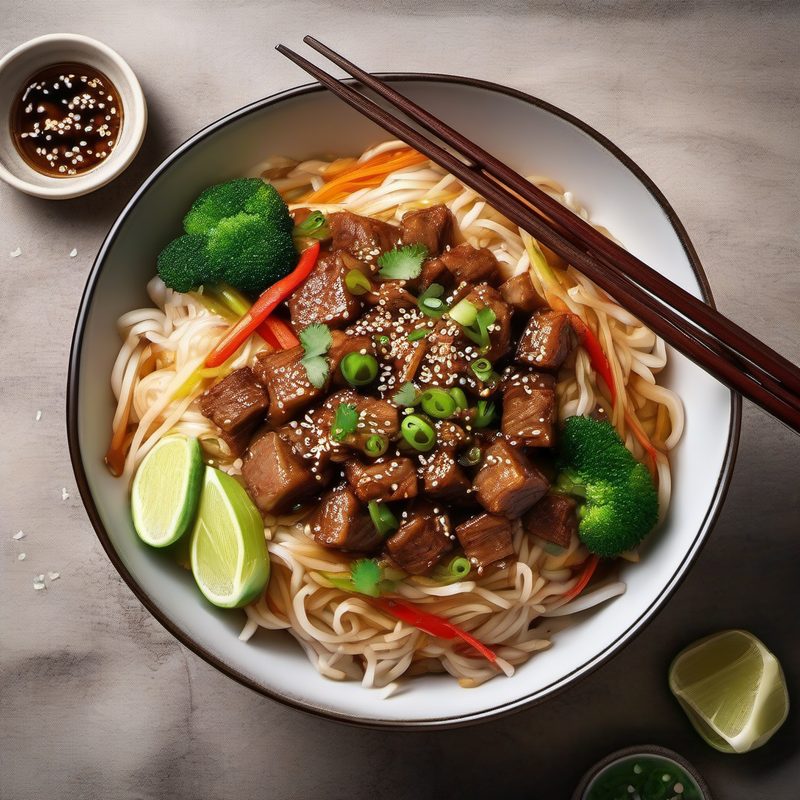
Rice Noodles Meat Vegetables
Tender rice noodles wok-tossed with thinly sliced chicken (or pork), colorful vegetables, and a savory soy-ginger glaze — a quick, satisfying Chinese-style stir-fry that delivers big flavor in under 30 minutes with minimal fuss.
| Amount | Ingredient |
|---|---|
| Overcooking the vegetables | Bell peppers go limp, mushrooms turn rubbery, and carrots lose their sweet crunch — all color and texture is lost Stir-fry vegetables for no more than 2 minutes total. They should remain vibrant and crisp-tender |
| Not cutting the noodles | Long, tangled rice noodles are nearly impossible to eat gracefully — you end up with a giant, slippery knot on your chopsticks Cut the soaked noodles into 6-inch (15 cm) lengths with kitchen shears before stir-frying |
| Cooking sesame oil | High heat destroys the delicate nutty flavor of toasted sesame oil and can make it bitter Add sesame oil off the heat, just before serving |
| Skipping the meat marinade | The meat stays bland and doesn't absorb any soy flavor — it becomes a pale, unseasoned element in an otherwise flavorful dish Marinate the sliced meat in 1 tablespoon soy sauce for at least 10 minutes |
| Adding garlic and ginger to cold oil | The aromatics won't bloom properly and the oil won't carry their flavor into the dish Heat the wok first, then add oil, then add aromatics — the oil should be hot enough that the garlic sizzles immediately |
| Serving on cold plates | Rice noodles cool and stiffen rapidly — within 2 minutes they go from tender to stiff Warm your serving bowls with hot water before plating. Serve immediately |
> Note: The 15-minute noodle soak is mostly hands-off. Active cooking time is about 8 minutes. Have all ingredients sliced and measured before you turn on the heat — stir-frying moves fast and there's no time to chop once the wok is hot.
Use standard US measuring spoons. All produce medium unless specified. Rice noodles (spaghetti di riso) are thin, white, translucent noodles made from rice flour and water — they are naturally gluten-free and become delightfully tender-chewy when soaked. Look for them in the Asian foods aisle of any well-stocked supermarket or at Asian grocery stores. The dish serves 4 as a main course (piatti unici).
🥘 Equipment
- Large bowl (for soaking noodles)
- Wok or large 12-inch (30 cm) skillet
- Chef's knife and cutting board
- Colander
- Paper towels
- Tongs or long chopsticks
- Measuring spoons
- Small bowl (for the soy sauce mixture)
📋 Preparation
Step 1 — Soak the Rice Noodles (15 minutes, mostly hands-off)
Place the rice noodles in a large bowl and cover with warm tap water (about 110°F / 43°C — comfortably warm to the touch). Make sure the noodles are fully submerged. Let soak for 15 minutes until they are pliable, white, and softened but still slightly firm to the touch.
Why warm water? Rice noodles are more delicate than wheat noodles — hot water would cook them too quickly, turning them into a mushy, clotted mass. Warm water gently rehydrates them so they retain their characteristic tender-chewy bite after a quick stir-fry. Cold water works but takes 30–40 minutes.
After 15 minutes, drain the noodles in a colander and rinse briefly under cool running water to stop the hydration. If the noodles are very long (many rice vermicelli bundles are), use kitchen shears to cut them into shorter lengths — about 6 inches (15 cm). This makes them much easier to stir-fry, toss, and eat. Set aside.
Long, tangled rice noodles are notoriously difficult to serve gracefully — cutting them before cooking is a simple step that transforms the eating experience.
Step 2 — Marinate the Meat and Prep the Vegetables (10 minutes)
While the noodles soak, prep everything else.
Marinate the meat: In a small bowl, toss the thinly sliced chicken or pork with 1 tablespoon of the soy sauce. Let marinate for 10 minutes (use this time to prep the vegetables). The brief marinade seasons the meat through and gives it a head start on flavor.
Don't skip this step — the meat is the only protein in the dish and needs direct seasoning. Marinating in just soy sauce (no oil or cornstarch) keeps this recipe light and lets the natural flavor of the meat come through.
Carrot: Peel the carrot. Cut crosswise into 2-inch (5 cm) lengths, then slice each length into thin planks (⅛ inch / 3 mm), then cut into matchsticks of the same dimensions.
Bell pepper: Trim away the stem, seeds, and white membranes. Slice into thin strips, about 2 inches (5 cm) long and ¼ inch (6 mm) wide.
Mushrooms: Wipe clean with a damp paper towel (do not rinse — mushrooms absorb water like sponges). Trim the stem ends and slice thinly (about ¼ inch / 6 mm thick). If using shiitake, remove the tough stems entirely and slice only the caps.
Green onions: Slice the white parts thinly (reserve for the stir-fry) and the green tops thinly (reserve for garnish).
Sauce: In a small bowl, combine the remaining 1 tablespoon of soy sauce with 2 tablespoons of water. Set aside.
Cut everything to roughly uniform size so all the vegetables cook evenly in the brief stir-fry. The matchstick cut (julienne) for the carrot and bell pepper ensures they cook in the same 2-minute window as the mushrooms.
Step 3 — Stir-Fry the Aromatics and Meat (3 minutes)
Place your wok or large skillet over high heat and let it heat for a full 30 seconds — the pan should be smoking hot before any oil goes in. Add 1 tablespoon of vegetable or peanut oil and swirl to coat the surface.
Add the minced garlic and minced ginger. Stir-fry constantly until fragrant, about 30 seconds — do not let the garlic brown or burn.
Add the marinated meat (chicken or pork) in a single layer, spreading it out. Let sear undisturbed for 30 seconds, then stir-fry, tossing constantly, until the meat is cooked through and lightly golden on the edges, about 2 minutes. Transfer to a clean plate and set aside.
High heat is non-negotiable: a screaming-hot wok creates the characteristic "wok hei" (breath of the wok) — that subtle, smoky char that defines great Chinese stir-fry. If you're using a skillet, resist the urge to lower the heat. Cooking the meat first and removing it prevents overcooking and keeps it tender.
Step 4 — Stir-Fry the Vegetables (2 minutes)
Return the wok to high heat and add the remaining 1 tablespoon of vegetable or peanut oil. Swirl to coat.
Add the carrot matchsticks and bell pepper strips. Stir-fry, tossing constantly, for 1 minute — the carrots should begin to soften and the peppers should brighten.
Add the sliced mushrooms and the white parts of the green onions. Continue stir-frying for another 1 minute. The mushrooms will release some liquid and begin to brown lightly around the edges.
The order matters: carrots and bell peppers go in first because they need slightly more cooking time, then mushrooms go in second — they cook quickly but benefit from a brief sear. If you dumped everything in at once, the mushrooms would release too much liquid at once and the carrots would be undercooked.
Step 5 — Combine Noodles, Meat, and Sauce (2 minutes)
Reduce the heat to medium-high. Add the drained rice noodles and the soy sauce mixture (1 tbsp soy sauce + 2 tbsp water) to the wok. Toss gently but constantly with tongs or chopsticks to separate the noodles and coat them evenly with the sauce.
Return the cooked meat to the wok. Continue tossing until everything is well combined, the noodles are heated through, and the sauce is absorbed — about 1 to 2 minutes. The noodles should be tender, glossy, and lightly coated with the savory sauce. Taste a strand — if it is still firm or chalky in the center, add 1 tablespoon of water and toss for 30 seconds more.
Rice noodles absorb liquid quickly and can turn dry if over-tossed. Work fast and keep the heat at medium-high — too much heat will dry them out, too little will make them clump.
Step 6 — Finish and Serve (30 seconds)
Remove the wok from heat. Drizzle 1 tablespoon of toasted sesame oil over the noodles and meat. Toss everything together gently until the noodles are evenly glossy and all the ingredients are well distributed.
Divide between four warmed bowls. Top with the sliced green scallion tops. Serve immediately.
The toasted sesame oil is added off-heat because its flavor is delicate and volatile — cooking it would turn it bitter and flat. Rice noodles cool quickly and can stiffen as they sit, so have your bowls warmed and your table set before you start cooking.
👨🍳 Chef's Tips
- Don't oversoak the noodles. Rice noodles soften quickly in warm water. Fifteen minutes is usually enough — oversoaking (over 25 minutes) turns them waterlogged and fragile. They'll fall apart in the wok and turn into broken fragments.
- Slice the meat thinly and against the grain. For chicken breast or pork tenderloin, a ¼-inch (6 mm) slice is ideal. Partially freeze the meat for 15 minutes before slicing — it firms up just enough to cut clean, even strips without shredding. Slicing against the grain ensures tenderness.
- Cut vegetables to uniform size. This is the single biggest factor separating good stir-fries from great ones. When every vegetable strip is roughly the same length and thickness, they cook evenly and every bite has a balanced mix of textures.
- Prepare all ingredients before you turn on the heat. Stir-frying happens at speed — once the wok is hot, there is no time to chop, measure, or search for a missing ingredient. This is the quintessential mise en place recipe.
- Wok hei matters but isn't essential. The smoky, slightly charred flavor of wok hei elevates this dish to restaurant quality. If you have a wok, use it. A large stainless steel or carbon steel skillet works very well — just make sure it's screaming hot before you add the oil.
- Don't crowd the wok. If your pan is smaller than 12 inches (30 cm), cook the meat in one batch and the vegetables in two batches, combining everything at the end. Overcrowding drops the pan temperature and turns the stir-fry into a steamed, soggy mess.
- Sesame oil is a finishing oil, not a cooking oil. It has a low smoke point and a delicate, nutty flavor that evaporates under high heat. Always add it at the very end, off the heat.
- Mushroom prep matters. Never rinse mushrooms under running water — they absorb moisture like a sponge and will steam instead of sear. Wipe them clean with a damp paper towel or a soft brush.
❌ Common Mistakes
| Mistake | Why It Hurts | The Fix |
|---|---|---|
| Soaking rice noodles in boiling water | The noodles cook unevenly and turn into a gummy, clotted mass — they stick together and refuse to separate in the wok | Use warm tap water (about 110°F / 43°C). The noodles should feel soft and pliable after 15 minutes, not fully cooked and sticky |
| Over-soaking the noodles | Waterlogged noodles turn mushy and fall apart during stir-frying, leaving broken fragments instead of intact strands | Set a timer for exactly 15 minutes. Drain immediately and rinse with cool water to stop hydration |
💡 Variations
| Variation | How To |
|---|---|
| Spicy Szechuan Version | Add 1 teaspoon Szechuan peppercorns and 2 dried red chilies (crumbled) to the oil along with the garlic and ginger. Finish with ½ teaspoon chili oil and a sprinkle of Szechuan pepper salt |
| Thai-Inspired | Replace 1 tablespoon of the soy sauce with 1 tablespoon fish sauce. Add 1 Thai bird chili (sliced) with the aromatics. Garnish with fresh cilantro and crushed peanuts |
| Vegetarian / Tofu Version | Substitute 7 oz (200 g) firm tofu for the meat — press, cube, and pan-sear until golden before stir-frying the aromatics. Add 1 teaspoon mushroom powder or a splash of vegetarian stir-fry sauce for umami depth |
| Shrimp Stir-Fry | Substitute 7 oz (200 g) peeled and deveined shrimp for the meat. Stir-fry for 2 minutes until pink and curled — shrimp cook even faster than chicken, so watch closely |
| Beef with Broccoli | Substitute 7 oz (200 g) thinly sliced flank steak for the chicken or pork, and replace the bell pepper with 1 cup small broccoli florets (blanched 1 minute first). Marinate beef with 1 tablespoon soy sauce and ½ teaspoon sugar |
| Add Bean Sprouts | Toss in 1 cup (100 g) fresh mung bean sprouts with the mushrooms. Cook just 30 seconds — they should stay crisp and crunchy |
| Egg Addition | After stir-frying the vegetables, push them to the side. Beat 2 eggs, pour into the empty space, scramble until just set (30 seconds), then toss with the vegetables before adding noodles |
| Peanut Sauce Noodles | Whisk 2 tablespoons creamy peanut butter with the remaining soy sauce and 2 tablespoons hot water. Drizzle over the finished noodles instead of plain soy sauce. Garnish with crushed peanuts and cilantro |
| Add Bok Choy | Slice 2 baby bok choy lengthwise and add along with the mushrooms. The bitter, earthy greens balance the savory soy sauce beautifully |
| Low-Sodium | Replace regular soy sauce with low-sodium soy sauce. Reduce the salt to a bare pinch. Add a splash of rice vinegar at the end to brighten the flavors without extra salt |
| Gluten-Free | This recipe is naturally gluten-free (rice noodles, soy sauce). Verify your soy sauce is labeled gluten-free, or substitute tamari (which is typically wheat-free) |
| Extra Veggie Load | Add thinly sliced snap peas, julienned zucchini, shredded purple cabbage, or bamboo shoots along with the bell pepper and carrots |
❄️ Storage & Leftovers
| Method | Details |
|---|---|
| Refrigerator | Store in an airtight container for up to 2 days. Rice noodles continue to absorb moisture as they sit, so the texture will be noticeably softer than fresh |
| Reheating (Stovetop) | Reheat in a wok or nonstick skillet over medium-high heat with 1 tablespoon of water. Toss until the noodles are hot and steaming (2–3 minutes). Add a tiny splash of soy sauce and a drizzle of sesame oil to refresh the flavor |
| Reheating (Microwave) | Place in a microwave-safe bowl, cover with a damp paper towel, and microwave at 70% power for 1 minute. Stir and repeat in 30-second bursts until hot. The noodles will be softer than stovetop reheating |
| Freezing | Not recommended — frozen-then-thawed rice noodles turn mushy, watery, and unpleasantly soft. Make only what you'll eat in one or two sittings |
| Make-Ahead Strategy | Soak and cut the noodles up to 1 day ahead (store drained in the refrigerator, covered). Prep and refrigerate the cut vegetables and marinated meat separately. On serving day, the stir-fry itself takes only 8 minutes |
🍵 Tea Pairing
| Tea | Why |
|---|---|
| Jasmine Green Tea (Moli Hua Cha) | The floral, gently sweet aroma of jasmine tea complements the savory soy sauce notes and provides a light, cleansing finish between bites. Serve hot, without sugar — its mild astringency cuts through the oiliness of the stir-fry beautifully |
| Genmaicha (Toasted Rice Green Tea) | The warm, nutty, popcorn-like flavor of genmaicha is a natural partner for stir-fried rice noodles — the toasted rice notes mirror the nuttiness of sesame oil and the caramelized edges of the stir-fried vegetables |
| Oolong Tieguanyin | A lightly oxidized oolong with notes of orchid and honey — its floral complexity and smooth mouthfeel echo the delicate sweetness of the vegetables. Steep for 2–3 minutes at 185°F (85°C) |
| Hojicha (Roasted Green Tea) | A roasted green tea with a toasty, caramel-like aroma and very low caffeine. Its warm, cozy flavor profile is a comforting match for this savory stir-fry |
| Pu'erh Tea | A fermented, earthy, rich dark tea that stands up to the soy sauce and caramelized flavors. Its deep, almost mushroomy complexity provides a grounding counterpoint to the bright vegetables |
| Chrysanthemum Tea (Ju Hua Cha) | A light, floral, slightly sweet herbal tea — served hot or iced. Its cooling, refreshing nature is a traditional Cantonese pairing for stir-fried noodle dishes, helping to balance the warmth of the ginger and the richness of the oil |
🥗 Suggested Side Dishes
- Simple cucumber salad — Thinly sliced English cucumber tossed with 1 tablespoon rice vinegar, 1 teaspoon soy sauce, ½ teaspoon sugar, and a pinch of red pepper flakes. The cool, crisp, acidic crunch is the perfect counterpoint to the warm, savory noodles
- Chinese smashed cucumber salad (pai huang gua) — Lightly smash a Persian cucumber with the side of a cleaver, cut into bite-sized chunks, and toss with 1 tablespoon rice vinegar, 1 teaspoon soy sauce, ½ teaspoon sugar, 1 minced garlic clove, and 1 teaspoon chili oil. Let sit 10 minutes before serving
- Egg drop soup — A simple, comforting broth: bring 3 cups chicken or vegetable broth to a gentle simmer, drizzle in 2 beaten eggs while stirring, season with white pepper, salt, and a drop of sesame oil. Serve alongside the noodles for a classic Chinese meal
- Steamed bok choy with oyster sauce — Halved baby bok choy, steamed for 3–4 minutes, then drizzled with a sauce of 1 tablespoon oyster sauce, 1 teaspoon soy sauce, and 1 teaspoon sesame oil. The bitter, earthy greens balance the rich noodles
- Edamame with sea salt — 1 cup frozen edamame (in pods), boiled for 5 minutes, drained, and sprinkled with flaky sea salt. A simple, protein-packed starter
- Spring rolls (fresh or fried) — Store-bought or homemade spring rolls make an excellent textural companion. Serve with sweet chili dipping sauce
- Quick pickled carrots and daikon — Thinly shredded carrots and daikon radish, tossed with rice vinegar, sugar, and a pinch of salt. Let sit 20 minutes. The bright, tangy, crunchy pickle provides a stunning contrast to the soft, tender noodles
📊 Nutrition (per serving, estimated — with chicken)
| Calories | Protein | Fat | Carbs | Fiber |
|---|---|---|---|---|
| ~385 | 22 g | 12 g | 48 g | 3 g |
Nutritional values are estimates based on 4 servings with 300 g rice noodles, 200 g chicken breast, 70 g carrot, 140 g bell pepper, 100 g mushrooms, 2 tbsp soy sauce, 2 tbsp vegetable oil, 1 tbsp sesame oil. For the pork version: approximately 400 calories, 21 g protein, 14 g fat, 48 g carbs, 3 g fiber. For the tofu version: approximately 350 calories, 15 g protein, 14 g fat, 48 g carbs, 4 g fiber. Rice noodles are naturally gluten-free and relatively low in fat. The dish is dairy-free. To reduce fat, use 1½ tablespoons of vegetable oil for stir-frying instead of 2 (approximately 350 calories and 10 g fat per serving).
❓ Frequently Asked Questions
What are rice noodles, and where do I find them?
Rice noodles (also called rice vermicelli, rice sticks, "spaghetti di riso," or bánh phở) are thin, white, translucent noodles made from rice flour and water. Despite the Italian name "spaghetti di riso," they are not related to wheat pasta — they are naturally gluten-free and have a delicate, tender-chewy texture when cooked. Look for them in the Asian foods aisle of most supermarkets, at Asian grocery stores, or online. They are usually sold in dried, brittle skeins or flat bundles.
Can I use chicken and pork together?
Absolutely — just adjust the quantities. Use 3½ oz (100 g) each of chicken and pork. Cook them together in the same batch (they take roughly the same time) or separately if you want to ensure each is perfectly cooked.
Can I make this without a wok?
Absolutely. A large 12-inch (30 cm) stainless steel or carbon steel skillet works beautifully. The key is high heat, not the shape of the pan. Heat the skillet for a full 30 seconds before adding oil, and don't overcrowd it. A nonstick skillet can work but cannot reach the temperatures needed for true wok hei — the result will still be delicious, just slightly less complex.
My noodles turned into a gummy, clumpy mass. What went wrong?
Three possible causes: (1) You soaked them in water that was too hot (near-boiling water causes the starch to gelatinize prematurely, creating a gummy paste). Always use warm tap water (about 110°F / 43°C). (2) You over-soaked them (more than 25 minutes in warm water will make them waterlogged and fragile). Set a timer for 15 minutes. (3) You didn't cut the noodles before cooking — long, tangled strands clump together. Cut the soaked noodles into 6-inch (15 cm) lengths with kitchen shears.
Can I use a different protein?
Yes. Shrimp (peeled and deveined, stir-fried for 2 minutes until pink), beef (thinly sliced flank steak, stir-fried for 2–3 minutes), or tofu (pressed, cubed, pan-seared until golden) all work beautifully. Adjust cooking times based on the protein you choose.
I can't eat gluten. Is this recipe gluten-free?
The rice noodles (100% rice flour), vegetables, and meat are naturally gluten-free. However, most standard soy sauces contain wheat. Use tamari (gluten-free Japanese soy sauce) or a certified gluten-free soy sauce instead of regular soy sauce.
Can I use different vegetables?
Yes. This is a highly adaptable stir-fry. Good substitutes or additions include: thinly sliced bell peppers of any color, snap peas, thinly sliced Napa cabbage, julienned jicama (for crunch), thinly sliced celery, shredded purple cabbage (for color), broccoli florets (blanched first), or bamboo shoots. Avoid watery vegetables like tomatoes or zucchini — they release too much liquid and turn the dish into a soup.
The noodles came out bland. How do I fix that?
Most likely the dish needs more soy sauce or a pinch of salt. Rice noodles are very mild and absorb whatever liquid you cook them in. If the dish is already cooked, add a splash of soy sauce and a few grinds of white pepper, toss well, and taste again. A drizzle of sesame oil at the end also helps boost flavor.
Why is toasted sesame oil added at the end and not cooked?
Toasted sesame oil has a low smoke point and a delicate, nutty flavor that is easily destroyed by high heat. Cooking it not only diminishes its aroma but can make it taste bitter. It's always used as a finishing oil in Asian cooking — added off the heat just before serving.
How do I keep the noodles from sticking to the wok?
Three tips: (1) Make sure the wok is screaming hot before adding oil — a properly seasoned carbon steel or cast iron wok develops a nonstick patina. (2) Don't let the liquid cook off completely before serving — a tiny amount of residual moisture keeps the noodles slippery. (3) Toss constantly during the stir-fry — standing still encourages sticking.
What type of mushrooms work best?
Cremini (brown button mushrooms) are the most accessible and have good flavor. Shiitake mushrooms add a more intense, earthy, umami-rich flavor — remove the tough stems first. Oyster mushrooms are delicate and cook quickly, with a lovely silky texture. A mix of any of these works wonderfully.
🔗 Related Recipes
- Spaghetti di soia all'orientale (Oriental Glass Noodle Stir-Fry) — page 456
- Ramen Thai alle Arachidi Vegano (Vegan Thai Peanut Ramen) — page 458
- Pasta con Sesamo e Fogli di Alga Nori (Sesame Nori Pasta) — page 457
- Dan Dan Mian — Sichuan Sesame Noodles — page 70
- Thai Red Curry with Silken Tofu — page 343
- Japanese Gyoza — page 162
- Spring Rolls with Shrimp and Vegetables — page 22
- Soba Noodles with Asparagus, Egg, and Nori — page 444
- Homemade Ramen Noodles — page 160
🏷️ Search Tags
📸 Photo Reference
Photo reference: `vol1_464.png` — A top-down or slightly angled overhead shot of a single large, shallow ceramic bowl in a muted celadon green or warm earthy brown. At the center, a neatly composed mound of glossy, white rice noodles, interwoven with golden-brown chicken strips (or pale pork strips), bright orange carrot matchsticks, vibrant red or green bell pepper slivers, and earthy brown mushroom slices — all catching the light. The noodles are glossy with a visible sheen of sesame oil — a few individual strands separate from the pile, showing their delicate, translucent quality. A scattering of vibrant green scallion rings dots the top for contrast. Beside the bowl: a pair of dark wooden chopsticks resting on a ceramic chopstick rest, a small white teacup filled with pale jasmine green tea (steam rising faintly), and a folded indigo-dyed cotton napkin. Soft, diffused natural light from a side window creates gentle highlights on the glossy noodles and the tea cup. A dark, textured wooden table surface provides a neutral backdrop. The overall mood is warm, homey, and inviting — a weeknight dinner that looks effortlessly beautiful.
🧠 Why This Recipe Works — The ATK Difference
- Brief warm-water soak instead of boiling. Unlike dried pasta, rice noodles are best rehydrated in warm (not hot) water — this preserves their delicate, tender-chewy texture and prevents the gummy, clotted mass that results from boiling. The 15-minute soak is nearly hands-off.
- Soy sauce marinade seasons the meat from within. A quick 10-minute soak in soy sauce penetrates thin slices of chicken or pork, ensuring every bite of meat is seasoned all the way through — not just on the surface.
- High-heat stir-fry in stages. Cooking the protein first and removing it prevents overcooking; adding vegetables in two stages (denser carrots and peppers first, quicker mushrooms second) ensures every component reaches peak doneness simultaneously.
- Rice noodles absorb the sauce, not just coat it. Rice noodles act like a sponge — they absorb the soy glaze as they heat through in the wok, so every strand is flavored from within, not just glazed on the surface.
- Sesame oil finished off-heat. Adding toasted sesame oil after removing the wok from the heat preserves its delicate, nutty aroma — cooking it would turn the oil bitter and destroy the very flavor it's meant to contribute.
- One-dish meal (piatto unico). Protein, vegetables, and carbohydrates all come together in a single wok — minimal cleanup, maximum flavor, and a nutritionally balanced meal in under 30 minutes.
Recipe from "The Italian Kitchen" by Vita Milanese — Volume 1: Pasta Perfetto
Recipe from The Italian Kitchen by Vita Milanese — Volume 1 · Pasta Perfetto. Discover all volumes on the ebook page.