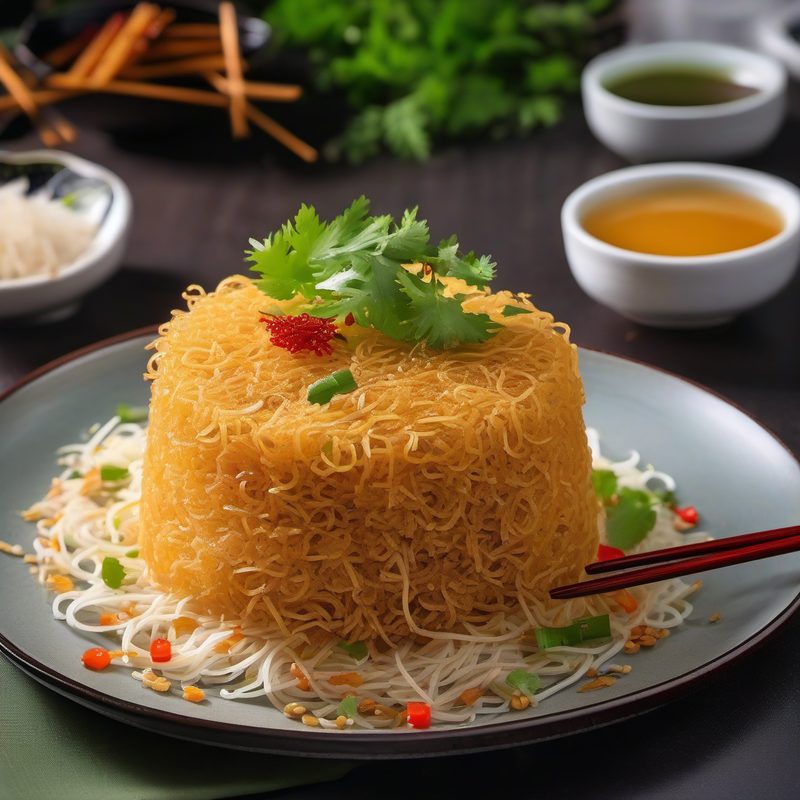
Crispy Rice Vermicelli Crunch
Category: Antipasti (Starters), Snack
| Amount | Ingredient |
|---|---|
| Kashmiri chili | A mild, deep-red chili powder from Kashmir, prized for its vibrant colour and moderate heat (about 1,000–2,000 Scoville units, compared to cayenne's 30,000–50,000). |
| Shichimi togarashi | A Japanese seven-spice blend typically containing chili pepper, nori (dried seaweed), sesame seeds, sansho pepper, ginger, orange peel, and poppy seeds. |
Original Title: Crunch di vermicelli cinesi
English Title: Crispy Rice Vermicelli Crunch
Position: 470
Servings: 4 (as a snack or appetizer)
Prep Time: 5 minutes
Cook Time: 10 minutes (in batches)
Total Time: 15 minutes
1. WHY THIS RECIPE WORKS
Crispy rice vermicelli nests — Crunch di vermicelli cinesi — are one of the most deceptively simple, instantly gratifying snacks in the Italian-Chinese fusion repertoire. Raw rice vermicelli, brittle and pale as straw, transforms into a billowy, shatteringly crisp nest in literally 3 to 5 seconds of contact with hot oil. The transformation is pure starch chemistry: rice vermicelli is made from rice flour and water, extruded into thin strands and dried to a moisture content of roughly 10–12%. When these strands hit 180°C (350°F) oil, the residual water flash-vaporizes into steam, expanding the starch matrix into a puffed, airy, fractal-like structure — a process called puffing or explosive expansion. The result is a cloud of delicate, crispy strands with an ethereal crunch that dissolves on the tongue.
This recipe optimizes three variables for maximum crunch and minimal grease. First, the oil temperature: 180°C is the sweet spot — below 170°C and the vermicelli absorbs oil before it puffs, turning greasy and chewy; above 190°C and the strands brown before they fully expand, yielding bitter, burnt edges. Second, the batch size: frying in small handfuls (about 20–25 g or a loosely packed bunch the size of a tangerine) ensures the oil temperature doesn't drop and every strand gets equal exposure. Third, the seasoning: salt, chili, and paprika are applied immediately after draining while the strands are still hot and oiled, so the spices cling to every crevice. The result is a snack that's simultaneously delicate and robust — a crisp, airy, spiced tangle that works as a bar snack, an appetizer garnish, or a textural topping for soups and salads.
Use level measurements. For a spicier version, substitute ½ teaspoon cayenne for ½ teaspoon of the chili powder.
3. EQUIPMENT
- Deep, heavy-bottomed pot or Dutch oven (4–6 quart / 4–6 litre capacity)
- Deep-fry thermometer (clip-on, digital preferred; see Equipment Notes)
- Spider skimmer or slotted spoon (wide, fine-mesh preferred)
- Paper towels (at least 3 layers thick)
- Baking sheet or large platter (for draining)
- Large mixing bowl (for seasoning)
- Small bowls (for salt and spice mix)
- Kitchen scale (for portioning vermicelli)
- Tongs or chopsticks (for handling hot nests)
- Fine-mesh sieve (for straining oil after use)
4. BEFORE YOU BEGIN
- Portion the vermicelli: Weigh out the 200 g of rice vermicelli. Using your hands, gently separate the dried noodles into 8 to 10 loose bunches, each about the size of a tangerine (20–25 g / roughly ¾ oz). Do not compress or pack them — loose, airy bunches puff more evenly. Set the bunches aside on a tray or plate.
- Prepare the draining station: Line a baking sheet or large platter with 3 layers of paper towels. Place it near the stove. Set a cooling rack over a second baking sheet as an alternative draining option.
- Mix the seasoning: In a small bowl, combine 1 teaspoon fine sea salt, 1 teaspoon chili powder, and 1 teaspoon sweet paprika. Stir to blend evenly. Set aside.
- Set up the oil: Pour the 1 litre (4 cups) vegetable oil into the deep, heavy-bottomed pot. The pot should be no more than half-full to allow for bubbling and splashing. Clip the deep-fry thermometer to the side of the pot, ensuring the probe is submerged in the oil but not touching the bottom of the pot.
- Ventilation: This recipe involves flash-frying — the rapid steam release can cause brief spluttering. Ensure your stovetop exhaust fan is on, or open a nearby window.
5. STEP-BY-STEP INSTRUCTIONS
Step 1: Heat the Oil
- Place the pot over medium-high heat and bring the oil to 180°C (350°F) on the deep-fry thermometer.
- Watch the temperature carefully: Heating takes about 8–10 minutes. While waiting, arrange your vermicelli bunches, skimmer, draining tray, and seasoning bowl in easy reach. Once the oil reaches 180°C, reduce the heat to medium to maintain the temperature.
The oil will continue to heat for about 30 seconds after you reduce the flame — anticipate this by adjusting the burner just before the target is reached.
Step 2: Fry the First Batch
- Pick up one loose bunch (about 20–25 g) of rice vermicelli. Hold it just above the surface of the hot oil.
- Drop the entire bunch into the oil in one smooth motion. Do not separate the strands — they will separate naturally as they puff.
- Count to 3 seconds (one-Mississippi, two-Mississippi, three-Mississippi) — and immediately flip the nest using the spider skimmer or chopsticks.
- Count another 1 to 2 seconds on the second side. The vermicelli will puff to roughly 3–4 times its original volume in a dramatic, instantaneous transformation.
- Total fry time: 4 to 5 seconds. The noodles should be white to very pale gold — not brown. Overcooking by even 2 seconds produces brown, bitter strands.
You will hear a vigorous sizzle as the moisture flashes to steam. The vermicelli should puff instantly on contact — if it doesn't, the oil is not hot enough. If it browns immediately, the oil is too hot.
Step 3: Drain and Season
- Quickly lift the puffed nest from the oil using the spider skimmer. Let excess oil drain back into the pot for 2–3 seconds.
- Transfer the nest to the paper-towel-lined baking sheet. Blot gently with another paper towel to absorb surface oil.
- Immediately — while the nest is still hot — transfer it to the large mixing bowl. Sprinkle a pinch of the seasoning mixture (about ¼ teaspoon) over the hot nest and toss gently with your hands or two forks to distribute evenly.
The timing of seasoning is critical: hot, oiled surfaces act as a binder for the spice particles — once the nest cools, the seasoning slides off. You have about 10 seconds after draining to get the spices on.
Step 4: Repeat with Remaining Bunches
- Allow the oil temperature to return to 180°C before adding the next bunch (about 30–45 seconds over medium heat).
- Repeat the fry-drain-season process with the remaining 7 to 9 bunches of vermicelli.
- Do not stack the finished nests while they are still warm — they will trap steam and soften. Arrange them in a single layer on the draining tray or on a serving platter.
Step 5: Serve
- Transfer the seasoned crispy nests to a serving bowl or platter. They can be piled loosely — unlike potato chips, they are sturdy enough to stack without crushing.
- Serve immediately (within 15 minutes) for maximum crunch. Crispy rice vermicelli nests begin to soften after about 30 minutes due to humidity absorption.
- Rice vermicelli (vermicelli di riso): These are thin, round, dried noodles made from rice flour and water, typically 1 mm or less in diameter. They are the same noodles used in Vietnamese bún bowls and Thai pad thai (though pad thai uses a slightly wider, flat version). Do not substitute rice sticks (flat, wider rice noodles used in stir-fries) or cellophane/glass noodles (made from mung bean starch, which puff differently and have a chewier texture). Look for brands from Thailand, Vietnam, or China. The key characteristic is brittleness: the dried noodles should snap cleanly when bent. If they bend without breaking, they are too moist and will not puff properly. Store opened packages in an airtight container in a cool, dark place for up to 6 months.
- Vegetable oil: Use a neutral oil with a high smoke point (above 200°C / 400°F). Peanut oil is ideal — it has a smoke point of 232°C (450°F) and adds a faint nutty richness. Canola, sunflower, or grapeseed oil are excellent alternatives. Avoid olive oil (smoke point ~190–210°C, but its flavour is too assertive for this delicate snack) and butter (which burns at 150°C / 300°F — far too low for this application).
- Chili powder: This recipe calls for mild chili powder for colour and gentle warmth, not searing heat. Kashmiri chili powder (deep red, mild heat) or Aleppo pepper flakes (ground to powder) are ideal. Standard American chili powder blends (which contain cumin, garlic powder, and other spices) will work but change the flavour profile significantly. For heat-seekers, substitute ½ teaspoon cayenne for ½ teaspoon of the chili powder.
- Sweet paprika: Hungarian or Spanish sweet paprika adds a vibrant red colour and a subtle earthy-sweet undertone that rounds out the chili's sharpness. Smoked paprika (pimentón) can be substituted for half the sweet paprika for a deeper, more savoury flavour — use ½ teaspoon smoked + ½ teaspoon sweet.
- Salt: Fine sea salt dissolves and distributes more evenly than coarse kosher salt on these delicate nests. If using flaky sea salt (Maldon), crush it lightly between your fingers before adding.
7. EQUIPMENT NOTES
- Deep-fry thermometer: This is non-negotiable. The difference between perfect puffing at 180°C and greasy failure at 170°C is just 10°C, and without a thermometer you are guessing. A clip-on probe thermometer (analogue or digital) costs little and eliminates all uncertainty. If using an infrared (laser) thermometer, measure the oil surface temperature — it will read 8–12°C lower than the true internal temperature, so aim for 190–192°C on the IR reading.
- Pot shape: A wide, heavy-bottomed pot (Dutch oven) is ideal because it provides thermal mass that stabilises the oil temperature when cold vermicelli is added. A narrow, thin-walled pot will experience temperature drops of 20°C or more per batch, leading to greasy, uneven results. The pot should be at least 20 cm (8 inches) in diameter at the opening.
- Spider skimmer: A wide-mesh wire skimmer (spider) is better than a slotted spoon because it allows oil to drain quickly and doesn't disturb the delicate puffed structure. If you don't have one, a fine-mesh strainer or a slotted spoon with wide slots works — just be gentle when lifting.
- Paper towels: Use at least 3 layers. The initial oil absorption is significant, and a single layer will soak through, causing the bottom of the nest to sit in oil and become greasy. Alternatively, drain on a wire cooling rack set over a baking sheet — this is actually superior for keeping the nests crisp, as air circulates on all sides.
8. TIMING & MAKE-AHEAD
- Vermicelli can be portioned in advance: The dried noodle bunches can be weighed, portioned, and stored in an airtight container or zip-top bag at room temperature for up to 1 week before frying.
- Spice mix can be made in advance: The salt-chili-paprika blend keeps indefinitely in an airtight container in a cool, dark cupboard. Scale up the recipe (e.g., 3 tbsp salt + 3 tbsp chili + 3 tbsp paprika) and store for future batches.
- Crispy nests do not hold: These are at their absolute peak within the first 15 minutes of frying. After 30 minutes, they begin to absorb ambient humidity and lose their shatter. After 1 hour, they become chewy and stale. Plan to fry them just before serving.
- Warm-holding strategy: If you must hold them, spread the finished nests in a single layer on a wire rack in a 95°C (200°F) oven with the door slightly ajar for up to 20 minutes. This keeps them crisp without further browning. Do not cover them or place them in a closed container — trapped steam is the enemy.
- Oil re-use: The frying oil can be strained through a fine-mesh sieve or cheesecloth and reused once or twice for neutral frying (not for this recipe again — rice vermicelli leaves very fine sediment). Cool completely, strain into a clean jar, and store in a cool, dark place. Discard after 2 uses.
9. STORING & REHEATING
- Room temperature (not recommended): Leftover nests can be stored in an uncovered container at room temperature for a few hours, but they will soften significantly. Do not seal in an airtight container — the trapped moisture accelerates staling.
- Reviving stale nests: If the nests have softened, spread them on a baking sheet and re-crisp in a 150°C (300°F) oven for 3–4 minutes. Watch carefully — they brown quickly. Let cool on a wire rack for 1 minute before serving. They will be about 80% as crisp as fresh.
- Freezing (not recommended): Fried rice vermicelli does not freeze well — the puffed structure collapses upon thawing, leaving a dense, chewy mass. Always fry fresh.
- Oil storage: After straining, the used oil can be refrigerated in an airtight container for up to 1 month. Bring to room temperature before reusing. Discard if it develops an off odour or becomes cloudy.
10. WINE & BEVERAGE PAIRING
| Drink | Why |
|---|---|
| Prosecco Superiore (Valdobbiadene) Extra Brut | The high acidity and fine bubbles cut through the oil and refresh the palate between crunchy bites; the crisp, green-apple notes echo the clean rice flavour |
| Pale ale or Italian pilsner | A cold, crisp lager (Birrificio Italiano Tipopils) or a citrusy American pale ale balances the mild heat of the chili and provides a clean, bitter counterpoint |
| Dry vermouth on the rocks | A classic Italian aperitivo — the botanicals (wormwood, gentian, citrus peel) complement the gentle spice and salt, while the chill keeps the pairing light |
| Sauvignon Blanc (Friuli or Loire) | Zesty acidity with grass and green pepper notes; the herbaceous character mirrors the paprika while the acidity cuts through the oil |
| Negroni Sbagliato | The bitter-sweet, sparkling vermouth-campari-prosecco mix is a perfect aperitivo partner — the bitterness tames the chili, the bubbles scrub the palate |
| Iced green tea (unsweetened) | The clean, slightly grassy character of Japanese sencha or Chinese gunpowder green tea is a non-alcoholic match that cleanses the palate and soothes any chili heat |
| Cold lager (Peroni Nastro Azzurro, Asahi Super Dry) | Sometimes simple is best — a cold, crisp lager with clean bitterness and high carbonation is the perfect foil for salty, crunchy, spicy snacks |
11. VARIATIONS
| Variation | How To |
|---|---|
| Spicy Szechuan Crunch | Add ½ teaspoon Szechuan peppercorns (ground) and ¼ teaspoon cayenne to the seasoning mix. The citrusy, numbing heat of Szechuan peppercorn is a brilliant counterpoint to the pure crunch. |
| Lemon-Herb Crunch | Replace chili powder with 1 teaspoon dried lemon zest (or finely grated fresh zest, dried for 1 hour on a paper towel) and ½ teaspoon dried thyme or oregano. Finish with a pinch of flaky sea salt. |
| Smoky Paprika Crunch | Replace sweet paprika with 1½ teaspoons smoked paprika (pimentón de la Vera). Add ¼ teaspoon garlic powder. The smoky notes are reminiscent of Spanish patatas bravas. |
| Japanese Shichimi Togarashi Crunch | Use 2 teaspoons shichimi togarashi (Japanese seven-spice blend — contains chili, nori, sesame, sansho pepper, ginger, orange peel, and poppy seeds) in place of the chili + paprika. |
| Curry Crunch | Add 1 teaspoon mild curry powder to the seasoning mix. The warm cumin-coriander-turmeric notes pair beautifully with the neutral rice flavour. |
| Italian Herbs & Garlic Crunch | Replace chili and paprika with a mixture of ½ teaspoon garlic powder, ½ teaspoon dried oregano, ½ teaspoon dried rosemary (crushed), and ½ teaspoon salt. Serve as an antipasto with drinks. |
| Chocolate-Dusted (Dessert Crunch) | Omit the salt and spices. After frying and cooling, dust the nests with a mixture of 1 tablespoon unsweetened cocoa powder and 1 tablespoon icing sugar. An unusual but delightful sweet-savoury snack. |
| Everything Bagel Crunch | Season with 1 teaspoon everything bagel seasoning (sesame seeds, poppy seeds, dried garlic, dried onion, salt). The umami-rich seasoning is addictive with the pure rice crunch. |
| Matcha-Salt Crunch | Mix 1 teaspoon matcha powder with 1 teaspoon flaky sea salt. Toss with the hot nests. The grassy, slightly bitter matcha offsets the oil beautifully. |
| Taco-Spiced Crunch | Combine 1 teaspoon chili powder, ½ teaspoon ground cumin, ½ teaspoon dried oregano, ¼ teaspoon garlic powder, and ½ teaspoon salt. A crowd-pleasing snack for game day. |
12. TROUBLESHOOTING
| Problem | Cause | Solution |
|---|---|---|
| Noodles are greasy and heavy, not puffed | Oil temperature too low (below 170°C / 340°F) | Use a thermometer to verify 180°C. Let oil return to temperature between batches. |
| Noodles brown immediately or taste burnt | Oil temperature too high (above 190°C / 375°F) | Reduce heat immediately. Remove the pot from the burner briefly to cool the oil by 5–10°C. |
| Noodles puff unevenly — some strands are still hard | Batch too large, causing a severe temperature drop | Reduce batch size to 20–25 g (one loose handful). The temperature should drop no more than 5°C when noodles are added. |
| Seasoning doesn't stick to the noodles | Nests cooled too much before seasoning; oil was blotted too thoroughly | Season within 10 seconds of draining. A thin film of oil on the surface acts as a binder — blot excess oil but leave a light sheen. |
| Nests are soft and chewy instead of crisp | Overcooked (strands reabsorb oil); or stored in an airtight container | Fry for 4–5 seconds total, no more. Serve within 15 minutes. Never store in sealed containers. |
| Oil splatters violently when noodles are added | Noodles may have been dropped from too high, or oil level too high | Drop noodles gently from just above the oil surface. Ensure the pot is no more than half-full of oil. |
| White spots or uncooked patches on the nest | Noodle strands were touching at the point of entry, preventing oil contact | Drop noodles in one smooth motion and agitate gently with chopsticks for the first second to separate strands. |
| Nests taste bland even though seasoned | Salt-to-noodle ratio is off; or seasoning was unevenly applied | Measure seasoning precisely (1 tsp salt per 200 g noodles). Toss each nest individually while hot rather than seasoning the whole batch at once. |
13. NUTRITIONAL INFORMATION
Per serving (based on 4 servings; one serving = ~50 g of dried vermicelli, fried and seasoned)
| Component | Value |
|---|---|
| Calories | 285 kcal |
| Protein | 3 g |
| Fat | 16 g |
| Saturated Fat | 2 g |
| Carbohydrates | 32 g |
| Fibre | 1 g |
| Sugar | 0.5 g |
| Sodium | 590 mg |
| Cholesterol | 0 mg |
Nutrition is an estimate. Actual values depend on oil absorption (which varies with frying time and temperature), the specific seasoning quantities used, and the exact noodle brand. Oil absorption typically ranges from 15–25 g per 200 g of dried vermicelli.
14. SCALING & ADAPTATIONS
- For 2 servings: Halve all ingredients — use 100 g vermicelli, 500 ml oil (minimum safe depth for frying), and ½ teaspoon each of salt, chili, and paprika. Fry in 5 batches.
- For 8 servings: Use 400 g vermicelli and 1.5 litres oil. Fry in 16–20 batches, keeping finished nests warm in a 95°C oven on a wire rack (see Timing & Make-Ahead).
- For 12 servings (party platter): Use 600 g vermicelli and 2 litres oil. Fry in 24–30 batches. This requires a larger pot (at least 8-quart capacity) to maintain oil temperature. Enlist a helper — one person fries, one person seasons.
- Alternative cooking method (oven, not recommended): Spread 50 g of vermicelli in a thin, even layer on a parchment-lined baking sheet. Brush with oil and bake at 200°C (400°F) for 5–7 minutes. The result is less puffed, more toasted, and only about 60% as crispy as deep-fried. Not a true substitute but useful for oil-free diets.
- Air fryer adaptation: Place 30 g of vermicelli in the air fryer basket. Spritz generously with oil. Cook at 200°C (400°F) for 3–4 minutes, shaking halfway through. The results are more toasted than puffed and lack the ethereal, airy structure of deep-fried nests. Acceptable for small batches when you don't want to deep-fry.
- Gluten-free note: Rice vermicelli is naturally gluten-free. This recipe contains no wheat, barley, rye, or cross-contamination risk from shared facilities (check the specific brand label to confirm). It is suitable for coeliac/gluten-free diets.
- Vegan/vegetarian note: All ingredients are plant-based. No animal products are used at any stage. This recipe is naturally vegan.
- Low-oil alternative (toasted): For a significantly lower-fat version, dry-toast the vermicelli in a non-stick skillet over medium heat, tossing constantly for 2–3 minutes until lightly browned and fragrant. The texture is more like toasted rice cracker — crunchy but not puffed. Season immediately after toasting.
15. RECIPE TIPS & TECHNIQUES
- The "Tangerine Rule" for portioning: Each bunch of dried vermicelli should be about the size of a tangerine (20–25 g). This size ensures the strands puff completely without the centre remaining undercooked. Larger bunches produce dense, chewy centres; smaller bunches are harder to handle and can overcook in seconds.
- Drop confidently, don't sprinkle: The worst thing you can do is gradually lower the vermicelli into the oil or sprinkle it in. A single, decisive drop ensures all strands hit the hot oil simultaneously, puffing evenly. Hesitation causes the first strands to puff and the last to land in already-cooling oil.
- Flip halfway through the fry: At the 3-second mark, flip the nest with chopsticks or a spider. This exposes the top half to the oil, ensuring both sides puff fully. Without flipping, the top half of the nest remains dense and under-puffed.
- The sizzle tells the story: When the vermicelli hits 180°C oil, you should hear a vigorous, immediate sizzle. If the sizzle is weak or delayed, the oil is too cool. If the sizzle is explosive with instant browning, the oil is too hot. Train your ear — it becomes more reliable than a thermometer for small temperature adjustments between batches.
- Blot, don't press: When draining the nests on paper towels, blot gently with another towel. Pressing crushes the delicate puffed structure, turning an airy nest into a flat, greasy mat. The goal is to absorb surface oil without collapsing the strands.
- Season each nest individually: Resist the temptation to pile all the nests into a bowl and season them together. The bottom nests will cool and the seasoning won't stick. Season each nest one at a time, immediately as it comes out of the oil, then move it to the serving platter. This takes 10 extra seconds per batch and makes a dramatic difference.
- Serve on a wire rack for maximum crunch: If you're not serving immediately, place the finished nests on a wire cooling rack (not a plate or platter). The air circulation keeps both sides crisp. A plate traps steam on the bottom, softening the nests within minutes.
- The single-serve approach: For a dinner-party presentation, fry individual nests in 15 g portions (about half a standard bunch). These smaller nests are perfect for garnishing a bowl of soup or serving one per person as a pre-appetizer amuse-bouche.
16. GLOSSARY
| Term | Definition |
|---|---|
| Rice vermicelli | Thin, round, dried noodles made from rice flour and water. When fried, they undergo explosive expansion (puffing) due to rapid steam generation. |
| Puffing (explosive expansion) | The rapid vaporisation of residual moisture inside a starch-based food when exposed to high heat, causing the starch matrix to expand and form a porous, airy structure. |
| Flash frying | A very brief deep-frying technique (typically under 10 seconds) used to puff or crisp foods with high surface area and low moisture content. |
| Smoke point | The temperature at which an oil begins to break down and produce visible smoke, accompanied by the formation of acrid flavours and harmful compounds. |
| Maillard reaction | A chemical reaction between amino acids and reducing sugars that produces browned compounds (melanoidins) and complex savoury flavours — relevant here when vermicelli is fried beyond the puffing stage to a golden brown. |
| Spider skimmer | A wide, shallow, wire-mesh scoop with a long handle, used for lifting foods from hot oil. The open mesh allows oil to drain quickly while leaving delicate foods undisturbed. |
| Antipasti | The first course of an Italian meal — a selection of hot or cold appetizers served before the primo (pasta, risotto, or soup). |
17. PLATING & PRESENTATION
- Rustic family-style (recommended): Pile the crispy nests in a large, wide ceramic bowl or on a wooden board. They can be stacked loosely — the nests are sturdy enough to support each other without crushing. Serve with small bowls of extra seasoning or dipping sauces on the side (sweet chili sauce, sriracha mayo, or a simple lemon aioli).
- Individual appetizer portions: Place one large nest (from a 25 g bunch) on each small plate. Garnish with a lemon wedge and a small sprinkle of fresh chives or micro-herbs. This presentation works beautifully as a pre-dinner amuse-bouche or as a first course passed on trays at a cocktail party.
- As a garnish: Crumble one or two nests over a bowl of silky coconut soup, tom kha gai, hot and sour soup, or a simple miso broth. The textural contrast between the crispy, airy strands and the smooth liquid is extraordinary. The nests can also be used to top a simple green salad, replacing croutons with an ethereal crunch.
- On a sharing platter: Arrange the nests on a large platter alongside other antipasti — marinated olives, prosciutto or salami, cheese cubes, pickled vegetables, and crusty bread. The nests act as both a textural contrast and an edible scoop for soft cheeses or dips.
- Cocktail-party skewers: Break the nests into large shards and thread a shard onto a cocktail pick with a cube of feta or fresh mozzarella and a cherry tomato. The contrast between creamy cheese and shatteringly crisp noodle is a knockout.
- Garnish ideas: A light dusting of extra paprika for colour, a few fresh cilantro or mint leaves, thin slices of fresh red chili for heat and visual pop, a sprinkle of black sesame seeds, or a wedge of lime on the side.
- Tableware recommendation: A matte ceramic bowl in white or cream makes the deep red-orange seasoning pop. Wooden boards or slate platters provide a rustic, earthy backdrop that complements the snack's casual elegance.
- Visual note: The finished nests should resemble a cloud of interlaced, airy strands — a pale gold to white base with a speckled red-orange coating from the chili and paprika. Each nest should be roughly 12–15 cm (5–6 inches) in diameter and 3–4 cm (1–1½ inches) thick, with visible air gaps between the strands.
18. SCIENCE & TECHNIQUE
- The puffing mechanism: Dried rice vermicelli contains 10–12% residual moisture, trapped within the starch matrix. When immersed in 180°C oil, the water superheats to well above its boiling point (100°C) — because the starch matrix confines it, the water cannot vaporise freely until it reaches a critical pressure. At ~140–150°C, the pressure exceeds the structural integrity of the starch, causing an explosive release of steam that expands the starch strands to 3–4 times their original diameter. This is analogous to the puffing of popcorn, breakfast cereals, or prawn crackers — all rely on the same principle of confined moisture undergoing rapid phase change.
- Why temperature precision matters within 5°C: At 170°C, the steam pressure builds more slowly, and the oil has time to infiltrate the starch matrix before the puffing event occurs. The result: oil-soaked, heavy strands that are greasy and dense. At 190°C, the water vaporises so violently that the outer surface of each strand reaches Maillard browning temperatures (~140°C+) before the interior has fully puffed, resulting in burnt exteriors and under-puffed interiors. At 180°C, the pressure builds at exactly the rate where puffing happens before significant oil absorption AND before the surface browns — the "Goldilocks window."
- Oil absorption dynamics: During deep frying, oil absorption occurs primarily during the cooling phase after the food is removed from the oil, not during active frying. As the puffed strand cools, steam inside the pores condenses, creating a vacuum that draws surface oil into the structure. This is why draining on paper towels is essential — it wicks away the surface oil before the cooling vacuum can pull it in. Blotting within the first 5 seconds of removal reduces final oil content by up to 40%.
- Why rice, not wheat or mung bean starch: Rice starch has a higher amylopectin content (roughly 80% of total starch, compared to 25% in wheat) and smaller granule size (3–8 microns vs. 20–35 microns for wheat). During the puffing process, high-amylopectin starches expand more dramatically because the branched structure traps steam more effectively than the linear amylose chains. This is why rice vermicelli puffs into light, airy nests while wheat-based pasta would simply brown and crisp (as in fried wonton strips). Mung bean starch (cellophane noodles) also puffs, but the structure is denser and more brittle — it shatters rather than clouds.
- The role of salt in texture: Beyond seasoning, salt applied to the hot noodles creates a hygroscopic (moisture-attracting) layer on the surface. This may seem counterproductive for a crispy product, but in practice the quantity is so small (1 teaspoon per 200 g of noodles) that any surface moisture absorption from the salt is offset by the rapid consumption of the snack before significant softening occurs. Additionally, the salt crystals create microscopic stress points in the starch surface — these points of weakness are actually desirable for maximising the "shatter" sensation.
- Why they soften over time: Atmospheric humidity causes the puffed starch to undergo plasticisation — water molecules penetrate the starch matrix, hydrogen-bonding with the amylose and amylopectin chains, relaxing the rigid structure and converting the crisp glassy state to a rubbery, chewy state. This transition begins within 15–20 minutes at 60% relative humidity. The effect accelerates dramatically above 70% RH. This is fundamentally the same process that causes potato chips and crackers to stale — it is not a loss of moisture but rather a gain of moisture.
- The importance of flipping during frying: Without flipping, the top half of the nest never contacts the oil directly. It relies on conduction through the already-puffed bottom half to reach puffing temperature. As puffed starch is a poor thermal conductor (air-filled pores insulate well), the top half heats much more slowly, resulting in asymmetric expansion — puffed and crisp on the bottom, dense and chewy on top. Flipping at the midpoint ensures both halves receive direct convective heat transfer from the oil, producing a uniformly puffed nest.
19. FINAL NOTES
- This recipe is a celebration of minimalism — three main ingredients (noodles, oil, seasoning) and one precise technique. The dramatic transformation from brittle, pale threads into an airy, spiced cloud is one of the most visually satisfying moments in home cooking.
- The recipe sits at the intersection of three culinary traditions: Italian antipasti culture (where simple, fried snacks accompany drinks), Chinese rice-noodle expertise (the foundational ingredient and the puffing technique), and the global language of crunch (every cuisine has its version of a crisp, salty, fried snack).
- The most common mistake is overcomplicating this recipe. Do not be tempted to add wet ingredients (soy sauce, lime juice, garlic paste) to the seasoning — moisture is the enemy of the delicate puffed structure. Keep it dry, keep it hot, keep it fast.
- Cook's note on safety: Deep frying requires respect. The rice vermicelli's explosive puffing can cause hot oil to splatter. Wear a long-sleeved apron, keep children and pets away from the stove, and never leave the pot unattended. Keep a lid nearby to smother any oil flare-up — never use water to extinguish a grease fire.
- The philosophy of crunch: There is something deeply satisfying about a food that announces its presence audibly. The sound of a crispy rice vermicelli nest shattering — a clean, high-pitched crack followed by a cascade of smaller crunches — is as much a part of the eating experience as the flavour. This recipe delivers that sound reliably, every time, in under 5 seconds per batch.
- The dish is best understood as a textural experience first and a flavour experience second. The pure, neutral canvas of puffed rice is a vehicle for whatever seasoning you choose, but the crunch itself is the star. Respect the crunch.
Source: Adapted from Italian-Chinese fusion snack tradition. Originally titled "Crunch di vermicelli cinesi" (Position 470 of 500 Mediterranean Classics).
Recipe from "The Italian Kitchen" by Vita Milanese — Volume 1: Pasta Perfetto
Recipe from The Italian Kitchen by Vita Milanese — Volume 1 · Pasta Perfetto. Discover all volumes on the ebook page.