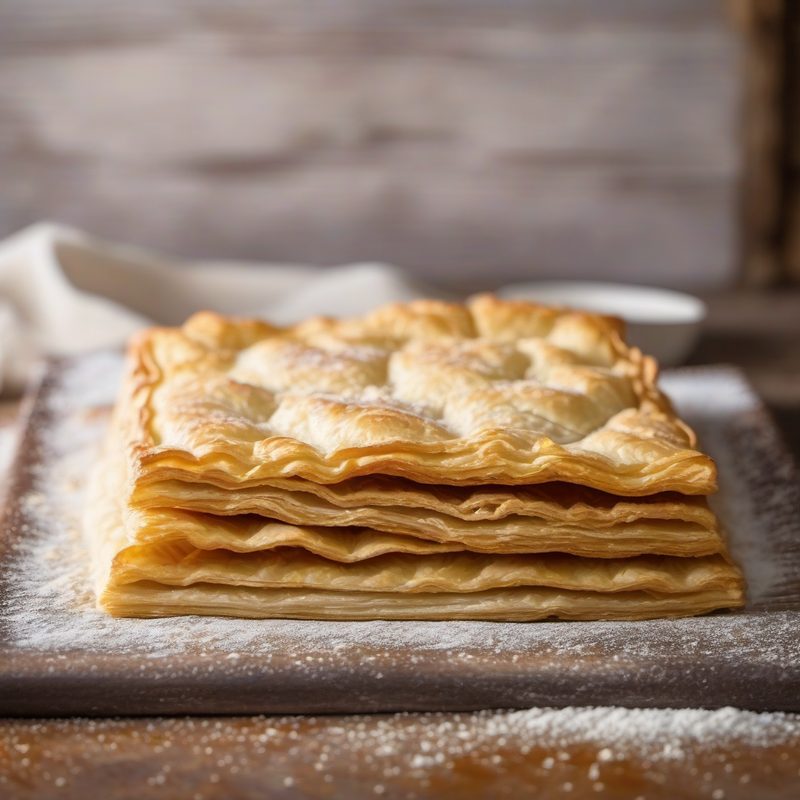
Rough Puff Pastry
A brilliantly clever shortcut to genuine puff pastry — no rolling-and-folding marathon, no all-day commitment, just four quick turns, fifteen-minute chills, and a buttery, shatteringly flaky result that rivals the full-day classic.
| Amount | Ingredient |
|---|---|
| 250 g (2 cups) | All-purpose flour (or tipo "00" flour) |
| 200 g (14 tbsp / 1¾ sticks) | Unsalted butter, very cold, cut into ½-inch (1 cm) cubes |
| ½ tsp | Fine sea salt |
| 125 ml (½ cup) | Ice-cold water |
Rough puff pastry — pasta sfoglia furba e veloce — is the Italian home cook's secret weapon. Traditional puff pastry (pasta sfoglia) is a labor of love: a block of butter is encased in dough, then subjected to six or more "turns" with lengthy rests between each, demanding an entire afternoon of patience and a cool kitchen. Rough puff throws that meticulous process out the window. Instead of enclosing a single butter block, you simply toss cold butter cubes into the flour, add ice water, and bring the dough together while the butter chunks remain stubbornly visible. Then, with just four book folds and a quick chill between each, you build the same layered structure — over a hundred delicate butter-and-dough laminations — in less than two hours.
The result is a pastry that bakes up tall, golden, and impossibly flaky, with a tenderness that the full method can't quite match. It's perfect for pies, tarts, turnovers, palmiers, cheese straws, and any application where you want serious puff without serious effort. The Italian name furba means "clever" or "sly" — and this recipe lives up to it: it's the smart way to get professional puff pastry without the professional workload.
> \Bake time depends on the application — rough puff pastry is typically used as the base for pies, tarts, and pastries. The dough itself is complete after the final chill and can be refrigerated for up to 3 days or frozen for 3 months.*
The ratio here is the key to the method: 250 g flour to 200 g butter (a 1.25:1 ratio by weight). This is slightly more butter than a classic puff pastry (which typically uses a 1:1 ratio by weight), but the rough method needs the extra fat because the butter is distributed as discrete chunks rather than a single enclosed block — the higher butter content ensures reliable lamination even with the less precise technique. Use European-style butter (82–84% butterfat) if possible; its lower water content produces a flakier, more tender pastry. The butter must be straight from the refrigerator — ideally, cube it and return it to the fridge or freezer for 10 minutes before starting. The water must be ice-cold; keep a few ice cubes in it while you work. Tipo "00" flour (the finely milled Italian standard) produces the most tender, delicate puff; all-purpose flour gives a slightly more robust but still excellent result. Do not use bread flour — its higher protein content develops too much gluten, making the pastry tough rather than tender.
🥘 Equipment
- Digital kitchen scale (strongly recommended for precision)
- Large mixing bowl
- Bench scraper or flexible spatula
- Plastic wrap
- Rolling pin
- Baking sheet (lined with parchment paper)
- Ruler or tape measure (optional, for checking dimensions during folding)
- Pastry brush (for egg wash, if using)
- Sharp knife or pastry wheel (for cutting the finished pastry)
- Parchment paper
- Wire cooling rack
📋 Preparation
Step 1 — Combine the Dry Ingredients (2 minutes)
In a large mixing bowl, whisk together 250 g (2 cups) all-purpose flour and ½ teaspoon fine sea salt until evenly distributed.
The salt should be thoroughly dispersed — an unevenly salted pastry is disappointing. Whisking for a full 15 seconds ensures even distribution without aerating the flour excessively.
Step 2 — Add the Butter and Coat (2 minutes)
Scatter the 200 g (14 tbsp) very cold butter cubes over the flour mixture. Using a bench scraper, rubber spatula, or your fingertips, toss and turn the butter cubes in the flour until each cube is thoroughly coated with flour.
Do not rub or press the butter into the flour — the cubes should remain intact. The goal is simply to coat the butter in flour, not to incorporate it. You should see distinct, individual butter cubes swimming in a sea of flour.
This is the defining moment of the rough puff method. In traditional puff pastry, you'd enclose a single butter block in dough and roll it out — the butter is distributed in one large slab. Here, the butter starts as discrete cubes that will be flattened and layered during the folding process. If you rub the butter into the flour at this stage (as you would for shortcrust), you'll get a dense, shortbread-like pastry instead of a flaky, laminated one. The visible, intact butter chunks are essential — they are the future layers of your puff pastry.
Step 3 — Add the Water and Form a Shaggy Dough (3 minutes)
Make a well in the center of the flour-butter mixture. Pour in 125 ml (½ cup) ice-cold water all at once.
Using a bench scraper or flexible spatula, cut and fold the mixture together with a quick, decisive motion — think of it as chopping through the dough rather than stirring it. Continue until the dough starts to come together in a shaggy, ragged mass. There should still be visible butter chunks throughout — the dough should look lumpy and uneven, with distinct yellow butter pieces clearly visible against the white flour.
Do not knead or overmix. If the dough seems dry and won't come together, add ice water 1 tablespoon at a time, folding gently after each addition. You need just enough water to bind the flour — the butter provides no hydration.
The dough at this stage should look nothing like a smooth, uniform dough. It should be ragged, shaggy, and studded with butter chunks. This is exactly right. The lumps and unevenness are what will become the flaky layers after folding. If you smooth it out now, you're destroying the very structure you're trying to build. Work quickly — the colder everything stays, the better the final result.
Step 4 — Pat into a Rectangle and First Chill (5 minutes + 30 minutes chill)
Turn the shaggy dough out onto a lightly floured work surface. Using your hands and a bench scraper, gently gather the dough into a rough rectangle about ½ inch (1.25 cm) thick — approximately 8 × 6 inches (20 × 15 cm). Do not knead or press firmly; just coax it into shape.
The rectangle does not need to be perfect — rough edges and visible butter chunks are expected.
Wrap tightly in plastic wrap and refrigerate for 30 minutes.
Chilling is critical for two reasons: (1) it relaxes the gluten that developed during mixing, making the dough easier to roll without springing back; (2) it re-chills the butter, ensuring the chunks remain firm and intact during the first fold. If the butter softens during rolling, it will smear into the dough rather than creating distinct layers, and you'll end up with a dense, greasy pastry instead of a light, flaky one. The 30-minute minimum is non-negotiable.
Step 5 — Perform Four Book Folds (5 minutes each + 15 minutes chilling between each)
After the first chill, the dough is ready for its series of four book folds (also called double turns or four-folds). A book fold creates four layers with each turn — after four folds, the dough will have 256 layers of butter and dough.
For each fold:
- Lightly flour your work surface and rolling pin. Place the chilled dough rectangle on the floured surface.
- Roll the dough into a rectangle about ½ inch (1.25 cm) thick — roughly 12 × 8 inches (30 × 20 cm). Roll from the center outward, applying even pressure. The dough should resist slightly as you roll — if it springs back aggressively, it needs more rest (return it to the refrigerator for 10 minutes).
- Perform the book fold: Take the short end of the rectangle and fold it toward the center, stopping just before the midpoint. Then take the other short end and fold it over, meeting the first fold at the center — like closing a book. Finally, fold the entire piece in half along the center seam, like closing a book completely. You now have a compact rectangle with four layers.
- Rotate the dough 90 degrees (so the open edges face you like a book spine), wrap in plastic wrap, and refrigerate for 15 minutes.
- Repeat for a total of 4 folds.
| Fold # | Action | Chill After |
|---|---|---|
| 1 | Roll → book fold → rotate | 15 minutes |
| 2 | Roll → book fold → rotate | 15 minutes |
| 3 | Roll → book fold → rotate | 15 minutes |
| 4 | Roll → book fold → rotate | 30 minutes (final chill) |
The book fold (double turn) is more efficient than a simple three-fold (single turn) — each book fold creates 4 layers instead of 3, so you achieve more laminations in fewer folds. After four book folds, the dough has 4⁴ = 256 layers, compared to 3⁶ = 729 layers in a traditional six-turn puff pastry. But because rough puff starts with butter chunks rather than a single block, 256 layers is more than sufficient for excellent puff — the irregular distribution of butter creates its own additional complexity.
Key tips for successful folding:
- Keep the work surface and rolling pin lightly floured but not excessive — too much flour will be incorporated into the dough and make it dry and tough.
- If the butter starts to break through the dough during rolling (you see streaks of butter on the surface), dust the area lightly with flour and continue. If it's warm and greasy, refrigerate immediately.
- If the dough resists rolling or springs back, stop and chill for 10 more minutes — the gluten needs to relax.
- Always rotate the dough 90 degrees between folds to ensure even lamination in all directions.
- Mark each fold on the plastic wrap with a pen or make a small indentation with your finger to track which fold you're on.
Step 6 — Final Chill and Storage (30 minutes)
After the fourth fold, wrap the dough tightly in plastic wrap and refrigerate for at least 30 minutes (or up to 3 days) before using. This final chill relaxes the gluten one last time and ensures the butter is firm, preventing the pastry from shrinking or leaking butter during baking.
The dough is now ready to roll out and use for any recipe calling for puff pastry.
🧑🍳 Chef's Tips
- Temperature is everything. The single most important rule of rough puff pastry: keep everything cold. Cold butter, cold water, cold hands, cool kitchen. If at any point the dough feels warm, sticky, or greasy, wrap it and refrigerate for 15 minutes. A dough temperature below 60°F (15°C) is ideal throughout the process. On a hot summer day, chill the flour and bowl before starting.
- Visible butter chunks are your goal, not your mistake. Unlike shortcrust pastry (where you rub the butter into fine crumbs), rough puff demands that the butter stay in visible chunks. Don't be tempted to work the dough until it's smooth — the lumps are what create the puff.
- Don't skip any chill steps. The 30-minute initial chill and the 15-minute rests between each fold are not optional. They serve two essential purposes: relaxing the gluten (so the dough rolls easily without springing back) and re-chilling the butter (so it remains solid and creates distinct layers during the next roll). Every skipped chill step reduces the eventual puff.
- Handle the dough gently. Rough puff is delicate, especially after the first few folds when the layers are becoming thin. Use a light touch when rolling — press firmly enough to extend the dough, but not so hard that you squeeze the butter layers together. A gentle, patient hand produces the flakiest pastry.
- Use a ruler for even dimensions. Measuring the rectangle dimensions as you roll ensures even layers and uniform lamination. It's worth the extra 10 seconds per fold.
- Mark your folds. It's easy to lose count of which fold you're on. Use a pen to mark the plastic wrap (e.g., "F1," "F2," "F3," "F4") or make small indentations with your fingertip on the wrapped dough.
- If butter breaks through the surface, don't panic. Dust lightly with flour, patch the area with a small piece of scrap dough if needed, and continue. A few butter patches on the surface won't ruin the final result — they'll just create extra-crispy, caramelized spots on the baked pastry.
- For best rise, use the dough cold. Always roll and shape the dough straight from the refrigerator. If it becomes too firm to roll, let it sit at room temperature for 5 minutes — no longer. Warm dough won't puff as dramatically because the butter will be soft and will melt into the dough rather than creating steam-driven layers.
- Make a double batch. This dough freezes beautifully, and having a block of rough puff in the freezer means you're always 20 minutes away from homemade palmiers, cheese straws, or a rustic tart. Double the ingredients, divide into two pieces after the final chill, wrap individually, and freeze for up to 3 months.
- Rest the dough after shaping. After you've rolled the dough to its final dimensions and shaped it (lined a tart pan, cut shapes, etc.), refrigerate for 15 minutes before baking. This final rest relaxes the gluten and re-chills the butter, ensuring maximum rise in the oven.
❌ Common Mistakes
| Mistake | Why It Hurts | The Fix |
|---|---|---|
| Butter is too warm when mixing | Butter smears into flour instead of staying in chunks; no distinct layers form | Cube the butter and freeze for 10 minutes before starting; work in a cool room |
| Overmixing the dough | Develops gluten → tough, dense pastry that won't rise; also warms the butter | Mix just until the dough comes together in a shaggy mass. Stop while it still looks lumpy |
| Skipping or shortening the chilling rests | Gluten hasn't relaxed → dough springs back when rolling; butter is soft → layers smear together | Respect the 15-minute rests between folds. Set a timer — don't guess |
| Rolling too thin before the first fold | Butter chunks get flattened too much and merge; layers can't form | Roll to ½ inch (1.25 cm) thickness for each fold — not thinner |
| Using too much flour on the work surface | Excess flour gets incorporated, drying out the dough and making it tough | Use a light, even dusting; brush off excess before folding |
| Butter breaks through the dough during rolling | The butter layer is exposed; the dough can tear and layers can fuse | Dust with flour and chill immediately. Next time, start with colder butter |
| Not rotating the dough between folds | Butter layers align in one direction only; pastry rises unevenly | Always rotate the rectangle 90 degrees before rolling each fold |
| Baking the pastry while it's warm | Butter melts before the steam can create lift; poor rise and greasy texture | Always chill the shaped pastry for 15 minutes before it goes into the oven |
| Oven temperature is too low | Butter melts slowly and the pastry essentially poaches in fat instead of rising | Bake at 400°F (200°C) or higher — the high heat creates instant steam that lifts the layers |
| Over-baking | Burnt butter flavor; pastry becomes too brittle and shatters when cut | Watch carefully in the last 5 minutes. Puff pastry goes from golden to burnt quickly |
💡 Variations
| Variation | How To |
|---|---|
| Whole Wheat Rough Puff | Replace 100 g (¾ cup) of the all-purpose flour with whole wheat flour. Add 1 extra tablespoon of ice-cold water. The pastry will be nuttier, more rustic, and slightly less tall — but beautifully flavorful. Best paired with savory fillings like mushrooms, root vegetables, or mature cheese. |
| Herb Rough Puff | Add 2 tablespoons finely chopped fresh herbs (thyme, rosemary, sage, or a mix) to the flour before adding the butter. The herbs infuse the layers with fragrance and are spectacular with cheese straws, savory tarts, or as a topping for pot pies. |
| Black Pepper and Parmigiano Rough Puff | Add 1 teaspoon coarsely ground black pepper and 50 g (½ cup) finely grated Parmigiano-Reggiano to the flour. The peppery, umami-laced pastry is extraordinary for cheese straws, palmiers with pesto, or as a crust for savory tarts. Reduce the salt to ¼ teaspoon (the cheese adds salt). |
| Spiced Sweet Rough Puff | Add 2 tablespoons granulated sugar, 1 teaspoon ground cinnamon, and ½ teaspoon ground ginger to the flour. Use the pastry for sweet applications: apple turnovers, palmiers with cinnamon sugar, or a rustic fruit tart. The sugar will caramelize during baking, adding a beautiful glaze. |
| Lemon-Zest Rough Puff | Add the finely grated zest of 1 large lemon to the flour. The bright citrus oils cut through the butter richness beautifully. Excellent with both sweet and savory fillings — perfect for spring vegetable tarts or lemon-sugar palmiers. |
| Smoked Paprika and Cumin Rough Puff | Add 1 teaspoon smoked paprika and ½ teaspoon ground cumin to the flour. A Spanish-inspired savory pastry that pairs brilliantly with chorizo, roasted peppers, and Manchego cheese in a rustic galette. |
❄️ Storage & Make-Ahead
| Method | Details |
|---|---|
| Refrigerator (unbaked dough) | Wrapped tightly in plastic wrap, the prepared dough keeps for up to 3 days. Let it sit at room temperature for 5–8 minutes before rolling — it will be quite firm. |
| Freezer (unbaked dough) | After the final chill, wrap the dough tightly in plastic wrap, then in aluminum foil. Freeze for up to 3 months. Thaw overnight in the refrigerator before using. Do not thaw at room temperature — the butter can soften unevenly. |
| Freezer (shaped, unbaked pastries) | Shape the pastry into your desired forms (turnovers, palmiers, tart shells), place on a parchment-lined baking sheet, and freeze until solid. Transfer to a zipper-lock bag and freeze for up to 2 months. Bake directly from frozen — add 3–5 minutes to the bake time and reduce the oven temperature by 25°F (15°C) to prevent burning before the center cooks through. |
| Refrigerator (baked pastries) | Baked puff pastry items are best enjoyed the same day. If you must store them, keep them in an airtight container at room temperature for up to 1 day. Do not refrigerate — moisture will soften the crisp layers. Re-crisp in a 350°F (180°C) oven for 3–5 minutes. |
| Freezer (baked pastries) | Cool completely, then freeze in a single layer on a baking sheet. Transfer to an airtight container or zipper-lock bag. Freeze for up to 1 month. Reheat directly from frozen in a 350°F (180°C) oven for 5–8 minutes. |
| Make-ahead tip: pre-folded dough | Complete all four folds and the final 30-minute chill. The dough is now at its peak for freezing. Portion it into 250 g (half-recipe) pieces and freeze individually — perfect for small projects. |
🍷 Wine Pairing
| Wine | Why |
|---|---|
| Franciacorta Brut (Lombardy) | Italy's answer to Champagne — fine bubbles, high acidity, and a toasty, nutty note that mirrors the browned butter in baked puff pastry. A celebratory pairing for any puff pastry creation. |
| Prosecco Superiore di Valdobbiadene (Veneto) | Lively, floral, and gently fruity — the crisp effervescence cuts through the buttery richness of puff pastry like a palate-cleansing sigh. Perfect for both sweet and savory applications. |
| Gavi di Gavi (Piedmont) | A steely, mineral-driven white wine with green apple and citrus notes. Its clean acidity balances the richness of butter-based pastry. Excellent with savory puff pastry tarts filled with vegetables or seafood. |
| Soave Classico (Veneto) | Almond, lemon zest, and white flowers — the bitter almond note in the finish is a beautiful counterpoint to the sweet, creamy taste of baked butter. A versatile, elegant pairing. |
| Lambrusco di Sorbara (Emilia-Romagna) | A dry, fizzy red with electric acidity and bright red berry flavors. The bubbles and acidity cut through buttery pastry, and the berry notes complement both sweet (fruit-filled) and savory (prosciutto-filled) puff pastries. Serve lightly chilled. |
| Moscato d'Asti (Piedmont) | Sweet, lightly sparkling, and low in alcohol — the peachy, floral sweetness is a natural match for sweet puff pastry desserts like fruit-filled turnovers, palmiers, or sfogliatelle. |
🥗 Suggested Accompaniments
- Crème fraîche or clotted cream — A cool, tangy dollop provides a luxurious contrast to the hot, flaky, buttery layers. The acidity cuts through the richness beautifully.
- Fresh berries and a dusting of powdered sugar — The simplest and most elegant way to dress up a sweet puff pastry creation. The bright acidity of raspberries or sliced strawberries balances the butter.
- Honey or aged balsamic glaze — A drizzle over a savory puff pastry tart (goat cheese, caramelized onions, arugula) adds a sweet-savory complexity that echoes the caramelized notes of the baked pastry.
- Lightly dressed arugula — Peppery arugula with a simple lemon vinaigrette is the perfect side for any savory puff pastry tart or turnover. The bitterness and acidity cut through the richness.
- Good-quality jam or fruit preserves — Apricot, fig, or raspberry jam, warmed and brushed over a sweet puff pastry creation, adds both flavor and a beautiful glossy finish.
- Whipped mascarpone — Lightly sweetened mascarpone (beaten with a touch of vanilla and powdered sugar) is a dreamy accompaniment for any fruit-filled puff pastry dessert.
📊 Nutrition (per ⅙ of total dough — approximately 85 g unbaked)
| Calories | Protein | Fat | Carbs | Fiber | Sugar |
|---|---|---|---|---|---|
| ~380 | 4 g | 28 g | 30 g | 1 g | 0.3 g |
Nutritional values are estimates for the unbaked dough (⅙ of the full 500 g recipe). The vast majority of calories come from butter (about 200 calories from fat alone per serving) and flour (about 110 calories from carbohydrates). This is, by its nature, a high-fat, high-calorie preparation — puff pastry is a celebration food, not an everyday staple. Each serving contains approximately 28 g of fat (18 g saturated), which represents the indulgence inherent in laminated pastry. The pastry is naturally low in sugar (less than 0.3 g per serving) — any sweetness comes from the filling or topping, not the dough itself. The full recipe (6 servings) contains approximately 2,280 calories and 168 g of fat. For a slightly lighter version, reduce the butter to 175 g (12½ tbsp) — the pastry will be less tall and flaky but still substantially more impressive than shortcrust. The whole wheat variation adds approximately 2 g of fiber per serving. Note that once the pastry is filled and baked, the nutritional profile changes dramatically based on the filling — a cheese and ham turnover can add 150–300 calories per serving, while a fruit-filled turnover with a dusting of sugar adds approximately 50–100 calories. Puff pastry is best enjoyed as an occasional indulgence, made well and savored fully.
❓ Frequently Asked Questions
What's the difference between rough puff pastry and classic puff pastry?
Classic puff pastry (pâte feuilletée) encloses a single block of butter in a dough envelope, then performs six "single turns" (three-folds) with 30-minute rests between each, creating 729 layers. Rough puff starts with butter chunks distributed throughout the dough and performs four "book folds" (four-folds) with shorter 15-minute rests, creating 256 layers. Rough puff is faster, more forgiving, and requires less technique, but it doesn't rise quite as high or as evenly as classic puff. For most home uses — pies, tarts, turnovers, cheese straws — rough puff is indistinguishable from the real thing.
Can I make this in a food processor?
Yes. Pulse the flour and salt 3 times to combine. Scatter the cold butter cubes over the flour and pulse 5 to 6 times (1-second pulses) — the butter should be broken into pieces ranging from pea-sized to ½-inch cubes, with some larger chunks remaining. Add the ice-cold water all at once and pulse 4 to 5 times, until the mixture looks like a shaggy, lumpy mass with visible butter chunks. Do not let it form a ball in the processor. Turn it out onto a floured surface, gather into a rectangle, and proceed with Step 4 (first chill). The food processor is faster and keeps the butter colder, making it ideal for warm kitchens.
Can I use salted butter instead of unsalted?
Yes, but omit the ½ teaspoon of salt. Different brands of salted butter vary in sodium content (from ¼ to ½ teaspoon per stick), so unsalted butter with your own salt gives the most consistent result.
Why is my puff pastry not rising?
Several possible causes: (1) the butter was too warm or too soft during mixing or folding → it melted into the dough rather than creating distinct layers; (2) the dough wasn't chilled enough between folds → the butter layers smeared together; (3) the oven wasn't hot enough → the butter melted before the steam could create lift (always preheat to at least 400°F/200°C); (4) the dough was overmixed or kneaded → gluten development made it tough and dense. For troubleshooting: start with colder butter, respect the chill times, and bake at a higher temperature.
Why is my puff pastry greasy?
A greasy result means the butter separated from the dough and pooled out during baking. This happens when: (1) the butter was too warm during folding and got absorbed into the dough instead of staying in distinct layers; (2) the oven temperature was too low, giving the butter time to melt and leak before the structure set; (3) the pastry was baked before it was fully chilled. To fix: make sure the pastry is very cold before baking, and use a hot oven (400°F/200°C minimum). Also, be sure you're not over-flouring the dough during rolling — excess flour can interfere with the lamination.
Can I use this dough for sweet applications?
Absolutely. The dough itself contains no sugar, so it's perfectly neutral and works for both sweet and savory. For sweet applications, you can add 2 tablespoons of granulated sugar to the flour at the beginning (see the Spiced Sweet Rough Puff variation above), or simply dust the finished baked item with powdered sugar, glaze with fruit preserves, or serve with a sweet filling. The unsweetened dough is actually preferred for many sweet applications because it allows the filling to provide all the sweetness without an overly sweet crust.
Can I halve or double this recipe?
Yes. Halve or double all ingredients proportionally. For a half recipe (125 g flour, 100 g butter, ¼ tsp salt, 63 ml water), the folding and chilling steps remain the same — the dough rectangle will be smaller, about 6 × 4 inches (15 × 10 cm). For a double recipe (500 g flour, 400 g butter, 1 tsp salt, 250 ml water), fold the dough in two separate batches — handling too much dough at once is unwieldy and the butter may warm up from extended handling.
How do I use this rough puff pastry?
Roll the chilled dough to your desired thickness (typically ⅛ to ¼ inch / 3 to 6 mm, depending on the application). Cut or shape as needed. For the best rise: after shaping, refrigerate the pastry pieces for 15 minutes before baking. Brush with egg wash (1 egg beaten with 1 tablespoon water or milk) for a golden, glossy finish. Bake at 400°F (200°C) for most applications — the high heat is essential for creating the steam that lifts the layers. For filled pastries, bake until the pastry is deep golden brown and feels light and crisp.
What can I make with rough puff pastry?
Endless possibilities! Savory: cheese straws, sausage rolls, pot pie topping, beef Wellington, savory tarts, palmiers with pesto or tapenade, turnovers filled with mushroom duxelles or spinach and feta. Sweet: fruit turnovers (apple, cherry, peach), palmiers with cinnamon sugar, mille-feuille (Napoleon pastry), tarte Tatin with puff pastry top, jam-filled chausson turnovers, or simply bake the plain pastry as pâte feuilletée sheets to use in layered desserts.
Can I use this dough immediately after making it, or does it need to rest?
The dough needs at least the final 30-minute chill before using. This relaxes the gluten and re-chills the butter, both of which are essential for a good rise. For the best results, refrigerate overnight — the flavor improves as the flour and butter meld, and the gluten relaxes completely, making the dough easier to roll and shape. Dough that has rested overnight rises noticeably higher than dough used after just 30 minutes.
What's the best way to cut rough puff pastry?
Use a sharp knife, pastry wheel, or pizza wheel with a clean, decisive motion — do not saw or drag the blade, which can press the layers together and prevent rising. For cleanest edges, dip the blade in hot water and dry it before cutting (the heat seals the edges slightly, helping the layers stay separate). After cutting, always chill the pieces for 15 minutes before baking.
🔗 Related Recipes
- Puff Pastry Tomato and Cheese (#181) — A classic savory puff pastry tart that can be made with this rough puff dough. See the recipe for the simple, rustic assembly.
- Apple Strudel Puff Pastry (#63) — A sweet, cinnamon-spiced apple strudel using store-bought or homemade puff pastry. This rough puff dough is a perfect substitute for the store-bought option.
- Puff Pastry Cottage Cheese and Asparagus (#248) — A savory springtime tart that showcases puff pastry's ability to cradle creamy fillings and tender vegetables.
- Air Fryer Ham and Cheese Pastries (#373) — Quick, cheesy puff pastry turnovers made in an air fryer. Use this rough puff dough for a homemade upgrade.
- Square Puff Pastry Pizzas (#269) — A fun, kid-friendly pizza variation using puff pastry as the base. The flaky, buttery crust is a delightful alternative to traditional pizza dough.
- Basic Shortcrust Pastry — Pasta Frolla (#124) — The sweet, tender Italian shortcrust that is the counterpart to this flaky, laminated pastry. If you master both, you cover the entire pastry repertoire.
- Pâte Brisée — Savory Shortcrust (#442) — The savory French shortcrust, a non-laminated alternative for quiches and savory tarts. Use this when you want a crisp, sturdy shell rather than a tall, flaky one.
- Pie Crust Dough (#243) — A simple, workhorse pie dough for everyday pies. Less flaky than rough puff but more forgiving and easier to handle.
- Pizza Dough (#29) — The yeast-risen counterpart to puff pastry. Between this rough puff and a good pizza dough, you can make anything from savory galettes to dessert calzones.
- Éclair Cream and Chocolate (#106) — The choux pastry equivalent of this puff pastry — a different type of pastry altogether, but equally foundational to the pastry chef's repertoire.
🏷️ Search Tags
📸 Photo Reference
Photo reference: `vol1_482.png` — A close-up, overhead shot on a cool marble pastry board, lightly dusted with flour. In the center, the finished rough puff dough has just completed its final chill and is unwrapped — a neat rectangle of pale, creamy dough showing faint striations of butter running through it in irregular, beautiful streaks. Beside it, a cross-section cut from a previous batch reveals the delicate layering: dozens of paper-thin alternating bands of dough and butter, some translucent, some opaque, creating a geological stratum effect. In the background, a small bowl holds a few remaining cubes of cold butter still dusted with flour, and a glass of ice water stands with condensation beading on its surface — a visual reminder of the two essential ingredients beyond flour and salt. A metal bench scraper, its blade smudged with butter and flour residue, rests beside the dough. A ruler lies alongside the rectangle to indicate scale. On the far left, a single baked rough puff pastry item — a golden, dramatically risen palmier — is posed on a small piece of parchment, its caramelized sugar stripes glistening, its puffed layers visibly separating like the pages of a tiny, edible book. The lighting is cool and natural — indirect daylight from a north-facing window, creating soft shadows that emphasize the striations in the dough cross-section and the crisp, elevated layers of the baked palmier. A small kitchen thermometer reads 58°F (14°C), confirming the ideal working temperature. The mood is precise, patient, and quietly triumphant — the image of a technique that rewards attention to detail with spectacular, flaky results.
Recipe from "The Italian Kitchen" by Vita Milanese — Volume 1: Pasta Perfetto 🥟
Recipe from The Italian Kitchen by Vita Milanese — Volume 1 · Pasta Perfetto. Discover all volumes on the ebook page.