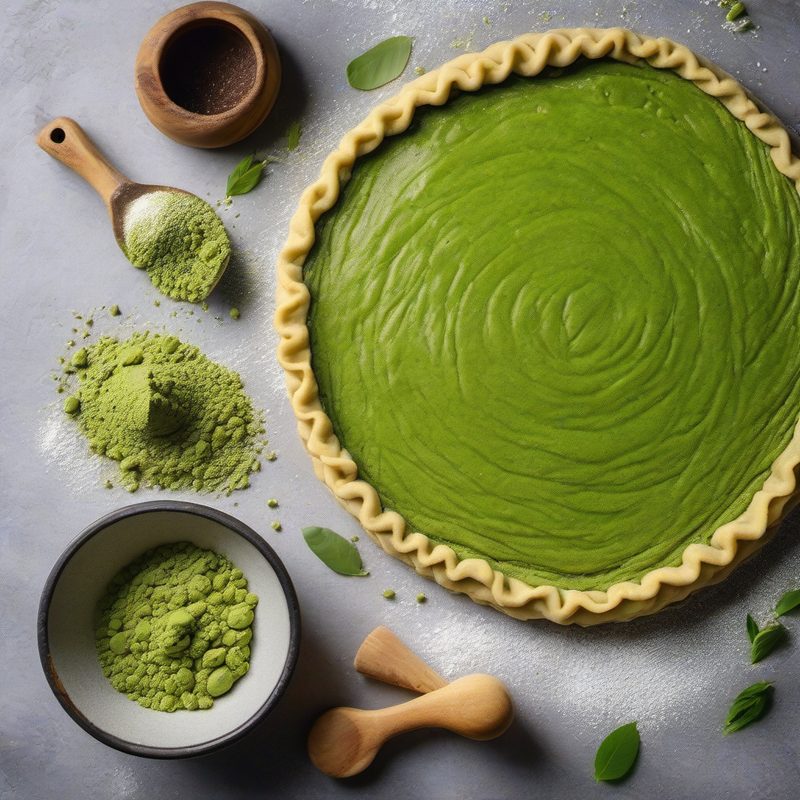
Matcha Shortcrust Pastry
A delicate, pale-green shortcrust pastry infused with the earthy elegance of Japanese matcha — tender, lightly sweet, and perfect for tarts, cookies, and cream-filled desserts. This Japanese-Italian fusion dough brings a whisper of green tea bitterness that beautifully balances sweet fillings.
| Amount | Ingredient |
|---|---|
| Dough is sticky and greasy | Butter too warm or over-creamed Chill dough for 30 minutes before rolling. If still sticky, roll between parchment sheets |
| Matcha flavor is bitter or harsh | Low-quality matcha or too much powder Stick to 1 tbsp (8 g) of good-quality matcha. Culinary grade is intentionally more bitter — reduce to 2 tsp if using it |
| Crust shrinks during baking | Gluten overdeveloped or dough not rested long enough Mix only until combined; chill a full 60 minutes. For tart shells, freeze 15 minutes before blind baking |
| Pastry turns brown, not green | Oven too hot or baked too long Bake at 350°F (175°C) max. Remove at the first sign of set edges. The matcha will continue to darken slightly as it cools |
> Key timing note: The dough requires a 1-hour refrigerator rest before rolling. For best flavor, the matcha blooms as the dough chills — do not shorten this step. The pastry can also be made a day ahead and kept refrigerated, tightly wrapped.
🥘 Equipment
- Large mixing bowl
- Electric hand mixer or stand mixer with paddle attachment
- Rubber spatula
- Plastic wrap
- Bench scraper or chef's knife
- Rolling pin (optional, depending on use)
- Baking sheet lined with parchment (for cookies)
- 9½–10 inch (24–26 cm) tart pan with removable bottom (for tart shell)
- Parchment paper
📋 Preparation
Step 1: Cream the Butter and Sugar
In a large mixing bowl, combine the softened butter and sugar. Beat with an electric mixer on medium speed for 2–3 minutes, until the mixture is pale, light, and fluffy. Scrape down the sides and bottom of the bowl with a rubber spatula.
Proper creaming is essential — it incorporates air that gives the finished crust a tender, melt-in-your-mouth texture. The matcha intensifies as it hydrates, so a well-creamed base ensures even color distribution.
Step 2: Add the Egg, Matcha, and Salt
Add the egg, matcha powder, and salt to the creamed mixture. Beat on low speed just until combined — about 30 seconds. Scrape the bowl again.
Do not overmix here. The matcha should be fully incorporated (no green streaks), but aggressive mixing at this stage can over-develop the gluten when the flour goes in.
Why matcha first? Dissolving the matcha in the wet ingredients ensures it disperses evenly throughout the dough rather than creating pockets of bitter green tea powder.
Step 3: Add the Flour
Add the flour all at once. Mix on the lowest speed — or switch to a rubber spatula — and stir just until the flour disappears into the dough. Stop as soon as the dough comes together. It should look sandy at first, then clump into a cohesive mass. Do not continue mixing once it forms a ball.
Overworking the dough develops gluten, resulting in a tough, shrunken crust. The hallmark of a great shortcrust is tenderness, not strength.
Step 4: Shape and Chill
Turn the dough out onto a lightly floured work surface. Pat it into a 6-inch (15 cm) disc about ¾ inch (2 cm) thick. Wrap tightly in plastic wrap.
Refrigerate for at least 1 hour. During this time the butter firms up, the gluten relaxes, and the matcha flavor deepens as the powder fully hydrates.
Pro tip: If the dough cracks when you try to roll it after chilling, let it sit at room temperature for 5–10 minutes. It should be firm but pliable — like a cold stick of butter you can still bend without snapping.
Step 5: Roll and Use
For a tart shell: Place the chilled disc between two sheets of lightly floured parchment paper. Roll from the center outward to a 12-inch (30 cm) circle, about ⅛ inch (3 mm) thick. Transfer to your tart pan, gently press into the bottom and fluted edges, and trim the overhang with a rolling pin. Dock (prick) the bottom all over with a fork. Freeze for 15 minutes before blind baking at 350°F (175°C) for 15 minutes with pie weights, then 10 minutes without.
For cookies: Roll the dough to ¼ inch (6 mm) thick between parchment sheets. Cut into desired shapes and bake at 350°F (175°C) for 12–14 minutes, until the edges are just set but not browned. The matcha color is your visual cue — it should remain a vibrant pale green.
🧑🍳 Chef's Tips
- Matcha quality matters: Use high-quality Japanese matcha — ceremonial grade for the most vibrant color and smoothest flavor, or culinary grade for a more assertive tea bitterness. Avoid pre-sweetened matcha latté powders, which contain added sugar and milk solids that will throw off the dough balance.
- Room-temperature ingredients: The butter and egg must both be at room temperature (about 65–70°F / 18–21°C). Cold butter won't cream properly; cold egg can seize the mixture.
- Softened, not melted: The butter should be soft enough to hold a finger印 easily, but not melted or oily. If it looks greasy or separated, chill the mixture for 10 minutes before proceeding.
- Blind baking for tart shells: Always freeze the shaped tart shell for 15 minutes before baking — this prevents the sides from slumping. Use pie weights or dried beans, and line the shell with parchment first.
- Matcha darkens with heat: Matcha naturally turns from bright green to olive or brown when exposed to high heat. Bake at a moderate temperature (350°F / 175°C) and watch carefully. The pastry is done when it feels set and dry to the touch, not when the edges color.
❌ Common Mistakes
| Mistake | Why | Fix |
|---|
💡 Variations
- Matcha-Chocolate Swirl: Divide the dough in half before adding flour. Add 1 tbsp cocoa powder to one half, then gently twist both doughs together before chilling. The result is a striking green-and-brown marble pattern.
- Citrus-Matcha: Add 1 tsp finely grated lemon or yuzu zest along with the egg. The citrus oils brighten the matcha's vegetal notes beautifully.
- Almond-Matcha: Replace 30 g (¼ cup) of the flour with almond flour. This adds nuttiness and makes the dough more tender — ideal for tart shells with fruit fillings.
- Vegan Matcha Shortcrust: Replace the butter with 100 g solid coconut oil (refined, for neutral flavor) and the egg with 3 tbsp aquafaba (chickpea brine) or a flax egg (1 tbsp ground flax + 3 tbsp water, rested 10 min). Chill 90 minutes instead of 60.
- Gluten-Free Version: Substitute the all-purpose flour with a 1:1 gluten-free baking blend (containing xanthan gum). The dough will be more delicate — roll between parchment sheets and handle gently.
❄️ Storage
| Condition | Duration | Method |
|---|---|---|
| Refrigerator (raw dough) | Up to 3 days | Wrap tightly in plastic wrap, then place in an airtight container |
| Freezer (raw dough disc) | Up to 3 months | Double-wrap in plastic wrap and foil. Thaw overnight in the fridge before rolling |
| Freezer (baked tart shell) | Up to 1 month | Cool completely, wrap in foil, place in a freezer bag. Re-crisp at 300°F (150°C) for 5 minutes before filling |
| Freezer (baked cookies) | Up to 2 months | Freeze in a single layer on a baking sheet, then transfer to a freezer bag. Thaw at room temperature for 15 minutes |
| Counter (baked shell or cookies) | Up to 5 days | Store in an airtight container at cool room temperature away from sunlight (matcha is light-sensitive) |
🍷 Wine Pairing
| Wine | Why |
|---|---|
| Moscato d'Asti | Lightly sparkling with peach and honey notes — the gentle sweetness complements matcha's earthy bitterness |
| Vin Santo | Rich, nutty, raisined — a classic Italian dessert wine that stands up to green tea flavors |
| Sauternes | Honeyed, botrytised sweetness balanced by bright acidity — the contrast with matcha's savory notes is sublime |
| Japanese Plum Wine (Umeshu) | Sweet-tart stone fruit character echoes matcha's grassy complexity |
🍵 Tea Pairing
| Tea | Why |
|---|---|
| Hojicha | Roasted green tea — a complementary toasted-nut profile that enhances the pastry without competing |
| Genmaicha | Toasted rice tea — the popcorn-like notes play against the buttery shortcrust |
| Jasmine Green Tea | Floral perfume lifts and brightens the matcha's vegetal depth |
| Cold-brew Sencha | Clean, umami-rich — serves as a palate cleanser between bites of sweet pastry |
🥗 Suggested Sides
- A small bowl of fresh strawberries or raspberries (the tart berries cut through the buttery richness)
- Whipped cream lightly sweetened with honey and a pinch of salt
- Vanilla gelato or honey ice cream — the classic pairing for matcha desserts
- A tiny cup of espresso or cold-brew coffee — the bitter notes of coffee and matcha harmonize beautifully
- Lemon curd or yuzu marmalade as a bright, tangy counterpoint to serve alongside
📊 Nutrition (per serving, ⅛ of tart shell)
| Calories | Protein | Fat | Carbs | Fiber | Sugar |
|---|---|---|---|---|---|
| 240 | 4 g | 13 g | 27 g | 1 g | 10 g |
Note: Nutrition varies based on actual use — cookie portions (per cookie) are approximately 95 calories.
❓ FAQ
Can I use salted butter instead of unsalted?
Yes — simply omit the added salt (¼ tsp) from the recipe. The butter provides enough seasoning on its own.
My matcha turned brown after baking. What did I do wrong?
Matcha is extremely heat-sensitive. The vibrant green oxidizes to olive or brown at high temperatures. Bake at 350°F (175°C) maximum, and watch closely. Some darkening is normal, but a pronounced brown color means the oven was too hot or the bake time too long. Next time, try 325°F (165°C) and extend the time by 2–3 minutes.
The dough is too dry to come together. Can I add liquid?
Yes — add 1 teaspoon of cold water or milk at a time, mixing gently after each addition. Stop as soon as the dough holds together when squeezed. Be sparing: it's easier to add moisture than to remove it.
Can I make this in a food processor?
Absolutely. Pulse the flour, sugar, and salt together (2 pulses). Add the cubed butter and pulse 8–10 times until the mixture looks like coarse meal. Whisk the egg and matcha together in a small bowl, add to the processor, and pulse just until the dough clumps. Turn out and shape into a disc — do not run the processor continuously or the gluten will develop.
What if I don't have a tart pan? Can I still use this dough?
Yes — this is a versatile shortcrust. Roll and cut into cookies, use as a galette base, press into a pie plate, or even roll into thin strips for matcha biscotti or matcha "grissini" (breadsticks).
Is there a dairy-free version?
Yes — substitute the butter with 100 g of high-quality vegan butter block (like Miyoko's or Naturli'), or refined coconut oil for a firmer texture. The flavor will shift slightly; coconut oil adds a subtle tropical note that pairs surprisingly well with matcha.
Can I double this recipe?
Yes. Double all ingredients and increase the creaming time to 4 minutes. Divide the dough into two discs before chilling — the dough keeps well in the freezer for up to 3 months.
🔗 Related Recipes
- Pasta Frolla Classica — The Essential Sweet Shortcrust (base recipe)
- Tart with Lemon Cream and Fresh Berries
- Matcha White Chocolate Cookies (using this dough)
- Bakewell Tart with Almond and Matcha Frangipane
🏷️ Search Tags
Recipe from The Italian Kitchen by Vita Milanese — Volume 1 · Pasta Perfetto. Discover all volumes on the ebook page.