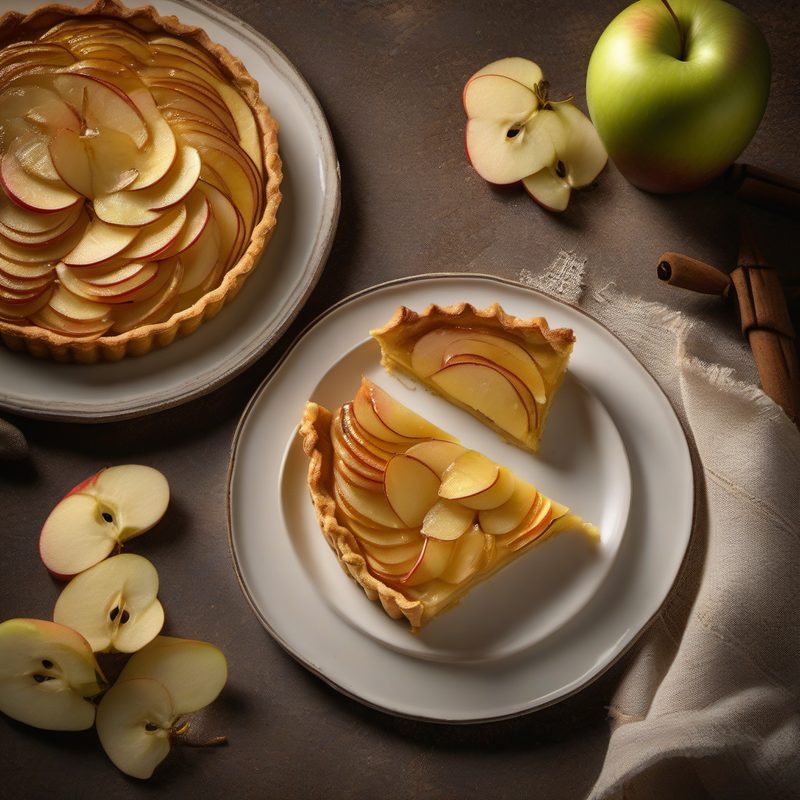
Landes Apple Tart
| Amount | Ingredient |
|---|---|
| Calories | ~365 kcal |
| Fat | 19 g |
| Saturated Fat | 11 g |
| Cholesterol | 85 mg |
| Sodium | 140 mg |
| Carbohydrates | 42 g |
| Fiber | 4 g |
| Sugar | 27 g |
| Protein | 4 g |
Landes Apple Tart — Tourtière Landaise
| Category | Dolci (Desserts) |
| Servings | 8 |
| Active Time | 25 minutes |
| Total Time | 1 hour 10 minutes (includes baking) |
🧠 Why This Recipe Works — The ATK Difference
The Tourtière Landaise is not a fancy tart — it is a farmer's dessert, born in the pine forests and apple orchards of southwestern France. It succeeds on the quality of its few ingredients and the care taken in their assembly.
Thinly sliced apples are the key. Sliced no thicker than ¼ inch (6 mm), they cook through evenly in the 40–45 minute bake, surrendering enough moisture to soften without turning to mush. The layers remain distinct, each forkful offering a clean slice of apple suspended in custard.
The custard does double duty. Beaten eggs, sugar, melted butter, and Armagnac (or rum) are poured over the raw apples rather than mixed in. As the tart bakes, the custard sinks between the slices, puffing gently around them, and sets into a delicate, barely-there crème that binds the filling without dominating it. The spirit's alcohol burns off during baking, leaving only its fruit-and-wood perfume.
Armagnac is not optional — or rather, its equal is not optional. The Landes region is the heart of Armagnac country, and this tart is defined by the warm, pruney, vanilla-tinged note that only Gascony's great brandy provides. Dark rum is the honorable substitute, but the soul of the dish changes. If you have Armagnac, use it.
A hot-from-the-oven rest is essential. This tart needs at least 20 minutes after baking to let the custard finish setting and the flavors meld. Served warm (not hot), it slices cleanly and the butter, sugar, and apple juices have a moment to marry into something greater than the sum of their parts.
- Apples — Choose a firm, moderately sweet apple that holds its shape when baked. Golden Delicious, Gala, Fuji, or Honeycrisp all work well. Avoid Granny Smith — their aggressive tartness clashes with the gentle character of this tart; avoid McIntosh or other soft varieties that collapse into sauce. Six medium apples (about 1.2 kg / 2.6 lb total) yields the right volume for a 9–10 inch (23–25 cm) tart shell. Peel, quarter, and core them before slicing.
- Shortcrust Pastry Shell (Pâte Brisée or Pasta Frolla) — A single pre-baked (blind-baked) 9- to 10-inch (23–25 cm) tart shell. You can use homemade shortcrust (175 g flour, 85 g cold butter, 1 egg yolk, 2 tbsp cold water, pinch of salt — par-baked at 180°C/350°F for 15 minutes with pie weights) or a high-quality store-bought shell. The shell should be fully baked and cooled before filling. Do not use puff pastry or phyllo — the sturdy, buttery shortcrust is essential to support the custard without turning soggy.
- Butter — Unsalted European-style butter (82% fat or higher) such as Plugrà or Kerrygold. Its lower water content produces a richer, more stable custard and a more tender crumb. Melt it gently and let it cool slightly before adding to the egg mixture so it doesn't scramble the eggs.
- Armagnac — The soul of the tart. Look for an Armagnac labeled VS or VSOP from the Bas-Armagnac region if possible — it will be fruit-forward with notes of plum, vanilla, and oak. If you don't have Armagnac, dark rum (preferably aged, such as Appleton Estate or Mount Gay XO) is the best substitute. Do not use light rum, bourbon, or cognac — they change the flavor profile substantially.
- Eggs — Large (about 50 g each), at room temperature. Room-temperature eggs incorporate more evenly into the custard and help it set with a finer texture.
- Sugar — Standard white granulated sugar. Its neutrality lets the apple and Armagnac flavors shine. Do not substitute brown sugar, which adds molasses notes that muddy the clean, orchard-fresh character of the tart.
- Cinnamon — A modest amount (about ¼ teaspoon, or one generous pinch) warms the apple flavor without overpowering the Armagnac. Freshly ground cinnamon from a whole stick is noticeably more aromatic than pre-ground. If you prefer, a scrape of fresh nutmeg (about ⅛ teaspoon) can stand in or complement the cinnamon.
Notes on Equipment
- 9- to 10-inch (23–25 cm) fluted tart pan with removable bottom — Essential for clean release and neat slicing. A standard metal pan (not dark nonstick, which conducts heat unevenly and can over-brown the crust) is best. A ceramic or glass tart dish works but requires a slightly longer bake (add 5–8 minutes) because it heats more slowly.
- Baking sheet — Place the tart pan on a heavy baking sheet (rimmed) before baking. This catches any dripping butter or custard overflow, distributes heat evenly, and makes it easy to rotate the tart halfway through.
- Chef's knife or mandoline — A mandoline (set to ¼ inch / 6 mm) produces perfectly uniform slices in seconds. If using a chef's knife, take your time to keep slices even — uneven slices lead to uneven cooking.
- Large mixing bowl and whisk — For beating the custard. A balloon whisk gives better aeration than a fork.
- Microplane or fine grater — If using fresh nutmeg or grating cinnamon stick.
- Cooling rack — Essential for the 20-minute rest. A rack allows air to circulate under the tart pan, preventing condensation from softening the bottom crust.
- Small saucepan — For melting the butter gently without browning it.
For serving (optional):
- Confectioners' sugar, for dusting
- Crème fraîche or lightly whipped cream
Prep Work (Mise en Place)
- Pre-bake the tart shell: If using homemade shortcrust, roll it to ⅛ inch (3 mm) thickness and line the tart pan. Prick the bottom all over with a fork. Line with parchment and fill with pie weights or dried beans. Bake at 180°C/350°F (160°C fan) for 15 minutes. Remove weights and parchment and bake 5 minutes more until pale gold and dry to the touch. Let cool completely on a rack. If using a store-bought shell, follow package instructions.
- Melt the butter in a small saucepan over low heat. Set aside to cool to room temperature — it should be liquid but not hot to the touch (about 35–40°C / 95–105°F).
- Prepare the apples: Peel the apples. Cut each into quarters and remove the core. Slice each quarter crosswise into ¼-inch (6 mm) thick slices. A mandoline is ideal; if using a knife, aim for uniform thickness. Place the slices in a large bowl and toss gently to separate them.
- Preheat the oven to 180°C / 350°F (160°C fan) with a rack in the middle position.
- Place the tart pan on a rimmed baking sheet for stability and easy handling.
Instructions
1. Layer the apples in the shell
- Arrange the apple slices in the pre-baked tart shell in concentric, slightly overlapping circles, starting at the outer edge and working inward. Fill every gap — the apples will settle during baking, so pack them generously. Mound them slightly in the center; they will sink to level as they soften.
2. Make the Armagnac custard
- In a medium mixing bowl, whisk the eggs and granulated sugar together until pale, thick, and slightly frothy — about 1 minute.
- Whisk in the cooled melted butter in a thin, steady stream, whisking constantly to emulsify.
- Whisk in the Armagnac (or rum), cinnamon, and a pinch of fine sea salt. The mixture should be smooth, homogeneous, and lightly thickened.
3. Pour the custard over the apples
- Pour the custard evenly over the layered apples, letting it cascade through the gaps. Use a rubber spatula to scrape every last drop from the bowl.
- Gently tilt the tart pan or use the spatula to help the custard reach all areas — especially the edges and the bottom. Don't worry if some apple slices remain partially exposed; the custard will puff and rise around them during baking.
4. Bake the tart
- Place the tart (still on the baking sheet) in the preheated oven. Bake for 40–45 minutes, rotating the baking sheet 180° after 20 minutes for even browning.
- The tart is done when the custard is set and lightly puffed — it should jiggle very slightly in the center (like a custard pie) but not slosh. The apples will be tender when pierced with a paring knife, and the crust will be deep golden brown. If the edges of the crust brown too quickly (after about 30 minutes), tent the entire tart loosely with aluminum foil.
5. Cool and rest
- Transfer the tart pan to a wire rack. Let the tart rest at least 20 minutes — ideally 30 — before slicing. This rest is non-negotiable: the custard continues to set as it cools, and the flavors meld into harmony.
- Serve warm (not hot). Dust lightly with confectioners' sugar just before serving if desired.
6. Slice and serve
- Remove the outer ring of the tart pan. Use a sharp, thin-bladed knife to cut into wedges, wiping the blade clean between cuts for neat slices.
- Serve each slice with a dollop of crème fraîche or a drift of lightly whipped cream.
Troubleshooting
Custard curdled or separated during baking:
The butter was likely too hot when added to the eggs, causing the eggs to seize. Always let melted butter cool to room temperature (about 35–40°C / 95–105°F) before whisking it in. If the custard does separate, the tart is still edible but the texture will be denser and slightly greasy — serve it warm with plenty of cream to mask the texture flaw.
Tart shell is soggy on the bottom:
The shell may not have been fully baked before filling, or the apples released more moisture than expected (very juicy apples). To prevent this, always fully pre-bake the shell to a pale golden color and let it cool completely before filling. Soggy bottoms can also be avoided by placing the tart on the lowest oven rack for the first 15 minutes of baking to ensure the bottom crust gets direct heat.
Apples are undercooked:
Your slices may have been too thick (over ¼ inch / 6 mm) or your apples were a very dense variety. Next time, slice more thinly or give the tart an additional 5–10 minutes of baking time, tented with foil to prevent over-browning the top.
Crust edges browning too quickly:
Cover the crust edges with foil or a pie shield after 25–30 minutes of baking. The sugars in the pastry darken faster than the rest of the tart.
Tart sticks to the pan:
A fluted tart pan with a removable bottom should release easily. If it sticks, run a thin spatula or knife between the crust and the pan wall before removing the outer ring. For future tarts, butter the pan generously before lining with pastry, even if the pan is nonstick.
Variations
Classic Normandy Style (Tarte Normande)
Replace the Armagnac with 100 ml of Calvados (apple brandy from Normandy) and add 1 tablespoon of crème fraîche to the custard. The Calvados reinforces the apple flavor with a sharper, fruitier kick. Serve with a generous spoonful of crème fraîche on the side.
Salted Butter Caramel Version
Drizzle 3 tablespoons of salted butter caramel (homemade or high-quality jarred) over the apples before pouring the custard. The salted caramel adds a deep, butterscotch-tinged sweetness that plays beautifully against the tartness of the apples.
Prune and Armagnac Variation (Tourtière Landaise aux Pruneaux)
Reduce the apples to 4 and add 8–10 pitted prunes (softened in warm Armagnac for 20 minutes, then drained and halved). Layer the prunes among the apple slices. Prunes are a classic pairing with Armagnac in the Landes region and add a jammy, concentrated sweetness.
Gluten-Free Version
Use a gluten-free shortcrust pastry (150 g gluten-free all-purpose flour blend, 80 g cold butter, 1 egg yolk, 1–2 tbsp cold water, pinch of xanthan gum). Blind-bake as directed. The gluten-free crust is more fragile, so handle it gently when slicing.
Dairy-Free Version
Substitute the butter with 80 g of refined coconut oil (melted and cooled) or a high-quality plant-based butter (e.g., Miyoko's). The coconut oil version will have a faint coconut aroma that pairs surprisingly well with the Armagnac and apples.
Serving Suggestions
- Serve warm (not hot) — the ideal temperature is about 10 minutes after the 20-minute rest, when the tart is still pleasantly warm to the touch but the custard has fully set.
- A dollop of crème fraîche is the classic accompaniment in Gascony. Its tangy, lactic coolness cuts through the richness of the buttery custard. Lightly whipped cream (barely sweetened) or a scoop of vanilla bean ice cream also work beautifully.
- Pair with a glass of Monbazillac (a sweet white wine from just north of the Landes), a late-harvest Sémillon, or — staying true to the region — a small glass of Armagnac served neat or on a single large ice cube.
- For a coffee pairing, serve with a small, strong espresso or a café noisette (espresso with a dash of milk). The bitterness of the coffee contrasts the tart's sweetness.
- This tart is rich enough to stand alone as a dessert, but a small green salad with a lemon vinaigrette makes an elegant palate cleanser beforehand.
Storage Instructions
- Room temperature: The tart can be kept at room temperature, loosely covered with foil or a clean kitchen towel, for up to 6 hours. Do not refrigerate if serving within this window — refrigeration dries out the custard and dulls the apple and Armagnac flavors.
- Refrigeration: For longer storage, cover tightly with plastic wrap and refrigerate for up to 3 days. Bring to room temperature (about 45 minutes) or reheat gently before serving.
- Freezing: Freezing is not recommended. The custard's delicate emulsion breaks upon thawing, leaving the tart watery and the crust soggy. If you must freeze, freeze the pre-baked shell alone (well-wrapped, for up to 1 month) and fill and bake fresh when needed.
Reheating
- Oven (best): Place slices on a baking sheet and warm at 160°C / 325°F for 8–10 minutes, or until the custard is just warmed through. Do not overheat or the custard will dry out.
- Microwave (acceptable in a pinch): Heat individual slices on medium power for 20–30 seconds. The texture will not be as good as oven-reheated, but the flavor will still be lovely.
Make-Ahead Tips
- The tart shell can be made up to 2 days in advance. Keep it in the tart pan, tightly wrapped in plastic, at room temperature (do not refrigerate). Par-bake or fully bake according to the recipe.
- The apples can be peeled, cored, and sliced up to 1 hour ahead. Toss them with a squeeze of lemon juice (about 1 teaspoon) to prevent browning, then drain off any excess liquid before layering.
- The custard can be whisked together (without the melted butter) up to 4 hours ahead and refrigerated. Whisk in the cooled melted butter just before pouring over the apples.
- The fully assembled tart (apples layered, custard poured) should be baked immediately. Do not assemble more than 15 minutes before baking — the custard will soak into the crust, making it soggy.
- The baked tart is best the day it is made, but leftovers (if any) keep well refrigerated for 2–3 days.
Behind the Recipe
The Tourtière Landaise comes from the Landes de Gascogne — a vast, flat region of pine forests, sandy soil, and rolling farmland between Bordeaux and the Pyrenees in southwestern France. It is a land of ducks, geese, corn, and Armagnac, and its cooking is straightforward, generous, and deeply tied to the land.
Apple tarts exist in some form across all of France, but the Tourtière Landaise has a distinct identity. Unlike the meticulously layered Tarte Tatin (upside-down, caramelized) or the custard-rich Tarte Normande (from Normandy, made with Calvados and cream), the Landaise version is defined by two things: the custard-to-apple ratio (more fruit, less custard — the apples are the star) and the Armagnac.
Armagnac is to Gascony what Cognac is to Charente — but older, earthier, and less polished. The earliest records of Armagnac distillation date to the 15th century, and the spirit has been an integral part of Landaise cooking for just as long. It appears in everything from duck confit to prunes to this humble apple tart.
In the farmhouses of the Landes, the tart was made with whatever apples came down from the attic store, whatever butter was churned that week, and whatever Armagnac was sitting on the sideboard. It was baked in a wood-fired oven and served to family and farmhands alike — not as a showpiece dessert, but as a small, everyday pleasure.
This recipe stays true to that spirit: unpretentious, ingredient-driven, and quietly luxurious. It asks nothing of you but good apples, good butter, and a splash of the finest spirit the region has to offer. The rest is trust in the oven.
Nutritional Information (per serving, 1 of 8 wedges)
Note: Values are approximate and based on the recipe as written with a standard shortcrust shell, Golden Delicious apples, Armagnac, unsalted butter, and granulated sugar. Actual values will vary depending on specific ingredients and portion sizes.
Source: Adapted from the traditional Tourtière Landaise of the Landes de Gascogne region. ATK-style format.
Recipe from The Italian Kitchen by Vita Milanese — Volume 1 · Pasta Perfetto. Discover all volumes on the ebook page.