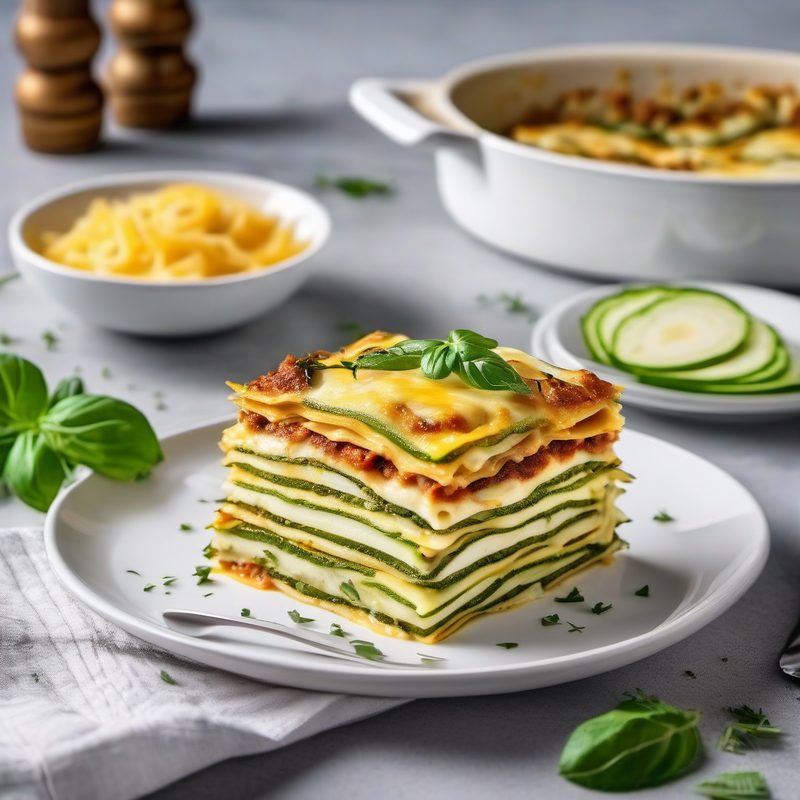
Zucchini Lasagna
A low-carb liberation of Italy's most beloved baked pasta — paper-thin grilled zucchini standing in for noodles, layered with creamy ricotta, bright tomato sauce, and gooey mozzarella, baked until golden and bubbling. All the soul of lasagna, none of the carbs.
This is not a compromise. By salting and grilling the zucchini until it develops smoky char marks and a tender-but-sturdy texture, you create a noodle substitute that doesn't just disappear into the sauce — it contributes its own sweet, vegetal character to the layering. The ricotta-and-egg mixture brings richness and structure. A simple crushed-tomato sauce infused with garlic and basil provides the acidic backbone. Mozzarella pulls the whole thing together in a blanket of molten, stretchy cheese. Served after a short rest, it slices as cleanly as any pasta lasagna — and tastes just as decadent.
> Note: Includes 15 minutes inactive time for salting the zucchini. This step is essential for drawing out excess moisture — without it, the lasagna will turn watery during baking.
Use a kitchen scale for best results. All produce is medium unless specified. Low-moisture mozzarella is crucial — fresh mozzarella releases too much liquid and will make the lasagna soggy.
🥘 Equipment
- Chef's knife and cutting board
- Vegetable peeler or mandoline (optional, for even slicing)
- Large rimmed baking sheet (for salting zucchini)
- Paper towels or clean kitchen towels
- Grill pan, cast-iron skillet, or outdoor grill (for charring zucchini)
- Tongs
- Large mixing bowl
- 9×13-inch (23×33 cm) baking dish
- Medium saucepan (for tomato sauce)
- Wooden spoon or spatula
- Measuring cups and spoons
- Microplane or fine grater (for Parmigiano)
- Aluminum foil (for covering during initial bake)
📋 Preparation
Step 1 — Prepare the Zucchini (15 minutes active + 15 minutes resting)
Slice the zucchini: Trim the ends from each zucchini. Using a chef's knife or mandoline, slice lengthwise into ¼-inch (6 mm) thick planks. You should get 8 to 10 slices per zucchini, depending on size. Discard the outermost slices if they are mostly skin.
Salt and sweat: Arrange the zucchini slices in a single layer on a large rimmed baking sheet. Sprinkle evenly with 1 teaspoon of kosher salt on both sides. Let rest for 15 minutes at room temperature. You'll see beads of moisture form on the surface — this is the excess water being drawn out.
Pat dry: After 15 minutes, use paper towels or a clean kitchen towel to thoroughly pat both sides of each zucchini slice dry. Be firm — you want to remove as much surface moisture as possible. This is the single most important step for a non-watery lasagna.
Why salt and rest? Zucchini is roughly 95% water. If that water escapes during baking, it pools in the bottom of the dish, turns the lasagna into a soupy mess, and prevents the cheese from browning. Drawing it out with salt beforehand is non-negotiable.
Step 2 — Grill or Roast the Zucchini (10 minutes)
Lightly brush or drizzle the dried zucchini slices with 1½ tablespoons of olive oil on both sides.
If grilling: Heat a grill pan or outdoor grill over medium-high heat until smoking. Place the zucchini slices in a single layer (work in batches) and cook until distinct char marks appear, 2 to 3 minutes per side. The zucchini should be tender but still hold its shape — not limp or falling apart.
If roasting: Preheat the oven to 220°C / 425°F. Arrange the oiled slices on a baking sheet in a single layer. Roast until lightly browned and tender, 8 to 10 minutes, flipping halfway through.
Either method works. Grilling adds a subtle smoky dimension that complements the tomato and cheese; roasting is more consistent and easier to scale. Set the cooked slices aside on a plate or baking sheet.
Don't overcook the zucchini at this stage — it will continue cooking in the oven. You want it pliable and marked with color, not fully cooked through.
Step 3 — Make the Ricotta Filling (5 minutes)
In a large mixing bowl, combine:
- 500 g (2 cups) ricotta
- 1 large egg
- 50 g (½ cup) grated Parmigiano-Reggiano
- ¼ cup chopped fresh basil
- ½ teaspoon kosher salt
- ¼ teaspoon freshly ground black pepper
Stir until smooth and homogeneous. Taste and adjust salt as needed. Set aside.
The egg is the binder — it firms up the ricotta layer during baking so the lasagna slices cleanly. Without it, the ricotta layer stays loose and runs as you cut.
Step 4 — Make the Quick Tomato Sauce (10 minutes)
In a medium saucepan, warm the remaining 1½ tablespoons of olive oil over medium heat. Add the 2 minced garlic cloves and cook, stirring constantly, until fragrant but not browned, about 30 seconds.
Add the 400 g (14 oz) crushed tomatoes. Season with a pinch of kosher salt and black pepper. Bring to a gentle simmer, then reduce heat to low and cook for 5 to 7 minutes, stirring occasionally, until slightly thickened. Stir in 2 tablespoons of chopped fresh basil. Remove from heat.
Keep the sauce simple. With a dish this layered, the tomato sauce doesn't need to be a complex ragù — crushed tomatoes, garlic, olive oil, and basil are all you need. The flavor intensifies as it bakes.
Step 5 — Layer the Lasagna (10 minutes)
Preheat the oven to 180°C / 350°F (no fan — if using convection, reduce to 160°C / 325°F).
Spread a thin layer of tomato sauce (about ⅓ cup) across the bottom of the 9×13-inch baking dish — just enough to prevent the bottom zucchini layer from sticking.
Build layers in this order, repeating 3 times:
- Zucchini slices — arrange in a single, slightly overlapping layer (about 8 to 10 slices per layer)
- Ricotta mixture — dollop and spread gently across the zucchini (about ½ cup per layer)
- Tomato sauce — about ⅓ cup per layer, spread to cover
- Shredded mozzarella — a generous handful (about ⅓ cup per layer)
For the final (top) layer: Arrange the last of the zucchini slices, then spread the remaining tomato sauce evenly over the top. Sprinkle with the remaining mozzarella and the reserved Parmigiano-Reggiano.
Build the layers deliberately but don't stress about precision — the cheese will melt and everything settles during baking. Just make sure each zucchini layer is mostly covered so nothing dries out.
Step 6 — Bake and Rest (40 minutes + 10 minutes resting)
Bake covered: Cover the dish with aluminum foil (tent it slightly so it doesn't stick to the cheese). Place on a rimmed baking sheet to catch any drips. Bake for 25 minutes.
Bake uncovered: Remove the foil and continue baking until the sauce is bubbling and the cheese is melted and golden in spots, 10 to 15 minutes more (35 to 40 minutes total).
Broil for color (optional): For a deeply browned, blistered top, switch the oven to broil for the final 2 to 3 minutes. Watch carefully — cheese burns quickly under the broiler.
Rest: Remove from the oven and let rest for at least 10 minutes before slicing. This rest is non-negotiable — it allows the layers to set so you get clean, stable slices instead of a lasagna landslide.
Garnish with fresh basil leaves and serve warm.
The covered baking phase allows the center to heat through and the zucchini to finish cooking without the top cheese burning. The uncovered phase builds the golden crust. The rest phase firms everything up — these three steps are the architecture of a great baked casserole.
🧑🍳 Chef's Tips
- The zucchini must be salted and dried. Skipping this step is the #1 reason zucchini lasagna turns into soup. The 15-minute salt-and-sweat is essential. Don't shortcut it.
- Grill, don't just slice-and-bake. Taking the extra step to grill or roast the zucchini before layering adds flavor and removes additional moisture. Raw zucchini layered directly into a lasagna releases too much liquid during baking.
- Low-moisture mozzarella matters. Fresh mozzarella packed in water contains too much liquid — it makes the lasagna watery and the layers slide. Use the block-style low-moisture mozzarella and shred it yourself. Pre-shredded cheese contains anti-caking agents (cellulose, potato starch) that prevent it from melting smoothly.
- Let it rest. The 10-minute rest after baking allows the ricotta-egg mixture to set and the layers to firm up. Slice too soon and you'll have a delicious but messy pile. This is the same principle as resting a lasagna made with pasta.
- Use a mandoline for even slices. Uniform ¼-inch (6 mm) slices ensure even cooking. If slicing by hand, take your time — uneven thickness means some slices will be undercooked while others turn mushy.
- Work in batches for grilling. Overcrowding the grill pan steams the zucchini instead of charring it. Work in a single layer and give each slice direct contact with the hot surface.
- Double the recipe for a crowd. This lasagna scales perfectly. Use a 10×15-inch (25×38 cm) dish and increase the bake time by 5 to 10 minutes.
- Make it a complete meal. Serve with a bright green salad dressed with lemon vinaigrette to cut through the richness. A glass of Vermentino or a light Sangiovese completes the Italian trattoria experience.
❌ Common Mistakes
| Mistake | Why It Hurts | The Fix |
|---|---|---|
| Skipping the salt-and-sweat step | Zucchini releases water during baking, creating a watery, soupy lasagna with no structure | Always salt the zucchini and let rest 15 minutes, then pat thoroughly dry |
| Using fresh mozzarella | High moisture content makes the lasagna watery and prevents clean slicing | Use low-moisture block mozzarella, shredded fresh |
| Overcrowding the grill pan | Zucchini steams instead of searing, producing pale, soggy slices | Work in a single layer — multiple batches are fine |
| Cutting too soon after baking | The ricotta-egg layer hasn't set, so the lasagna collapses into a messy pile | Let rest at least 10 minutes — 15 is even better |
| Layering raw zucchini without grilling | Much higher water content leads to a watery final dish, and the raw zucchini flavor is less developed | Grill or roast first to concentrate flavor and remove moisture |
| Using too much sauce | Lasagna becomes soupy and the layers slide apart | Use just enough to coat each layer — about ⅓ cup per layer |
| Skipping the covered bake | Top cheese browns before the center is hot, leaving a cold middle | Cover with foil for the first 25 minutes |
| Not patting the zucchini dry after salting | Surface water dilutes the sauce and prevents browning in the oven | Pat vigorously with paper towels |
💡 Variations
| Variation | How To |
|---|---|
| Add Ground Meat | Brown 1 lb (455 g) of ground beef, turkey, or Italian sausage before making the sauce. Stir into the crushed tomatoes for a heartier, non-vegetarian version |
| Make It Vegan | Replace ricotta with 400 g (14 oz) firm tofu (crumbled and blended with 2 tbsp nutritional yeast, 1 tbsp lemon juice, and 1 tsp salt). Omit egg and mozzarella — use vegan mozzarella shreds or a cashew-based cheese sauce |
| Add Spinach | Wilt 200 g (7 oz) fresh spinach in a skillet, squeeze dry, chop, and fold into the ricotta mixture. Adds color, nutrients, and an extra layer of flavor |
| Use Eggplant Instead | Substitute 2 medium eggplants for 2 of the zucchini. Slice, salt, and grill the same way. Great for a lower-alkaloid alternative or for gardeners with an eggplant surplus |
| Spicy Arrabbiata Version | Add 1 tsp red pepper flakes to the garlic when making the tomato sauce. The heat cuts through the creamy ricotta beautifully |
| Gluten-Free | This recipe is naturally gluten-free — no substitutions needed. Confirm your crushed tomatoes are certified gluten-free |
| Extra Cheesy | Add ½ cup (50 g) shredded provola or scamorza between layers for an even richer, stringier result. These cheeses melt beautifully and add a smoky depth |
| Roasted Red Peppers | Layer 1 cup (150 g) jarred roasted red peppers (drained and patted dry) between the zucchini and ricotta. Adds sweetness and color |
| Herb Swap | Substitute fresh oregano, marjoram, or thyme for half the basil. The earthy notes complement the zucchini and tomato |
❄️ Storage & Leftovers
| Method | Details |
|---|---|
| Refrigerator | Cover tightly with foil or transfer to an airtight container. Refrigerate for up to 4 days. The flavors actually improve overnight as the layers meld |
| Reheating (oven) | Cover with foil and reheat at 160°C / 325°F for 15 to 20 minutes, until hot throughout. Uncover for the last 5 minutes to re-crisp the top |
| Reheating (microwave) | Microwave on medium power for 2 to 3 minutes. The zucchini will be softer than oven-reheated, but the flavors are still excellent |
| Freezing (baked) | Let cool completely, then wrap tightly in foil and freeze for up to 3 months. Thaw overnight in the refrigerator before reheating |
| Freezing (unbaked) | Assemble completely but do not bake. Wrap tightly in a double layer of foil. Freeze for up to 3 months. Bake from frozen: remove foil, cover with new foil, bake at 180°C / 350°F for 55 to 65 minutes, then uncover and bake 10 minutes more |
| Individual portions | Portion into single-serving airtight containers. Refrigerate up to 4 days or freeze up to 1 month. Reheat as needed |
🍷 Wine Pairing
| Wine | Why |
|---|---|
| Vermentino di Sardegna | Crisp, herbal, and saline with bright acidity — cuts through the creamy ricotta and echoes the basil and zucchini |
| Soave Classico (Veneto) | Garganega's almond blossom and citrus notes mirror the fresh, clean flavors. Medium-bodied enough to carry the cheese |
| Gavi di Gavi (Piedmont) | Light, crisp, mineral-driven. The steely acidity refreshes the palate between each rich, cheesy bite |
| Chianti Classico (young) | High acidity and bright cherry notes complement the tomato sauce without overwhelming the zucchini's delicate flavor |
| Sangiovese di Romagna | A lighter, fruit-driven Sangiovese — earthy, savory notes bridge the gap between the tomato and the creamy ricotta |
| Franciacorta Brut (Lombardy) | Italy's sparkling answer to this rich, cheesy casserole. The fine bubbles scrub the palate clean between layers |
🥗 Suggested Side Dishes
- Simple arugula salad with lemon vinaigrette — Peppery arugula tossed with lemon juice, good olive oil, flaky salt, and shaved Parmigiano. The sharp, peppery greens cut through the rich, cheesy lasagna
- Grilled radicchio with balsamic — Halve 2 heads of radicchio, brush with olive oil, grill until charred, and drizzle with aged balsamic vinegar. The bitterness is a brilliant contrast to the creamy zucchini layers
- Fennel and orange salad — Thinly sliced raw fennel bulb tossed with orange segments, extra-virgin olive oil, and flaky salt. Bright and crunchy, it offers a refreshing palate cleanser
- Caprese salad — Classic tomatoes, fresh mozzarella, basil, and olive oil — a simple, no-cook starter that celebrates the same Italian summer ingredients
- Crusty ciabatta or sourdough — For sopping up every last bit of sauce from the plate. Look for a loaf with a thick, crackling crust and open crumb
- Warm white beans with rosemary and garlic — Cannellini beans warmed in olive oil with garlic and rosemary. The creamy beans add protein and heft to round out the meal
- Roasted asparagus with lemon and Parmigiano — Toss asparagus spears with olive oil, salt, and lemon zest, roast at 200°C / 400°F for 12 minutes, then finish with a squeeze of lemon and shaved Parmigiano
📊 Nutrition (per serving, estimated)
| Calories | Protein | Fat | Carbs | Fiber |
|---|---|---|---|---|
| 315 | 22 g | 19 g | 12 g | 3 g |
Net carbohydrates: approximately 9 g per serving. Nutrition values are estimates based on 6 servings using the ingredients listed. Actual values will vary based on specific brands, exact ingredient quantities, and portion sizes. This is a low-carb, high-protein, gluten-free dish that fits ketogenic and low-carb dietary patterns while delivering the soul-satisfying comfort of traditional lasagna.
❓ Frequently Asked Questions
Do I have to peel the zucchini?
No. The dark green skin adds color, texture, and nutrients. Leave it on for visual contrast against the red sauce and white cheese. If the zucchini has a tough, thick skin (common with oversized or older zucchini), a quick peel with a vegetable peeler won't hurt.
Can I use yellow squash instead of zucchini?
Yes. Yellow summer squash is nearly identical in texture and moisture content. The flavor is slightly milder and the lasagna will be paler, but the technique and timing are identical.
Why did my lasagna turn out watery?
Almost certainly because the zucchini wasn't properly salted and dried beforehand. Zucchini is mostly water — if you don't draw it out before baking, it releases into the dish. Other causes: fresh mozzarella (use low-moisture), too much sauce, or skipping the rest time after baking.
Can I make this ahead of time?
Yes. Assemble the lasagna completely (unbaked), cover tightly, and refrigerate for up to 24 hours. Add 10 minutes to the covered bake time since you're starting from cold. You can also freeze the assembled unbaked lasagna for up to 3 months.
What's the best cheese substitution for ricotta?
Full-fat cottage cheese, blended until smooth, is the closest substitute — use 500 g (2 cups) in place of ricotta. For a dairy-free option, use crumbled firm tofu blended with 2 tablespoons nutritional yeast and 1 tablespoon lemon juice.
Can I use no-boil lasagna noodles AND zucchini?
Absolutely. For a hybrid lasagna, use a single layer of no-boil noodles between two layers of zucchini. The noodles absorb excess moisture from the zucchini and add structural support. This works beautifully for a transitional dish.
How do I know when the lasagna is done?
The edges should be bubbling vigorously, the cheese should be melted and golden in spots, and a knife inserted into the center should come out hot to the touch after 5 seconds. An instant-read thermometer inserted in the center should read at least 75°C / 165°F.
My ricotta layer came out grainy — why?
Two possible causes: (1) the ricotta was overmixed, which can cause it to break, or (2) the ricotta was low-quality or skim-milk variety. Use full-fat, whole-milk ricotta from a reputable brand. Stir gently until just combined.
🔗 Related Recipes
- Lasagna Bolognese — The Most Delicious Lasagna of All Time (page 8)
- Pasta with Zucchini and Cherry Tomatoes (page 100)
- Pasta alla Nerano (Zucchini and Provolone Pasta) (page 52)
- Baked Ziti with Sausage and Ricotta (page 42)
- Eggplant Parmesan (Melanzane alla Parmigiana) (page 203)
- Creamy Zucchini and Shrimp Pasta (page 93)
- Pasta with Ricotta and Zucchini Flowers (page 106)
- Roasted Vegetable Tian (page 312)
🏷️ Search Tags
📸 Photo Reference
Photo reference: `vol1_466.png` — A deep 9×13-inch baking dish of zucchini lasagna, sliced to reveal distinct layers: lightly charred green zucchini planks, creamy white ricotta-egg filling, ruby-red tomato sauce, and molten golden mozzarella. The top is blistered and browned in spots, with fresh basil leaves scattered on top. Steam rises from the cut slice. A spatula lifts a clean, stable square from the corner of the dish, showing the layers holding together. Shot from a 45-degree overhead angle in warm, diffuse natural light on a rustic wooden table. A small bowl of grated Parmigiano and a glass of white wine sit in the background. Rustic Italian home-cooking aesthetic — hearty, honest, and deeply inviting.
Recipe from "The Italian Kitchen" by Vita Milanese — Volume 1: Pasta Perfetto
Recipe from The Italian Kitchen by Vita Milanese — Volume 1 · Pasta Perfetto. Discover all volumes on the ebook page.