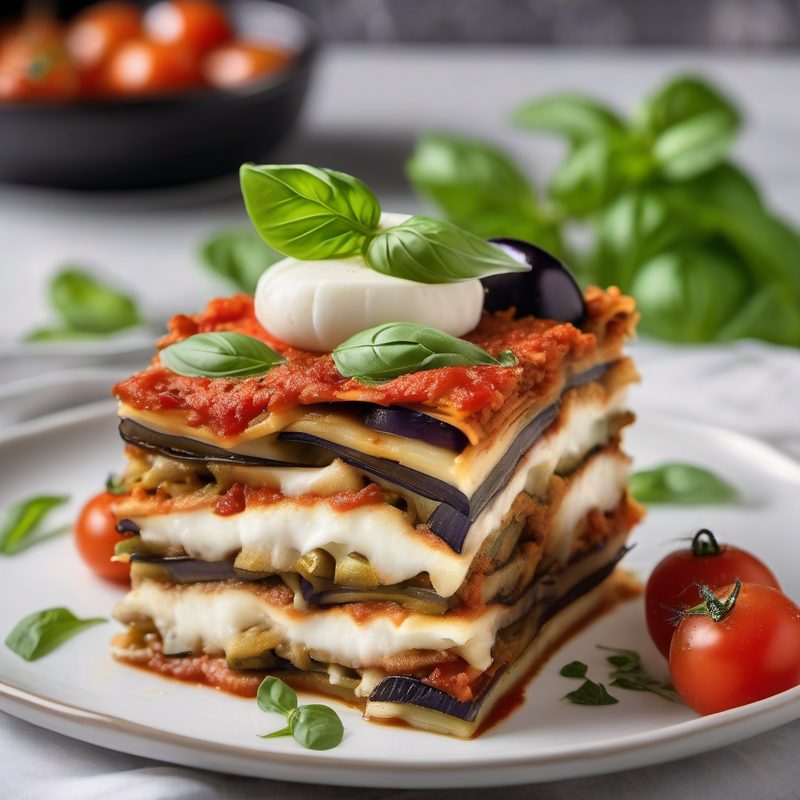
Lasagna Norma
Sicily's famous eggplant-and-tomato pasta casserole, reimagined as a layered lasagna—no ricotta-drowning, no soggy eggplant, just golden-fried slices of purple eggplant nestled between sheets of fresh pasta, creamy ricotta, and a bright basil-tomato sauce. It's the vegetarian centerpiece that even carnivores fight over.
| Amount | Ingredient |
|---|---|
| 8 oz (225 g) | Fresh mozzarella, thinly sliced |
| ¼ cup (25 g) | Grated Parmigiano-Reggiano, for topping |
You might think that layering fried eggplant into a lasagna would turn the whole thing into an oily mess, but the trick—as with so many Sicilian classics—is in the salting. Sliced eggplant is salted, rested until it weeps bitter liquid, patted bone-dry, then fried until deeply golden on both sides. What you get is a pliable, almost meaty layer that absorbs just enough tomato sauce to stay tender without disintegrating. The homemade pasta sheets (flour, eggs, salt—that's it) are rolled thin enough to cook through in the oven, so no boiling required. Each slice reveals a cross-section of custard-soft eggplant, barely-set ricotta cream, and glossy tomato-stained pasta. It's rustic, it's elegant, and it's the kind of dish that makes you want to invite people over just so you can watch their faces when you serve it.
For the Fresh Pasta
For the Fried Eggplant
For the Tomato Sauce
For the Ricotta Cream
For Assembly
Use level tablespoons and standard US measuring cups. All produce is medium unless specified.
Equipment
- Large baking sheet
- Colander
- Paper towels
- 9×13-inch (23×33 cm) baking dish
- Large skillet (12-inch / 30 cm preferred)
- Medium saucepan
- Mixing bowls (small, medium)
- Rolling pin or pasta machine
- Chef's knife
- Cutting board
- Kitchen towel
Preparation
Step 1 — Salt and Purge the Eggplant (30 minutes, plus 30 minutes resting)
Trim the stems off the eggplants and slice them crosswise into ¼-inch (6 mm) rounds. Arrange the slices in a single layer on a large baking sheet and sprinkle generously with the 2 tsp kosher salt. Let them sit for 30 minutes at room temperature. You'll see beads of dark liquid form on the surface—that's the bitter moisture being drawn out.
Don't skip this step. Salting transforms spongy, bitter eggplant into dense, creamy, sweet eggplant. The salt penetrates and breaks down the cell walls, and the liquid you wipe away carries the bitterness with it.
After 30 minutes, transfer the slices to a colander and rinse briefly under cold water to remove excess salt. Pat each slice bone-dry with paper towels. Lay them out on a clean kitchen towel while you make the pasta.
Step 2 — Make the Fresh Pasta (15 minutes, plus 30 minutes resting)
On a clean work surface, mound the flour and create a well in the center. Crack the eggs into the well and add the ½ tsp salt. Using a fork, beat the eggs gently, then begin incorporating flour from the inner wall of the well a little at a time. When the mixture becomes too thick for a fork, use your hands to bring the dough together. Knead for 8–10 minutes until the dough is smooth, elastic, and no longer sticky. Wrap tightly in plastic wrap and let rest at room temperature for 30 minutes.
Fresh pasta for lasagna should be rolled thin—about 1/16 inch (1.5 mm)—so it cooks through in the oven without pre-boiling. If using a pasta machine, go to the second-to-last setting on a standard Italian roller.
After resting, divide the dough into 4 pieces. Roll each piece into a thin sheet roughly the size of your baking dish. Dust lightly with flour and set aside on a floured tray, layered with parchment.
Step 3 — Fry the Eggplant (20 minutes)
Pour the frying oil into a large skillet to a depth of about ¼ inch (6 mm). Heat over medium-high until shimmering (about 375°F / 190°C). Working in batches without crowding, fry the eggplant slices for 2–3 minutes per side, until deep golden brown and the edges are slightly crisp. Transfer to a paper-towel-lined baking sheet to drain. Season lightly with a pinch of salt while still hot.
The eggplant should be truly golden—pale blond eggplant means it wasn't fried long enough and will turn soggy in the lasagna. Don't rush this step.
Step 4 — Make the Tomato Sauce (20 minutes)
In a medium saucepan, heat the 3 tbsp olive oil over medium heat. Add the garlic and cook, stirring, until fragrant and just beginning to turn golden at the edges, about 1 minute. Add the crushed tomatoes, torn basil, ½ tsp salt, and ¼ tsp pepper. Bring to a gentle simmer, then reduce heat to low and cook, stirring occasionally, for 15 minutes. The sauce should thicken slightly and deepen in color. Taste and adjust salt.
Step 5 — Make the Ricotta Cream (5 minutes)
In a medium bowl, combine the ricotta, ½ cup Parmigiano-Reggiano, egg, ¼ tsp salt, ⅛ tsp pepper, and chopped basil. Stir until smooth and well combined. Set aside.
Step 6 — Assemble the Lasagna (15 minutes)
Preheat the oven to 350°F (175°C).
Spread a thin layer of tomato sauce (about ½ cup) over the bottom of the 9×13-inch baking dish. Lay down a single layer of pasta sheets, trimming to fit if needed. Top with a single layer of fried eggplant slices (about ⅓ of the total), overlapping slightly. Dollop and spread about ⅓ of the ricotta cream over the eggplant. Scatter a few mozzarella slices and a sprinkle of Parmigiano-Reggiano over the ricotta. Repeat the layering process: sauce → pasta → eggplant → ricotta → mozzarella → Parmigiano, for a total of 3–4 layers. Finish with a final layer of pasta, the remaining tomato sauce, and a generous dusting of Parmigiano-Reggiano.
The top layer should look saucy and cheesy—don't be shy with the final Parmigiano blanket; it creates that irresistible golden-brown crust.
Step 7 — Bake and Rest (35 minutes, plus 10 minutes resting)
Place the assembled lasagna on a rimmed baking sheet (to catch any drips) and bake at 350°F (175°C) for 30–35 minutes, until the top is deep golden brown and the sauce is bubbling at the edges. Let rest on a wire rack for at least 10 minutes before slicing.
This rest is non-negotiable. A hot-from-the-oven lasagna is a puddle; a rested lasagna is a perfect square. The ricotta cream sets, the pasta finishes absorbing the sauce, and the layers hold together when you cut into them.
Chef's Tips
- Salt the eggplant diligently — skipping or rushing the purging step is the #1 reason eggplant lasagna turns watery and bitter. The 30-minute salt + 30-minute rest is worth every minute.
- Use a mandoline for even slices — ¼-inch (6 mm) rounds that are perfectly uniform fry at the same rate. Uneven slices mean some burn while others stay raw.
- Don't boil the pasta — fresh pasta sheets laid raw into the lasagna absorb sauce and cook perfectly in the oven. Boiled sheets become mushy and waterlogged.
- Let the lasagna rest — 10 minutes on the counter transforms a sloppy mess into clean, photogenic slices. Use this time to set the table and pour the wine.
- Fry in batches — overcrowding the pan drops the oil temperature, and the eggplant absorbs oil instead of frying in it. Work in a single layer.
Common Mistakes
| Mistake | Why It Hurts | The Fix |
|---|---|---|
| Skipping the eggplant salting | Bitter, watery layers that make the lasagna soggy | Always salt and rest eggplant for 30 minutes; pat dry thoroughly |
| Overcrowding the frying pan | Eggplant absorbs oil instead of frying; soggy, greasy result | Fry in a single layer; use two skillets if needed |
| Using a tomato sauce that's too thin | Pasta sheets get soupy rather than al dente | Simmer the sauce until slightly thickened (15–20 minutes) |
| Slicing eggplant too thick | Interior stays spongy while exterior burns | Cut uniform ¼-inch (6 mm) rounds |
| Cutting the lasagna immediately | Layers slide apart; it looks like a wreck on the plate | Wait the full 10-minute rest |
Variations
| Variation | How To |
|---|---|
| Bechamel Style | Replace the ricotta cream with a classic béchamel (butter, flour, milk, nutmeg) for a creamier, more North-Italian-style lasagna |
| Spicy Arrabbiata Twist | Add 1 tsp red pepper flakes to the tomato sauce and dot the layers with sliced fresh peperoncini |
| Add Ground Meat | Brown ½ lb (225 g) ground beef or pork with the garlic before adding tomatoes for a meaty Norma |
| Vegan Version | Use dairy-free ricotta (cashew-based), omit the egg, and use a plant-based mozzarella shred |
| Grilled Eggplant Shortcut | Instead of frying, brush eggplant slices with olive oil and grill on a hot grill pan 3 minutes per side—less rich but faster |
Storage & Leftovers
| Method | Details |
|---|---|
| Refrigerator | Cover tightly with foil or transfer to an airtight container. Keeps for up to 4 days. The flavors actually improve overnight. |
| Freezer | Assemble the lasagna but do not bake. Cover tightly with foil (plastic wrap first, then foil). Freeze for up to 3 months. Bake directly from frozen, adding 20 minutes to the cook time. |
| Reheating | Reheat individual slices in a 350°F (175°C) oven for 15 minutes, or in a covered skillet over medium-low heat for 8–10 minutes. Microwave works but the pasta will be softer. |
Wine Pairing
| Wine | Why |
|---|---|
| Nero d'Avola | Sicily's signature red—dark fruit, medium tannins, and a hint of spice that mirrors the sweetness of the fried eggplant and bright tomato |
| Frappato | Lighter and more aromatic than Nero d'Avola; its strawberry-and-herb profile cuts through the ricotta without overwhelming the vegetables |
| Chianti Classico | High acidity and savory cherry notes complement the tomato-basil backbone of this dish beautifully |
| Rosé di Sicilia (dry) | A chilled, bone-dry rosé with good acidity—especially good on warm evenings when a heavy red feels like too much. If you prefer beer, a crisp Italian lager like Moretti or Peroni works the same magic. |
Suggested Side Dishes
- Simple Arugula Salad with Lemon and Parmigiano — the sharp, peppery greens cut the richness of the lasagna
- Roasted Cherry Tomatoes and Garlic — an extra hit of sweet-tart tomato alongside
- Grilled Zucchini with Mint and Red Pepper Flakes — more summer vegetables for the table
- Crusty Sourdough Bread with Olive Oil — perfect for sopping up leftover sauce on the plate
- Marinated Olives and Celery — a simple, crunchy starter that doesn't compete with the main event
Nutrition (per serving)
| Calories | Protein | Fat | Carbs | Fiber |
|---|---|---|---|---|
| 630 | 28 g | 34 g | 55 g | 8 g |
Nutritional values are estimates based on a 4-serving yield and may vary based on specific ingredients and portion sizes.
FAQs
Can I use dried lasagna sheets instead of fresh pasta?
Yes. Use no-boil (oven-ready) dried lasagna sheets. You'll need about 12 sheets. Do NOT boil them first—they hydrate in the sauce during baking. Add an extra ½ cup of tomato sauce to the layers to ensure they soften fully. Bake time may increase by 5–10 minutes.
Can I skip the frying and roast the eggplant instead?
You can, but you'll lose the texture that makes this lasagna special. Roasted eggplant (tossed in oil, 425°F / 220°C for 20 minutes) is delicious but softer and more prone to turning mushy in the layers. If you're determined to cut calories, roasting works—just be prepared for a more custard-like texture.
Is there a substitute for fresh mozzarella?
Low-moisture whole-milk mozzarella (the block kind, not the balls in brine) works well. It melts beautifully and doesn't release as much water as fresh mozzarella. Shred it instead of slicing.
Why didn't my pasta cook through?
Two likely causes: (1) the pasta sheets are too thick—roll them to 1/16 inch (1.5 mm), the second-to-last setting on a pasta machine; (2) the sauce is too thick and didn't provide enough moisture for the pasta to hydrate. Make sure your sauce is saucy, not pasty.
Can I make this ahead for company?
Absolutely. Assemble the lasagna completely (through Step 6), cover tightly, and refrigerate for up to 24 hours before baking. Add 10–15 minutes to the bake time since you're starting from cold. The extra resting time actually helps the flavors meld.
Related Recipes
- Parmigiana di Melanzane alla Pugliese
- Ricotta Gnocchi with Peas, Pecorino, and Guanciale
- Penne alla Vodka
- Baked Ziti with Sausage and Ricotta
- Sicilian Caponata
Search Tags
Photo reference: `vol1_88.png` — A square of golden-crusted eggplant lasagna served on a warm white plate, the cross-section revealing distinct layers of fried eggplant, ricotta cream, and tomato-stained pasta sheets, with a sprinkle of fresh basil leaves across the top, shot from a 45-degree angle in warm natural light with a soft-focus background.
Recipe from "The Italian Kitchen" by Vita Milanese — Volume 1: Pasta Perfetto
Recipe from The Italian Kitchen by Vita Milanese — Volume 1 · Pasta Perfetto. Discover all volumes on the ebook page.