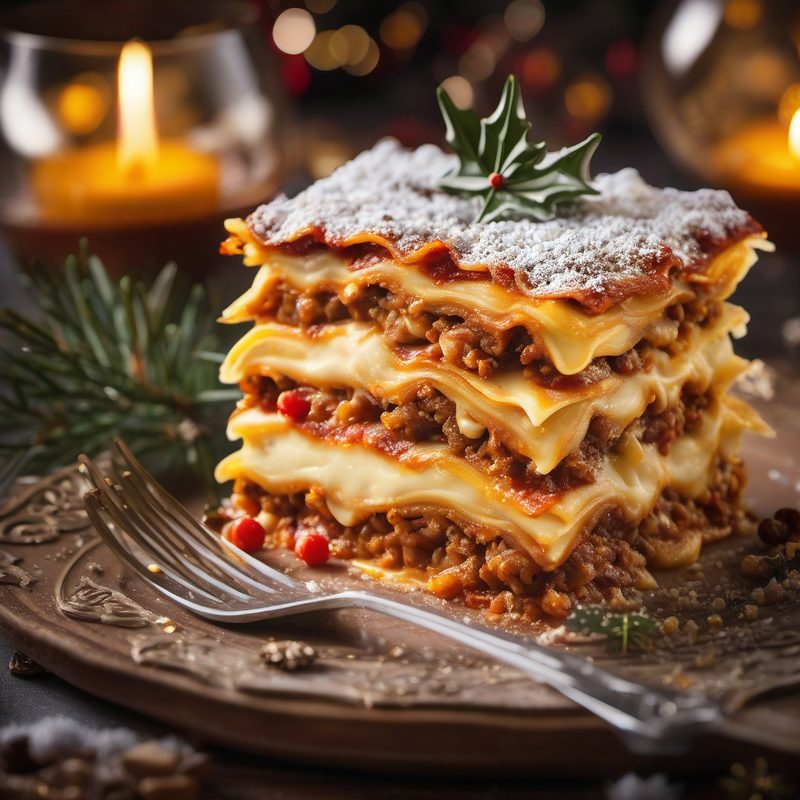
Christmas Lasagna Cannavacciuolo
| Amount | Ingredient |
|---|---|
| Fresh lasagna sheets | 400 g (14 oz) About 12 sheets (depending on size of dish); or dried noodles |
| Fresh mozzarella (fior di latte) | 300 g (10½ oz) Torn into 1-inch pieces; drain well if packed in brine |
| Parmigiano-Reggiano | 150 g (5¼ oz) Grated on the fine side of a box grater (not microplane — too powdery) |
| Unsalted butter | 1 tablespoon (15 g) For greasing the baking dish |
Chef Antonino Cannavacciuolo's Christmas Lasagna
Category: Primi Piatti (First Courses) — Holiday/Bake
Serves: 8
Total Time: 2 hours 15 minutes (1 hour 30 minutes active)
Oven Temperature: 180°C / 350°F
Bake Time: 35–40 minutes
Rest Time: 10 minutes before serving
Why This Recipe Works
Chef Antonino Cannavacciuolo, Italy's Michelin-starred master of refined comfort food, created this Christmas lasagna as a tribute to the holiday table — a dish that bridges rustic Southern Italian tradition with the precision of fine dining. Three elements define its greatness:
- The Ragù Napoletano: Slow-simmered with soffritto and red wine until deeply concentrated yet still bright with tomato. Unlike many long-cooked ragùs, Cannavacciuolo keeps the simmer to one hour, retaining the ground meat's texture and the tomato's natural acidity — a deliberate choice that prevents the lasagna from becoming a heavy, muddy casserole.
- The Besciamella (Béchamel): Made fresh with whole milk, butter, and a whisper of nutmeg. It drapes each layer with silkiness rather than gluey thickness. Cannavacciuolo's ratio of milk to roux is slightly higher than standard (about 750 ml per 60 g each of butter and flour), yielding a besciamella that flows just enough to settle into the pasta's ridges without pooling.
- The Layering Architecture: Ragù → pasta → besciamella → mozzarella → Parmesan, repeated. This sequence ensures each forkful delivers the full spectrum: the meaty depth of the ragù, the creamy embrace of besciamella, the elastic pull of melted mozzarella, and the sharp, crystalline crunch of aged Parmesan. The 10-minute rest after baking is non-negotiable — it allows the layers to marry and set into clean, proud squares.
This lasagna is not a weeknight project. It is a Sunday-afternoon ritual, a Christmas Eve labor of love, a dish that fills the house with the aroma of soffritto and wine and promises abundance.
Before You Begin
- Use fresh egg lasagna sheets if available; dried lasagna noodles work but must be cooked until barely al dente (about 1 minute less than package directions) and laid flat on oiled baking sheets to prevent sticking.
- The ragù can be made up to 3 days in advance. The besciamella is best made fresh on the day of assembly.
- Do not skip the 10-minute rest after baking. The lasagna continues to set and will slice into clean portions rather than collapsing into a soupy heap.
- A 9×13-inch (23×33 cm) baking dish is ideal. If using a dish of different dimensions, adjust the number of layers accordingly — you want 3 to 4 full layers of pasta.
- The mozzarella should be fresh (fior di latte or bufala), drained, and roughly torn into 1-inch (2.5 cm) pieces. Pre-shredded mozzarella contains anti-caking agents that prevent proper melting and introduce a chalky texture.
Why This Combination Works: The Science of Layering
Each component in this lasagna plays a defined structural and sensory role:
| Component | Role | Why It Works |
|---|---|---|
| Ragù | Flavor anchor | The wine and soffritto add savory depth; the 1-hour simmer concentrates flavors without drying the meat, preserving moisture that will hydrate the pasta during baking. The tomato's acidity cuts through the fat of the besciamella and cheese. |
| Besciamella | Structural binder + creaminess | The starch from the flour (gelatinized in milk at about 85°C/185°F) creates a stable emulsion that prevents the lasagna from separating into pools of grease. Its fat content (butter + milk) coats the pasta proteins, preventing them from absorbing too much liquid and turning mushy. |
| Mozzarella | Elastic stretch + moisture | Fresh mozzarella is about 50–60% water. As it melts, it releases steam that keeps the lasagna moist. Its casein proteins form long, stretchy strands when heated to 60–65°C (140–149°F) — the quintessential "cheese pull." |
| Parmesan | Umami catalyst + crust | Aged Parmesan is rich in glutamate and free amino acids (specifically glutamic acid and aspartic acid), which amplify the savory notes of the ragù. Grated fine and sprinkled on top, it forms a golden, crispy crust that contrasts with the soft interior. |
| Lasagna Sheets | Structure + texture | The egg-rich pasta provides protein and starch. During baking, it absorbs liquid from the ragù and besciamella, swelling slightly and creating a tender but distinct layer. The edges exposed to heat become pleasantly chewy and browned. |
Equipment
- 9×13-inch (23×33 cm) baking dish (ceramic or Pyrex preferred for even heat distribution)
- Large heavy-bottomed pot or Dutch oven (5–6 quart capacity) for ragù
- Medium saucepan (2–3 quart) for besciamella
- Whisk
- Wooden spoon or silicone spatula
- Chef's knife + cutting board
- Box grater (for Parmesan, do not use pre-grated)
- Fine-mesh strainer (if draining mozzarella)
- Large pot for boiling lasagna sheets
- Colander
- Kitchen scale (optional but recommended for accuracy)
- Aluminum foil
For the Ragù
For the Besciamella
For Assembly
Instructions
Step 1: Prepare the Soffritto (10 minutes)
- Finely dice the onion, carrot, and celery into uniform ¼-inch (6 mm) pieces. The soffritto should be fine enough to melt into the sauce but coarse enough to retain a whisper of texture.
- Heat 3 tablespoons of olive oil in a large heavy-bottomed pot or Dutch oven over medium heat until shimmering but not smoking (about 175°C / 350°F).
- Add the soffritto and ½ teaspoon of salt. Cook, stirring frequently, for 8–10 minutes, until the vegetables are soft, translucent, and fragrant but not browned. The soffritto should smell sweet and vegetal, not caramelized.
> Test Kitchen Note: Do not rush the soffritto. This is the flavor foundation of the entire dish. If the vegetables brown, they will introduce bitterness that competes with the wine and tomato. Soft, gentle cooking — soffriggere means "to fry slowly" — is the goal.
Step 2: Cook the Meat (10 minutes)
- Add the ground beef and pork to the pot, breaking the meat into small (½-inch / 1 cm) pieces with a wooden spoon.
- Increase heat to medium-high and cook, stirring occasionally, for 6–8 minutes. The meat should lose its raw pink color and begin to brown. You want a fond (browned bits) to form on the bottom of the pot — this is pure flavor.
- Season with ½ teaspoon of salt and the black pepper.
- Do not drain the fat. The rendered fat from the beef and pork carries flavor and will be absorbed by the besciamella during baking.
Step 3: Deglaze with Wine (3 minutes)
- Pour in the red wine, scraping the bottom of the pot with the wooden spoon to dissolve the fond (this is deglaçage — deglazing).
- Let the wine bubble vigorously for 2–3 minutes, until its raw alcohol smell has cooked off and the liquid has reduced by about half. The wine should coat the meat in a dark, glossy film.
Step 4: Simmer the Ragù (1 hour)
- Add the crushed tomatoes (passata) and 120 ml (½ cup) of water. Stir to combine.
- Bring to a gentle simmer — bubbles should break the surface lazily, not aggressively.
- Reduce heat to low, partially cover the pot (tilt the lid so steam can escape), and cook for 1 hour, stirring every 10–15 minutes.
- After 1 hour, the ragù should be thick, richly colored, and intensely flavored. Taste and adjust seasoning with the remaining ½ teaspoon of salt if needed.
- Remove from heat and set aside. The ragù can be used immediately or cooled and refrigerated for up to 3 days.
> Visual Cue: When ready, the ragù should hold its shape on a spoon — it should mound slightly, not run flat. If it's too thin, simmer uncovered for an additional 10–15 minutes. If too thick, stir in a splash of warm water or broth.
Step 5: Make the Besciamella (15 minutes)
- In a medium saucepan, melt the 60 g of butter over medium heat. Watch carefully — butter burns at about 120°C (248°F), and burned butter will ruin the besciamella.
- Add the flour all at once, whisking constantly. Cook for 2–3 minutes, whisking the whole time, until the mixture (a roux) is pale blonde, fragrant, and slightly puffed. It should smell like toasted biscuits, not nutty or brown.
- Remove from heat for 30 seconds (this prevents shocking the milk and creating lumps).
- Add the milk in a slow, steady stream, whisking vigorously. Start with just a splash — about 60 ml (¼ cup) — whisk until smooth, then add the rest of the milk in two more additions, whisking each time until no lumps remain.
- Return the saucepan to medium heat and cook, whisking constantly (especially in the corners of the pan), for 5–7 minutes.
- Watch for the besciamella to thicken: it is ready when it coats the back of a spoon and a line drawn through it with your finger holds cleanly (nappé consistency — about 80–82°C / 176–180°F).
- Remove from heat. Whisk in ½ teaspoon of salt, ¼ teaspoon of freshly grated nutmeg, and a pinch of white pepper.
- Cover the surface directly with plastic wrap or wax paper (this prevents a skin from forming). Set aside.
> Troubleshooting: If lumps form, the roux was too hot when the milk was added, or the milk was added too quickly. Rescue by whisking vigorously or blitzing with an immersion blender for 10 seconds. A few tiny lumps in a home kitchen are tolerable — they will disappear during baking.
Step 6: Boil the Lasagna Sheets (if using dried pasta)
- Bring a large pot of well-salted water (about 1 tablespoon salt per 4 liters / 1 gallon) to a rolling boil.
- Cook the lasagna sheets in batches if necessary, to avoid overcrowding. Cook until just barely al dente — about 1 minute less than the package directions. They will finish cooking in the oven.
- Transfer the sheets to a large bowl of ice water to stop cooking, then lay them flat in a single layer on clean kitchen towels or oiled baking sheets. Pat dry with paper towels.
- If using fresh pasta sheets, no pre-cooking is needed — they will cook perfectly in the oven.
Step 7: Assemble the Lasagna (20 minutes)
Position: Center rack of the oven.
Temperature: 180°C / 350°F, conventional (not fan-forced). If using fan-forced, reduce temperature to 160°C / 320°F.
- Preheat the oven to 180°C (350°F).
- Grease the 9×13-inch baking dish with the 1 tablespoon of butter, coating the bottom and sides.
- Spread a thin layer of ragù (about 4 tablespoons / 60 ml) on the bottom of the dish. This prevents the pasta from sticking and adds flavor to the bottom layer.
- Layer 1 — Pasta: Arrange a single layer of lasagna sheets over the ragù, overlapping slightly (by about ½ inch / 1 cm) if needed. Break a sheet to fill gaps — do not leave empty spaces, as unfilled pasta will dry out and become brittle.
- Layer 1 — Ragù: Spread about 100–120 g (½ cup) of ragù evenly over the pasta, reaching all the way to the edges.
- Layer 1 — Besciamella: Dollop about 80–100 g (⅓ cup) of besciamella over the ragù and spread gently with the back of a spoon. Do not stir into the ragù — keep distinct layers.
- Layer 1 — Mozzarella: Scatter about 70 g (a generous handful) of torn mozzarella over the besciamella.
- Layer 1 — Parmesan: Sprinkle about 30 g (2 tablespoons) of grated Parmesan over the mozzarella.
- Repeat steps 4–8 for three more layers (four total). For the top (fourth) layer:
- Pasta sheets only (no ragù over them)
- Besciamella: Spread a slightly thicker layer (about 120–150 g / ½ cup) over the top pasta
- Mozzarella: Scatter about 90 g (a generous handful)
- Parmesan: Sprinkle 60 g (¼ cup) in an even, thick blanket over the entire surface
- Cover the dish loosely with aluminum foil, making sure the foil does not touch the cheese. (Crimp a small piece of foil into a dome if needed.)
> Chef's Tip: Cannavacciuolo emphasizes that each layer should be applied deliberately and evenly. A pastry brush can help spread the besciamella. The goal is not chaos but control — every forkful should contain all four elements in the same proportions.
Step 8: Bake (35–40 minutes)
- Place the covered lasagna in the preheated oven and bake for 20 minutes.
- Remove the foil and bake for an additional 15–20 minutes, until:
- The top is deep golden brown with bubbling cheese and crispy Parmesan edges.
- The sauce is visibly bubbling around the edges of the dish.
- The internal temperature at the center reaches 82°C (180°F) when probed.
- Total bake time: 35–40 minutes.
> Visual Cues & Troubleshooting:
> - Top too dark before center is hot? Re-cover with foil and reduce heat by 10°C.
> - Not browning on top? Increase heat to 200°C (400°F) for the last 5 minutes, or switch to broil for 2–3 minutes (watch carefully — Parmesan burns quickly under broiler).
> - Bubbling over in the oven? Place a baking sheet on the rack below to catch drips.
Step 9: Rest and Serve (10 minutes + serving)
- Remove the lasagna from the oven and place on a wire rack or trivet.
- Rest for exactly 10 minutes. This step is critical: as the lasagna cools, the starch molecules in the pasta and besciamella re-bond (retrogradation), transforming the loose layers into a cohesive, sliceable block.
- After 10 minutes, cut into 8 squares (4 × 2) using a long, sharp knife. Wipe the knife clean between cuts for neat edges.
- Serve immediately on warmed plates. Each portion should stand tall on the plate, with distinct layers visible.
Troubleshooting Guide
| Problem | Likely Cause | Solution |
|---|---|---|
| Lasagna is soupy / doesn't hold shape | Besciamella too thin; mozzarella released too much water; insufficient rest time | Cook besciamella until nappé consistency; drain mozzarella for 30 minutes before use; never skip the 10-minute rest |
| Pasta is mushy | Overcooked pasta before assembly; too much liquid in the dish | Cook dried pasta 1 minute less than al dente; fresh pasta needs no pre-cooking |
| Pasta is crunchy / undercooked | Not enough liquid in layers; dried pasta not pre-cooked | Ensure ragù and besciamella cover every sheet fully |
| Top burns before center is hot | Oven too hot; foil not used | Bake covered for first 20 minutes; check oven temperature with an oven thermometer |
| Lasagna is dry | Too little besciamella; bake time too long; meat too lean | Use whole-milk besciamella; don't drain meat fat; cover with foil for longer bake |
| Cheese doesn't melt properly | Pre-shredded cheese with anti-caking agents; mozzarella too dry | Always tear fresh mozzarella; grate Parmesan from the block |
| Layers slide apart when cutting | Insufficient rest time; too much mozzarella | Rest exactly 10 minutes; keep mozzarella to ~70 g per layer |
The soffritto — onion, carrot, and celery — is the backbone of Italian cooking. In Campania (Cannavacciuolo's native region), the soffritto for lasagna is typically cut finer than for a long-simmered Sunday ragù, so it "dissolves" into the sauce during the shorter cooking time. The ratio is usually 2:1:1 (onion:carrot:celery) by weight, giving a slightly sweeter, more aromatic base.
Why not garlic? Traditional Neapolitan ragù for lasagna rarely includes garlic in the soffritto. Garlic's pungency can overwhelm the delicate balance of the besciamella and mozzarella. If you must add it, use one small clove, minced, added in the last minute of cooking the soffritto.
The carrot factor: Carrot brings natural sugars (sucrose and glucose) that balance the acidity of the tomatoes and wine. If your tomatoes are particularly acidic (common with canned supermarket brands), you can add an extra small carrot, finely grated, to the soffritto — it will melt into the sauce and provide sweetness without detectable carrot flavor.
Equipment Corner: The Right Baking Dish
Cannavacciuolo prefers ceramic or enameled cast-iron baking dishes for lasagna. Here's why:
| Material | Heat Conductivity | Edge Browning | Best For |
|---|---|---|---|
| Ceramic / Stoneware | Low to medium | Gentle, even | Even, steady cooking; edges don't burn |
| Pyrex (borosilicate glass) | Low | Good — transparent sides let you see browning | Home cooks who want visual cues |
| Enameled cast iron (e.g., Le Creuset) | High — heats evenly, holds heat well | Excellent — browns edges deeply | The ideal, but heavy and expensive |
| Stainless steel | Medium — hot spots possible | Good if well-made | Acceptable; not as even as ceramic or enameled cast iron |
| Disposable aluminum | Poor — uneven heating | Often burns edges | Not recommended for this recipe |
Size matters: A 9×13-inch (23×33 cm) dish with 3-inch (7.5 cm) sides gives you 4 perfect layers. Smaller dishes (8×8) will give you more, taller layers but need longer baking time. Larger dishes produce thinner, fewer layers and may cook faster.
Make-Ahead Instructions
Ragù (Up to 3 Days Ahead)
- Prepare the ragù through Step 4.
- Cool completely (within 2 hours of cooking), transfer to an airtight container, and refrigerate.
- Before assembling, reheat gently in a saucepan or microwave until warm enough to spread easily.
Full Assembly (1 Day Ahead)
- Assemble the lasagna completely through Step 7.
- Do not bake. Cover tightly with plastic wrap (directly on the surface of the besciamella to prevent skin) and then with foil.
- Refrigerate for up to 24 hours.
- On baking day: Remove from refrigerator 30 minutes before baking to take the chill off. Bake as directed, but add 10–15 minutes to the covered baking time (total 45–55 minutes). The lasagna is ready when the internal temperature reaches 82°C (180°F).
Make-Ahead Besciamella: Not Recommended
Besciamella thickens and forms a skin as it sits. It can be made 1 day ahead, but it will need vigorous whisking (and possibly a splash of warm milk) to restore its original consistency. For best results, make besciamella fresh.
Freezing
- Unbaked: Assemble, do not bake. Wrap tightly in plastic wrap + foil. Freeze for up to 3 months. Thaw in the refrigerator for 24 hours before baking (add 10–15 minutes to bake time).
- Baked: Cool completely, slice into portions, wrap individually, and freeze. Reheat in a 160°C (320°F) oven for 20–25 minutes.
Reheating Instructions
| Method | Time | Notes |
|---|---|---|
| Oven (best) | 20–25 min at 160°C (320°F) | Cover with foil; add a splash of milk or water to prevent drying out |
| Microwave (acceptable) | 2–3 min per portion | Cover with a damp paper towel; texture will be softer |
| Skillet (surprisingly good) | 8–10 min, covered, low heat | Add a tablespoon of water; the bottom gets a nice crispy edge |
Pairing Suggestions
| Element | Recommendation |
|---|---|
| Wine (Red) | Sangiovese di Romagna, Chianti Classico, or a soft Primitivo. Avoid heavy, tannic wines (Barolo, young Nebbiolo) — they clash with the creaminess of besciamella. |
| Wine (White - alternative) | A rich, oaked Chardonnay (not too oaky — think Gaja or similar) can stand up to the richness of the dish. Unusual but lovely. |
| Bread | A simple, crusty sourdough or ciabatta — nothing garlicky or herbed that would compete. |
| First Course | A light antipasto: prosciutto e melone, or a simple arugula salad with lemon and shaved Parmesan. |
| Dessert | Panettone, a classic Italian Christmas cake, or a simple lemon sorbet to cleanse the palate. |
| Non-Alcoholic | San Pellegrino sparkling water with a lemon wedge; or a dark, fruity sparkling grape juice. |
Recipe Timeline
| When | What |
|---|---|
| 3 days before | Make the ragù (Steps 1–4). Cool and refrigerate. |
| 1 day before (optional) | Assemble the lasagna (Step 7). Refrigerate. |
| Day of — 1 hour before serving | Remove assembled lasagna from fridge (if made ahead). |
| Day of — 45 minutes before serving | Preheat oven to 180°C (350°F). |
| Day of — 40 minutes before serving | Place lasagna in oven (covered). |
| Day of — 20 minutes before serving | Remove foil. |
| Day of — 5 minutes before serving | Remove from oven. Rest on counter. |
| Day of — 0 minutes (serve) | Cut into squares and serve. |
Total day-of active time: ~20 minutes (assembly) + 5 minutes (plating).
Total guest-to-table time: 50 minutes start to finish (if assembled in advance).
Chef's Notes
> "La lasagna di Natale non è solo un piatto. È un abbraccio." — Chef Antonino Cannavacciuolo
> ("Christmas lasagna is not just a dish. It is a hug.")
Cannavacciuolo's philosophy centers on molto amore — much love — in every layer. This is not a recipe to be rushed. Play music. Pour yourself a glass of the wine you'll use in the ragù. Involve a friend or family member. The soffritto asks for your attention. The layering asks for your patience. The table asks for your presence.
The beauty of this lasagna is its generosity: it feeds eight, but it could feed twelve with a green salad and good bread. It welcomes children and grandparents to the same table. It is, in every sense, a Christmas dish.
Recipe adapted from the culinary tradition of Chef Antonino Cannavacciuolo, reflecting the techniques and philosophy of one of Italy's most beloved Michelin-starred chefs.
Recipe from The Italian Kitchen by Vita Milanese — Volume 1 · Pasta Perfetto. Discover all volumes on the ebook page.