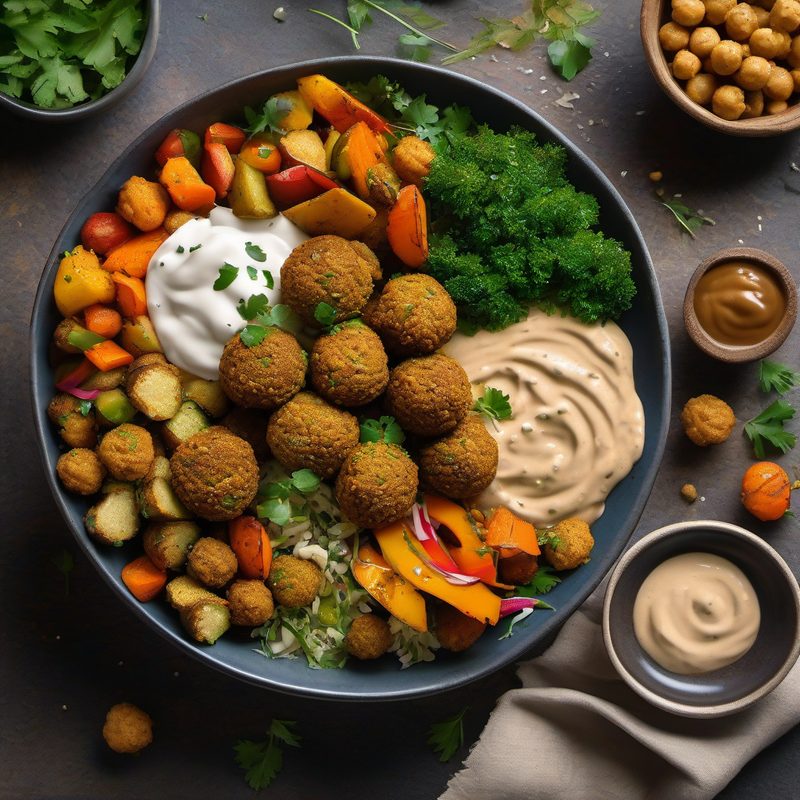
Winter Falafel Bowl
Category: Piatti unici · Vegetariano
| Amount | Ingredient |
|---|---|
| Calories | ~540 kcal |
| Protein | 18 g |
| Total Fat | 28 g |
| — Saturated Fat | 3.5 g |
| — Monounsaturated Fat | 16 g |
| — Polyunsaturated Fat | 7 g |
| Cholesterol | 0 mg |
| Sodium | 720 mg |
| Total Carbohydrates | 58 g |
| — Dietary Fiber | 14 g |
| — Sugars | 12 g |
Servings: 4
Total Time: 1 hour 15 minutes (35 minutes active)
Source: Middle Eastern–Italian fusion — Mediterranean winter comfort
Why This Recipe Works
A winter bowl should be more than a pile of cold leaves and sad tomatoes. This one is built around contrast: warm, crunchy falafel against cool, crisp greens; sweet, caramelized roasted sweet potato against bright, acidic cherry tomatoes; and a creamy, nutty tahini sauce that ties everything together into a cohesive, satisfying meal. Each element is engineered for peak texture and flavor — the falafel are made from canned chickpeas blended just until coarse (never pasty), then shallow-fried to a deep golden crust with a tender, herb-flecked interior; the sweet potato cubes are roasted at high heat to concentrate their natural sugars and develop crispy, caramelized edges; and the tahini sauce is emulsified with lemon juice and cold water into a pourable, luscious dressing that cuts through the richness of the fried falafel.
The genius of this bowl is its modularity: every component can be prepped ahead and assembled at the last minute, making it perfect for winter meal prep. The warm elements (falafel and roasted sweet potato) sit atop a bed of cool greens, gently wilting them in spots while keeping the overall texture varied. A generous drizzle of tahini sauce — made creamy by the magic of tahini's sesame solids emulsifying with water — seeps into every crevice, binding the disparate components into one cohesive, deeply satisfying bowl. It's a complete meal in a single dish, packed with protein, fiber, and the vibrant flavors that make winter eating anything but dreary.
Equipment
- Food processor
- Large mixing bowl
- 12-inch (30 cm) skillet or sauté pan (for frying falafel)
- Sheet pan (half-sheet, 18 × 13 inches / 46 × 33 cm)
- Parchment paper
- Chef's knife and cutting board
- Vegetable peeler
- Small bowl (for tahini sauce)
- Medium bowl (for mixing falafel)
- Whisk or fork
- Spider skimmer or slotted spoon
- Paper towels (for draining)
- Measuring cups and spoons
- Digital scale (optional, for accuracy)
- Instant-read thermometer (optional, for oil temperature)
For the Falafel
For the Roasted Sweet Potato
For the Tahini Sauce
For the Bowl Assembly
Before You Begin
- Canned chickpeas are intentional. Dried chickpeas, while traditional in Middle Eastern falafel, require overnight soaking and careful cooking. Canned chickpeas produce a softer, more tender falafel that binds easily and fries up golden and crisp — ideal for the home cook. The key is to drain and rinse them thoroughly, then pat them completely dry with paper towels before processing. Excess moisture is the enemy of crisp falafel.
- Do not overprocess the falafel mixture. The chickpeas should be chopped into a coarse, mealy texture — not puréed into a hummus-like paste. Pulse in short bursts and stop when the mixture holds together when pinched but still has visible bits of chickpea and parsley. Overprocessing produces dense, gummy falafel.
- Chill the falafel mixture before frying. A 30-minute rest in the refrigerator firms up the mixture, making it easier to shape and less likely to fall apart in the hot oil. This is not optional — it's the difference between falafel that holds together and falafel that disintegrates.
- Oil temperature matters. For shallow-frying, maintain the oil between 170–180°C (340–355°F). Too low and the falafel absorb oil and become greasy; too high and they burn on the outside before cooking through. An instant-read thermometer is your best friend here, but you can test with a small piece of the mixture — it should sizzle vigorously on contact and rise to the surface within 15 seconds.
- Cube the sweet potatoes uniformly. Cut them into ¾-inch (2 cm) cubes so they cook evenly. Larger cubes won't caramelize properly; smaller cubes may burn before the centers soften.
- Tahini separates naturally. Always stir your tahini vigorously before measuring — the sesame paste settles at the bottom and the oil rises to the top. An unstirred jar will yield a thin, broken sauce instead of a creamy, emulsified one.
- Have all components ready before assembly. The bowl should be composed just before serving so the greens stay crisp and the falafel remain crunchy. Prep all the individual elements first, then assemble.
Instructions
1. Prepare the Falafel Mixture (10 minutes)
Drain and rinse the chickpeas. Pat them very dry with paper towels, removing as much moisture as possible. In a food processor, combine the chickpeas, roughly chopped onion, garlic cloves, parsley, cumin, coriander, salt, and pepper. Pulse in 3–4 short bursts (1 second each), scrape down the sides, then pulse 2–3 more times until the mixture is coarsely ground — it should look like a crumbly, chunky paste with visible bits of chickpea and parsley, not a smooth purée.
Transfer the mixture to a bowl. Add the flour and mix with a fork until evenly distributed. Cover and refrigerate for 30 minutes (this is the perfect time to start the sweet potatoes).
2. Roast the Sweet Potatoes (35 minutes, mostly hands-off)
Preheat the oven to 200°C (400°F) with a rack in the middle position. Line a sheet pan with parchment paper.
Peel the sweet potatoes and cut them into ¾-inch (2 cm) cubes. In a medium bowl, toss the cubes with olive oil, salt, cumin, and smoked paprika until evenly coated. Spread in a single layer on the prepared sheet pan — do not overcrowd; if the cubes are crowded, they'll steam instead of roast.
Roast for 25 minutes, flipping halfway through, until the cubes are tender throughout and deeply browned on two or more sides, with caramelized edges. Remove from the oven and set aside (keep warm).
3. Make the Tahini Sauce (5 minutes)
In a small bowl, combine the tahini, lemon juice, minced garlic, salt, and cumin (if using). Whisk until the mixture seizes and thickens — this is normal; the tahini is absorbing the acid. Slowly drizzle in the cold water, 1 tablespoon at a time, whisking continuously. After 3–4 tablespoons, the sauce should loosen into a smooth, pourable, creamy consistency — it should fall off the whisk like heavy cream. If it's too thick, add water 1 teaspoon at a time. Taste and adjust salt and lemon juice as needed.
Cover and refrigerate until ready to use. The sauce will thicken slightly as it sits; stir in a teaspoon of water to thin it back if needed before serving.
4. Shape and Fry the Falafel (15 minutes)
Remove the chilled falafel mixture from the refrigerator. Using damp hands (to prevent sticking), shape the mixture into 16 small patties, each about 1½ inches (4 cm) wide and ½ inch (1.3 cm) thick. Place them on a clean plate or baking sheet.
Add vegetable oil to a 12-inch skillet to a depth of ½ inch (1.3 cm). Heat over medium-high heat until the oil reaches 170–180°C (340–355°F) — a small piece of the mixture dropped in should sizzle vigorously and rise to the surface immediately. If you don't have a thermometer, flick a pinch of flour into the oil; it should sizzle on contact.
Working in two batches (8 patties per batch to avoid overcrowding), carefully slide the falafel patties into the hot oil. Fry until the bottoms are deep golden brown and crisp, 3–4 minutes. Flip carefully with a slotted spatula and fry the second side for another 3–4 minutes, until evenly browned and cooked through. Transfer to a paper-towel-lined plate to drain. Sprinkle lightly with flaky sea salt while still hot. Repeat with the remaining patties.
Note: If the falafel brown too quickly (under 3 minutes), reduce the heat slightly. If they take longer than 4 minutes per side, increase the heat — they'll absorb too much oil at lower temperatures.
5. Assemble the Bowls (5 minutes)
Divide the mixed greens evenly among 4 wide, shallow bowls (about 1 cup per bowl). Arrange the components in sections for visual appeal:
- Roasted sweet potato: Place ¼ of the cubes in one section of each bowl.
- Cherry tomatoes: Scatter the halved tomatoes over the greens.
- Cucumber: Add the diced cucumber in another section.
- Falafel: Place 4 warm falafel patties per bowl, nestled among the vegetables.
Drizzle generously with the tahini sauce (about 2 tablespoons per bowl). Garnish with fresh mint leaves, a sprinkle of toasted sesame seeds, and a pinch of flaky sea salt. Serve immediately.
Chickpeas: Canned chickpeas (ceci in scatola) are our choice for convenience and consistent texture. Use the standard 400 g (15 oz) cans — two cans yields enough for 16 falafel patties. Avoid chickpeas canned with added preservatives or firming agents (check labels). If using dried chickpeas, soak 200 g (1 cup) overnight in cold water, drain, and cook in fresh water for 1–1½ hours until tender, then proceed with the recipe.
Tahini: Look for tahini made from 100% hulled sesame seeds — Middle Eastern brands (Al Arz, Ziyad, Soom) are widely available and consistent. Avoid tahini with added oils or stabilizers, which can prevent proper emulsification. Well-stirred, high-quality tahini should be pourable, not stiff and pasty.
Sweet Potatoes: Orange-fleshed sweet potatoes (sometimes labeled "yams" in US supermarkets) are ideal for their natural sweetness and creamy texture when roasted. Garnet or Jewel varieties work best. White or purple sweet potatoes can be substituted but will be less sweet and slightly drier.
Parsley and Mint: Use flat-leaf (Italian) parsley, not curly — it has a cleaner, less bitter flavor. Fresh mint is worth seeking out for its bright, cooling contrast to the rich falafel and tahini. If unavailable, substitute fresh cilantro or omit.
Notes on Equipment
- Food processor: A standard 7–11 cup (1.7–2.6 L) food processor is ideal. A smaller mini-chopper will require processing in batches. If you don't have a food processor, mash the chickpeas by hand with a potato masher or fork until coarsely broken up, then mix in the remaining ingredients — the texture will be chunkier but just as delicious.
- Skillet for frying: A 12-inch (30 cm) stainless steel or cast-iron skillet provides enough surface area for 8 patties per batch. Nonstick works but will produce a slightly less crusty exterior. A deep fryer or heavy-bottomed pot can be used for deep-frying instead of shallow-frying — maintain the same oil temperature and fry for 2–3 minutes total, turning once.
- Sheet pan: A rimmed half-sheet pan (18 × 13 inches) prevents sweet potato juices from spilling. If using a smaller pan, split the potatoes between two pans to ensure even browning.
- Instant-read thermometer: Highly recommended for both oil temperature (frying) and checking sweet potato doneness. A thermometer takes the guesswork out of frying.
Step-by-Step Visual Guide
- Step 1 — Falafel mixture consistency: After pulsing, the mixture should resemble coarse sand with visible green parsley flecks. Squeeze a small amount in your palm — it should hold together without crumbling. If it's too wet, add 1 tablespoon more flour; if too dry, add 1 teaspoon of water.
- Step 3 — Tahini sauce stages: When lemon juice first hits the tahini, the mixture will seize and thicken dramatically — this is correct. As you whisk in cold water, it will loosen into a creamy, glossy sauce. Stop when it flows from the whisk in a steady ribbon.
- Step 4 — Oil temperature test: A wooden chopstick or skewer dipped in the oil should produce a steady stream of tiny bubbles around it. If the bubbles are large and aggressive, the oil is too hot.
- Step 4 — Falafel doneness: A finished falafel should be deep golden brown on both sides with a slightly darker ring around the edge. The exterior should be crisp enough to make a faint cracking sound when bitten; the interior should be tender and moist, not dry or pasty.
- Step 5 — Bowl assembly: Arrange components in quadrants for the most visually striking presentation, then drizzle the tahini sauce in a zigzag pattern across the entire bowl rather than a single pool — this ensures every bite has some sauce.
The Science of Tahini Emulsification
Tahini (ground sesame seeds) is a paste of finely milled sesame solids suspended in sesame oil. When you add an acidic liquid like lemon juice, the proteins in the sesame solids denature and the mixture thickens — this is the same protein-coagulation reaction that occurs when you add acid to milk or cream. Adding cold water in a slow, steady stream while whisking vigorously creates a temporary oil-in-water emulsion: the water droplets become trapped within the sesame protein matrix, resulting in a creamy, stable sauce that doesn't separate.
The key variables: temperature (cold water emulsifies better than warm — warm water can cause the sesame solids to clump), rate of addition (slow and steady prevents the emulsion from breaking), and fat content (tahini with higher oil content requires slightly more water to reach the same consistency). If your sauce breaks or looks grainy, whisk in 1 teaspoon of tahini at room temperature to rebind it.
Variations
| Variation | How To |
|---|---|
| Baked Falafel (lighter version) | Skip the frying. Preheat oven to 200°C (400°F). Place shaped patties on a parchment-lined sheet pan, brush lightly with olive oil (about 1 tablespoon total), and bake for 12–15 minutes, flipping halfway, until golden and firm. The texture will be less crisp but still satisfying. |
| Air-Fryer Falafel | Preheat air fryer to 190°C (375°F). Lightly spray patties with oil and air-fry in a single layer for 10–12 minutes, flipping once at the halfway mark. No need to flip mid-cook in most air fryers. |
| Spicy Falafel | Add ½ teaspoon cayenne pepper or 1 small fresh red chili (seeded and minced) to the falafel mixture. Alternatively, add ½ teaspoon harissa paste for a smoky, North African heat. |
| Herb-Forward Falafel | Increase parsley to 1 cup (30 g) and add ¼ cup (5 g) fresh cilantro and ¼ cup (5 g) fresh mint to the food processor. The extra greens make for a brighter, grassier falafel. |
| Roasted Vegetable Bowl | Substitute or add other winter vegetables: cubed butternut squash, halved Brussels sprouts, or wedges of red onion tossed in olive oil and roasted alongside the sweet potatoes. |
| Grain Bowl | Add 1 cup cooked quinoa, farro, or freekeh to each bowl as a base layer under the greens. This turns the dish into an even heartier, more substantial meal. |
| Mediterranean Bowl | Add ¼ cup crumbled feta cheese, ¼ cup Kalamata olives, and 2 tablespoons pickled red onions per bowl for a Greek-inspired twist. (Not suitable for vegan diets.) |
| Pomegranate Falafel Bowl | Add ½ cup pomegranate arils to the bowl and swap mint for fresh cilantro. The sweet-tart arils pop against the creamy tahini and earthy falafel. |
| Lemon-Herb Tahini | Add 1 tablespoon finely chopped fresh dill or parsley and an extra ½ teaspoon lemon zest to the tahini sauce for a brighter, fresher finish. |
Make-Ahead Tips
| Component | Make-Ahead | Storage |
|---|---|---|
| Falafel mixture (uncooked) | Up to 24 hours | Cover tightly and refrigerate. Shape and fry just before serving for best texture. |
| Falafel (cooked) | Up to 3 days | Refrigerate in an airtight container. Reheat in a 180°C (350°F) oven for 8–10 minutes or in an air fryer at 190°C (375°F) for 3–4 minutes to re-crisp. |
| Roasted sweet potatoes | Up to 4 days | Refrigerate in an airtight container. Reheat in a 200°C (400°F) oven for 5 minutes or in a microwave. |
| Tahini sauce | Up to 5 days | Refrigerate in a jar or airtight container. The sauce will thicken upon refrigeration; stir in warm water 1 teaspoon at a time to restore pourable consistency. |
| Chopped vegetables | Up to 1 day | Store cucumber and tomatoes separately (cucumber in a paper-towel-lined container). Do not dress or mix greens ahead. |
| Full bowls (assembled) | Not recommended | The falafel will soften, greens will wilt, and cucumbers will release water, diluting the tahini sauce. Assemble just before serving. |
Freezer: Cooked falafel freeze beautifully. Arrange cooled patties in a single layer on a parchment-lined sheet pan, freeze until solid (about 2 hours), then transfer to a freezer bag. Freeze for up to 3 months. Reheat directly from frozen in a 200°C (400°F) oven for 12–15 minutes or in an air fryer at 190°C (375°F) for 8–10 minutes.
Serving Suggestions
- Serve as a standalone main course for lunch or dinner. The bowl is nutritionally complete (protein from chickpeas, complex carbs from sweet potatoes, healthy fats from tahini and olive oil, and plenty of vegetables).
- Pair with warm pita bread or naan for scooping up any stray falafel crumbs and soaking up extra tahini sauce.
- A side of pickled turnips or quick-pickled red onions adds a bright, acidic counterpoint to the richness of the falafel and tahini.
- For a Middle Eastern–inspired spread, serve alongside hummus, baba ganoush, a bowl of olive oil for dipping pita, and a plate of marinated olives.
- Soup pairing: A cup of harira (Moroccan lentil soup), roasted tomato soup, or lemony lentil soup makes a warming starter before the bowl.
Wine Pairing
| Wine | Why |
|---|---|
| Vermentino di Sardegna (Sardinia) | Bright acidity and herbaceous, citrus notes cut through the creamy tahini and earthy chickpeas without overpowering the delicate falafel spice |
| Grüner Veltliner (Austria) | White pepper, green apple, and mineral notes mirror the cumin and coriander in the falafel; zesty acidity handles the tahini richness |
| Rosé of Cinsault or Grenache (Provence) | Dry, crisp, with red fruit and herbal undertones — a bridge between red and white, complementing both the roasted sweet potato and the greens |
| Nerello Mascalese (Etna, Sicily) | Light-bodied red with volcanic minerality, red cherry, and dried herb notes — low in tannins, high in drinkability, a surprising but excellent match |
| Beaujolais Cru (Morgon or Fleurie) | Gamay's bright red fruit, low tannins, and earthy undertones echo the sweet potato's caramel notes and the falafel's spice blend |
Beer Pairing
| Beer | Why |
|---|---|
| Belgian Witbier (e.g., Hoegaarden) | Coriander and orange peel in witbier mirror the falafel's spice profile; the light, hazy body and modest bitterness let the tahini shine |
| Kölsch (Germany) | Clean, crisp, subtle fruitiness — a versatile, unobtrusive partner that won't compete with the bowl's complex flavors |
| IPA with citrus notes (American or Italian-style) | The hop bitterness cuts through the fried falafel, while citrus notes (grapefruit, orange) echo the lemon in the tahini |
| Session Saison (Belgian/French) | Peppery, fruity esters and a dry finish complement the herbs and cumin; higher carbonation cleanses the palate between bites |
| Non-Alcoholic IPA | The same hop structure and bitterness as a full-strength IPA, without the alcohol — the bitterness is especially good at balancing the tahini richness |
Nutritional Information (per serving, based on 4 servings)
Note: Values are estimates. Actual nutrition depends on specific brands, oil absorption during frying, and portion sizes. The fiber content is notably high thanks to the chickpeas and sweet potatoes — this bowl provides over 50% of the recommended daily fiber intake.
Storage
| Condition | Duration | Method |
|---|---|---|
| Refrigerator (components separate) | Up to 3 days | Store falafel, sweet potatoes, and tahini sauce in separate airtight containers. Keep greens, cucumber, and tomatoes unwashed and loosely wrapped. |
| Freezer (falafel only) | Up to 3 months | Arrange cooled falafel in a single layer on a sheet pan, freeze until solid, then transfer to a freezer-safe bag or container. |
| Reheating falafel | 8–12 min | Reheat in a 180°C (350°F) oven for 8–10 minutes, or in an air fryer at 190°C (375°F) for 3–4 minutes, to restore crispness. Do not microwave — it will make them soggy. |
| Reheating sweet potatoes | 3–5 min | Microwave on high for 1–2 minutes or reheat in a 200°C (400°F) oven for 5 minutes. |
| Tahini sauce after refrigeration | — | Stir in warm water 1 teaspoon at a time until pourable consistency returns. Do not microwave — heat will break the emulsion. |
Troubleshooting
| Problem | Cause | Solution |
|---|---|---|
| Falafel falls apart in the oil | Mixture too wet; not enough flour; not chilled long enough | Add 1 tablespoon more flour; chill for a full 30 minutes. If already in the oil, carefully remove with a slotted spoon, let cool slightly, reshape, and return to the oil. |
| Falafel is dense and gummy | Overprocessed in the food processor; chickpeas too wet | Pulse only until coarse; the mixture should still have texture. Next time, drain and pat chickpeas very dry. |
| Falafel is greasy | Oil temperature too low; pan overcrowded | Maintain oil at 170–180°C (340–355°F). Fry in batches — the oil temperature drops significantly when food is added; overcrowding makes it impossible to recover. |
| Sweet potatoes not caramelized | Not enough space on the pan; oven temperature too low | Spread in a single layer with space between cubes. Roast at 200°C (400°F) minimum. If they're steaming, increase heat to 220°C (425°F) for the last 5 minutes. |
| Sweet potatoes burnt on outside, raw inside | Cubes too large; oven too hot | Cut into uniform ¾-inch (2 cm) cubes. Reduce oven to 190°C (375°F) and roast 5–10 minutes longer. |
| Tahini sauce is bitter | Tahini was not stirred before measuring; low-quality tahini | Always stir tahini thoroughly — the settled solids are less bitter than the surface oil. If the brand is consistently bitter, switch to a different brand (Al Arz, Ziyad, or Soom are reliable). |
| Tahini sauce is grainy or broken | Water added too quickly; water too warm; emulsion broke | Whisk in 1 tablespoon more tahini (room temperature) to rebind the emulsion, then slowly add cold water 1 teaspoon at a time while whisking. |
| Bowl is dry | Not enough tahini sauce | Increase tahini sauce quantity by 50% (use 4–5 tablespoons per bowl). The sauce should generously coat each component. |
| Greens are wilted | Assembled too far ahead; hot falafel placed directly on greens | Assemble only at serving time. If the greens must sit, place falafel on top of a barrier of sweet potatoes or cucumber to delay direct heat contact. |
FAQ
Can I use dried chickpeas instead of canned?
Yes. Soak 200 g (1 cup) dried chickpeas in cold water overnight (at least 8 hours). Drain, then cook in fresh water with a pinch of baking soda for 1–1½ hours until tender but not mushy. Drain very well, pat dry, and proceed with the recipe. Dried chickpeas produce a firmer, nuttier falafel with a slightly better texture — but they require planning ahead. Canned chickpeas are our recommended choice for weeknight cooking.
Is this recipe vegan?
Yes — as written, this recipe is 100% vegan. All ingredients are plant-based: chickpeas, vegetables, tahini, olive oil, and flour. The variations section includes suggestions with feta cheese for those who aren't vegan.
Can I make this gluten-free?
Yes. Substitute the all-purpose flour in the falafel with chickpea flour (gram flour/besan), rice flour, or a 1:1 gluten-free baking flour blend. The texture will be slightly different (chickpea flour yields a more tender falafel; rice flour a crisper one). All other components are naturally gluten-free. Verify that your tahini and spices are certified gluten-free if you have celiac disease.
Can I grill the falafel instead of frying?
We don't recommend it — the mixture is too delicate to hold together on a grill grate. However, you can bake or air-fry them (see Variations above) for a lighter result.
What can I substitute for tahini?
Tahini is difficult to replace because its unique nutty, slightly bitter flavor is central to the dish. For a non-tahini dressing, try a lemon-herb vinaigrette (3 tablespoons olive oil, 2 tablespoons lemon juice, 1 teaspoon Dijon mustard, 1 minced garlic clove, salt, and pepper) or a yogurt-based sauce (½ cup Greek yogurt, 1 tablespoon lemon juice, 1 minced garlic clove, salt). Neither will replicate the authentic tahini experience, but both are delicious in their own right.
Can I use frozen falafel instead of homemade?
You can, but the quality difference is significant. Most store-bought frozen falafel are baked, not fried, and often contain fillers (breadcrumbs, potato starch) that dilute the chickpea flavor. If using frozen falafel, crisp them in a 200°C (400°F) oven for 10–12 minutes. The rest of the bowl remains the same.
How spicy is this dish?
As written, the dish is not spicy — the falafel are seasoned with cumin and coriander, which are warming and aromatic rather than hot. For heat, add chili to the falafel mixture (see Spicy Falafel Variation) or drizzle with harissa or sriracha at the table.
What if I don't have a food processor?
Mash the chickpeas by hand with a potato masher or the back of a fork until coarsely broken up. Finely mince the onion, garlic, and parsley by hand, then mix everything together with the spices and flour. The texture will be chunkier and less uniform, but the falafel will still be delicious. This is, in fact, the traditional method in many Middle Eastern kitchens.
Can I double this recipe?
Yes. Double all ingredients. Fry the falafel in 4 batches rather than 2 to maintain oil temperature. You may need to roast the sweet potatoes on two sheet pans (one on the upper rack, one on the lower, swapping positions halfway through) or roast them in consecutive batches.
Why do my falafel turn out green inside?
That's the parsley! The vibrant green color from fresh parsley is a sign of a properly made falafel. Some food processors can also break down chlorophyll molecules, creating a greenish tint throughout the mixture — this is normal and desirable. Adding cilantro or mint will intensify the green color.
Chef's Notes
- The 30-minute chill is non-negotiable. This rest allows the flour to hydrate fully and the flavors to meld. Falafel shaped and fried immediately without chilling will be more fragile and less flavorful.
- Use damp hands for shaping. Run your hands under cold water and shake off the excess before shaping each patty. The moisture prevents the mixture from sticking to your palms. Re-wet your hands every 3–4 patties.
- Tahini sauce can be made in a blender for an even creamier, more emulsified result. Combine all sauce ingredients in a blender and process on low for 30 seconds, adding water as needed until the desired consistency is reached.
- Season the falafel while hot. Sprinkling flaky sea salt (Maldon or fleur de sel) on the falafel immediately after they come out of the oil ensures the salt adheres to the hot, slightly oily surface. Salt added later will just fall off.
- Warm your bowls. Just as with pasta or risotto, pre-warming the serving bowls keeps the falafel and sweet potatoes hot longer and prevents the tahini sauce from congealing on contact with cold ceramic. A quick 30-second rinse under hot tap water, dried thoroughly, does the trick.
- Don't skip the mint garnish. Fresh mint adds a cooling, aromatic lift that contrasts beautifully with the warm, spiced falafel and the nutty, rich tahini. It's a small detail that makes a big difference.
- Scale the vegetables by season. In winter, swap cucumber for shaved fennel or roasted carrots. In spring, use asparagus and snap peas. In summer, add grilled corn and bell peppers. The falafel and tahini sauce are the constants; the vegetable component can change with the calendar.
Common Mistakes
| Mistake | Why | Fix |
|---|---|---|
| Falafel are pale and soft | Oil not hot enough; undercooked | Heat oil to 170–180°C (340–355°F) and test with a small piece of mixture before committing the whole batch |
| Falafel are dark brown outside, raw inside | Oil too hot; patties too thick | Reduce heat; shape patties no thicker than ½ inch (1.3 cm) |
| Tahini sauce is too thick / paste-like | Not enough water added | Whisk in cold water 1 teaspoon at a time until it reaches a pourable, cream-like consistency |
| Tahini sauce is too thin / watery | Too much water added too quickly | Whisk in 1 tablespoon more tahini to thicken |
| Bowl components are cold by the time they're served | Bowls not warmed; assembly too slow | Warm bowls; have all components ready before arranging; serve immediately after assembly |
| Sweet potato cubes are unevenly cooked | Cubes not uniform in size | Cut into precise ¾-inch (2 cm) cubes; discard tiny scraps (save for soup) |
| Falafel mixture is too dry | Parsley was too dry; chickpeas were too dry | Add 1 teaspoon water at a time and pulse until the mixture just holds together |
| Cucumber releases water into the bowl | Cucumber diced too far ahead; salted before serving | Dice cucumber just before assembly; do not salt until the bowl is eaten |
| Tahini sauce separates after sitting | Emulsion was not stable; oil and water separated | Whisk vigorously to re-emulsify; add 1 tsp tahini if needed |
Search Tags
Recipe ID: 467 · Source: Mediterranean Fusion Kitchen · ATK Conversion: v1.0
Recipe from The Italian Kitchen by Vita Milanese — Volume 1 · Pasta Perfetto. Discover all volumes on the ebook page.