Eclair Cream Chocolate
Light, crisp French choux pastry eclairs filled with silky vanilla pastry cream, half-dipped in dark chocolate and half in white chocolate, finished with contrasting chocolate stripe decorations — a stunning two-tone dessert that's as elegant as it is irresistible.
| Amount | Ingredient |
|---|---|
| 7 oz (200 g) | Dark chocolate (70% cocoa), finely chopped |
| 7 oz (200 g) | White chocolate, finely chopped |
The éclair — which means "flash of lightning" in French — is one of the world's great pastries, and this Italian interpretation takes it to another level. The secret is a perfectly executed pâte à choux: a double-cooked dough that puffs into a golden, hollow shell with a crackling-crisp exterior and an airy, custard-like interior. Fill it with a velvety vanilla crema pasticcera, then gild it with both dark and white chocolate in a striking half-and-half presentation. The result is a pastry that's simultaneously sophisticated and deeply satisfying — the dark chocolate brings a bittersweet edge, the white chocolate adds creamy sweetness, and the vanilla pastry cream ties it all together with its silky, luxurious heart. These are the kind of eclairs that disappear at parties, the kind that make bakers feel like pastry chefs. Master the choux technique here, and you'll have a foundation for cream puffs, gougères, and Paris-Brest for a lifetime.
Choux Pastry (Pâte à Choux)
Vanilla Pastry Cream (Crema Pasticcera)
Chocolate Decoration
Use good-quality chocolate — the dark chocolate should be at least 70% cocoa for the right balance of bitterness and sweetness. Callebaut, Valrhona, or any couverture chocolate works beautifully. European-style butter (82% butterfat) gives the choux a richer flavor and crisper texture. The eggs must be at room temperature — cold eggs will seize the warm dough and make it difficult to pipe. For the pastry cream, powdered sugar dissolves more easily than granulated, but if you only have granulated, whisk it into the egg yolks until fully dissolved before adding the starches.
🥘 Equipment
- 2 medium saucepans (1 for choux, 1 for pastry cream)
- Large mixing bowl
- Whisk
- Rubber spatula or wooden spoon
- Handheld electric mixer or stand mixer (optional, for choux)
- Fine-mesh sieve (for sifting flour)
- Piping bag (16-inch / 40 cm or larger)
- Large plain round piping tip (½-inch / 1.25 cm, e.g., Ateco #806 or similar)
- Baking sheets (2 half-sheet pans)
- Parchment paper
- Ruler (for measuring éclair lengths)
- Small offset spatula
- Wire rack
- 2 small heatproof bowls (for melting chocolate)
- Knife or toothpick (for steam vents)
- Serrated knife (for piercing eclairs)
- Plastic wrap
📋 Preparation
Step 1 — Make the Choux Pastry (15 minutes)
Preheat the oven to 340°F (170°C). Line 2 baking sheets with parchment paper. (If you have only one sheet, pipe one tray, bake it, and pipe the second while the first bakes — but the second batch won't rise quite as well because the dough sits.)
Sift the 1¼ cups (155 g) all-purpose flour and ¼ teaspoon salt onto a piece of parchment paper or into a bowl.
In a medium saucepan over medium heat, combine 1 stick (113 g) butter, ½ cup (125 ml) milk, and ½ cup (125 ml) water. Heat until the butter is fully melted and the mixture comes to a rolling boil — the butter should be completely liquefied, and the liquid should be bubbling vigorously all over, not just at the edges.
Remove the pan from the heat, add the sifted flour and salt all at once, and stir vigorously with a rubber spatula or wooden spoon until the mixture forms a smooth, cohesive dough that pulls cleanly away from the sides and bottom of the pan — about 30 to 60 seconds.
Return the pan to medium heat and cook, stirring constantly and pressing the dough against the pan, for 1 to 2 minutes more. You'll see a thin film form on the bottom of the pan, and the dough will feel drier and look slightly glossy. This step is critical — it dries the dough so the eggs can be absorbed properly and the pastry will puff.
Transfer the dough to a large mixing bowl and let it cool for 2 to 3 minutes, stirring occasionally, until it's warm but not hot — you should be able to touch it comfortably.
The dough must cool before adding eggs; if it's too hot, the eggs will scramble. But it can't be too cold either — an overly cool dough won't absorb the eggs properly. The sweet spot is about 120°F to 130°F (49°C to 54°C), warm but not uncomfortable to touch. The all-at-once addition of the flour is a classic French technique — it gelatinizes the starch instantly, creating the structure that will puff into a hollow shell.
Step 2 — Add the Eggs (5 minutes)
Add the eggs one at a time, beating vigorously after each addition until the dough is completely smooth before adding the next. You can do this with a handheld electric mixer, a stand mixer with the paddle attachment, or by hand with a wooden spoon (it takes some elbow grease but works beautifully).
After the first egg, the dough will look curdled and broken — this is normal. Keep beating. By the second egg, it will begin to come back together. By the third egg, the dough should be smooth, glossy, and thick enough to hold a V-shape when you lift the spatula — it should fall from the spatula in a slowly tearing ribbon. If the dough seems too stiff to pipe, add a fourth egg (beaten) one teaspoon at a time, beating well after each addition, until the dough reaches the right consistency.
Transfer the dough to a piping bag fitted with a ½-inch (1.25 cm) plain round tip.
The consistency check is crucial: dip your finger into the dough and pull it out — the dough should form a pointy peak that droops slightly at the tip but doesn't fall off. If the peak stands straight up, the dough is too stiff (add more egg). If it flops over completely, the dough is too loose (add a tablespoon of flour). The "curdled" look after the first egg is the most nerve-wracking moment for new choux makers — trust the process and keep beating.
Step 3 — Pipe and Bake the Eclairs (45 minutes)
Pipe the eclairs onto the prepared baking sheets in 4-inch to 4½-inch (10–12 cm) long strips, about 1 inch (2.5 cm) wide, leaving at least 2 inches (5 cm) of space between each éclair — they will expand significantly. Hold the piping bag at a 45-degree angle, touching the parchment, and pipe in one smooth, continuous motion, lifting the tip sharply at the end to avoid a tail.
Smooth any pointy tips with a damp fingertip (dip your finger in water first). This prevents the tips from burning.
Place the baking sheets in the preheated 340°F (170°C) oven and bake for 45 minutes total. Do not open the oven door during the first 35 minutes — not even a crack. The steam created inside the choux needs to stay trapped to inflate the pastry; opening the door releases the steam and collapses the shells.
After 35 minutes, check the eclairs: they should be puffed, golden brown, and feel light for their size. If they're browning unevenly, rotate the pans front to back and switch racks. Continue baking for the final 10 minutes.
At the 45-minute mark, remove one éclair and pierce it with a toothpick or the tip of a knife to release steam. If it feels hollow and the interior is dry (not doughy), they're done. If not, return to the oven for 5 more minutes, keeping the door shut.
Transfer the baked eclairs to a wire rack and immediately pierce each one in 2 or 3 places with a toothpick — this allows steam to escape and prevents the shells from becoming soggy. Let cool completely, about 30 minutes.
The cardinal rule of choux: DO NOT OPEN THE OVEN DOOR. The steam that puffs the pastry is a precious resource — the moment you open the door, it escapes, and the shells collapse into flat, sad discs. If your oven runs hot, reduce the temperature to 325°F (163°C) and bake for 50 minutes. The eclairs should be a deep golden brown all over — pale eclairs will be soft and deflate when cooled. Undercooked choux is the #1 cause of soggy eclairs.
Step 4 — Make the Vanilla Pastry Cream (15 minutes + cooling)
In a medium bowl, whisk together 3 large egg yolks, ⅓ cup (40 g) powdered sugar, 1 tbsp (10 g) cornstarch, 1¼ tbsp (10 g) all-purpose flour, and a pinch of salt until smooth and pale, about 1 minute. The mixture should form a thick, creamy paste.
In a medium saucepan over medium heat, bring 1 cup minus 1 tbsp (230 ml) whole milk to a gentle simmer — small bubbles around the edges, not a full boil.
Slowly drizzle about ⅓ cup of the hot milk into the egg yolk mixture, whisking constantly to temper the eggs. Then pour the tempered mixture back into the saucepan with the remaining milk, whisking continuously.
Return the saucepan to medium heat and cook, whisking constantly — especially around the edges and corners of the pan where lumps like to form — until the mixture thickens and comes to a gentle boil. It should be thick enough to coat the back of a spoon and hold a clear line when you run your finger through it, about 2 to 3 minutes after it starts bubbling.
Remove from heat and whisk in 2 teaspoons vanilla extract.
Transfer the pastry cream to a shallow bowl and press a piece of plastic wrap directly onto the surface — this prevents a skin from forming. Let cool to room temperature, then refrigerate until thoroughly chilled, at least 30 minutes.
The key to lump-free pastry cream is whisking constantly — particularly at the edges and corners of the pan where the cream thickens fastest. If lumps do form, pass the finished cream through a fine-mesh sieve before chilling. The plastic wrap must touch the cream directly; if there's any air gap, an unappetizing skin will form. Chilling the cream thoroughly is essential — warm pastry cream will turn your crisp eclairs into soggy disasters.
Step 5 — Fill the Eclairs (10 minutes)
Transfer the chilled pastry cream to a piping bag fitted with a small plain tip (or use the same large tip as before if that's all you have — just be gentle).
Use the tip of a serrated knife or a small skewer to poke 2 or 3 small holes in the bottom of each cooled éclair. (Piercing the bottom keeps the top intact for the chocolate glaze.)
Insert the piping tip into each hole and gently fill the éclair with pastry cream — you'll feel the éclair become heavier and see the cream beginning to bulge slightly at the openings. Don't overfill, or the éclair will split. A properly filled éclair should feel noticeably heavier than an empty one but still feel firm, not bulging.
Wipe away any excess cream that oozes from the holes with a clean fingertip.
Filling from the bottom is the classic technique — it preserves the smooth, unblemished top surface for the chocolate dip. If you don't have a small tip, you can cut the eclairs in half horizontally with a serrated knife, pipe the cream over the bottom half, and replace the top. This is easier but less elegant. If you accidentally overfill and the éclair splits, serve it as a "broken éclair" — it'll still taste amazing.
Step 6 — Melt the Chocolate (10 minutes)
Finely chop 7 oz (200 g) dark chocolate and place in a small heatproof bowl. Repeat with 7 oz (200 g) white chocolate in a second small heatproof bowl.
Melt each chocolate separately using your preferred method:
- Microwave method: Microwave at 50% power in 20-second bursts, stirring thoroughly between each burst, until mostly melted (lumps should remain — they'll melt from residual heat). Dark chocolate typically takes 1½ to 2 minutes total; white chocolate, which is more delicate, takes about 1 to 1½ minutes.
- Bain-marie method: Place each bowl over a saucepan of barely simmering water (the bowl should not touch the water). Stir gently until melted. Remove from heat when mostly melted.
Let the melted chocolate cool slightly — it should still be liquid but not hot to the touch. If it's too hot, it will melt the pastry cream and make the eclair shell soggy.
White chocolate is more heat-sensitive than dark — it can seize into a grainy paste if overheated. Go slow. If either chocolate seizes (turns grainy and stiff), stir in a teaspoon of neutral oil (coconut, grapeseed, or vegetable) to bring it back. The dark chocolate should be fluid enough to dip into but not watery — slightly thicker than heavy cream, so it coats the éclair in a smooth, even layer. White chocolate tends to be thicker; thin it with a teaspoon of coconut oil if needed.
Step 7 — Dip and Decorate (15 minutes)
Dip the top half of each filled éclair — about half the eclairs into the melted dark chocolate, the other half into the melted white chocolate. Hold the éclair by the filled end and dip at a slight angle, submerging about half the top surface. Lift, let the excess drip back into the bowl, and turn the éclair right-side up on the parchment-lined baking sheet.
Repeat with all eclairs.
For the contrasting decoration, use a small spoon or the tines of a fork to drizzle thin lines of melted white chocolate over the dark chocolate eclairs, and melted dark chocolate over the white chocolate eclairs. Drag the lines crosswise in a zigzag or straight-across pattern — classic éclair style.
Let the chocolate set at room temperature until firm, about 20 to 30 minutes. Do not refrigerate to speed this up — condensation from the fridge will dull the chocolate's shine.
The key to a clean, professional dip is a steady hand and chocolate at the right temperature — warm enough to flow but not so hot it melts the pastry. If the chocolate starts to thicken as it cools, reheat briefly (5 seconds in the microwave, stir, repeat). The contrasting stripes should be thin and deliberate — you're going for elegant, not overworked. If the chocolate has slightly different temperatures, the stripes will sit on top of the base coat rather than sinking in, creating a raised decorative effect.
Step 8 — Serve (2 minutes)
Arrange the finished eclairs on a serving platter or cake stand, alternating dark and white chocolate sides for visual contrast.
Serve immediately for the crispiest shells and best texture. Eclairs are at their peak within 2 to 3 hours of assembly — the shell begins to soften as it absorbs moisture from the pastry cream and chocolate.
Room temperature is best — the pastry cream is cool and silky, the shell is crisp, and the chocolate has a clean snap. If you must refrigerate, let the eclairs sit at room temperature for 15 to 20 minutes before serving so the shell loses its chill and regains some crispness.
💡 Chef's Tips
- Measure everything before you start. Choux pastry comes together in minutes, and there's no time to measure ingredients while butter-and-water mixture is boiling. Set out all your ingredients — butter cut, flour sifted, eggs at room temperature — before you turn on the heat.
- Room-temperature eggs are non-negotiable. Cold eggs straight from the fridge will seize the warm choux dough, making it stiff and impossible to pipe. If you forgot to take them out, place the eggs in a bowl of warm water for 5 to 10 minutes before starting.
- The texture of the choux dough should be just right. When you lift the spatula, the dough should fall in a slowly tearing V-shape ribbon. If it's too stiff, add beaten egg a teaspoon at a time. If it's too loose, beat in a tablespoon of flour. A properly made choux dough is the difference between hollow, puffed eclairs and dense, flat ones.
- Pipe consistently sized eclairs. Use a ruler as a guide, or mark 4-inch lines on the parchment with a pencil (flip it over so the pencil doesn't touch the food). Uniform size ensures even baking.
- Use a damp finger to smooth the tips. Those little points on the piped eclairs will burn in the oven. A light swipe with a wet fingertip eliminates them.
- Don't open the oven — not even a crack. The steam inside the oven is what puffs the choux. Opening the door even a little releases it, and the eclairs will deflate. Use the oven light to check progress.
- Bake until deeply golden. Pale eclairs will be soft and collapse when cooled. They should be a rich golden brown all over — if you see pale spots on the sides, they need more time.
- Pierce the eclairs immediately after baking. This lets steam escape and prevents soggy shells. If you skip this step, the steam condenses inside and softens the pastry.
- Make the components ahead for easier assembly. The choux shells can be baked a day ahead and stored in an airtight container at room temperature (recrisp in a 300°F/150°C oven for 5 minutes before filling). The pastry cream can be made up to 3 days ahead and refrigerated. On serving day, all you need to do is fill, dip, and decorate.
- Chocolate temperature matters. If the chocolate is too hot, it will melt the pastry cream and soften the shell. Let it cool to just above room temperature before dipping. If it gets too thick while you work, reheat gently.
- Save leftover filling. Any extra pastry cream is delicious on its own, served with fresh berries, or used as a cake filling. Any leftover melted chocolate can be drizzled over ice cream or used for another batch.
❌ Common Mistakes
| Mistake | Why It Hurts | The Fix |
|---|---|---|
| Opening the oven during baking | The steam escapes and the choux collapses into flat discs | Never open the oven door during the first 35 minutes. Use the oven light and window to check progress |
| Under-baking the choux | The shells come out soft, pale, and deflate as they cool; the interior is doughy instead of hollow | Bake until deep golden brown all over — 45 minutes minimum. Pierce one to check: the interior should be dry and hollow, not moist |
| Adding eggs while the dough is too hot | The eggs scramble, creating lumpy, greasy choux that won't puff | Let the dough cool for 2 to 3 minutes after the pan step — it should be warm but not hot to the touch |
| Adding eggs while the dough is too cold | The dough won't absorb the eggs, resulting in a heavy, dense paste that won't rise | If the dough has cooled completely (more than 5 minutes), reheat it briefly over low heat, stirring constantly, before adding eggs |
| Using cold eggs | They seize the warm dough, making it stiff and lumpy | Always use room-temperature eggs. Warm them in a bowl of warm water for 5 minutes if needed |
| Overfilling the eclairs | The éclair splits, pastry cream leaks out, and the structure is compromised | Fill until the éclair feels heavier but still firm. Stop when cream just starts to bulge from the holes |
| Dipping in chocolate that's too hot | The hot chocolate melts the pastry cream and softens the crisp choux shell | Let melted chocolate cool until it's warm but not hot — test a drop on your wrist; it should feel barely warm |
| Refrigerating the finished eclairs | The cold causes condensation on the chocolate (dulling the shine) and the shell softens | Set the chocolate at room temperature. Serve within 2 to 3 hours. If refrigerated, bring to room temp before serving |
| Using low-quality chocolate | The flavor is waxy, artificial, and overpowers the delicate pastry cream | Use good-quality dark (70% cocoa) and white chocolate — Valrhona, Callebaut, or Ghirardelli work well |
| Making the pastry cream too thin | It doesn't hold its shape inside the éclair and leaks out of the holes | Cook the pastry cream until it's thick enough to hold a clear line when you run your finger across the back of a coated spoon |
💡 Variations
| Variation | How To |
|---|---|
| Coffee Eclairs | Add 1½ tsp instant espresso powder dissolved in 1 tsp hot water to the pastry cream along with the vanilla. The coffee flavor pairs beautifully with the dark chocolate |
| Classic Chocolate Eclairs | Melt 3 oz (85 g) dark chocolate and whisk into the pastry cream before chilling. Dip the filled eclairs entirely in dark chocolate glaze. This is the classic French éclair au chocolat |
| Pistachio Eclairs | Add 3 tbsp (45 g) pistachio paste to the pastry cream after cooking (omit the vanilla). Top with chopped pistachios and dip in white chocolate tinted pale green with a drop of food coloring |
| Hazelnut Eclairs | Replace the vanilla in the pastry cream with 3 tbsp (45 g) hazelnut paste (Nutella works in a pinch). Dip in dark chocolate and garnish with chopped toasted hazelnuts |
| Salted Caramel Eclairs | Replace the vanilla pastry cream with a homemade salted caramel pastry cream: caramelize ½ cup (100 g) sugar, add ¼ cup (60 ml) heavy cream and 2 tbsp (28 g) butter, then whisk in 2 egg yolks and 1 tbsp cornstarch. Cook until thick. Dip in dark chocolate and finish with flaky sea salt |
| Lemon Eclairs | Add the finely grated zest of 1 lemon to the milk before heating for the pastry cream. Replace the vanilla with 1 tsp lemon extract. The bright, citrusy filling cuts through the richness of the chocolate |
| Mini Eclairs (Profiteroles-style) | Pipe 2-inch (5 cm) lengths instead of 4-inch. Reduce baking time to 25 to 30 minutes. Fill and dip as directed. These bite-sized versions are perfect for party platters |
| Gluten-Free Eclairs | Replace the all-purpose flour in the choux with an equal weight (155 g) of gluten-free all-purpose blend (with xanthan gum). The texture will be slightly more delicate but still puffs beautifully. The pastry cream is naturally gluten-free — just omit the 1¼ tbsp (10 g) of flour and use 2 tbsp (20 g) cornstarch instead |
❄️ Storage & Leftovers
| Method | Details |
|---|---|
| Room temperature | Assemble no more than 2 to 3 hours before serving. The shells are at their crispiest within this window; after that, they begin to soften as they absorb moisture from the cream and chocolate |
| Refrigerator | Stored in an airtight container, filled eclairs keep for up to 24 hours, but the shells will lose their crispness. Let them sit at room temperature for 15 to 20 minutes before serving to restore some texture |
| Freezing unfilled shells | Unfilled, baked choux shells freeze beautifully for up to 1 month. Cool completely, freeze in a single layer on a baking sheet, then transfer to a zipper-lock bag. Recrisp in a 300°F (150°C) oven for 5 minutes before filling |
| Freezing filled eclairs | Not recommended — the pastry cream will separate upon thawing, and the shells will be irreversibly soggy |
| Component make-ahead (choux shells) | Baked unfilled shells keep in an airtight container at room temperature for 1 day. Recrisp in a 300°F (150°C) oven for 5 minutes before using |
| Component make-ahead (pastry cream) | The pastry cream can be made up to 3 days ahead and stored in the refrigerator with plastic wrap pressed directly onto the surface. Whisk briefly before using to restore its smooth texture |
| Component make-ahead (melted chocolate) | Leftover melted chocolate can be cooled, transferred to an airtight container, and stored at room temperature (dark chocolate) or in the refrigerator (white chocolate) for up to 2 weeks. Reheat gently before using |
| Leftover pastry cream | Any leftover cream is delicious on its own, served with fresh berries, spread on toast, or used as a cake filling. Keeps for 3 days refrigerated |
| Leftover chocolate | Drizzle over ice cream, dip strawberries, or use in your next batch of eclairs. Store at room temperature for dark chocolate (cool, dark place) or refrigerate for white chocolate |
🍷 Wine Pairing
| Wine | Why |
|---|---|
| Moscato d'Asti (Piedmont) | Lightly sparkling, low-alcohol, and intensely aromatic with notes of peach, orange blossom, and lychee. Its delicate sweetness and refreshing bubbles cut through the rich pastry cream and complement both chocolates beautifully |
| Passito di Pantelleria (Sicily) | Made from Zibibbo grapes dried in the Sicilian sun — intensely sweet with notes of dried apricot, honey, and orange zest. The concentrated fruit character stands up to the dual chocolate flavors without overpowering the vanilla cream |
| Vin Santo (Tuscany) | A classic Tuscan dessert wine with flavors of caramel, dried fig, toasted almond, and honey. Its nutty, almost sherry-like complexity is a stunning match for the rich pastry and chocolate |
| Late Harvest Gewürztraminer (Alto Adige) | Exotically aromatic with notes of rose, lychee, honey, and spice. Its floral character echoes the vanilla in the pastry cream while its sweetness balances the bittersweet dark chocolate |
| Brachetto d'Acqui (Piedmont) | A lightly sparkling, sweet red wine with notes of wild strawberries, raspberries, and rose petals. The red fruit character provides a surprisingly lovely contrast to the vanilla and chocolate — almost like adding fresh berries to the plate |
| Recioto della Valpolicella (Veneto) | A rich, sweet red wine from dried Corvina grapes, with flavors of black cherry, chocolate, and dried figs. This is the red-wine lover's dessert pairing — the dark fruit notes harmonize with the dark chocolate while the sweetness lifts the cream |
🥗 Suggested Side Dishes
- Fresh berries with mint — A small bowl of mixed raspberries, sliced strawberries, and blueberries with torn fresh mint leaves. The bright acidity and pop of fresh fruit are the perfect counterpoint to the rich, creamy eclairs
- Espresso or caffè macchiato — A small, strong coffee served alongside. The bitterness cuts through the sweetness and refreshes the palate between bites — this is the classic Italian way to end a meal
- Late-harvest Riesling or ice wine — A small glass of intensely sweet wine served alongside the eclairs. The honeyed, concentrated fruit character enhances the chocolate and cream
- Lightly sweetened whipped cream — A cloud of unsweetened or barely sweetened whipped cream on the side. The cool, airy texture contrasts with the dense pastry cream and provides a blank canvas for the intense chocolate
- Chilled limoncello — A small glass of icy limoncello. The bright, bracing lemon flavor is a stunning palate cleanser that refreshes the mouth between bites of rich pastry
- Toasted almond biscotti (cantucci) — A few almond biscotti alongside. The crunchy, nutty cookies provide textural contrast and are perfect for dipping into the coffee or dessert wine
📊 Nutrition (per serving, estimated)
| Calories | Protein | Fat | Carbs | Fiber |
|---|---|---|---|---|
| ~380 | 7 g | 24 g | 36 g | 2 g |
Nutritional values are estimates based on 12 eclairs (1 éclair per serving). The butter in the choux, the egg yolks in the pastry cream, and the chocolate coating contribute the majority of the fat content, while the flour and powdered sugar account for most of the carbohydrates. This is a rich, decadent dessert — one éclair is deeply satisfying. To lighten it, reduce the chocolate coating by half (3½ oz / 100 g of each chocolate) and use 2% milk instead of whole milk in the pastry cream. The choux pastry itself is surprisingly low in sugar — none is added to the dough. These eclairs are not suitable for low-carb or keto diets due to the high starch and sugar content from the pastry cream, flour, and chocolate.
❓ Frequently Asked Questions
What makes choux pastry puff up?
Choux pastry is unique among pastries because it's cooked twice — once on the stovetop and once in the oven. The stovetop cooking gelatinizes the starch in the flour, creating a structure that can trap steam. In the oven, the moisture in the dough turns to steam, which inflates the pastry into a hollow shell. The eggs add additional structure (protein) that sets the shell as it bakes, preventing it from collapsing. This is why you can't open the oven — the steam is the leavening agent, and it needs to stay inside.
Why did my eclairs come out flat?
Flat eclairs are almost always caused by one of four things: (1) the oven door was opened during baking, releasing the steam, (2) the dough was too wet (too much egg), (3) the dough wasn't cooked long enough on the stovetop (the flour wasn't fully gelatinized), or (4) the oven temperature was too low. Next time, make sure the dough forms a clean film on the bottom of the pan, bake at a full 340°F (170°C), and absolutely do not open the oven for the first 35 minutes.
Can I make the eclairs a day ahead?
The components can be made ahead, but assembled eclairs are best within 2 to 3 hours of assembly. The shells soften as they absorb moisture from the pastry cream. For a dinner party, bake the shells and make the pastry cream a day ahead, then fill, dip, and decorate the day of serving. The final assembly takes only about 25 minutes.
How do I store leftover eclairs?
Store in an airtight container in the refrigerator for up to 24 hours. The shells will soften, but the flavor will still be excellent. Bring to room temperature for 15 minutes before serving to restore some texture. Do not freeze filled eclairs — the pastry cream will separate upon thawing.
Why did my pastry cream turn out lumpy?
Lumpy pastry cream is usually caused by (1) the hot milk was added too quickly to the egg yolks, scrambling them, (2) the cream wasn't whisked constantly during cooking, or (3) the heat was too high. To fix it, pass the finished cream through a fine-mesh sieve immediately — this removes all lumps. To prevent lumps in the future, add the hot milk to the eggs in a slow, steady stream while whisking constantly, and cook over medium heat, not high.
My chocolate dip is streaky and uneven — what went wrong?
Streaky chocolate is usually too thick or too cold. Reheat it gently (5 seconds in the microwave, stir, repeat) until it flows smoothly. If it's still too thick, stir in 1 teaspoon of coconut oil or neutral vegetable oil. The chocolate should be fluid enough that a dipped éclair has a smooth, glossy surface with no streaks or brush marks. If the chocolate is too thin (watery), let it cool and thicken slightly before dipping.
Do I have to use both dark and white chocolate?
No — you can dip all the eclairs in dark chocolate for a classic look, or all in white chocolate for a sweeter, more modern presentation. The half-and-half approach is purely decorative, but it does make for a stunning presentation on a serving platter.
Can I use milk chocolate instead of dark?
Absolutely. Milk chocolate will give a sweeter, creamier flavor that some people prefer. Use about 7 oz (200 g) of high-quality milk chocolate. The result will be less bittersweet and more kid-friendly.
Why are my choux shells soggy after baking?
Soggy shells are underbaked. The shells need to be fully dry on the inside — completely hollow with no moist, doughy interior. Bake until deep golden brown all over (45 minutes minimum), and pierce each shell immediately after removing from the oven to let steam escape. If they're still pale after 45 minutes, give them 5 more minutes.
Can I pipe the eclairs into different shapes?
Yes! You can pipe choux into circles for cream puffs (profiteroles), large rings for Paris-Brest, or even swans (pipe a teardrop body and a separate S-shaped neck). The baking time will vary based on size — smaller shapes bake faster, larger shapes take longer. Watch for the same deep golden-brown color.
🔗 Related Recipes
- Vanilla Pastry Cream (Crema Pasticcera) — The master recipe for the silky vanilla pastry cream used in this recipe; versatile enough for tarts, cakes, and cream puffs
- Chocolate Panna Cotta (#109) — Another classic Italian chocolate dessert that's simpler to make but equally impressive; a great alternative when you want chocolate without the choux
- Tiramisu (#88) — The iconic Italian layered dessert with coffee-soaked ladyfingers and mascarpone cream; shares the make-ahead convenience and coffee-chocolate affinity
- Puff Pastry Apple Strudel (#63) — A different pastry technique (laminated dough vs. choux) with a fruit filling; perfect for bakers who want to expand their pastry repertoire
- Cannoli Siciliani (#121) — Fried pastry shells filled with sweet ricotta cream and chocolate chips; another iconic Italian filled pastry that contrasts with the baked choux technique
- Italian Sponge Cake (Pan di Spagna) — The classic Italian sponge cake that can be used for a layered eclair-inspired dessert (chocolate pastry cream between sponge layers)
🏷️ Search Tags
📸 Photo Reference
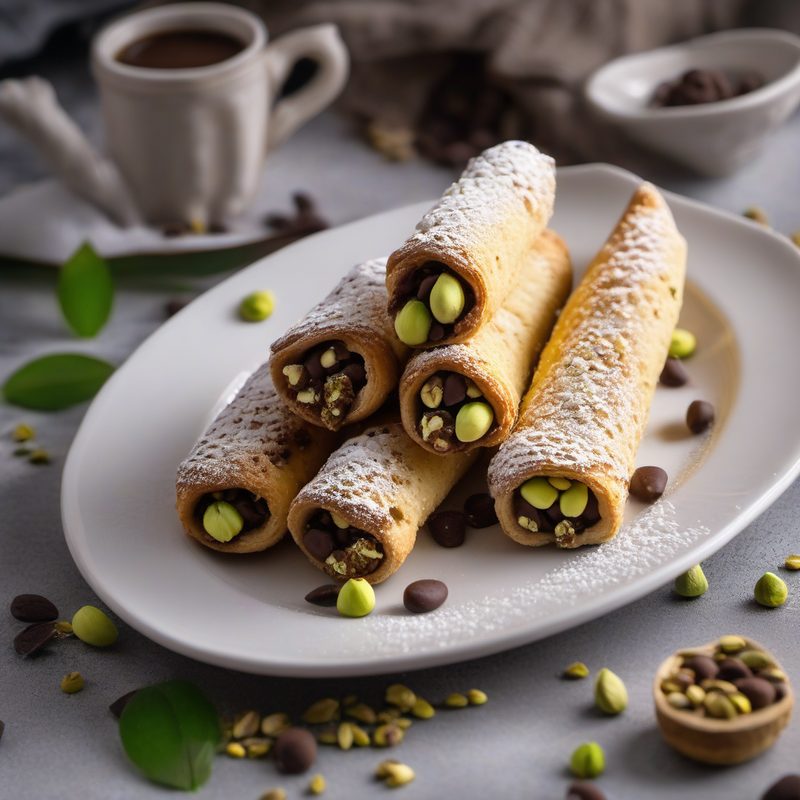
Photo reference: `vol1_106.png` — A close-up, elevated three-quarter angle shot of a serving platter or marble pastry board densely arranged with a dozen glossy eclairs. Half the eclairs are dipped in rich, dark chocolate (70% cocoa) with thin, white chocolate zigzag stripes across the top; the other half are dipped in creamy white chocolate with thin dark chocolate stripes. The chocolate surfaces are smooth, glossy, and unblemished — not a single bloom or fingerprint. One éclair is displayed in cross-section on a small plate beside the platter, revealing the crisp, hollow choux shell filled with smooth, pale golden vanilla pastry cream studded with tiny black vanilla bean specks. The cross-section shows the distinct layers: the thin, golden-brown choux shell, the creamy vanilla center, and the chocolate coating on top. Soft, natural daylight from a nearby window falls across the scene, creating subtle highlights on the glossy chocolate. A small cup of dark espresso sits to the side, a single espresso bean resting on the saucer. A linen napkin, a few vanilla beans, and a small pile of chocolate shavings complete the artfully casual composition. The mood is elegant, refined, and irresistible — the kind of image that makes you want to reach through the screen and grab one.
Recipe from "The Italian Kitchen" by Vita Milanese — Volume 1: Pasta Perfetto 🥐
Recipe from The Italian Kitchen by Vita Milanese — Volume 1 · Pasta Perfetto. Discover all volumes on the ebook page.