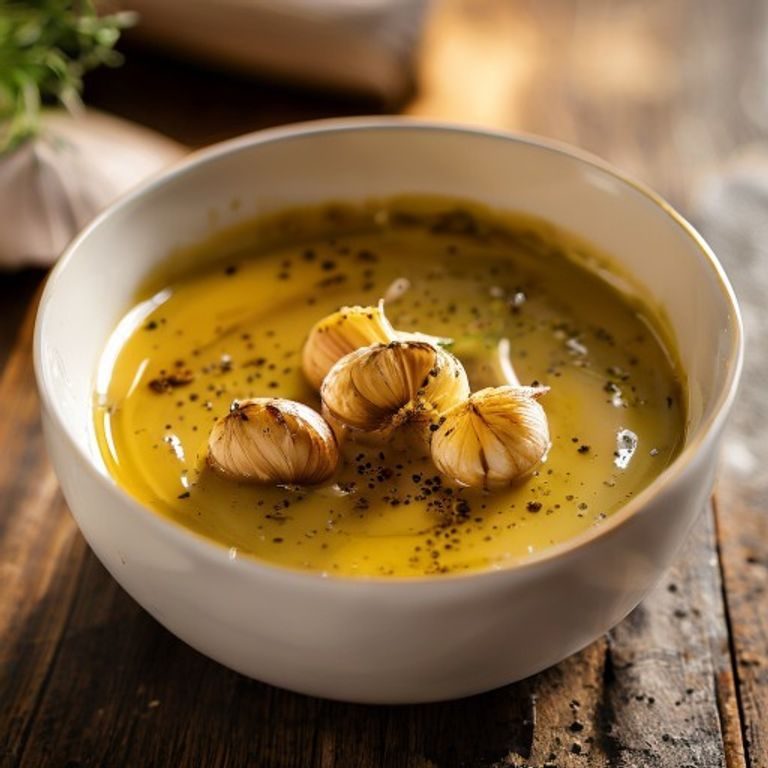
Roasted Garlic Emulsion
A silky, spreadable, intensely savory roasted garlic emulsion that transforms a full kilogram of garlic bulbs into liquid gold — sweet, mellow, nutty, and impossibly smooth, with a versatility that stretches from bread dips to steak sauces to vegetable glazes.
| Amount | Ingredient |
|---|---|
| 1 kg (2.2 lb) | garlic bulbs (about 6-8 whole heads) |
| 5 sprigs | fresh lemon thyme (or regular thyme + 1 strip lemon zest) |
| 1 tsp (5 g) | flaky sea salt (such as Maldon), plus more to taste |
| 250 ml (1 cup) | sunflower oil (or other neutral oil) |
| 150 ml (⅔ cup) | extra-virgin olive oil |
This is not your grandmother's roasted garlic. This is roasted garlic pushed to its most refined, most elegant conclusion: a luscious, spoonable emulsion made by blasting whole garlic bulbs with gentle heat until the cloves collapse into a sweet, buttery paste, then blending that paste with a combination of sunflower oil and extra-virgin olive oil until it transforms into a silky, mayonnaise-like sauce. The lemon thyme and flaky sea salt infuse the garlic as it roasts, adding herbal and mineral notes that lift the sweetness of the caramelized cloves. The result is an emulsion that is both luxurious and practical — it spreads like butter on crusty bread, drizzles like a sauce over roasted meats or vegetables, works as a dip for crudités, and even doubles as a finishing glaze for grilled fish or chicken. It is the kind of recipe that looks unassuming but will become the most-used condiment in your refrigerator.
Ingredient notes: Choose firm, plump garlic bulbs with tight, unblemished skins — the fresher the garlic, the sweeter and juicier the roasted cloves. Lemon thyme is ideal for its delicate citrus-herb notes, but regular fresh thyme combined with a strip of lemon zest (added to the roasting dish) works beautifully. Do not substitute dried thyme; the fresh herb releases its essential oils into the roasting oil, infusing the garlic with flavor. Sunflower oil is the preferred neutral oil for its clean flavor and high smoke point — you can substitute grapeseed, canola, or avocado oil, but avoid vegetable oil blends that may contain soybean oil, which can impart a grassy note. Use a fruity, medium-intensity extra-virgin olive oil; a very peppery or bitter olive oil will compete with the sweet roasted garlic. Flaky sea salt (Maldon or similar) is important for its purity and texture; fine table salt may contain anti-caking agents that can affect the emulsion.
- Baking dish (8×8 inch / 20×20 cm or similar)
- Aluminum foil
- Chef's knife and cutting board
- High-speed blender (Vitamix or similar)
- Rubber spatula
- Measuring cups
- Airtight storage container or jar
- Kitchen shears (optional, for trimming garlic tops)
- Preheat the oven (5 min). Preheat your oven to 350°F / 175°C with a rack in the center position.
- Prepare the garlic bulbs (5 min). Using a sharp chef's knife, cut about ½ inch (1 cm) off the top of each garlic bulb to expose the tops of the cloves. Do not cut too much — you only need to expose the cloves, not halve the bulbs. Place the garlic bulbs cut-side up in a baking dish that holds them snugly in a single layer.
- Season and oil the garlic (2 min). Drizzle about 2 tablespoons of the sunflower oil over the exposed tops of the garlic bulbs, allowing it to run down between the cloves. Tuck the lemon thyme sprigs between and around the bulbs. Sprinkle the flaky sea salt evenly over the tops. Cover the baking dish tightly with aluminum foil.
- Roast the garlic (45-60 min). Roast the covered garlic in the preheated oven for 45 to 60 minutes, until the cloves are very soft, golden, and easily pierced with a knife. The garlic is done when the cloves yield to gentle pressure like softened butter and the cut tops are a deep golden-amber color. The exact time depends on the size and age of your garlic bulbs — check at 45 minutes and continue in 5-minute increments if needed.
- Cool slightly (5 min). Remove the baking dish from the oven. Uncover and let the garlic cool just enough to handle, about 5 minutes. Do not let it cool completely — warm garlic blends more smoothly into the emulsion.
- Extract the roasted garlic (5 min). Working one bulb at a time, squeeze the roasted garlic cloves out of their skins from the root end upward. The softened cloves should slide out easily in a single mass — if they resist, use a small knife or your fingers to coax them out. Discard the empty skins and the spent thyme sprigs. Transfer all the roasted garlic cloves to the blender jar. You should have about ¾ cup (180 ml) of concentrated roasted garlic paste.
- Blend the emulsion (2 min). Pour the remaining sunflower oil and the extra-virgin olive oil into the blender jar with the roasted garlic. Start the blender on low speed and gradually increase to high speed. Blend for a full 2 minutes, stopping once to scrape down the sides of the blender jar with a rubber spatula, until the emulsion is completely smooth, silky, and homogeneous. The mixture will transform from a chunky paste into a thick, creamy, glossy sauce. If the emulsion appears too thick, add 1 tablespoon of warm water and blend again; if too thin, add a few more roasted garlic cloves (if you have them) or a tablespoon of sunflower oil and blend again.
- Season and finish (30 sec). Taste the emulsion and add additional flaky sea salt if needed. Pulse 2 or 3 times to incorporate. Transfer to an airtight container and let cool to room temperature before refrigerating.
- Serving Suggestions. Spread on crusty bread, toast, or crackers; use as a dip for crudités, roasted vegetables, or grilled artichokes; spoon over grilled steak, roast chicken, lamb chops, or pork tenderloin; drizzle over roasted or grilled vegetables (asparagus, zucchini, peppers, eggplant); stir into mashed potatoes or polenta; brush onto pizza crust before baking; use as a base for salad dressings (whisk 2 tablespoons of the emulsion with 1 tablespoon of vinegar); swirl into soups (minestrone, tomato, potato-leek) for a garlicky, creamy finish; or thin with a little warm water and use as a pasta sauce with plenty of Parmigiano.
- Roast low and slow. The key to sweet, mellow roasted garlic is gentle, even heat at 350°F / 175°C. Higher temperatures will brown the exterior too quickly, producing bitter notes before the interior is fully tender. If your oven runs hot, reduce to 325°F / 160°C and extend the roasting time by 10-15 minutes.
- Cover tightly with foil. The foil traps steam, which gently cooks the garlic from all sides and prevents the exposed cloves from drying out or burning. A loose cover defeats the purpose.
- Use warm garlic for blending. Warm garlic blends into a much smoother, more stable emulsion than cold garlic. The residual heat helps the oils incorporate evenly and prevents the emulsion from breaking.
- Do not skimp on the blending time. A full 2 minutes of high-speed blending is necessary to break down the garlic fibers completely and create a truly silky, mayonnaise-like texture. Less time will leave the emulsion slightly grainy.
- Balance the oils. The combination of neutral sunflower oil and fruity olive oil is deliberate — pure olive oil would be too heavy and overpowering, while pure sunflower oil would be too flat. The 5:3 ratio (sunflower to olive) yields the ideal balance of richness and clean flavor.
- Flaky salt matters. The large, delicate crystals of flaky sea salt dissolve slowly and provide bursts of salt that enhance the garlic's sweetness. Fine salt incorporates too quickly and can make the emulsion taste harsh.
- Lemon thyme is ideal. If you cannot find lemon thyme, substitute 5 sprigs of regular fresh thyme plus one 3-inch strip of lemon zest (removed with a vegetable peeler — no white pith). Add the zest strip to the baking dish during roasting and remove it before blending.
| Mistake | Why It Hurts | The Fix |
|---|---|---|
| Roasting at too high a temperature | The exposed garlic cloves brown and caramelize too quickly, developing bitter, burnt flavors before the inside is tender | Roast at 350°F / 175°C or lower; if your oven runs hot, reduce to 325°F / 160°C |
| Not covering the dish tightly | The garlic dries out and the exposed cloves harden into dry, browned crusts rather than soft, spreadable paste | Cover tightly with foil and ensure it is well-sealed around the edges |
| Using old, sprouting garlic | The cloves will be tough, bitter, and have a harsh, acrid flavor that roasting cannot fully tame | Always use fresh, firm, tight-skinned garlic bulbs — check that there is no green sprout visible at the top |
| Blending for too short a time | The emulsion remains grainy and separated — the garlic fibers have not been fully broken down | Blend on high for a full 2 minutes, stopping to scrape down the sides once |
| Adding all the oil at once | The blender cannot properly incorporate the oils, resulting in a thin, broken, watery emulsion | The recipe calls for all oil at once because the high volume in a blender helps create a vortex; if using a smaller blender, drizzle the oil in slowly with the motor running |
| Using only olive oil | The emulsion is too heavy, greasy, and overpowering — olive oil's strong flavor dominates the delicate roasted garlic | Use the 5:3 sunflower-to-olive ratio; the neutral sunflower oil lets the garlic flavor shine |
| Forgetting to remove the thyme sprigs | Woody stems get blended into the emulsion, creating unpleasant fibrous bits | Remove and discard the thyme sprigs before transferring the garlic to the blender |
| Not seasoning the garlic before roasting | The garlic roasts without salt penetration, resulting in a flat, underseasoned final emulsion | Sprinkle flaky sea salt over the cut tops of the garlic before roasting — the salt draws moisture and flavor into the cloves |
- Smoky Roasted Garlic Emulsion: Add 1 teaspoon of smoked paprika or ½ teaspoon of chipotle powder to the blender along with the oils for a deep, smoky, barbecue-tinged version.
- Herb-Infused Emulsion: Add 2 tablespoons of fresh rosemary, sage, or thyme leaves to the blender along with the oils for an herbaceous variation that pairs beautifully with roasted lamb or poultry.
- Lemon-Garlic Emulsion: Add 1 tablespoon of fresh lemon juice and 1 teaspoon of finely grated lemon zest to the blender for a brighter, more citrus-forward version that is spectacular with fish and seafood.
- Cheesy Roasted Garlic Emulsion: Add ¼ cup (25 g) of finely grated Parmigiano-Reggiano to the blender during the last 30 seconds of blending for a savory, umami-rich emulsion that doubles as a pasta sauce.
- Spicy Roasted Garlic Emulsion: Add 1 small dried Calabrian or Thai chili (or ½ teaspoon of red pepper flakes) to the baking dish during roasting, then transfer it to the blender with the garlic for a warm, peppery heat throughout.
- Truffle Roasted Garlic Emulsion: Add 1 teaspoon of truffle oil (or 2 teaspoons of truffle zest) to the blender during the last 10 seconds for an ultra-luxurious version that is perfect for special occasions.
- Balsamic Roasted Garlic Emulsion: Swirl in 1 tablespoon of aged balsamic vinegar just before serving for a sweet-tart contrast that is excellent with grilled steak or roasted root vegetables.
| Storage Method | Details |
|---|---|
| Refrigerator | Store in an airtight container or jar for up to 2 weeks. The emulsion will thicken and the olive oil may partially solidify when cold — this is normal. Bring to room temperature (about 20 minutes) and stir vigorously before serving. Do not microwave to soften, as this can break the emulsion. |
| Freezer | Freeze in an ice cube tray (about 2 tablespoons per cube) for up to 3 months. Once frozen, transfer the cubes to a zip-top freezer bag. Thaw individual cubes in the refrigerator overnight or at room temperature for about 30 minutes. Stir well before using. The texture remains excellent after thawing. |
| Oil separation | Some separation of the oils is normal over time, especially after refrigeration. Simply stir or whisk the emulsion back together before serving. If the emulsion has fully separated (oil floating on top of a watery garlic layer), it has been stored too long or at too high a temperature — discard and make a fresh batch. |
This rich, savory emulsion pairs well with a wide range of wines, depending on how you use it:
- Soave Classico (Garganega) — The subtle almond and citrus notes of a good Soave complement the sweet roasted garlic without overpowering it.
- Verdicchio dei Castelli di Jesi — A bright, mineral-driven white with enough structure and acidity to cut through the richness of the emulsion.
- Pinot Grigio (Friuli) — Clean, crisp, and neutral enough to let the garlic flavor take center stage.
- Chardonnay (unoaked, Chablis or Gavi) — The pure, mineral-driven character of unoaked Chardonnay is a perfect match for the emulsion's creamy texture and sweet garlic notes.
- Barbera d'Alba — If serving the emulsion with red meat or roasted vegetables, a light, fruity Barbera with bright acidity cuts through the richness beautifully.
- Sparkling wine (Franciacorta Brut or Prosecco Superiore) — The bubbles and high acidity make this an excellent pairing when the emulsion is served as a bread dip or appetizer.
| Per Serving (about 2 tablespoons / 30 ml) | |
|---|---|
| Calories | 165 |
| Protein | 0.5 g |
| Fat | 18 g |
| Carbohydrates | 3 g |
| Fiber | 0 g |
Nutrition values are approximate and based on a 2-tablespoon serving. Actual values will vary based on oil absorption during roasting, garlic bulb size, and exact measurements. The majority of calories come from the sunflower and olive oils.
Can I make this with pre-peeled garlic cloves?
It is not recommended. Pre-peeled garlic cloves are often treated with preservatives and lack the complex flavor of whole bulbs. More importantly, roasting whole bulbs in their skins protects the cloves from direct heat, allowing them to steam and caramelize gently. Pre-peeled cloves will dry out and burn before they become sweet and tender. If you must use pre-peeled cloves, place them in a small baking dish, cover generously with oil and foil, and roast at 325°F / 160°C for 30-40 minutes, checking frequently.
How long does roasted garlic emulsion keep?
Up to 2 weeks in the refrigerator when stored in an airtight container. After that, the flavor begins to fade and the subtle bitterness of oxidized garlic starts to emerge. Always use a clean, dry utensil to scoop out the emulsion to prevent introducing bacteria.
Can I use a food processor instead of a blender?
A high-speed blender produces the smoothest, most stable emulsion because it creates a powerful vortex that forces the garlic and oil to emulsify completely. A food processor will work, but the result will be slightly less silky and may separate more quickly. If using a food processor, drizzle the oils in through the feed tube with the motor running and process for at least 3 minutes.
My emulsion broke — can I fix it?
Yes, in most cases. If the emulsion has separated into oil and garlic solids, pour it into a clean blender jar. Warm 2 tablespoons of water to about 110°F / 45°C (warm to the touch, not hot). With the blender running on low speed, drizzle the warm water in slowly. The emulsion should come back together. If it remains broken, add 1 teaspoon of Dijon mustard (a natural emulsifier) and blend again.
Can I reduce the amount of oil?
The oil is essential for the emulsion's texture and shelf stability — reducing it will result in a thick, pasty garlic spread rather than a smooth, spoonable emulsion. If you prefer a lower-oil version, use the roasted garlic paste as-is (before blending with oil) as a spread or compound butter base, mixed with an equal amount of softened unsalted butter.
What can I do with the leftover garlic skins?
Compost them! Garlic skins are rich in nutrients and break down well in a compost pile. They are also excellent for making garlic-infused vegetable stock — simply add them to a stock bag in the freezer and use them the next time you make broth.
- Roasted Garlic Compound Butter (Volume 1)
- Delicate Garlic Cream (Volume 2, #26)
- Garlic Confit (Volume 1)
- Classic Aioli (Volume 2)
- Roasted Garlic & Parmesan Mashed Potatoes (Volume 2)
- Garlic-Herb Oil (Volume 1)
- Slow-Roasted Tomatoes with Garlic & Thyme (Volume 1)
Recipe from "The Italian Kitchen" by Vita Milanese — Volume 2: Sunday Sauce
Recipe from The Italian Kitchen by Vita Milanese — Volume 2 · Sunday Sauce. Discover all volumes on the ebook page.