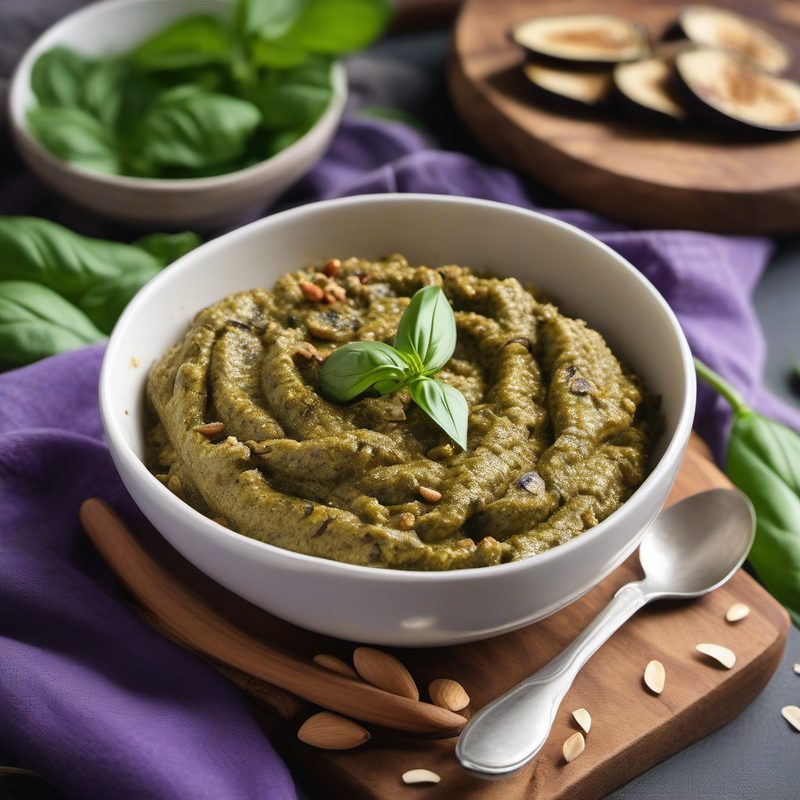
Eggplant Pesto
The secret to the deepest, smokiest pesto you've ever tasted is not a harder-to-find cheese or a rarer herb — it's a whole roasted eggplant whose tender, smoky flesh replaces the usual torrent of olive oil, delivering a creamy, luscious sauce that clings to pasta like a dream while using a fraction of the fat.
| Amount | Ingredient |
|---|---|
| 1 (about 350 g / 12 oz) | large eggplant |
| 20 g (3/4 cup packed) | fresh basil leaves |
| 70 g (2/3 cup) | raw almonds |
| 1 clove | garlic, minced |
| 40 g (1/3 cup) | Parmigiano-Reggiano, finely grated |
| 30 ml (2 tbsp) | extra-virgin olive oil |
| to taste | salt |
Traditional basil pesto is a marvel of simplicity, but its generous pour of olive oil can make it heavy and, frankly, one-dimensional. Eggplant pesto — a specialty of Sicily and Calabria, where eggplants are as common as tomatoes — solves this by swapping volume for depth. The roasted eggplant breaks down into a silky, almost buttery purée that binds the basil, almonds, garlic, and Parmigiano into a sauce that is simultaneously rich and light. The air fryer method here is a game-changer: it delivers concentrated, smoky flavor in half the time of a conventional oven, with no need to preheat the entire kitchen. The result is a pesto that is deeply savory, faintly smoky, and compellingly creamy — equally at home tossed with hot pasta, spread on crusty bread, or spooned over grilled vegetables.
Use level tablespoons and standard US measuring cups.
- Air fryer (or oven with baking sheet)
- Chef's knife and cutting board
- Spoon for scooping eggplant flesh
- Food processor
- Rubber spatula
- Airtight container for storage
- Cook the eggplant — 25 minutes. Prick the whole eggplant 6 to 8 times with a fork to allow steam to escape. Place it in the air fryer basket and cook at 400°F (200°C) for 25 minutes, until the skin is wrinkled and collapsed and the flesh feels very soft when pressed. If the eggplant is unusually large, add 3 to 5 more minutes. Pro tip: For oven roasting, place the whole eggplant on a parchment-lined baking sheet and roast at 400°F for 40 to 45 minutes, turning once halfway through. The eggplant is ready when it deflates dramatically and a knife slides through with no resistance.
- Cool and scoop — 5 minutes. Transfer the cooked eggplant to a plate or cutting board and let it cool until comfortable to handle, about 5 minutes. Cut it in half lengthwise. Use a spoon to scoop out all the tender flesh, discarding the skin. You should have about ¾ cup (180 ml) of cooked eggplant. Pro tip: Don't worry about a few stray bits of skin — they'll blend in invisibly. Do, however, avoid scooping any large clumps of seeds, which can add bitterness.
- Process the base — 2 minutes. In the bowl of a food processor, combine the eggplant flesh, basil leaves, almonds, minced garlic, grated Parmigiano-Reggiano, olive oil, and ½ teaspoon of salt. Pro tip: Toast the almonds in a dry skillet over medium heat for 3 to 4 minutes before adding them — this deepens their nuttiness and adds another layer of complexity to the pesto.
- Pulse to desired texture — 1 minute. Pulse the processor in short bursts (10 to 12 pulses), scraping down the sides with a rubber spatula as needed, until the mixture is creamy but still has visible texture from the almonds. You want a spreadable, scoopable consistency — not a completely smooth purée. Pro tip: If the pesto seems too thick, add 1 tablespoon of warm pasta cooking water (or plain water) and pulse once more. The starch in the water helps the sauce cling to pasta.
- Season and adjust — 1 minute. Taste and add more salt if needed. The pesto should be savory, nutty, and herbaceous, with the eggplant adding a subtle smoky sweetness in the background. If it tastes flat, a small squeeze of lemon juice can brighten it. Pro tip: Remember that Parmigiano is already salty — taste before adding extra salt, and adjust gradually.
- Serve — immediately or within 1 hour. Toss with hot pasta (reserve ½ cup of pasta water to loosen the sauce), spread on crostini, or use as a sauce for grilled vegetables or fish. The pesto is best served within an hour of making, when the eggplant's moisture is still integrated and the basil is bright.
- Tossed with 340 g (12 oz) of orecchiette, busiate, or casarecce — the pesto clings to the pasta's nooks and crannies
- Spread generously on grilled or toasted crostini, topped with a shaving of Parmigiano and a drizzle of olive oil
- Spooned over grilled eggplant slices, zucchini, or bell peppers as a roasted-vegetable reprise
- Dolloped onto grilled chicken or fish (swordfish, sea bass, or salmon)
- Used as a sandwich spread in place of mayonnaise, especially on a Caprese-style panino
- Served as a dip with raw vegetables — fennel sticks, celery, and bell pepper strips
- Use a whole eggplant, not pre-roasted or canned. The roasting process concentrates flavor and removes bitterness. Pre-cooked eggplant products are often watery and bland.
- Air fryer is the fastest path to smoky flavor. The high-speed fan circulates heat evenly, producing deeply caramelized flesh in 25 minutes versus 40 minutes in the oven. If using an oven, don't skip the high heat — 400°F minimum.
- Do not peel the eggplant before cooking. The skin acts as a natural steaming vessel, holding in moisture while the interior cooks to custard-like tenderness. It also protects the delicate flesh from burning.
- Almonds, not pine nuts. Traditional Genovese pesto uses pine nuts, but this Sicilian-style pesto calls for almonds. They're more affordable, less prone to rancidity, and their sturdy texture holds up better in the food processor. Toasted walnuts are an excellent substitute.
- Basil must be fresh and dry. Wash the basil leaves at least an hour ahead and dry them thoroughly in a salad spinner or between kitchen towels. Wet basil makes the pesto watery and dilutes the flavor.
- Serve at room temperature for best flavor. Straight from the food processor or gently warmed. Cold pesto clumps and the olive oil stiffens — if refrigerated, let it sit at room temperature for 20 minutes before serving.
- Grate the Parmigiano yourself. Pre-grated cheese contains anti-caking agents that prevent smooth blending and add a chalky texture. Grate a 40 g piece from a block on the fine holes of a box grater.
| Mistake | Why It Hurts | The Fix |
|---|---|---|
| Undercooking the eggplant | Raw eggplant is spongy, bitter, and won't blend into a creamy sauce | Cook until the skin is deeply wrinkled and the flesh offers no resistance to a knife; air fry at 400°F for a full 25 minutes |
| Using too much olive oil | The pesto becomes greasy and separates, losing the creamy eggplant texture | Start with 2 tablespoons and add more only if needed; the eggplant provides most of the moisture |
| Over-processing | The almonds turn into almond butter and the pesto becomes pasty and greasy | Use short pulses and stop while there is still visible texture — 10 to 12 pulses is usually enough |
| Adding garlic too early | Raw garlic can turn harsh and bitter when sitting in the finished pesto | Add the garlic just before processing, and mince it first to distribute evenly |
| Using wet basil | Water prevents the pesto from emulsifying and dilutes the flavor | Pat basil leaves completely dry before measuring; better yet, wash and dry them hours ahead |
| Skipping the salt | Eggplant absorbs salt aggressively; without enough, the pesto tastes flat and watery | Season generously — eggplant flesh is bland on its own and needs salt to come to life |
| Making too far ahead | The basil oxidizes and turns dark within hours, and the garlic becomes harsh | Make within 2 hours of serving; press plastic wrap directly onto the surface if storing |
- Smoky Eggplant Pesto: Before roasting, pierce the eggplant and stuff the slits with 2 small garlic cloves and 1 teaspoon of smoked paprika. The garlic roasts inside and the paprika adds barbecue-like depth.
- Spicy Eggplant Pesto: Add ½ teaspoon of red pepper flakes or 1 small dried Calabrian chili (rehydrated and chopped) to the food processor with the other ingredients.
- Mint and Basil Eggplant Pesto: Replace half the basil with fresh mint leaves. This is especially good with lamb or as a spread on grilled bread.
- Ricotta-Enriched Pesto: Fold 2 tablespoons of whole-milk ricotta into the finished pesto for an even creamier, milder sauce — excellent with gnocchi.
- Nut-Free Eggplant Pesto: Replace almonds with 40 g (¼ cup) of sunflower seeds or pepitas. Toast them first for best flavor.
- Vegan Eggplant Pesto: Omit the Parmigiano-Reggiano and add 1 tablespoon of nutritional yeast plus ½ teaspoon of white miso paste for umami depth.
| Method | Details |
|---|---|
| Refrigerator | Store in an airtight container with plastic wrap pressed directly onto the surface for up to 3 days |
| Best Before | Peak flavor is within 2 hours; after 24 hours, basil darkens and garlic sharpens |
| Reviving | Stir vigorously before serving; if thickened, add 1 tablespoon warm water or pasta cooking water |
| Freezing | Freeze in an ice cube tray, then transfer cubes to a freezer bag — up to 3 months; thaw in the refrigerator |
| Freezing Note | Eggplant pesto freezes better than basil pesto because the eggplant matrix protects the basil from oxidation; still, use within 3 months for best color and flavor |
- Etna Rosso (Sicily, Italy) — the volcanic, mineral-driven red from Mount Etna's slopes, with juicy red fruit and enough acidity to cut through the eggplant's sweetness
- Cerasuolo di Vittoria (Sicily, Italy) — Sicily's only DOCG red, a blend of Nero d'Avola and Frappato, light-bodied and fragrant with cherry and floral notes
- Grillo (Sicily, Italy) — a full-bodied white with citrus and almond notes that echo the pesto's own almonds — unexpectedly perfect
- Verdicchio dei Castelli di Jesi (Marche, Italy) — a crisp, lemony white with enough structure to stand up to garlic and Parmigiano
- Prosecco Brut (Veneto, Italy) — the bubbles and acidity cut through the creamy pesto and refresh the palate — ideal as an aperitivo with pesto crostini
| Calories | Protein | Fat | Carbs | Fiber |
|---|---|---|---|---|
| 95 per ¼ cup (60 ml) serving | 4 g | 7 g | 5 g | 3 g |
Q: Can I use a different type of eggplant?
A: Yes. Globe eggplants (the large, teardrop-shaped kind) work well and are the most widely available. Japanese or Italian eggplants are excellent too — they have thinner skins and fewer seeds, and they cook slightly faster. Check for doneness 5 minutes early if using smaller eggplants. Do not use white eggplants, which are milder and less flavorful.
Q: My pesto is too thick after refrigerating — what do I do?
A: This is normal. The eggplant's natural pectin stiffens when cold, and the olive oil solidifies slightly. Let the pesto sit at room temperature for 20 minutes, then stir in 1 to 2 tablespoons of warm water or pasta cooking water until it reaches a spoonable consistency.
Q: Can I make this with roasted garlic instead of raw?
A: Absolutely. Roast 4 garlic cloves alongside the eggplant (toss them in the air fryer basket after 10 minutes of eggplant cooking, wrapped in foil). The result is sweeter, mellower, and less pungent — ideal for those who find raw garlic too harsh. Increase the salt slightly, as roasted garlic lacks the sharpness that raw garlic provides.
Q: Is this pesto gluten-free?
A: Yes. All ingredients are naturally gluten-free. Just be sure to toss it with gluten-free pasta or serve it on gluten-free bread. Check your Parmigiano-Reggiano label if you have celiac disease — some aged cheeses may use gluten-containing production methods, though authentic Parmigiano-Reggiano does not.
Q: Can I use frozen basil?
A: Frozen basil is not recommended for pesto. Freezing ruptures the cell walls, making the leaves waterlogged and brown. The resulting pesto will be darker and less flavorful. Fresh basil is essential for the bright, herbaceous flavor that defines this dish.
Q: The almonds didn't break down — what went wrong?
A: Two likely causes: (1) The food processor was not powerful enough — a standard 7-cup or larger processor works best; (2) The almonds were not pulsed long enough — try another 5 to 6 pulses. If the almonds are still too coarse, soak them in hot water for 10 minutes, then drain and pat dry before processing.
- Tzatziki (Volume 2, Recipe #78)
- Sicilian Pesto (Volume 2, Recipe #77)
- Arugula Pesto (Volume 2, Recipe #59)
- Pistachio Pesto (Volume 2, Recipe #85)
- Baba Ghanoush (Volume 1, Recipe #45)
- Caponata (Volume 1, Recipe #48)
Recipe from "The Italian Kitchen" by Vita Milanese — Volume 2: Sunday Sauce
Recipe from The Italian Kitchen by Vita Milanese — Volume 2 · Sunday Sauce. Discover all volumes on the ebook page.