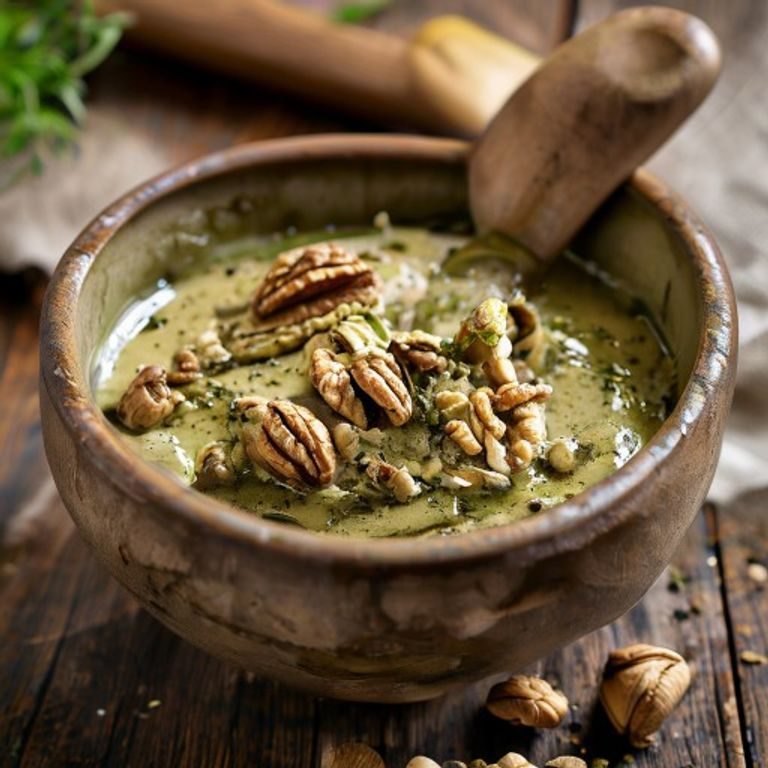
Walnut Pesto
This is the pesto of autumn — no basil, no pine nuts, just toasted walnut richness tempered by sweet milk-soaked bread, sharp Parmigiano, and a whisper of garlic, all pounded by hand into a creamy, nutty sauce that clings to pasta like velvet and turns the simplest bowl of gnocchi or a boiled potato into something hauntingly good.
| Amount | Ingredient |
|---|---|
| 180 g (6 oz / about 1½ cups) | walnut kernels (gherigli di noce) |
| 50 g (½ cup) | Parmigiano-Reggiano, finely grated |
| 1 medium clove | garlic |
| 50 g (about 2 oz, 2 slices) | stale white bread, crust removed |
| 150 ml (⅔ cup) | whole milk, plus more if needed |
| 5 tbsp (75 ml) | extra-virgin olive oil |
| to taste | fine sea salt |
| to taste | freshly ground black pepper |
This is the pesto that grandmas across Piedmont, Liguria, and Lombardy make when the first walnuts fall from the trees and the basil has long since faded. Unlike the familiar green Genovese pesto, walnut pesto has no basil at all — its flavor comes entirely from the walnuts themselves, which are first blanched to remove their bitter skins, then pounded in a mortar with garlic, stale bread soaked in milk, and a stream of fruity olive oil. The bread-and-milk binder is the secret: it gives the pesto an impossibly creamy, spreadable texture without the heaviness of too much oil, and it softens the tannic edge of the walnuts into something sweet, mellow, and almost buttery. Finished with nutty Parmigiano-Reggiano and a final adjustment of salt and pepper, this pesto is rustic and refined at once — a sauce that tastes of wood-fired ovens, winter kitchens, and tradition. Toss it with gnocchi, trofie, or linguine (the classic pairing in Liguria is with trofie al pesto di noci), spread it on crostini, spoon it over roasted squash or grilled chicken, or stir it into a bowl of steaming boiled potatoes for a meal that costs pennies and tastes like gold. The mortar-and-pestle method is non-negotiable for the best texture — let the rhythmic pounding be your meditation.
Ingredient notes: Walnuts are the soul of this recipe — use fresh, high-quality walnut kernels (gherigli di noce) that smell sweet and nutty, not rancid or dusty. Old or stale walnuts will ruin the pesto; buy them from a vendor with high turnover and taste one before starting. The stale bread should be an inexpensive white loaf (pain de mie or a simple baguette) that is a day or two old — not so hard that it resists soaking, but firm enough that it doesn't disintegrate into mush. Soft sandwich bread is too fluffy and will turn gluey. Whole milk is best for the soak; the fat helps emulsify the pesto and contributes to its velvety texture. Parmigiano-Reggiano is the canonical cheese here — its crystalline, nutty, savory character is a perfect match for the walnuts. Grana Padano is an acceptable substitute but produces a milder, less complex finish. Pecorino Romano is too salty and sharp for this delicate sauce; save it for heartier preparations. The garlic should be fresh and fragrant — a single medium clove will perfume the pesto without overwhelming it. If your garlic is very large or very old (with a green germ in the center), remove the germ before using.
- Large chef's knife and cutting board
- Small saucepan (for blanching walnuts)
- Mortar and pestle (preferably marble or granite, at least 12 cm / 5-inch diameter)
- Small bowl or shallow dish (for soaking the bread)
- Fine-mesh sieve or slotted spoon
- Kitchen towel or paper towels
- Measuring cups and spoons
- Flexible spatula
- Citrus juicer or garlic press (optional)
- Prepare the bread (10 min). Remove the crust from the stale bread slices and discard the crusts. Tear or cut the bread into rough 2 cm (¾ inch) pieces. Place the bread pieces in a small shallow dish and pour the milk over them. Press the bread gently into the milk to ensure even absorption. Let it soak for at least 10 minutes — the bread should become completely soft and saturated but not swimming in excess milk.
- Blanch the walnuts (5 min). While the bread soaks, bring a small saucepan of water to a rolling boil over high heat. Add the walnut kernels and let them boil for exactly 2 minutes. Do not over-blanch — the goal is to loosen the bitter skins, not to cook the walnuts. Drain the walnuts in a fine-mesh sieve and rinse briefly with cool water to stop the cooking. Spread them on a kitchen towel or paper towels and let them cool for 2 to 3 minutes — just enough that you can handle them without burning your fingers.
- Peel the walnuts (5–10 min). Once the walnuts are cool enough to handle, peel them. Working one at a time, pinch each walnut kernel between your thumb and forefinger and rub gently — the thin, papery brown skin should slip off easily. It is okay if small patches of skin remain; do not obsess over perfection. Removing the bulk of the skins eliminates the bitter, astringent tannins that would otherwise dominate the pesto. Transfer the peeled walnuts to a clean bowl as you go.
- Begin pounding the walnuts and garlic (3 min). Place the peeled walnuts and the garlic clove in the mortar. Using a firm, rhythmic motion with the pestle, pound and grind the walnuts and garlic together, working the pestle in a circular, crushing motion against the sides and bottom of the mortar. Continue until the mixture resembles a coarse, almost pasty, granular mass — about 2 to 3 minutes of steady work. The walnuts should release their oils and begin to clump together into a rough paste. Do not rush this step; the texture depends on the mechanical action of the mortar.
- Add the soaked bread (2 min). Using your hand or a slotted spoon, lift the soaked bread pieces from the milk and squeeze them gently to remove the excess liquid — the bread should be moist but not dripping. Discard the remaining milk or reserve it for adjusting consistency later. Add the squeezed bread to the mortar with the walnut-garlic paste. Continue pounding with the same circular, crushing motion. The bread will break apart and merge with the walnuts, transforming the coarse paste into a smoother, more homogenous cream. Work for about 2 minutes, scraping down the sides of the mortar with a spatula as needed.
- Incorporate the olive oil (3 min). With the pestle still moving in a steady rhythm, begin adding the extra-virgin olive oil one tablespoon at a time. Add the first tablespoon and pound and stir until it is fully absorbed before adding the next. The mixture will go through stages — first it will seem stiff and thick, then gradually it will loosen and emulsify into a creamy, spreadable paste. Each addition of oil should be completely incorporated before the next. This slow, patient emulsion is what gives the pesto its silky, luxurious texture.
- Add the Parmigiano-Reggiano (2 min). Once all the olive oil has been incorporated, add the finely grated Parmigiano-Reggiano to the mortar. Pound, stir, and fold the cheese into the walnut-cream mixture until it is completely uniform. The cheese adds salt, umami, and body — the pesto will thicken slightly and take on a more cohesive, spreadable consistency. Taste a small amount on a piece of bread or your finger — it should be nutty, creamy, and savory with a gentle garlic warmth in the background.
- Season and adjust consistency (2 min). Season the pesto with salt and freshly ground black pepper to taste. Start with a pinch of salt and a few grinds of pepper, taste, and adjust — the Parmigiano already contributes salt, so add cautiously. If the pesto is too thick and stiff (it should be creamy and spreadable, like a thick hummus or a soft butter), stir in a splash of the reserved milk or a tablespoon of warm water until it reaches your desired consistency. If it is too thin (unlikely with this method), let it rest for 5 minutes — the bread will continue to absorb liquid and thicken as it sits.
- Serve immediately or store (1 min). The pesto is at its best within the first hour, when the walnut oils are still bright and the garlic is fresh. Toss it with freshly cooked pasta (reserve about ½ cup / 120 ml of pasta water to loosen the sauce if needed), spread it on crostini or bruschetta, or spoon it over roasted vegetables, grilled chicken, or poached fish. For the classic Genovese pasta pairing, serve with trofie or linguine, garnished with a few reserved whole walnuts, chopped, and an extra grating of Parmigiano.
- Fresh walnuts are everything. Taste a walnut kernel before you begin. If it tastes even faintly bitter, stale, or rancid, the entire pesto will be ruined — there is no fixing it. Buy walnuts from a store with high turnover, store them in the freezer until you are ready to use them (walnuts go rancid quickly at room temperature), and bring them to room temperature before blanching.
- Do not skip the blanching and peeling step. The thin brown skin of the walnut kernel is intensely bitter and astringent. If you leave it on, the pesto will have a harsh, puckering aftertaste that overpowers the nutty sweetness and the creamy texture. The 2-minute blanch loosens the skins effortlessly; the peeling takes only a few extra minutes and makes a transformative difference.
- The mortar and pestle matter. A food processor is faster but produces a different result — it generates heat that can warm the walnuts and release their bitterness prematurely, and it creates a finer, more homogenous paste that lacks the rustic, slightly granular texture that makes hand-pounded pesto so satisfying. If you must use a food processor, pulse in very short bursts (1 to 2 seconds each) and scrape the bowl frequently; stop while the texture is still slightly coarse.
- Bread-to-milk ratio is critical. The bread should be saturated but not swimming in milk. If you use too much milk, the pesto will be thin and watery; too little, and the bread will be dry and won't incorporate smoothly. The 150 ml (⅔ cup) of milk for 50 g of bread is a reliable ratio: the bread will absorb what it needs, and any leftover milk can be used to adjust consistency at the end.
- Go slow with the oil. Adding all the oil at once will cause the pesto to separate rather than emulsify. One tablespoon at a time, fully absorbed before the next addition — this is the same principle as making mayonnaise, and it produces the same velvety emulsion.
- Reserve pasta water. If serving with pasta, do not forget to reserve about ½ cup (120 ml) of the starchy pasta cooking water before draining. A splash of pasta water stirred into the pesto just before tossing creates a silky, clinging sauce that coats every strand or twist of pasta beautifully.
| Mistake | Why It Hurts | The Fix |
|---|---|---|
| Using rancid or old walnuts | Rancid walnuts have a bitter, stale, petroleum-like flavor that permeates the entire pesto — there is no masking it | Taste a walnut before starting; store walnuts in the freezer; buy from a high-turnover source |
| Skipping the blanching/peeling step | The brown walnut skins are intensely bitter and astringent — leaving them on produces a harsh, puckering pesto | Always blanch for 2 minutes and peel; it adds 5 minutes to the prep and transforms the final flavor |
| Using a food processor on high speed | The blade generates heat that cooks the walnuts, releasing bitter oils, and creates a gluey, over-emulsified paste | Use a mortar and pestle; if you must use a food processor, pulse in 1-second bursts and stop while still coarse |
| Soaking the bread too long or in too much milk | Waterlogged bread produces a thin, watery, gluey pesto that won't emulsify properly | Squeeze the bread firmly after soaking to remove excess milk; reserve the milk for later adjustment |
| Adding all the oil at once | The oil and walnut paste will separate rather than emulsify, creating a greasy, broken sauce | Add the oil one tablespoon at a time, pounding until each addition is fully absorbed before adding the next |
| Using garlic that is too old or too much garlic | Old garlic has a harsh, sulfurous, burning quality that overwhelms the delicate walnut flavor | Use one fresh medium clove; remove the green germ if present |
| Over-seasoning with salt | The Parmigiano is already salty — adding too much salt makes the pesto inedible | Season cautiously at the end; taste after adding the Parmigiano before adding any salt |
| Using the wrong cheese | Pecorino Romano is too salty and sharp; Grana Padano is too mild — both throw the flavor balance off | Use authentic Parmigiano-Reggiano for its nutty, crystalline, savory character |
- Walnut Pesto with Mascarpone (Pesto di noci e mascarpone): Add 2 tablespoons (30 g) of mascarpone to the finished pesto and stir until smooth. The mascarpone adds an extra layer of creamy richness that mellows the walnuts even further — beautiful with pumpkin-filled tortelli or sage butter pasta.
- Smoked Walnut Pesto: Substitute half the fresh walnuts with smoked walnuts (available at specialty food stores or smoked at home over wood chips). The smoky, savory depth is spectacular with grilled meats, aged cheeses, or roast root vegetables.
- Walnut and Hazelnut Pesto: Replace half the walnuts with blanched, skinned hazelnuts (toasted lightly in a dry pan until fragrant). The combination of walnut and hazelnut is classic in Piedmontese cuisine and pairs beautifully with tajarin (thin egg pasta) and butter.
- Walnut Pesto with Lemon and Thyme: Add the finely grated zest of ½ unwaxed lemon and 1 teaspoon of fresh thyme leaves (chopped) after the cheese. The bright citrus and herbaceous thyme cut through the richness and make the pesto feel lighter — ideal for summer pasta salads or as a spread on grilled fish.
- Walnut Pesto with Ricotta (Pesto di noci e ricotta): Replace the soaked bread with 100 g (⅓ cup) of fresh sheep's-milk ricotta (drained if very wet). Omit the milk soak entirely. This produces a significantly richer, creamier, denser pesto that is wonderful as a dip, a spread, or a filling for rolled pasta like cannelloni.
- Vegan Walnut Pesto: Substitute the Parmigiano-Reggiano with 2 tablespoons of nutritional yeast and 1 tablespoon of white miso paste (or ½ teaspoon of salt, adjusted to taste). Use a plant-based milk (unsweetened oat or soy milk) for the bread soak. The umami from the miso and nutritional yeast mimics the savory depth of the cheese admirably.
- Spicy Walnut Pesto: Add a pinch (⅛ to ¼ teaspoon) of red pepper flakes or a small dried chili (crumbled) to the mortar with the walnuts and garlic. The heat is a wonderful counterpoint to the creamy richness — excellent with broccoli rabe orecchiette or grilled lamb chops.
- Walnut Pesto with Anchovy (Pesto di noci e acciughe): Add 2 salted anchovy fillets (rinsed and patted dry) to the mortar with the walnuts and garlic. Pound until the anchovies dissolve into the paste before proceeding. The anchovy adds a profound savory depth (umami) that does not taste at all fishy — it simply makes the pesto taste more intensely of itself. A classic pairing that elevates the sauce to an entirely different level, especially with grilled swordfish or roasted cauliflower.
| Storage Method | Details |
|---|---|
| Refrigerator | Store in an airtight container with a thin layer of olive oil poured over the surface (to prevent oxidation and discoloration) for up to 5 days. The pesto will darken slightly as it sits — this is normal and does not affect flavor. Stir well before using. Bring to room temperature for 20 minutes before serving to restore the best texture and flavor. |
| Freezer | Walnut pesto freezes beautifully for up to 3 months. Portion into ice cube trays (each cube is about 1 tablespoon / 15 g — perfect for single servings of pasta), freeze until solid, then transfer the cubes to a freezer-safe bag. Thaw in the refrigerator overnight or at room temperature for 1 hour. Stir in a teaspoon of warm water or olive oil after thawing to restore the creamy consistency. |
| Make-Ahead (walnuts only) | Blanch, peel, and store the peeled walnut kernels in an airtight container in the refrigerator for up to 2 days before making the pesto. Do not soak the bread or pound the pesto more than 1 day ahead — the fresh, bright flavor degrades quickly after the garlic and oil are incorporated. |
This delicate, nutty, creamy pesto calls for wines that mirror its richness without overwhelming its subtlety. The tannins in the walnuts and the savory umami of the Parmigiano demand wines with good acidity and moderate body.
- Vermentino (Liguria, Italy) — The classic pairing for any Ligurian pesto, Vermentino is crisp, citrusy, and herbal with a subtle almond-bitter finish that echoes and complements the walnuts. Serve lightly chilled. Look for Vermentino from the Riviera Ligure di Ponente DOC.
- Pigato (Liguria, Italy) — Pigato is a close relative of Vermentino but with more body and a distinct saline, mineral edge. Its slightly richer texture and notes of white flowers, citrus, and sea salt are a brilliant match for the creamy, nutty pesto — especially if the pesto is served with seafood or grilled fish.
- Gavi di Gavi (Piedmont, Italy) — A classic Piedmontese white made from Cortese grapes, Gavi is crisp, elegant, and mineral-driven with subtle green apple and almond notes. Its bright acidity cuts through the richness of the walnuts and cheese beautifully.
- Roero Arneis (Piedmont, Italy) — Arneis is a fragrant, medium-bodied white with notes of white peach, pear, and fresh herbs, and a soft, round texture that complements the creaminess of the pesto without competing. A lovely, underrated pairing.
- Lugana (Lombardy/Veneto, Italy) — Made from Trebbiano di Lugana grapes on the southern shores of Lake Garda, Lugana is a crisp, floral white with a hint of almond on the finish — almost as if the wine was designed to pair with this pesto.
- Etna Bianco (Sicily, Italy) — For an unexpected but excellent pairing: Etna Bianco (Carricante) is crisp, smoky, and mineral-driven with a distinct salty, volcanic edge and a long, citrusy finish that stands up beautifully to the richness of the walnuts and cheese.
- For beer drinkers: A Belgian witbier (coriander and orange peel notes mirror the pesto's aromatic complexity), a Berliner Weisse (tart, light, and refreshing), or a Czech pilsner (clean, crisp, and lightly bitter) all work beautifully.
- For cocktails: A Negroni Sbagliato (the sweet vermouth and sparkling wine balance the nutty richness), a White Negroni (gin, Suze, and Lillet Blanc — herbal, bitter, and bright), or a Boulevardier (whiskey, Campari, vermouth — the bitterness cuts through the creamy texture).
| Per Serving (about 75 g / ¼ cup) | |
|---|---|
| Calories | 297 |
| Protein | 8 g |
| Fat | 26 g |
| Carbohydrates | 8 g |
| Fiber | 2 g |
Nutrition values are approximate and based on 4 servings of pesto (about 75 g / ¼ cup each). Actual values will vary depending on the specific walnuts, olive oil, and Parmigiano-Reggiano used. The pesto is naturally high in healthy unsaturated fats from the walnuts and olive oil, and relatively low in carbohydrates. Walnuts are also an excellent source of omega-3 fatty acids (alpha-linolenic acid).
What is Walnut Pesto (Pesto di noci), exactly?
It is a traditional Italian sauce made by pounding blanched, peeled walnuts with garlic, milk-soaked stale bread, extra-virgin olive oil, and Parmigiano-Reggiano in a mortar and pestle. Unlike Genovese basil pesto (pesto alla genovese), it contains no basil and no pine nuts — its flavor comes entirely from the sweet, rich walnut kernels, which are first blanched to remove their bitter skins. It is most common in the cuisines of Liguria, Piedmont, and Lombardy, where walnuts are abundant in the autumn months. It is served with pasta (especially trofie, linguine, or gnocchi), spread on crostini, or used as a sauce for roasted vegetables, grilled meats, and fish.
Can I make this pesto in a food processor or blender?
Yes, but the texture will be different. A food processor generates heat and creates a finer, smoother paste that lacks the rustic, slightly granular character of hand-pounded pesto. If using a food processor: use the pulse function in very short bursts (1 to 2 seconds each), scrape the bowl frequently, and stop well before the mixture becomes completely smooth. A blender is not recommended — it creates a gluey, over-emulsified paste that is too fine and homogenous. The mortar and pestle is absolutely worth the effort for the superior texture.
Do I really have to peel the walnuts?
Yes. The thin brown skin of the walnut kernel is intensely bitter and astringent. If you leave it on, the pesto will have a harsh, unpleasant aftertaste that dominates the delicate nutty sweetness. The 2-minute blanch and quick peeling is the single most important step in the recipe — do not skip it. If the skins are not coming off easily after the blanch, return the walnuts to the boiling water for another 30 seconds and try again.
What if I cannot find stale bread? Can I use fresh bread?
Fresh bread is too soft and will dissolve into a gluey paste in the mortar. To quickly stale fresh bread: cut it into pieces, spread them on a baking sheet, and bake at 150°C (300°F) for 5 to 7 minutes, turning once, until the pieces are dry and firm but not browned. Let them cool completely before soaking in milk. Alternatively, use panko breadcrumbs (Japanese-style): soak 40 g (about ½ cup) of panko in 100 ml of milk for 5 minutes, squeeze dry, and proceed.
What pasta shapes work best with walnut pesto?
Short, twisted, and grooved shapes are ideal because they trap the creamy, chunky sauce: trofie (the classic Ligurian pairing), gemelli, fusilli, casarecce, cavatappi, or orecchiette all work beautifully. Gnocchi (potato or ricotta) is another classic pairing — the soft, pillowy dumplings are a perfect vehicle for the rich, nutty sauce. Long pasta like linguine, spaghetti, or tagliatelle also works but you will need extra pasta water (about ¾ cup / 180 ml) to loosen the sauce into a silky coating consistency.
Can I serve this pesto cold or at room temperature?
Absolutely. Walnut pesto is delicious at room temperature as a spread on crostini, bruschetta, or panini, or as a dip for raw vegetables, breadsticks, or crackers. If serving cold, pull it from the refrigerator 30 minutes before serving to take the chill off and let the flavors open up. It is also wonderful as a sandwich spread — try it on crusty bread with grilled zucchini, roasted red peppers, and fresh mozzarella.
What other dishes does this pesto pair well with?
Beyond pasta, walnut pesto is spectacular with: roasted butternut squash or pumpkin (the sweetness of the squash is a perfect match for the nutty pesto), grilled chicken or turkey breast, poached or grilled fish (especially trout, salmon, or sea bass), roasted or boiled potatoes (a traditional pairing in Lombardy — simply boil baby potatoes, halve them, toss with walnut pesto and a handful of arugula), steamed green beans, roasted cauliflower or broccoli, grilled portobello mushrooms, and stirred into risotto in the last minute of cooking for a walnut-infused finish.
- Classic Basil Pesto (Pesto alla genovese, Volume 2, Recipe #80)
- Arugula Pesto (Pesto di rucola, Volume 2, Recipe #59)
- Almond Pesto (Pesto di mandorle, Volume 2, Recipe #32)
- Ricotta and Sun-Dried Tomato Pesto (Volume 2, Recipe #33)
- Parmigiano Cream Sauce (Volume 2, Recipe #39)
- Walnut and Gorgonzola Sauce (Volume 2, Recipe #66)
- Pumpkin Seed Pesto (Volume 2, Recipe #89)
Recipe from "The Italian Kitchen" by Vita Milanese — Volume 2: Sunday Sauce
Recipe from The Italian Kitchen by Vita Milanese — Volume 2 · Sunday Sauce. Discover all volumes on the ebook page.