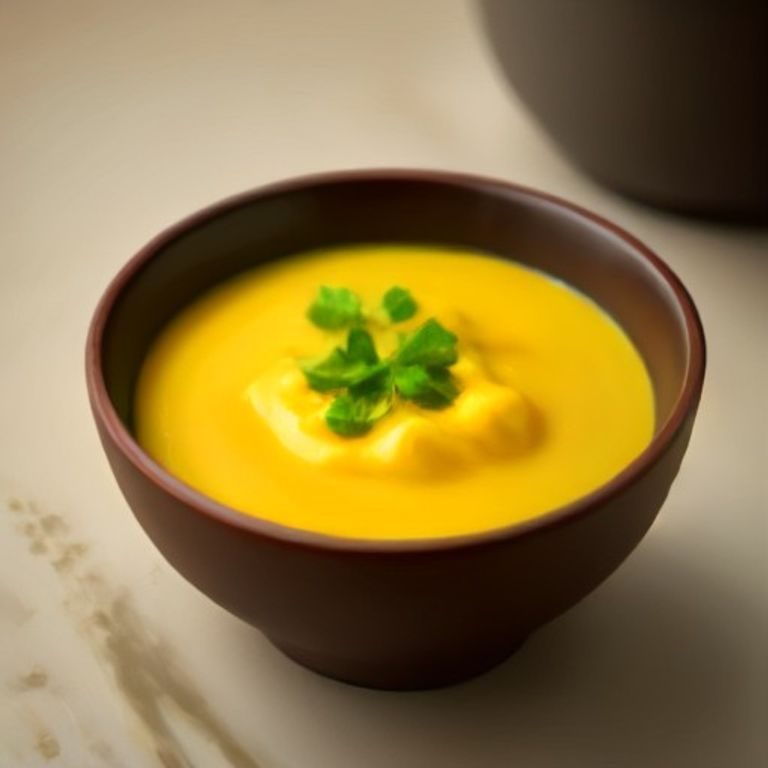
Curry Sauce with Apple and Banana
A velvety, fruit-laced curry sauce where the natural sweetness of apple and banana mellows the warmth of Madras curry and the gentle heat of fresh chili — a surprising, deeply flavorful sauce that proves fruit belongs in savory cooking.
| Amount | Ingredient |
|---|---|
| Boiling instead of simmering | The sauce reduces too quickly (concentrating the spice) and the fruit may scorch on the bottom Keep the sauce at a gentle simmer — occasional small bubbles, never a rolling boil |
| Adding too much salt early | The sauce reduces and concentrates, becoming overly salty Season only at the very end, after straining and re-boiling — taste and adjust gradually |
| Using a tart apple | The sauce becomes acidic and unbalanced, requiring added sugar to compensate Use a sweet apple variety (Fuji, Gala, Honeycrisp) — the apple's sweetness is functional, not optional |
This unusual but brilliant sauce comes from the Italian tradition of pairing fruit with savory dishes — a practice that predates the better-known Indian fruit chutneys and pickles. Here, finely diced onion, ginger, and chili are softened in sunflower oil alongside cubes of apple and banana, which slowly melt into the sauce as it simmers, contributing natural sweetness and a silky texture that eliminates the need for added sugar or cream. Madras curry powder is bloomed in the oil to deepen its fragrance before coconut milk and vegetable broth are added, creating a rich, aromatic base. After 30 minutes of gentle simmering, the sauce is blended until smooth with an immersion blender, then passed through a fine-mesh strainer for an ultra-luxurious, velvety finish. A final brief boil and a pinch of salt bring everything into focus. The result is a beautifully balanced sauce — mildly spicy, subtly sweet, savory, and silky — that pairs as beautifully with roasted vegetables and tofu as it does with chicken, fish, or rice.
Ingredient notes: Choose a ripe but not overripe banana — a spotty yellow banana with a few brown flecks is ideal, as it provides sweetness without being mushy or overwhelmingly banana-flavored. For the apple, any sweet, crisp variety such as Fuji, Gala, or Honeycrisp works well; avoid very tart apples like Granny Smith, as they will tip the balance toward acidity rather than sweetness. Madras curry powder is the key spice here — look for a fresh, aromatic brand (such as Sharwood's, MDH, or TRS) that contains a blend of coriander, cumin, turmeric, fenugreek, and chili. Avoid "mild curry powder" blends, which often contain fillers and lack the warm, complex heat of Madras. Full-fat coconut milk is non-negotiable for the silky texture — light coconut milk will make the sauce thin and watery. Sunflower oil is traditional here for its neutral flavor, but any neutral oil with a high smoke point (grape seed, avocado, or refined coconut oil) will work.
- Chef's knife and cutting board
- Vegetable peeler
- Medium saucepan or sauté pan (3–4 quart / 3–4 L)
- Wooden spoon or spatula
- Immersion blender (or stand blender)
- Fine-mesh strainer (sieve)
- Measuring cups and spoons
- Bowl (for straining)
- Prepare the aromatics and fruit (10 min). Peel the onion and cut it into small dice (about ½ cm / ¼ inch). Peel the ginger using the edge of a spoon (easy and waste-free) and finely mince it. Halve the chili, remove the seeds and white membrane (use the tip of a small knife), and finely mince. Halve the apple, remove the core and seeds, and cut into small cubes (about 1 cm / ½ inch) — no need to peel the apple unless you prefer a perfectly smooth sauce. Peel the banana and cut it into small cubes (about 1 cm / ½ inch).
- Sweat the aromatics and fruit (6 min). Heat the sunflower oil in a medium saucepan over medium heat. Add the diced onion, minced ginger, minced chili, apple cubes, and banana cubes. Cook, stirring frequently, for about 5–6 minutes, until the onion is translucent and the fruit has softened and begun to release its juices. Do not let the mixture brown — the heat should be gentle enough that the ingredients sweat rather than fry.
- Bloom the curry powder (1 min). Add the Madras curry powder to the pan. Stir constantly for about 1 minute — this blooming step is critical for awakening the spices and releasing their essential oils. The mixture will become fragrant and deepen in color. If it starts to stick to the bottom of the pan, add a tablespoon of the broth to loosen it.
- Simmer the sauce (30 min). Pour in the coconut milk and vegetable broth, stirring to combine. Bring the sauce to a gentle simmer (small bubbles breaking the surface, not a rolling boil). Reduce the heat to low and let it simmer uncovered for 30 minutes, stirring occasionally. The sauce will reduce slightly and the fruit will break down completely. If the sauce looks too thick at any point, add a splash of water or extra broth.
- Blend until smooth (3 min). Remove the pan from the heat. Using an immersion blender, purée the sauce directly in the pan until completely smooth — 1 to 2 minutes of blending, moving the blender in a circular motion to catch every bit. If using a stand blender, let the sauce cool for 5 minutes, then blend in batches (never fill the blender more than halfway with hot liquid — remove the center cap from the lid and cover with a towel to let steam escape).
- Strain for velvety texture (2 min). Pass the blended sauce through a fine-mesh strainer set over a clean bowl or directly back into the saucepan. Use a spatula or the back of a ladle to push the sauce through the mesh; you will be left with mainly fibrous solids (ginger fibers, chili skins, a bit of fruit skin if you did not peel the apple). This straining step is what gives the sauce its restaurant-quality, velvety-smooth finish — do not skip it.
- Finish and season (3 min). Return the strained sauce to the saucepan and bring it to a gentle boil over medium heat. Let it bubble for 1–2 minutes, then remove from heat. Season with fine sea salt, starting with ½ teaspoon (3 g) and adding more to taste. The sauce should be savory, mildly spicy, and gently sweet, with the curry flavor prominent but not aggressive.
- Bloom the curry powder properly. This is the single most important step in the recipe. Raw curry powder tastes dusty and harsh; blooming it in hot oil for just 60 seconds transforms it into something warm, complex, and aromatic. Do not skip or rush this step.
- Sweat, don't fry. The onion, ginger, chili, apple, and banana should soften in the oil without browning. Browning would introduce caramelized flavors that compete with the delicate fruit-curry balance. Keep the heat at medium or medium-low and stir often.
- Straining is essential for the silky finish. After blending, the sauce will still contain fine fibers from the ginger and chili, plus any apple skin fragments. Straining through a fine-mesh sieve removes these and produces an ultra-smooth, luxurious sauce that clings beautifully to whatever you serve it with.
- Adjust the chili to your spice tolerance. Half a bird's eye chili (with seeds removed) produces a very mild warmth. If you want more heat, use a whole chili, leave the seeds in, or add a pinch of cayenne pepper along with the curry powder.
- Use the ripest banana you have. A spotty, fully ripe banana provides more sweetness and blends into a smoother puree than a green or barely-ripe banana. The banana flavor should be subtle — a background note, not a dominant one.
- Let the sauce cool slightly before blending hot liquids. Hot liquid expands in a blender and can blow the lid off — always remove the center cap, cover with a towel, and blend in batches. An immersion blender is safer and easier for this recipe.
| Mistake | Why It Hurts | The Fix |
|---|---|---|
| Using unripe banana | Hard, starchy, and lacking sweetness — the sauce will taste thin and need added sugar | Use a ripe banana with brown spots; if yours are green, roast them (skin on) at 180°C / 350°F for 15 minutes before peeling |
| Skipping the curry powder bloom | The curry tastes raw, dusty, and one-dimensional — it never develops its full aromatic potential | Always bloom the curry powder in hot oil for 1 minute before adding liquid; this is non-negotiable |
| Overcooking the curry powder | Burnt, bitter spices that ruin the entire sauce | Bloom for exactly 1 minute over medium heat, then add liquid immediately — do not let the dry spices sit in the hot oil |
| Not straining the sauce | Fibrous, slightly gritty texture — especially noticeable from ginger fibers and chili skins | Always strain through a fine-mesh sieve after blending; the 2 minutes it takes make a dramatic difference |
- Creamy Coconut Version: Replace 200 ml (¾ cup + 2 tbsp) of the vegetable broth with an equal amount of full-fat coconut milk for an extra-rich, almost gravy-like sauce.
- Spicy Mango Curry Sauce: Replace the apple and banana with 1 ripe mango (peeled and cubed) — the tropical sweetness pairs beautifully with Madras curry and the result is bolder and fruitier.
- Roasted Vegetable Base: Before making the sauce, roast the onion, apple, and banana at 200°C / 400°F for 20 minutes until lightly caramelized, then proceed with the recipe. This adds a deeper, smokier sweetness.
- Herb-Infused Finish: Stir 2 tablespoons of fresh cilantro (coriander), finely chopped, into the finished sauce just before serving for a bright, herbal contrast.
- Garlic and Lemongrass Version: Add 2 cloves of minced garlic and 1 stalk of lemongrass (bruised, then finely chopped) along with the onion — a nod to Southeast Asian curry traditions.
- Cashew Cream Thickener: For an even richer sauce, add ¼ cup (35 g) of raw cashew butter along with the coconut milk — this adds body and a subtle nuttiness.
- Smoked Curry Version: Replace the Madras curry powder with 1½ tablespoons of Madras and ½ tablespoon of smoked paprika for a subtly smoky, BBQ-adjacent sauce.
- Yellow Coconut Curry Sauce: Add ½ teaspoon of ground turmeric and ¼ teaspoon of white pepper along with the curry powder for a brighter color and a more classic Southeast Asian curry profile.
| Storage Method | Details |
|---|---|
| Refrigerator | Store in an airtight container for up to 5 days. The sauce will thicken as it cools — thin with a splash of water, broth, or coconut milk when reheating. |
| Freezer | Freeze in a sealed container or ice cube trays for up to 3 months. Defrost overnight in the refrigerator, then reheat gently. The texture remains excellent after freezing. |
| Make-Ahead | The sauce can be made fully up to 3 days in advance and refrigerated. In fact, the flavors deepen and meld overnight — it may taste even better the next day. |
| Reheating | Reheat gently in a saucepan over medium-low heat, stirring occasionally. Add a splash of broth or water if the sauce has thickened too much. Do not boil aggressively — it can separate the coconut milk. |
This curry sauce's mild heat and sweet-fruit profile calls for wines and drinks that can match its silky texture and aromatic spices.
- Riesling (Kabinett or Spätlese, Germany) — Off-dry Riesling with a touch of residual sugar complements the fruit sweetness perfectly, while its high acidity cuts through the coconut richness.
- Gewürztraminer (Alsace, France) — Lychee, rose, and spice notes mirror the curry's aromatic complexity; a slightly off-dry style works best.
- Chenin Blanc (Vouvray, demi-sec or sec, Loire Valley) — Honeysuckle and quince flavors bridge the gap between fruit and spice; the medium body matches the sauce's creamy texture.
- Viognier (Condrieu or Languedoc, France) — Rich, full-bodied, and subtly floral, with enough weight to stand up to the coconut milk and curry spices.
- For beer drinkers: A Belgian dubbel (with dark fruit and malt sweetness), a Gose (salty-tart contrast cuts the richness), or a New England IPA (juicy, low-bitterness hops echo the fruit notes).
- For cocktails: A Mango Lassi Cocktail (vodka, mango purée, yogurt, lime), a Ginger Beer Buck (whiskey or rum, ginger beer, lime), or a Turmeric Margarita (tequila, lime, turmeric syrup, pinch of black pepper).
| Per Serving (about ¾ cup / 175 ml) | |
|---|---|
| Calories | 148 |
| Protein | 2 g |
| Fat | 11 g |
| Carbohydrates | 12 g |
| Fiber | 3 g |
Nutrition values are approximate and based on 4 servings. Actual values will vary based on coconut milk brand, curry powder blend, and fruit ripeness. The sauce is naturally vegan, gluten-free, and dairy-free. Most of the fat comes from the coconut milk — it is rich but not heavy.
Can I make this sauce ahead of time?
Absolutely. In fact, the sauce benefits from resting overnight in the refrigerator — the flavors meld and deepen beautifully. Make it up to 3 days ahead, cool completely, and store in an airtight container. Reheat gently, adding a splash of broth or water if it has thickened too much. The sauce also freezes exceptionally well for up to 3 months.
What is the best apple to use?
Any sweet, crisp apple variety works well — Fuji, Gala, Honeycrisp, Pink Lady, or Braeburn are all excellent. Avoid very tart apples (Granny Smith, Cripps Pink) as they will add unwanted acidity. The apple should contribute sweetness and body, not sourness.
Can I taste the banana in the finished sauce?
Barely. The banana's role here is primarily textural (it helps create the silky, velvety body) and subtly sweet — it does not add a distinct banana flavor. Think of it as a natural thickener and sweetener rather than a distinct flavoring agent. If you are truly opposed to banana, replace it with half a ripe pear (peeled and cored).
Is this sauce spicy?
Mildly. Half a bird's eye chili (with seeds removed) produces a very gentle warmth that is more aromatic than fiery. For no heat at all, omit the chili entirely. For more heat, use a whole chili, keep the seeds, or add a pinch of cayenne or chili flakes along with the curry powder.
Can I use a different curry powder?
Yes, but with caveats. Madras curry powder is the recommended choice for its balanced heat, warm color, and complex flavor. If you use a generic "mild curry powder," the sauce will be milder and less aromatic — consider adding ½ teaspoon each of ground cumin and ground coriander to compensate. If using a very hot curry powder (like some Thai or Indian blends), reduce the chili accordingly. Avoid curry pastes (which are oil-based and much more concentrated) unless you adjust the liquid ratios.
What dishes pair well with this sauce?
This is an incredibly versatile sauce. Serve it over steamed jasmine or basmati rice, with roasted or grilled chicken thighs, pan-seared fish (especially white fish like cod, halibut, or sea bass), grilled shrimp, pan-fried tofu, roasted cauliflower or sweet potatoes, or simply tossed with cooked vegetables and fresh herbs. It also makes an excellent dipping sauce for samosas, spring rolls, or naan bread.
My sauce seems thin — what went wrong?
The sauce should be slightly thin after 30 minutes of simmering (it thickens significantly after blending and straining). If it remains thin after the final re-boil, simmer it for another 5–10 minutes to reduce further. If it is _too_ thick, thin it with a splash of broth, water, or extra coconut milk. The ideal consistency is similar to heavy cream — it should coat the back of a spoon but still flow freely.
Is this sauce gluten-free?
Yes, as written — use a gluten-free vegetable broth (most are, but check the label) and ensure your curry powder contains no wheat-based fillers. All other ingredients are naturally gluten-free. Also dairy-free and vegan.
- Yogurt Gochujang Fusion Sauce (Volume 2)
- Basic Gochujang Sauce Korean (Volume 2)
- Classic French Carrot Sauce (Volume 2)
- Creamy Turmeric Cashew Sauce (Volume 2)
- Coconut Lemongrass Sauce (Volume 2)
Recipe from "The Italian Kitchen" by Vita Milanese — Volume 2: Sunday Sauce
Recipe from The Italian Kitchen by Vita Milanese — Volume 2 · Sunday Sauce. Discover all volumes on the ebook page.