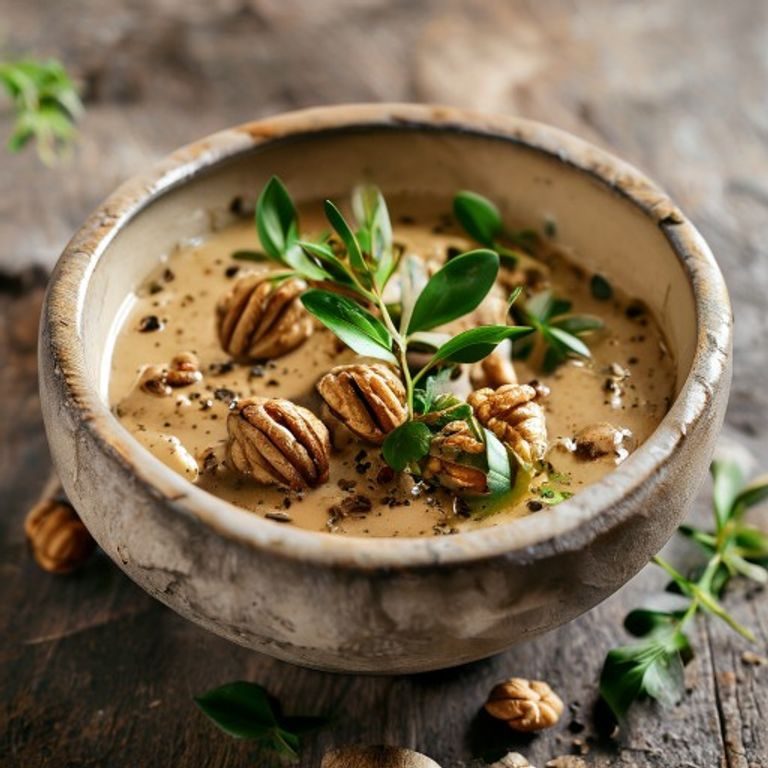
Walnut Sauce with Marjoram
A second, more rustic walnut sauce from the Italian tradition — this one skips the blanching and peeling step entirely, using the full walnut kernel (skins and all) for a deeper, more tannic character, bound with milk-soaked bread into a coarse, creamy sauce, and perfumed with fresh marjoram for an herby, almost floral lift that sets it apart from the milder blanched-walnut pestos of Liguria and Piedmont.
This is the walnut sauce of southern and central Italy — a heartier, more assertive condiment that embraces the full walnut flavor rather than softening its edges. Where the classic Pesto di noci (Recipe #109) blaches and peels the walnuts to remove the bitter skins, this Salsa alle noci uses the kernels in their natural state, shelled and crushed in a mortar with garlic, milk-soaked stale bread, Parmigiano-Reggiano, and a generous handful of fresh marjoram. The result is a sauce that is darker in color, more rustic in texture, and bolder in flavor — the tannins from the walnut skins give it a subtle astringency that cuts through rich pasta dishes, while the marjoram adds a sweet, herbaceous, almost oregano-like note that lifts the whole sauce and keeps it from feeling heavy. Made in generous quantity (this recipe yields about 3 cups / 700 g), it is intended for serving over trofie, pansotti, or gnocchi, or for spreading on crostini and grilled bread. The technique is pure Italian home cooking: a mortar and pestle, some patience, and the rhythmic pounding that transforms simple ingredients into something far greater than the sum of their parts.
Ingredient notes: Start with 400 g of whole walnuts in their shells — this yields approximately 200 g of shelled kernels. Fresh, high-quality walnuts are essential; shell them yourself just before using, as pre-shelled walnuts can turn rancid more quickly and lose their sweet, nutty character. If you are using pre-shelled walnut kernels, buy them from a source with high turnover and taste one before starting — they should be sweet and nutty, not bitter or dusty. The stale bread should be a simple white loaf (pain de mie or a day-old baguette), crust removed, using only the soft crumb. The bread acts as both a thickener and an emulsifier, giving the sauce its creamy, spreadable body. Do not use soft sandwich bread — it is too fluffy and will turn gluey. Whole milk is best for soaking; the fat content helps the sauce emulsify and contributes to its velvety mouthfeel. Parmigiano-Reggiano DOP is the canonical cheese here; its crystalline, nutty, savory character balances the more assertive walnut flavor. Grana Padano is an acceptable substitute. Marjoram (majorana) is the signature herb of this recipe — it has a sweeter, more delicate, slightly floral character compared to oregano, which is its close relative. Do not substitute with oregano; the flavor profiles are distinct. If fresh marjoram is unavailable, use half the amount of dried marjoram (about 1 tablespoon), crumbled between your palms to release its oils. The garlic should be fresh and fragrant — one medium clove provides a gentle warmth in the background without overwhelming the walnuts or marjoram.
- Nutcracker (for shelling walnuts)
- Large chef's knife and cutting board
- Medium mixing bowl (for soaking the bread)
- Mortar and pestle (preferably marble or granite, at least 14 cm / 6-inch diameter — you need a large one for this quantity)
- Fine grater or Microplane (for the Parmigiano-Reggiano)
- Measuring cups and spoons
- Flexible spatula
- Small bowl (for discarding shells and garlic germ)
- Shell the walnuts (10 min). Working over a bowl to catch the kernels, crack each walnut with a nutcracker. Remove the shell pieces and pick out the kernel halves. Discard any kernels that are shriveled, discolored, or smell faintly rancid. You should end up with about 200 g (2 cups) of clean walnut kernels. Set aside. If using pre-shelled kernels, skip this step and proceed directly to checking their freshness.
- Prepare the bread (10 min). Remove the crust from the stale bread slices and discard the crusts. Tear or cut the soft white crumb into rough 2 cm (¾ inch) pieces. You should have about 200 g of bread crumb. Place the bread pieces in a medium bowl and pour the whole milk over them. Using your hands, work the bread and milk together, squeezing gently, until the bread has absorbed the milk and become a soft, porridge-like, granular paste. Set aside to rest while you prepare the other ingredients.
- Prepare the aromatics (2 min). Peel the garlic clove and cut it in half lengthwise. If the garlic has a green germ (sprout) in the center, remove and discard it — the germ can be bitter and harsh. Set the garlic halves aside. Pick the marjoram leaves from the stems — you need about 2 tablespoons of loosely packed leaves. Do not chop them; they will be crushed in the mortar.
- Begin pounding the garlic (1 min). Place the two garlic halves in the mortar. Using a firm, rhythmic motion with the pestle, pound the garlic until it is completely broken down and "disappeared" into a paste against the surface of the mortar — about 30 to 45 seconds. The garlic should be so finely crushed that you can barely see individual pieces.
- Add the walnuts and pound to a paste (5 min). Add the walnut kernels to the mortar with the crushed garlic. Pound, grind, and crush the walnuts with the pestle, working in a circular, pressing motion against the sides and bottom of the mortar. Continue until the walnuts are reduced to a creamy but still slightly granular paste — about 3 to 4 minutes of steady work. The walnuts will first break into small pieces, then release their oils and begin to clump together. Do not rush this step; the texture of the final sauce depends on thorough mechanical action. The paste should be cohesive and spreadable but still have some visible texture — it should not be completely smooth.
- Add the soaked bread (2 min). Add the milk-soaked bread paste to the mortar with the walnut-garlic mixture. Continue pounding, folding, and mixing with the pestle until the bread is fully incorporated and the mixture is uniform — about 2 minutes. The bread will loosen the dense walnut paste and transform it into a softer, creamier, more homogenous cream. Scrape down the sides of the mortar with a spatula as needed to ensure everything is evenly combined.
- Add the marjoram and olive oil (2 min). Add the fresh marjoram leaves and begin drizzling in the extra-virgin olive oil while you continue to pound and stir with the pestle. Add the oil in a slow, steady stream — do not pour it all in at once. As you work the oil into the sauce, the marjoram leaves will be crushed and release their essential oils, perfuming the entire mixture. Continue pounding and stirring until the oil is fully incorporated and the sauce is glossy, emulsified, and semi-creamy.
- Add the Parmigiano-Reggiano (2 min). Add the finely grated Parmigiano-Reggiano to the mortar. Pound, stir, and fold the cheese into the sauce until it is completely uniform. The cheese will thicken the sauce slightly and add saltiness, umami, and a deeper savory character. Taste a small amount — it should be nutty, herby, savory, and gently garlicky.
- Season and final adjust (1 min). Add a pinch of fine sea salt. Continue to work the sauce with the pestle until the salt is incorporated. Taste and adjust salt as needed — remember that the Parmigiano-Reggiano already contributes significant salt, so add cautiously. If the sauce seems too thick (it should be a semi-creamy, spreadable consistency, like a thick hummus or a coarse pesto), stir in a tablespoon of warm water or a splash of milk to loosen it. If it is too thin, let it rest for 5 minutes — the bread will continue to absorb liquid and thicken as it sits.
- Serve or store (1 min). Transfer the sauce to a serving bowl or an airtight container. It is ready to serve immediately, but the flavors deepen and harmonize after 30 minutes at room temperature. Toss with freshly cooked pasta (reserve about ½ cup / 120 ml of pasta water to loosen the sauce), spread on crostini or grilled bread, or use as a sauce for roasted vegetables, grilled chicken, or boiled potatoes. For the classic pairing, serve with trofie or pansotti — the twisted or stuffed pasta shapes trap the chunky, creamy sauce beautifully.
- Use a large mortar. This recipe makes about 700 g (3 cups) of sauce — a standard small mortar will overflow. You need a mortar with at least a 14 cm (6-inch) diameter and a deep bowl to accommodate the volume and prevent splashing.
- Do not skip shelling your own walnuts. Pre-shelled kernels are convenient but stale faster and lose the sweet, fresh, nutty aroma that makes this sauce special. Shelling 400 g of walnuts takes about 10 minutes and the difference in flavor is transformative.
- The bread-milk paste is your emulsifier. The bread soaked in milk is the key textural element — it replaces the need for large quantities of oil and gives the sauce its uniquely creamy, spreadable body without being greasy. Squeeze the bread and milk together with your hands until they form a uniform paste before adding to the mortar.
- Marjoram is not oregano. These two herbs are often confused, but marjoram is sweeter, more delicate, and has a floral, almost thyme-like quality, while oregano is more pungent, earthy, and assertive. If you substitute oregano, the sauce will be heavier and spicier — still delicious, but different. If you must use dried marjoram, crumble it between your palms to release its oils and use about half the volume.
- Go slow, grind steady. The mortar-and-pestle method is not just tradition — it creates a different texture and flavor profile than a food processor. The grinding, pressing, and crushing action releases oils and aromas more gradually and at a lower temperature, preserving the fresh character of the walnuts and marjoram.
- This sauce is meant to be coarse. Unlike the silky, smooth Pesto di noci (Recipe #109), this Salsa alle noci intentionally retains a slightly granular, rustic texture. You should see and feel small pieces of walnut in the finished sauce. Stop pounding when the mixture is cohesive but still has visible texture.
| Mistake | Why It Hurts | The Fix |
|---|---|---|
| Using rancid or stale walnuts | Rancid walnuts have a bitter, stale, petroleum-like flavor that permeates the entire sauce — it is inedible and impossible to mask | Taste a kernel before starting; buy from a high-turnover source; shell walnuts yourself just before using |
| Using food processor on high speed | The blade generates heat that warms the walnuts, releasing bitterness prematurely, and creates a fine, homogenous paste that lacks the rustic texture this sauce is known for | Use a mortar and pestle; if you must use a food processor, pulse in 1-second bursts and stop while the texture is still coarse |
| Variation | How To |
|---|---|
| Walnut Sauce with Lemon and Marjoram | Add the finely grated zest of ½ unwaxed lemon and 1 teaspoon of fresh lemon juice along with the marjoram in step 7. The bright citrus cuts through the richness and complements the floral marjoram beautifully — ideal for summer pasta salads or fish dishes. |
| Spicy Walnut Sauce (Salsa alle noci piccante) | Add ½ teaspoon of red pepper flakes or one small dried chili (crumbled) to the mortar along with the garlic in step 4. The gentle heat is a wonderful counterpoint to the creamy, nutty sauce — excellent with orecchiette and broccoli rabe. |
| Walnut Sauce with Ricotta (Salsa alle noci e ricotta) | Replace the milk-soaked bread with 150 g (½ cup) of fresh sheep's-milk ricotta (drained if very wet). Omit the milk soak entirely. This produces a richer, creamier, denser sauce with a luscious, almost cheesecake-like texture — wonderful as a crostini spread. |
| Storage Method | Details |
|---|---|
| Refrigerator | Store in an airtight container with a thin layer of olive oil poured over the surface (to prevent oxidation and discoloration) for up to 5 days. The sauce will darken slightly as it sits — this is normal and does not affect flavor. Stir well before using. Bring to room temperature for 20 minutes before serving to restore the best texture and flavor. |
| Freezer | This recipe freezes well for up to 3 months. Portion into ice cube trays (each cube is about 2 tablespoons / 30 g — perfect for single servings of pasta), freeze until solid, then transfer the cubes to a freezer-safe bag. Thaw in the refrigerator overnight or at room temperature for 1 hour. Stir in a teaspoon of warm water or olive oil after thawing to restore the creamy consistency. |
This bold, herbaceous, rustic walnut sauce calls for wines that can stand up to its more assertive character — the tannins from the unpeeled walnuts and the floral notes of fresh marjoram require wines with good structure and aromatic complexity.
- Vermentino (Liguria or Sardinia, Italy) — The classic pairing for any walnut sauce, Vermentino is crisp, citrusy, and herbal with a subtle almond-bitter finish that echoes the tannic edge of the unpeeled walnuts. Serve lightly chilled. Look for Vermentino from the Riviera Ligure di Ponente DOC or Sardinian Vermentino di Gallura.
- Vernaccia di San Gimignano (Tuscany, Italy) — A crisp, mineral-driven white with notes of green apple, pear, and a distinctive almond-like bitterness. Its bright acidity and herbal character are an excellent foil for the rich walnut and marjoram flavors.
- Gavi di Gavi (Piedmont, Italy) — A classic Piedmontese white from the Cortese grape, Gavi is crisp, elegant, and mineral-driven with subtle green apple and almond notes. Its clean, bright profile cuts through the creamy richness of the sauce beautifully.
- Pecorino (Abruzzo, Italy) — A white grape with surprising depth and structure, Pecorino wines are floral, herbal, and slightly nutty with excellent acidity — almost as if they were made for this sauce. The herbal notes echo the marjoram while the acidity balances the walnut richness.
- Etna Rosso (Sicily, Nerello Mascalese) — A light, mineral-driven red with red fruit, dried herb, and subtle smoky, volcanic notes. Its gentle tannins and aromatic complexity stand up to the walnut skins' tannins without overpowering the sauce. Serve slightly cool (14–16°C / 57–61°F).
- Barbera d'Albi (Piedmont, Italy) — A medium-bodied red with bright acidity, red cherry, and herbaceous notes. Barbera's naturally high acidity and moderate tannins make it a surprisingly good match for the creamy, nutty sauce and the floral marjoram — especially if the sauce is served over filled pasta like pansotti or served as part of a heartier autumn meal.
- For beer drinkers: A Belgian saison (herbal, spicy, and dry), a Czech pilsner (clean, crisp, and lightly bitter), or an Italian witbier (coriander and orange peel notes mirror the sauce's aromatic complexity).
- For cocktails: A Negroni (the bitterness of Campari and vermouth cut through the creamy richness and complement the walnut tannins), a White Negroni (gin, Suze, and Lillet Blanc — herbal, bitter, and bright), or a Boulevardier (whiskey, Campari, vermouth — the herbal bitterness is a perfect match for the marjoram).
| Per Serving (about ⅓ cup / 85 g) | |
|---|---|
| Calories | 312 |
| Protein | 10 g |
| Fat | 26 g |
| Carbohydrates | 11 g |
| Fiber | 3 g |
Nutrition values are approximate and based on 8 servings of sauce (about 85 g / ⅓ cup each). Actual values will vary depending on the specific walnuts, milk, bread, olive oil, and Parmigiano-Reggiano used. The sauce is naturally high in healthy unsaturated fats from the walnuts and olive oil. Walnuts are an excellent source of omega-3 fatty acids (alpha-linolenic acid). The bread contributes moderate carbohydrates, making this sauce more substantial than a pure nut paste.
What is the difference between this Salsa alle noci and the Pesto di noci (Recipe #109)?
The key difference is the treatment of the walnuts. Pesto di noci (Recipe #109) blances and peels the walnuts to remove their bitter brown skins, producing a sweeter, milder, creamier sauce that is pale in color and delicate in flavor. This Salsa alle noci uses the walnut kernels in their natural state — skins and all — giving the sauce a darker color, a more rustic texture, a bolder, more tannic flavor, and a slightly astringent edge. Additionally, this recipe uses marjoram as its signature herb, whereas Pesto di noci typically uses only salt and black pepper. The quantities are also different: this recipe yields about 700 g (3 cups), roughly double the yield of a standard pesto di noci, making it a substantial sauce meant for serving larger groups or for multiple uses.
Do I need to shell 400 g of walnuts myself? Can I use pre-shelled kernels?
You can use pre-shelled kernels, but fresh-shelled walnuts are significantly better. The moment a walnut is shelled, its oils begin to oxidize and the nut begins to lose its sweet, fresh character. Walnuts that have been sitting in a bag on a shelf for weeks or months can develop a stale, bitter, or rancid flavor that will ruin the sauce. If you must use pre-shelled kernels, buy them from a store with high turnover, check the package date, and taste one before starting. They should smell sweet and nutty, not dusty or like old cooking oil.
Can I make this sauce in a food processor?
Yes, but the texture will be different — smoother, finer, and more homogenous, lacking the rustic, slightly granular character that defines this sauce. If using a food processor: use the pulse function in very short bursts (1 to 2 seconds each), scrape the bowl frequently, and stop well before the mixture becomes completely smooth. Work in stages: pulse the garlic first, then add the walnuts and pulse in short bursts, then add the soaked bread and pulse, and finally incorporate the marjoram, oil, and cheese. A blender is not recommended — it creates a gluey, over-emulsified paste.
What is the best pasta shape for this sauce?
Short, twisted, and grooved shapes are ideal because they trap the chunky, creamy sauce: trofie (the classic Ligurian pairing), gemelli, fusilli, casarecce, cavatappi, or orecchiette all work beautifully. Pansotti (the triangular stuffed pasta from Liguria) is another classic pairing — the herby filling of pansotti (traditionally made with borage, chard, and ricotta) is a beautiful partner for the walnut and marjoram sauce. Gnocchi (potato or ricotta) also works wonderfully. Long pasta like linguine or tagliatelle is acceptable but you will need extra pasta water (about ¾ cup / 180 ml) to loosen the sauce into a coating consistency.
Can I use dried marjoram instead of fresh?
Yes. Dried marjoram is more concentrated than fresh, so use about half the volume: 1 tablespoon of dried marjoram (crumbled between your palms) in place of 2 tablespoons of fresh leaves. Add the dried marjoram to the mortar in step 7 along with the olive oil so it has time to rehydrate and bloom. Note that dried marjoram has a more muted, earthier character than fresh — the floral, delicate top notes of fresh marjoram are partially lost in drying, but the sauce will still be delicious.
What are pansotti and where do I find them?
Pansotti (also spelled pansoti) are a triangular stuffed pasta from Liguria, traditionally filled with a mixture of borage, chard, ricotta, and herbs. The name comes from "pancia" (belly) — the pasta's rounded, pot-bellied shape. They are the classic pairing for walnut sauce in Ligurian cuisine. If you cannot find pansotti, substitute with tortellini, ravioli (especially cheese or herb-filled), or simply use trofie or gnocchi.
Can I serve this sauce cold or at room temperature?
Absolutely. This sauce is delicious at room temperature as a spread on crostini, bruschetta, or panini, or as a dip for raw vegetables, breadsticks, or crackers. If serving cold, pull it from the refrigerator 30 minutes before serving to take the chill off and let the flavors open up. It is also wonderful as a sandwich spread — try it on crusty bread with grilled zucchini, roasted red peppers, and fresh mozzarella.
What other dishes does this sauce pair well with?
Beyond pasta, this walnut sauce is spectacular with: roasted butternut squash or pumpkin (the sweetness balances the tannic walnuts), grilled chicken or turkey breast, poached or grilled fish (especially trout, sea bass, or swordfish), roasted or boiled potatoes (halve baby potatoes, toss with the sauce and a handful of arugula), steamed green beans, roasted cauliflower or broccoli, grilled portobello mushrooms, and as a spread on crostini with a drizzle of honey and a few crumbles of Gorgonzola.
- Walnut Pesto (Pesto di noci, Volume 2, Recipe #109)
- Classic Basil Pesto (Pesto alla genovese, Volume 2, Recipe #80)
- Arugula Pesto (Pesto di rucola, Volume 2, Recipe #59)
- Almond Pesto (Pesto di mandorle, Volume 2, Recipe #32)
- Walnut and Gorgonzola Sauce (Volume 2, Recipe #66)
- Sous Vide Chili Oil (Volume 2, Recipe #104)
- Pumpkin Seed Pesto (Volume 2, Recipe #89)
Recipe from "The Italian Kitchen" by Vita Milanese — Volume 2: Sunday Sauce
Recipe from The Italian Kitchen by Vita Milanese — Volume 2 · Sunday Sauce. Discover all volumes on the ebook page.