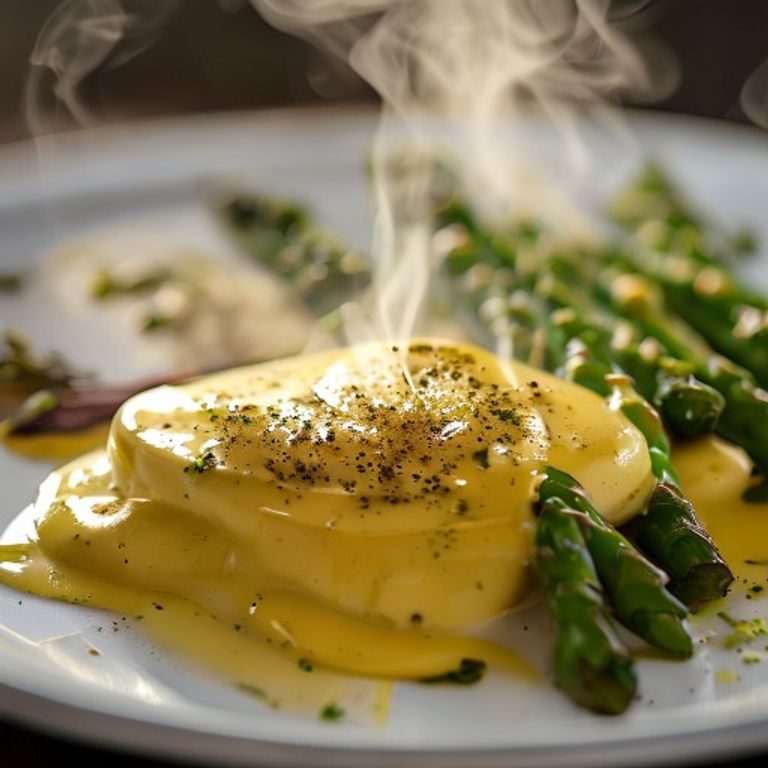
Hollandaise Sauce
The queen of French sauces — a silky, butter-rich emulsion of egg yolks and clarified butter, sharpened with white wine vinegar and lemon, that transforms eggs Benedict, steamed asparagus, and poached fish into something transcendent.
| Amount | Ingredient |
|---|---|
| 1 small | shallot, finely minced |
| 5⅓ oz (150 g) | unsalted butter |
| ½ tsp | coarsely ground black pepper |
| 3 tbsp | white wine vinegar |
| ½ cup (120 ml) | dry white wine |
| 3 large | egg yolks, at room temperature |
| ½ tsp | fine sea salt |
| 1 tsp | fresh lemon juice |
Classic hollandaise is one of the five French mother sauces, and for good reason: its luxurious texture and bright, buttery flavor elevate the simplest ingredients. This recipe breaks down the technique into foolproof steps, using a clarified butter approach that produces a stable, velvety emulsion every time. The key is patience — a slow, steady stream of warm clarified butter into the egg yolk reduction, with constant whisking, creates the signature thick, creamy consistency that hollandaise is known for. A touch of lemon juice at the end cuts through the richness and balances the sauce beautifully. Perfect for brunch, spring vegetables, or any dish that deserves an elegant finishing touch.
Ingredient notes: Use the freshest eggs you can find — the emulsion relies on the egg yolks' lecithin content, which degrades as eggs age. European-style butter (like Plugrà or Kerrygold) has a higher butterfat content (82%+) and less water, making it ideal for clarifying. The shallot-and-pepper reduction (vinegar + wine) must be reduced by half to concentrate flavor and remove enough liquid for the sauce to thicken properly. White wine vinegar is traditional, but champagne vinegar or a mild sherry vinegar work beautifully. Do not substitute with distilled white vinegar, which is too harsh. Fresh lemon juice is non-negotiable — bottled lemon juice lacks the brightness needed to balance the rich sauce.
- Small saucepan (for clarifying butter)
- Medium saucepan (for the reduction)
- Stainless steel or heatproof glass bowl (for the bain-marie)
- Whisk (a balloon whisk works best)
- Fine-mesh strainer
- Instant-read thermometer (optional but helpful)
- Rubber spatula
- Clarify the butter (5 minutes). Cut the butter into small cubes and place in a small saucepan over very low heat. Let it melt slowly without stirring — this takes about 3 to 4 minutes. Once fully melted, you will see three distinct layers: a foamy white layer on top (milk solids), a clear golden layer in the middle (clarified butter), and a milky white layer at the bottom (water and more milk solids). Remove from heat and let it rest for 1 minute. Using a small ladle or spoon, carefully skim off the foamy top layer and discard. Slowly pour the clear golden liquid through a fine-mesh strainer into a small bowl, leaving the milky residue at the bottom of the pan behind. Pro tip: Do not stir the butter while it melts — stirring reincorporates the milk solids into the clarified butter. Gentle, undisturbed melting produces the cleanest separation. The clarified butter should be warm (not hot) when you add it to the egg yolks; if it has cooled too much, warm it very gently.
- Make the reduction (5 minutes). In a medium saucepan, combine the minced shallot, coarsely ground black pepper, white wine vinegar, and dry white wine. Bring to a boil over medium-high heat, then reduce the heat to medium and let it simmer. Cook until the liquid has reduced by half — about 3 to 4 minutes. You should have approximately 3 to 4 tablespoons of intensely flavored liquid remaining. Remove from heat. Pro tip: The reduction concentrates the acidity and shallot flavor while removing enough liquid that the sauce can thicken properly. If you reduce it too far (less than 2 tablespoons), the sauce will be too acidic; if not enough, it will be too thin. Watch for the liquid to become syrupy and aromatic.
- Prepare the bain-marie (1 minute). Fill a medium saucepan with about 1½ inches (4 cm) of water and bring to a gentle simmer over medium heat. Place a stainless steel or heatproof glass bowl on top of the saucepan — the bottom of the bowl should NOT touch the water. Reduce the heat to low to maintain a gentle simmer. Pro tip: The bowl must be stainless steel or heatproof glass — aluminum will react with the vinegar and give the sauce a metallic taste. The water should be steaming with only occasional small bubbles; if it is boiling vigorously, the eggs will scramble.
- Strain the reduction (1 minute). Pour the reduction through a fine-mesh strainer into the stainless steel bowl, pressing on the shallot solids with a rubber spatula to extract all the liquid. Discard the solids. Let the strained reduction cool for 30 seconds — it should be warm but not hot. Pro tip: Straining is essential — any pieces of shallot or peppercorn will interfere with the smooth, silky texture of the finished sauce. The reduction should be warm (about 100°F / 38°C) when you add the yolks; if it is too hot, it will cook the yolks too quickly.
- Whisk the yolks (5 minutes). Add the egg yolks to the bowl with the strained reduction. Place the bowl over the simmering water and begin whisking immediately and constantly. Whisk in a figure-eight pattern, making sure to scrape the bottom and sides of the bowl. The yolks will gradually thicken and become pale, frothy, and creamy — this is called the "ribbon stage." When the mixture is thick enough that the whisk leaves a visible trail on the bottom of the bowl for 2 to 3 seconds, remove the bowl from the heat. This takes about 3 to 5 minutes of continuous whisking. Pro tip: Do not stop whisking for even a second — egg yolks over heat will scramble instantly if left unstirred. The mixture is ready when it has doubled in volume, turned pale yellow, and feels warm to the touch (about 140°F / 60°C) — this is the pasteurization temperature. If you see any sign of scrambling (small lumps), immediately remove the bowl from the heat and whisk in 1 tablespoon of cold water to cool the mixture down.
- Emulsify with clarified butter (5 minutes). With the bowl off the heat, begin adding the warm clarified butter in a VERY thin, steady stream — about as thick as a pencil lead — while whisking constantly. Start with just a few drops at a time; the emulsion needs to establish before you can add the butter more freely. After about half the butter has been incorporated, the mixture will transform into a thick, creamy, pale yellow sauce. Continue adding the remaining butter in a thin stream, whisking continuously, until all the butter is incorporated and the sauce is thick, glossy, and velvety. Pro tip: The pace of butter addition is the single most important factor. Too fast, and the emulsion will break — the sauce will turn greasy and thin. If the sauce becomes too thick to whisk easily, add 1 teaspoon of warm water to loosen it. If it looks like it is about to separate (becoming greasy or thinning out), stop adding butter and whisk vigorously for 30 seconds to re-stabilize the emulsion before continuing.
- Season and finish (1 minute). Whisk in the fine sea salt and fresh lemon juice. Taste and adjust: if the sauce needs more brightness, add another few drops of lemon juice. If it is too acidic, whisk in a few drops of warm water. If it is too thin, continue whisking off the heat for another minute — the residual warmth will help it thicken. The finished hollandaise should be thick enough to coat the back of a spoon generously, with a smooth, glossy surface and a pale yellow color. Pro tip: The sauce will continue to thicken slightly as it sits. If you are not serving immediately, keep it warm by placing the bowl over warm (not hot) water and covering with plastic wrap touching the surface. Do not reheat hollandaise over direct heat — it will break.
- Serve immediately (1 minute). Spoon or drizzle the hollandaise over poached eggs, steamed asparagus, grilled fish, or roasted vegetables. Serve within 30 minutes for the best texture. Pro tip: If the sauce thickens too much while waiting, whisk in 1 teaspoon of warm water just before serving to restore the proper consistency.
- Hollandaise separates if left to sit too long. Serve within 30 minutes. If it starts to separate, whisk in 1 tablespoon of warm water — this often brings it back together.
- Clarify the butter properly. Any remaining milk solids in the butter will make the sauce grainy and less stable. Take the extra 30 seconds to strain carefully.
- Room temperature eggs are essential. Cold egg yolks shock the warm reduction and make emulsification much harder. Let eggs sit on the counter for 20 minutes before starting.
- Use a heavy-bottomed saucepan for the bain-marie. Thin pans conduct heat too aggressively and can easily scramble the yolks.
- If the sauce is too thin, it was under-whisked at the ribbon stage or the butter was added too quickly. Next time, whisk the yolks longer before adding butter.
| Mistake | Why It Hurts | The Fix |
|---|---|---|
| Sauce is thin and runny | Yolks were not whisked to ribbon stage, or butter was added too quickly | Whisk vigorously off heat for 1 minute; add 1 tsp warm water if needed |
| Sauce is greasy and separated | Butter was added too fast, or sauce was overheated | Remove from heat, whisk in 1 tbsp cold water, then restart butter addition slowly |
| Sauce tastes like scrambled eggs | Yolks were overheated in the bain-marie | Cannot be fixed — start over with fresh yolks |
| Sauce is too thick | Too much butter or sauce cooled too much | Whisk in 1 tbsp warm water or lemon juice to loosen |
| Sauce is grainy | Butter was not properly clarified (milk solids present) | Strain through a fine-mesh sieve lined with cheesecloth |
| Variation | How To |
|---|---|
| Béarnaise Sauce | Replace vinegar reduction with tarragon vinegar + fresh tarragon; finish with chopped fresh tarragon and chervil |
| Foyot (Valois) Sauce | Add 1 tbsp reduced meat glaze (glace de viande) to the finished hollandaise |
| Maltaise Sauce | Replace lemon juice with blood orange juice and add grated blood orange zest |
| Mousseline Sauce | Fold ¼ cup (60 ml) softly whipped cream into the finished hollandaise just before serving |
| Choron Sauce | Fold 2 tbsp tomato paste into béarnaise sauce (omit the tarragon) |
| Noisette Sauce | Use browned butter (beurre noisette) instead of clarified butter for a nutty flavor |
| Mustard Hollandaise | Whisk 1 tbsp Dijon mustard into the finished sauce |
| Storage | Method |
|---|---|
| Refrigerator | Hollandaise does not store well — its texture degrades significantly. If you must, transfer to a jar, press plastic wrap onto the surface, and refrigerate for up to 2 days. |
| Reheating | Place the jar in warm water (not hot, not boiling — about 110°F / 43°C) and whisk gently until smooth. Do not microwave or heat directly — the sauce will break. |
| Wine | Why |
|---|---|
| Chablis (Chardonnay) | The crisp minerality and high acidity of Chablis cut through the rich, buttery sauce beautifully |
| Sancerre (Sauvignon Blanc) | Herbaceous, bright, and zesty — ideal with hollandaise-topped asparagus or fish |
| Champagne Brut | The fine bubbles and high acidity provide a perfect palate cleanser between rich bites |
| Grüner Veltliner | Peppery, citrusy, and refreshing — a classic pairing for eggs Benedict |
| Unoaked Chardonnay | Buttery flavor complements the sauce without adding oak heaviness; choose a Chablis or Macon |
| Per Serving (2 tbsp / 30 ml) | |
|---|---|
| Calories | 142 |
| Protein | 1 g |
| Fat | 15 g |
| Carbohydrates | 1 g |
| Fiber | 0 g |
Nutrition values are approximate and based on using the full amount of clarified butter divided across 12 servings (about 2 tablespoons each).
Can I make hollandaise in a blender?
Yes — a blender hollandaise is faster and more forgiving. Heat the clarified butter until hot (not boiling). In a blender, combine egg yolks, lemon juice, salt, and the strained reduction. Blend on low for 10 seconds, then, with the blender running, slowly drizzle in the hot clarified butter through the opening in the lid. The sauce will emulsify in about 30 seconds. It will be slightly thinner than whisked hollandaise but still delicious. Serve immediately.
Why did my hollandaise separate?
Separation happens when the emulsion breaks — most commonly from adding butter too quickly, overheating, or not whisking enough during the ribbon stage. If your sauce separates, try this rescue: in a clean bowl, whisk 1 egg yolk with 1 teaspoon of lemon juice. Very slowly whisk the broken sauce into this new yolk — it should re-emulsify.
Can I use whole eggs instead of just yolks?
No — hollandaise relies on the high lecithin content of egg yolks for a stable emulsion. Using whole eggs introduces too much water from the whites, making it nearly impossible to achieve a thick, stable sauce.
Is hollandaise safe to eat if I'm pregnant?
Traditional hollandaise uses raw or lightly cooked egg yolks. If you are concerned about food safety, use pasteurized eggs (sold in most US supermarkets) or heat the yolk mixture to 160°F (71°C) in the bain-marie — this pasteurizes the yolks while maintaining the emulsion.
Can I freeze hollandaise?
No — freezing destroys the emulsion completely. The thawed sauce will be watery, grainy, and impossible to restore. Make only as much as you will use within 30 minutes.
- Classic Mayonnaise (Volume 2)
- Béarnaise Sauce (Volume 2)
- Delicate Garlic Cream (Volume 2)
- Parmigiano Cream Sauce (Volume 2)
- Tartar Sauce (Volume 2)
Recipe from "The Italian Kitchen" by Vita Milanese — Volume 2: Sunday Sauce
Recipe from The Italian Kitchen by Vita Milanese — Volume 2 · Sunday Sauce. Discover all volumes on the ebook page.