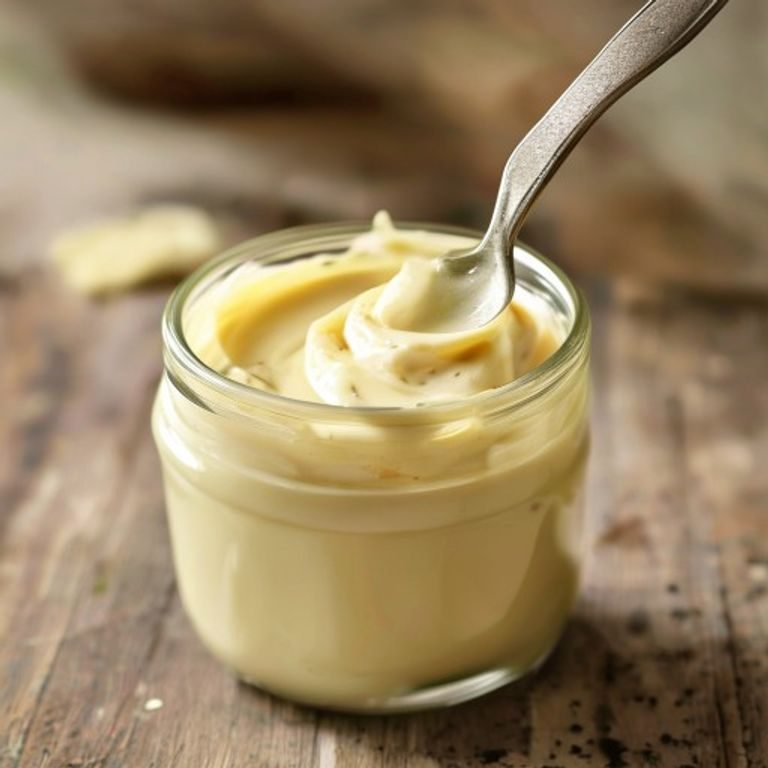
Pasteurized Mayonnaise
A brilliant, chef-driven twist on classic mayonnaise: by streaming piping-hot sunflower oil (121°C / 250°F) into the egg mixture, the eggs are gently pasteurized in seconds — eliminating any food-safety concerns around raw yolks — while simultaneously creating a stable, luxuriously creamy emulsion that keeps longer and tastes even richer than a traditional cold-made mayonnaise.
| Amount | Ingredient |
|---|---|
| 1 large | fresh whole egg, at room temperature |
| 2 large | fresh egg yolks, at room temperature |
| 20 g (4 tsp) | fresh lemon juice |
| 20 g (4 tsp) | white wine vinegar |
| 4 g (1 tsp) | fine sea salt |
| 120 g (½ cup) | sunflower oil (for heating) |
| 125 g (½ cup + 1 tbsp) | extra-virgin olive oil, at room temperature |
| To taste | freshly ground white pepper |
This is Luca Montersino's signature technique, and it represents a paradigm shift in how home cooks can approach mayonnaise. The principle is deceptively simple and mathematically elegant: heat a portion of the oil (the neutral sunflower oil) to exactly 121°C, then stream it into the egg and yolk mixture with the immersion blender running. The hot oil's thermal energy cooks the eggs on contact, raising them through the pasteurization zone (above 71°C / 160°F for a sustained interval) fast enough to destroy pathogens but gently enough to avoid scrambling. What emerges is not a cooked egg — it is a perfectly stable, fully pasteurized mayonnaise with a silky, compact texture that holds its shape beautifully and keeps in the refrigerator for up to 10 days (versus 3–5 days for a raw-egg mayo). The technique requires only patience and a reliable kitchen thermometer, but the payoff is enormous: a mayonnaise that is simultaneously safer, longer-lasting, and more luxurious than any cold-emulsion version. The hot oil also gives the finished mayonnaise a subtle cooked richness — a gentle depth that cold-made mayo lacks — while the final addition of warm vinegar and room-temperature extra-virgin olive oil rounds the flavor into something supremely balanced: bright from the lemon, fruity from the olive oil, and creamy from the hot-emulsified eggs.
Ingredient notes: The eggs must be as fresh as possible — the fresher the eggs, the better their proteins will emulsify and the cleaner the flavor. Room temperature is non-negotiable: cold eggs would drop the oil temperature below the pasteurization threshold on contact, defeating the technique's purpose. The two oils play distinct roles: the sunflower oil is the pasteurization vehicle — it must be heated to exactly 121°C (250°F) and streams into the eggs first, cooking and emulsifying them simultaneously. A neutral, high-smoke-point oil like sunflower, grapeseed, or light peanut oil is essential here; olive oil's smoke point is too low and its flavor too assertive for this step. The extra-virgin olive oil is added afterward at room temperature, contributing its fruity, peppery character to the finished mayonnaise. The white wine vinegar is heated briefly before being added all at once — this step brightens the final flavor and helps stabilize the emulsion. Use a good-quality white wine vinegar with at least 6% acidity. A digital instant-read thermometer or a probe thermometer is strongly recommended for accuracy — the entire technique hinges on hitting and maintaining 121°C.
- Immersion (stick) blender (a powerful model, 300+ watts, is ideal)
- Tall, narrow beaker or jar (the beaker that came with your immersion blender works perfectly)
- Small saucepan (preferably stainless steel, for heating the sunflower oil)
- Small saucepan (for heating the vinegar)
- Kitchen thermometer (digital instant-read or probe — essential for accuracy)
- Flexible rubber spatula
- Kitchen scale (for precise measurements)
- Small sterilized glass jars with lids (for storage, 2–3 jars, about 125–175 ml / 4–6 oz each)
- Plastic wrap (for covering the surface of the mayonnaise in the jars)
- Prepare all ingredients (5 minutes). Weigh and measure every ingredient before you begin. Crack the whole egg into the tall beaker of the immersion blender. Add the two egg yolks, the lemon juice, and the salt. Do not stir or blend yet — just leave them layered at the bottom. Measure the sunflower oil into a small saucepan. Measure the extra-virgin olive oil into a small bowl or pitcher and set aside at room temperature. Measure the white wine vinegar into a separate small saucepan. Mise en place is critical here — once the heating begins, the steps follow in rapid succession and you will not have time to measure or hunt for ingredients.
- Initial foaming (1 minute). Position the immersion blender head flat against the bottom of the beaker, directly over the egg mixture. Turn the blender on to full speed and blend for 1 to 2 minutes. The mixture should transform from liquid yolks into a pale, frothy, slightly thickened foam — it should look like a thin, aerated custard, with small bubbles covering the surface. Do not rush this step. The initial aeration incorporates air into the egg proteins, which helps them accept the hot oil in the next stage. If the mixture is not visibly foamy after 1 minute, continue blending for another 30 seconds — a dense, un-aerated egg mixture is more likely to seize when hit with hot oil.
- Heat the sunflower oil (3–4 minutes). Place the small saucepan with the sunflower oil over medium heat. Insert the kitchen thermometer — do not let the probe touch the bottom of the pan (touching the metal gives a false, elevated reading). Heat the oil to exactly 121°C (250°F). This is the most technically critical step. If the oil is below 115°C (239°F), the eggs will not reach pasteurization temperature and the technique fails — you end up with raw-egg mayonnaise, no safer than a cold method. If the oil exceeds 130°C (266°F), it risks scrambling the eggs on contact — the emulsion will break and you will have sweet, oily scrambled eggs instead of mayonnaise. At 121°C, the oil is hot enough to pasteurize the eggs instantaneously on contact and hot enough to create a stable emulsion, but not so hot that it cooks the proteins into curds. Maintain the heat at medium-low once the oil approaches 115°C to avoid overshooting. If you overshoot past 121°C, remove the pan from the heat and let it cool, stirring gently with a clean spoon, until it drops back to 121°C — this takes only 15–30 seconds.
- Stream in the hot oil — the pasteurization step (3–4 minutes). With the immersion blender running at full speed (still at the bottom of the beaker), begin pouring the hot 121°C sunflower oil into the egg mixture in a VERY THIN, STEADY STREAM. This is the most demanding part of the recipe: the hot oil must be added slowly enough that the immersion blender can incorporate it fully before the next drop arrives, but steadily enough that the oil temperature does not drop below the pasteurization threshold before it contacts the eggs. A stream about as thick as a soda straw (2–3 mm / ⅛ inch) is ideal. Pour with one hand while holding the blender steady with the other. Do not rush. The entire 120 g of hot oil should take approximately 3 to 4 minutes to incorporate. The mixture will visibly transform: it will go from pale and frothy to thick, creamy, and pale yellow, with a matte sheen. You may hear the blender's pitch change as the emulsion thickens — this is normal. If you see any sign of the mixture looking greasy or separated, slow the pour rate immediately. This slow-streaming technique is what Montersino calls the pasteurization — each droplet of 121°C oil contacts the egg proteins, cooks them through the danger zone, and emulsifies them in a single, continuous process. By the time all the sunflower oil is incorporated, the mayonnaise should be fully pasteurized, safe, and beautifully thick.
- Switch to olive oil (1–2 minutes). With the blender still running, begin streaming the room-temperature extra-virgin olive oil into the mixture in the same thin, steady stream. The olive oil should pour in more easily than the hot oil did — the emulsion is already established, and the cooler oil will incorporate without the same thermal risk. Continue blending and pouring until all 125 g of olive oil is emulsified. The switch from hot sunflower oil to room-temperature olive oil is intentional: the hot oil builds the structural emulsion and pasteurizes the eggs; the olive oil contributes flavor without compromising the emulsion's stability. The finished mixture at this point should be thick, creamy, and glossy, with a pale golden color.
- Heat and add the vinegar (30 seconds). Place the small saucepan with the white wine vinegar over medium-high heat. Heat for only 10–15 seconds — the vinegar should be just warm (about 40–50°C / 104–122°F), not boiling, not even simmering — you should see tiny wisps of steam rising but no bubbles. Immediately pour the warm vinegar all at once into the mayonnaise while the immersion blender is running. The warm vinegar adds brightness and acidity that lifts the entire mayonnaise, and the thermal shock (albeit mild) helps set the final emulsion. Do not boil the vinegar — that would evaporate its acidity and dull the final flavor. Adding it all at once (rather than streaming) is correct: the vinegar is a small volume relative to the total, and a single addition ensures even distribution.
- Final emulsification (1–2 minutes). Continue blending the mayonnaise for another 1 to 2 minutes. Listen to the blender — you will hear its pitch change from a high-speed whir to a deeper, slower, more labored sound as the mayonnaise achieves its final, compact texture. The mixture should be thick enough that the blender head leaves visible trails as it moves through the mayonnaise. Stop when the mayonnaise is creamy, compact, and holds its shape on a spoon. Over-blending at this stage is not a concern — the pasteurized emulsion is extremely stable. What you are listening for is the sonic signature of a fully set emulsion: the blender should sound like it is working through a thick, dense, homogeneous mass, not a thin liquid. If the sound stays high-pitched and watery after 2 minutes, the emulsion may need more oil or more time — continue in 30-second intervals, streaming in an additional 10–15 g of sunflower oil at room temperature if needed to tighten the emulsion.
- Season and jar (5 minutes). Season with freshly ground white pepper to taste — start with a small pinch, stir gently with a rubber spatula, taste, and adjust. The mayonnaise should be creamy, compact, and pale yellow, with a balanced acidity from the lemon and vinegar, a fruity finish from the olive oil, and no raw-egg taste whatsoever. Spoon the mayonnaise into sterilized glass jars, filling each to within 1 cm (½ inch) of the rim. Press a piece of plastic wrap directly onto the surface of the mayonnaise (this prevents a skin from forming), then screw on the lid. Sterilize the jars by washing them in hot soapy water, rinsing thoroughly, then placing them in a 120°C (250°F) oven for 10 minutes, or running them through a dishwasher on the hottest cycle. The surface-contact plastic wrap is essential — without it, the exposed surface will oxidize and form a dark, unappetizing skin within hours.
- Cool and rest (overnight). Let the jars cool to room temperature on the counter (about 1–2 hours), then transfer them to the refrigerator. Let the mayonnaise rest, undisturbed, for at least 8 hours or overnight. This overnight rest is non-negotiable for the best texture. The pasteurized emulsion relaxes and stabilizes as it chills, and the flavors of the oils, lemon, vinegar, and egg meld into a harmonious whole. The mayonnaise will also thicken noticeably overnight — what seemed almost pourable at room temperature will become spoonable and compact after a full chill. Do not skip this rest; a freshly made, unchilled pasteurized mayonnaise tastes flabby and one-dimensional compared to its rested self.
- Serving Suggestions. Use as a luxurious spread for sandwiches (it is spectacular on a turkey, bacon, and roasted tomato sandwich); as a dip for blanched vegetables, crispy fries, or seafood (shrimp, crab claws, fried calamari); as the base for dressings (tartar sauce, remoulade, aioli, ranch); spooned over grilled fish (salmon, sea bass, halibut) as a cooling counterpoint; or folded into chicken, tuna, egg, or potato salad for a mayonnaise that stands up to bold mix-ins without thinning. The pasteurized mayonnaise's extended shelf life also makes it ideal for picnics, packed lunches, and meal prep — you can make a batch on Sunday and use it confidently through the following week.
- Thermometer accuracy is everything. A cheap analog thermometer can be off by 5–10°C. Use a digital instant-read or probe thermometer calibrated to ensure the oil hits exactly 121°C. Test your thermometer in boiling water first (100°C / 212°F at sea level; adjust for your altitude — every 300 m / 1000 ft reduces the boiling point by about 1°C).
- Do not let the thermometer touch the pan bottom. The metal of the saucepan is significantly hotter than the oil, and a probe touching the bottom will give a false reading 5–15°C higher than the true oil temperature. Clip the thermometer to the side of the pan with the probe immersed in the center of the oil, not touching the bottom or sides.
- The slower you pour the hot oil, the better the emulsion. Luca Montersino emphasizes this emphatically: the hot oil must be added LENTISSIMAMENTE (very, very slowly). A stream the thickness of a toothpick, poured over 3–4 minutes, is not too slow. Rushing this step is the single most common cause of broken pasteurized mayonnaise.
- The blender must stay at the bottom during hot oil addition. Do not lift, tilt, or move the blender head while streaming in the hot oil. The emulsion is forming at the blender's blades, and any movement can disrupt the nascent structure. Only after all the oil is incorporated should you lift the blender to check consistency.
- Listen for the blender's pitch change. This is Montersino's own recommended diagnostic: a properly emulsifying mayonnaise changes the blender's acoustic signature from a high, thin whine to a deeper, fuller, more labored sound. When you hear this change, the emulsion is setting. If the blender sound stays thin and watery after all the oil is in, the emulsion has not taken — see the Mistake table for rescue steps.
- Room-temperature eggs are not optional. If your eggs are refrigerator-cold, the hot oil will not raise their temperature through the pasteurization zone quickly enough. Let the eggs sit on the counter for at least 30 minutes (or up to 1 hour in a cool kitchen) before starting.
- The overnight rest is transformative. Taste the mayonnaise fresh, then taste it after 24 hours in the refrigerator. The rested version will be noticeably creamier, more compact, and more harmonious in flavor.
| Mistake | Why It Hurts | The Fix |
|---|---|---|
| Oil temperature below 115°C (239°F) | The eggs do not reach pasteurization temperature — the mayonnaise is no safer than raw-egg mayo, and the emulsion may be unstable | Reheat the oil to 121°C before proceeding. If you already added some oil, transfer the mixture to a clean bowl, reheat fresh oil to 121°C, and stream it into the mixture with the blender running — the additional hot oil will pasteurize the eggs retroactively |
| Oil temperature above 130°C (266°F) | The eggs scramble on contact — the emulsion breaks into oily, curdled solids and watery liquid | Unfortunately, this is not fixable — the egg proteins have denatured irreversibly. Discard and start over with fresh eggs and fresh, undamaged oil. Let the oil cool to 121°C before pouring next time |
| Adding the hot oil too quickly | The hot oil overwhelms the blender's emulsification capacity — the mayonnaise turns thin, greasy, and may separate completely | Pour the broken mixture into a clean bowl. Crack 1 fresh egg yolk into the original beaker, add 1 tablespoon of the broken mixture, blend until creamy, then slowly stream the rest of the broken mixture back in — the fresh yolk provides new emulsifiers |
| Adding the hot oil too slowly | The oil cools below the pasteurization threshold before contacting the eggs, and the mayonnaise does not pasteurize fully | The risk is food-safety, not texture — the mayonnaise may still emulsify but the eggs will not be pasteurized. If you suspect the oil dropped below 115°C during pouring, heat a fresh 60 g portion of sunflower oil to 121°C and stream it in slowly as a corrective pasteurization pass |
| The blender pitch never changes (stays high and thin) | The emulsion has not formed — the oil and eggs are still separate | Stop the blender. Pour the mixture into a clean bowl. Add 1 fresh egg yolk and 1 teaspoon of room-temperature water to the beaker. Blend, then slowly stream the broken mixture back in — the fresh yolk and splash of water restart the emulsion |
| Blender lifts during hot oil addition | Oil splashes above the blades, unemulsified, creating pockets of free oil in the finished mayonnaise | The mayonnaise may still be salvageable: blend on high for 15 seconds, then check. If it looks greasy or separated, use the fresh-yolk rescue method above |
| Mayonnaise is too thin after cooling | The emulsion is underdeveloped or the oil-to-egg ratio was off | Whisk in 1 tablespoon of room-temperature sunflower oil, added drop by drop while the blender runs — this can tighten a borderline mayonnaise. If still thin, refrigerate overnight and check again; the cold will thicken it considerably |
| Mayonnaise tastes greasy or heavy | Too much oil was added, or the olive oil was too assertive | Stir in 1–2 teaspoons of fresh lemon juice — the acid cuts through the oiliness. If that does not fix it, fold in 1 tablespoon of Greek yogurt or crème fraîche to lighten the mouthfeel |
| A dark skin forms on the surface after jarring | The plastic wrap was not pressed directly against the surface — oxidation occurred | The mayonnaise underneath the skin is fine. Carefully peel off the skin with a clean spoon and discard. Stir the remaining mayonnaise gently before serving. Always press plastic wrap onto the surface for future batches |
| Variation | How To |
|---|---|
| Garlic Aioli (Pasteurized) | Add 1 small clove of garlic, finely grated or crushed to a paste, along with the whole egg and yolks in step 1. Proceed with the recipe as written. The garlic flavor infuses the mayonnaise during the hot-oil emulsification, resulting in a mellow, sweet garlic aioli with none of raw garlic's harsh bite. |
| Herb Mayonnaise (Pasteurized) | After the overnight rest, fold in 3 tablespoons of finely chopped fresh herbs (a combination of parsley, chives, tarragon, and chervil — or just chives for a milder flavor). The pasteurized mayonnaise's stable, compact texture holds herbs suspended beautifully without weeping. |
| Lemon Zest Mayonnaise | Add the finely grated zest of 1 organic lemon (about 1 teaspoon) along with the lemon juice in step 1. The zest adds a bright, aromatic citrus note that the heat of the hot oil gently diffuses into the emulsion. |
| Smoked Paprika & Lime Mayonnaise | Replace the lemon juice and white wine vinegar with 25 g (5 tsp) of fresh lime juice and 5 g (1 tsp) of lime zest. Add 1 teaspoon of sweet smoked Spanish paprika (pimentón de la Vera) along with the egg in step 1. Finish with a small pinch of cayenne. Extraordinary with grilled fish, corn on the cob, or roasted potatoes. |
| Saffron Mayonnaise | Add a generous pinch of saffron threads (about 15–20 threads) to the white wine vinegar before heating it in step 6. Let the saffron steep in the warm vinegar for 1 minute before adding it all at once. The saffron infuses the mayonnaise with a golden hue and a subtle, honeyed floral note — spectacular with seafood, especially shellfish. |
| Truffle Mayonnaise | After the overnight rest, fold in 1 tablespoon of white truffle oil (use sparingly — a little goes a long way) and a pinch of fleur de sel. The pasteurized mayonnaise's creamy, compact texture is an ideal canvas for truffle's earthy, aromatic intensity. |
| Chipotle & Honey Mayonnaise | After the overnight rest, fold in 1 chipotle pepper in adobo sauce, finely minced (or 1 teaspoon of chipotle powder), and 1 tablespoon of honey. The smoky heat and gentle sweetness create a versatile condiment for burgers, tacos, grilled corn, and fried chicken. |
| Reduced-Fat Pasteurized Mayonnaise | Replace 60 g (¼ cup) of the sunflower oil with 60 g (¼ cup) of water. Heat the remaining 60 g of sunflower oil to 121°C as directed, then stream it in. The water adds volume without calories, but the mayonnaise will be slightly looser and less stable — use within 5 days and do not freeze. |
| Storage Method | Details |
|---|---|
| Refrigerator | Store in sterilized glass jars, with plastic wrap pressed directly onto the surface and the lid screwed on tightly, for up to 10 days. The mayonnaise will thicken considerably as it chills. Let it sit at room temperature for 10–15 minutes before serving for easier spreading. Stir gently with a clean spoon before each use. |
| Freezer | Not recommended — the pasteurized emulsion breaks upon thawing, resulting in a watery, separated, grainy texture. The long 10-day refrigerator life makes freezing unnecessary. |
| Make-Ahead Tip | The mayonnaise is at its best after a full 24-hour rest in the refrigerator — the flavors meld and the texture sets to its ideal compact, spoonable consistency. It remains excellent through day 7, with a gradual, barely perceptible decline in freshness after day 8. Mark the jar with the preparation date. |
| Signs of Spoilage | An off, sour, or yeasty smell; any visible mold (even a tiny spot); separation that does not re-emulsify when stirred vigorously; or a slimy texture. Homemade pasteurized mayonnaise lasts longer than raw-egg mayonnaise, but it is still a perishable dairy-egg emulsion — when in doubt, discard it. |
Pasteurized mayonnaise is a supporting condiment that pairs best with whatever it accompanies, but its creamy, slightly rich character and bright acidity complement certain wines beautifully.
- Crisp, high-acid white wines — A Sauvignon Blanc from the Loire (Sancerre, Pouilly-Fumé) or New Zealand; a Gavi di Gavi; a young, unoaked Chardonnay from Chablis. The acidity cuts through the richness and cleanses the palate.
- Dry sparkling wines — Champagne, Crémant (Loire, Alsace, Burgundy), Franciacorta, or Cava. The bubbles and high acidity provide the perfect foil to the creamy, oil-rich mayonnaise.
- Dry Vermouth on the rocks — The herbal, slightly bitter notes of a good dry vermouth (Dolin, Noilly Prat, or Cocchi Americano) are a surprisingly excellent match for the lemon and vinegar notes in the mayonnaise.
- Fino or Manzanilla Sherry — The saline, almondy, briny character of these bone-dry sherries is a classic pairing for mayonnaise-dressed seafood — especially shrimp, crab, or fried fish.
- For cocktail drinkers: A Gimlet (gin, fresh lime, simple syrup) — the citrus and botanical notes echo the mayonnaise's lemon-vinegar acidity. A Martini (gin or vodka, dry vermouth, olive) — the saline olive brine and herbal vermouth play against the creamy richness.
- For non-alcoholic: A tonic water with a squeeze of lemon — the quinine bitterness and citrus cut through the fat beautifully. A sparkling water with cucumber and mint — clean, refreshing, and palate-cleansing.
| Per Serving (about 2 tablespoons / 30 ml) | |
|---|---|
| Calories | 175 |
| Protein | 1 g |
| Fat | 19 g |
| Carbohydrates | 0.5 g |
| Fiber | 0 g |
| Sugar | 0 g |
Nutrition values are approximate and based on sunflower oil, extra-virgin olive oil, 1 whole egg, 2 egg yolks, and the specified quantities of lemon juice and vinegar. Actual values will vary based on oil brands, egg size, and optional additions. The majority of calories come from the oils. This recipe is naturally gluten-free, low-carb, and keto-friendly.
What makes this mayonnaise "pasteurized"?
The term refers to the process of heating the sunflower oil to 121°C (250°F) before emulsifying it with the eggs. As the hot oil is streamed into the egg mixture, its thermal energy raises the egg temperature above the pasteurization threshold (71°C / 160°F) — destroying Salmonella and other pathogens — while simultaneously creating the oil-in-water emulsion. Luca Montersino developed this technique as a home-cook-friendly alternative to commercial pasteurization (which requires specialized equipment), allowing anyone to enjoy the safety and extended shelf life of pasteurized mayonnaise without a thermal immersion circulator or commercial pasteurizer.
Is the mayonnaise actually cooked? Does it taste like cooked eggs?
No — the eggs are pasteurized, not scrambled. The key is that the hot oil is added slowly while the blender runs at full speed, dispersing each droplet's thermal energy instantly into the surrounding egg mixture. The eggs reach pasteurization temperature (71°C+) for a sufficient duration to kill pathogens, but the constant blending prevents the proteins from coagulating into curds. The finished mayonnaise tastes creamy and rich — not "eggy" or cooked — with a subtle depth that cold-made mayonnaise lacks. Most people cannot identify it as "pasteurized" in a blind taste test; they simply describe it as exceptionally good mayonnaise.
What type of thermometer do I need?
A digital instant-read or digital probe thermometer is strongly recommended. They are accurate to within ±0.5°C, respond quickly, and are inexpensive (typically 15–25 USD / 15–25 EUR). A candy/deep-fry thermometer with a clip can also work but tends to be slower to respond and less accurate (±2–3°C). Avoid analog glass thermometers, which are slow, fragile, and often inaccurate. Whatever thermometer you use, calibrate it: test it in a glass of ice water (should read 0°C / 32°F) and in boiling water (should read 100°C / 212°F at sea level). If it is off by more than 1°C, adjust your target temperature accordingly or replace the thermometer.
Can I use all olive oil instead of sunflower oil?
No — extra-virgin olive oil has a smoke point around 190–210°C (375–410°F), which is well above the 121°C target, but its flavor is too strong and assertive for the pasteurization step. Hot olive oil develops bitter, peppery, even acrid notes that transfer into the mayonnaise. Furthermore, olive oil's polyphenols can destabilize emulsions over time. Stick to the two-oil system: neutral sunflower oil for the hot pasteurization step, and extra-virgin olive oil added afterward at room temperature for flavor.
What if I cannot find sunflower oil?
Any neutral, high-smoke-point vegetable oil works: grapeseed oil, light/refined peanut oil, safflower oil, canola oil (rapeseed oil), or avocado oil (refined). Avoid coconut oil (solid at room temperature, not suitable for this technique), unrefined nut oils, and toasted sesame oil (too strongly flavored).
How long does the pasteurized mayonnaise actually last?
Up to 10 days in the refrigerator — about 2–3 times longer than traditional raw-egg mayonnaise (which lasts 3–5 days). The pasteurization eliminates most spoilage microorganisms, and the high acidity (from lemon juice and vinegar) creates an inhospitable environment for any that remain. Always use clean, sterilized jars; never double-dip a used knife or spoon into the jar; and mark the jar with the date of preparation. If you see mold, smell an off odor, or notice separation that does not re-emulsify when stirred, discard immediately.
Can I halve or double this recipe?
Yes, but with care. Halving: reduce all ingredients by half, including the egg yolks. Use a slightly smaller beaker for the immersion blender. The oil heating and streaming times decrease proportionally (heat 60 g of sunflower oil; stream in over about 2 minutes). Doubling: double all ingredients. Use a larger tall beaker or a wide-mouth quart jar. The oil heating time increases slightly (5–6 minutes to reach 121°C), and the streaming time increases to about 5–6 minutes. For larger batches, use a container no wider than the immersion blender head to maintain suction at the bottom.
Does this mayonnaise work for plated fine-dining presentations?
Absolutely — the pasteurized mayonnaise is even more stable than cold-made mayonnaise, holding its shape beautifully for quenelles, dots, piped rosettes, and swooshes on the plate. Its compact, non-weeping texture makes it ideal for composed plates that sit for several minutes before service. Many professional chefs (not just Montersino) use this technique specifically for its superior plate performance.
- Classic Homemade Mayonnaise — Easy Method (Volume 2)
- Tartar Sauce (Volume 1)
- Aioli Provençal (Volume 3)
- Fish Taco Sauce (Volume 2)
- Roasted Garlic Emulsion (Volume 2)
- Cocktail Sauce (Volume 2)
- Salsa Verde (Volume 2)
- Lemon-Herb Yogurt Sauce (Volume 2)
Recipe adapted from Luca Montersino's pasteurized mayonnaise technique — Volume 2: Sunday Sauce
Recipe from The Italian Kitchen by Vita Milanese — Volume 2 · Sunday Sauce. Discover all volumes on the ebook page.