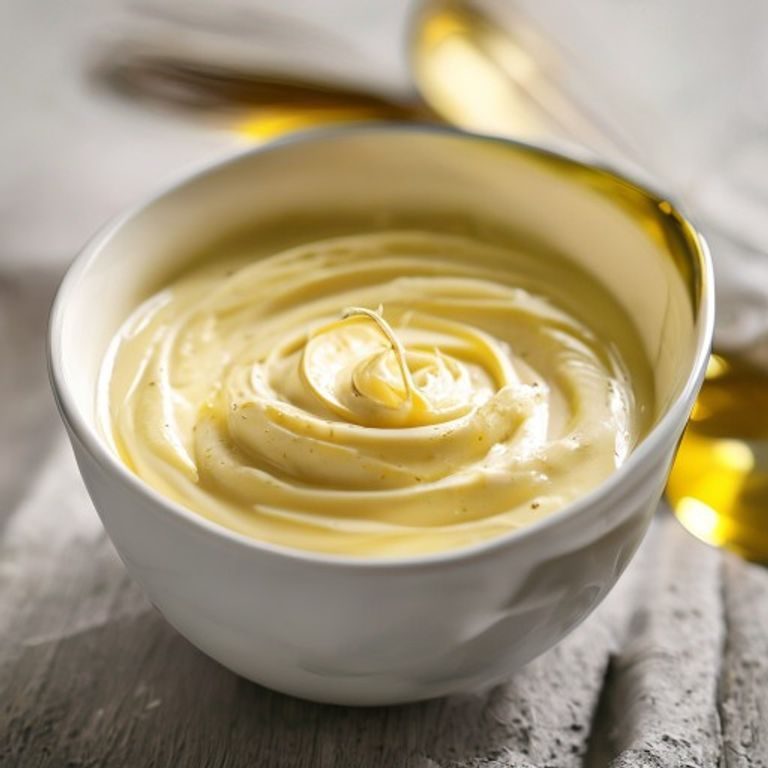
Classic Mayonnaise (Maionese fatta in casa)
A creamy, stable, foolproof mayonnaise made in under 60 seconds with an immersion blender — this four-ingredient emulsion transforms humble pantry staples into a rich, velvety, perfectly balanced condiment that puts any store-bought jar to shame.
| Amount | Ingredient |
|---|---|
| 1 large | whole egg, at room temperature |
| 220 ml (1 cup minus 2 tbsp) | neutral oil (sunflower or peanut preferred) |
| Juice of ½ | lemon (about 15 ml / 1 tbsp) |
| To taste | kosher salt |
Homemade mayonnaise is one of those things that seems intimidating until you try it — and then you wonder why you ever bought the jarred stuff. This immersion blender method is the ultimate shortcut: you simply pile all the ingredients into a tall container, plunge the blender to the bottom, and let physics do the work. In seconds, the oil and egg transform into a thick, glossy, golden emulsion that is stable, luscious, and infinitely more flavorful than anything from a shelf. The secret is starting the blender at the very bottom, where the yolk, acid, and oil sit in a concentrated layer — the blender head creates an instant emulsion that pulls the rest of the oil into its wake as you slowly lift. No pouring in a thin stream, no whisking until your arm aches. Just perfect mayonnaise, every time.
Ingredient notes: Room-temperature eggs are critical — a cold egg will slow the emulsion and can cause it to break. Use a neutral-flavored oil like sunflower, peanut, or light olive oil. Extra-virgin olive oil produces a much stronger, grassier flavor (reserve it for Mediterranean-style mayonnaise where you want that assertive character). The lemon juice provides both acidity and natural emulsifying support. If you prefer, you can substitute an equal amount of white wine vinegar for the lemon juice.
- Immersion (stick) blender
- Tall, narrow beaker or jar (the beaker that came with your immersion blender is ideal — the head must fit snugly at the bottom)
- Rubber spatula
- Small bowl (in case you need to rescue a broken emulsion)
- Airtight jar or container for storage
- Assemble the ingredients (2 min). Crack the room-temperature egg into the bottom of your tall beaker. Add the lemon juice and a generous pinch of salt. Pour all of the oil on top. Do not stir — the ingredients should form distinct layers, with the egg and acid at the bottom and the oil floating on top.
- Position the blender (10 sec). Place the head of the immersion blender flat against the very bottom of the beaker, directly over the egg yolk. Make sure the blender is fully submerged and resting flat on the bottom.
- Blend without moving (10 sec). Turn the blender on to full speed and hold it firmly at the bottom for 10 seconds. Do not move, tilt, or lift the blender during this time. You will see the emulsion begin to form at the bottom, turning white and creamy as the oil is pulled into the egg.
- Lift slowly (15 sec). After 10 seconds, begin to lift the blender very slowly upward through the oil, maintaining a steady, even speed. The emulsion will follow the blender head, transforming the remaining oil into mayonnaise as it rises. Once you reach the top, continue blending for 5 more seconds to aerate and stabilize the mayonnaise.
- Check and finish (30 sec). The mayonnaise should be thick, creamy, and pale yellow, with a soft, spoonable consistency that holds its shape. If it seems too thin, let it sit for 2 minutes — it will continue to thicken as the air bubbles settle. Scrape the sides with a rubber spatula and stir gently to incorporate any unblended oil. Taste and adjust salt or lemon juice as needed.
- Serving Suggestions. Use as a spread on sandwiches, burgers, and wraps; as a base for dressings and sauces (aioli, tartar sauce, remoulade); as a dip for steamed artichokes, blanched asparagus, or crispy fries; spooned over grilled fish or roasted vegetables; or folded into tuna, chicken, or egg salad.
- Room-temperature ingredients. A cold egg will resist emulsification and can cause your mayonnaise to break. Let the egg sit on the counter for 30 minutes before starting. In a pinch, place the whole egg in a bowl of warm water for 5 minutes.
- Use a tall, narrow container. The beaker must be just wide enough to fit the immersion blender head — if it's too wide, the blender won't create enough suction at the bottom to pull the oil into the emulsion. If you don't have the right beaker, a wide-mouth pint jar works well.
- Blender must rest flat on the bottom. This is non-negotiable. The head needs to seal against the bottom to trap the egg and acid underneath, creating the initial emulsion.
- Don't rush the lift. Lift the blender slowly and steadily — if you lift too fast, you'll pull unemulsified oil into the mixture and the mayonnaise may break.
- The 10-second rule is a guideline. Some immersion blenders are more powerful than others. Start checking at 8 seconds; if you see a white, creamy ring forming at the bottom, you're on track.
- Fix a broken mayonnaise. If the mayonnaise separates or looks thin and greasy, crack a fresh egg yolk into a clean bowl and slowly whisk the broken mixture into the new yolk in a thin stream — the fresh yolk provides new emulsifiers to rescue the sauce.
- Season at the end. Add salt and extra lemon juice after the emulsion is fully formed. Acid and salt added at the beginning can slightly affect the emulsification; adding at the end lets you season precisely based on the final volume.
| Mistake | Why It Hurts | The Fix |
|---|---|---|
| Using a cold egg | The fat molecules won't emulsify properly with the water-based egg yolk, resulting in a thin, broken sauce | Let egg come to room temperature (30 min on counter or 5 min in warm water) |
| Lifting the blender too quickly | Unemulsified oil is pulled into the mixture, breaking the emulsion | Lift the blender slowly and steadily — aim for 15 seconds from bottom to top |
| Using the wrong container | A wide container prevents the blender from creating the suction needed to start the emulsion | Use the tall, narrow beaker that came with your immersion blender, or a wide-mouth pint jar |
| Using extra-virgin olive oil alone | The strong, peppery flavor can be overwhelming and the mayonnaise may taste bitter | Use a neutral oil (sunflower, peanut, or light olive oil) and add EVOO for flavor only if desired |
| Over-blending | Excessive blending incorporates too much air and can cause the mayonnaise to thin out or break | Stop as soon as the mixture is thick and creamy — about 25-30 seconds total |
| Not scraping the sides | Pockets of unincorporated oil sit at the sides and can destabilize the whole batch | Scrape the sides with a rubber spatula at the end and stir briefly to incorporate |
| Adding all the oil at once with a weak blender | Some immersion blenders lack the power to pull all the oil into the emulsion at once | Pour the oil in two stages: half at first, blend at bottom for 10 seconds, add remaining oil, then lift |
- Basil Mayonnaise. Blanch a generous handful of fresh basil leaves in boiling water for 10 seconds, then plunge into an ice bath. Squeeze the basil completely dry in a paper towel (any residual water will thin the mayonnaise). Finely chop and fold into the finished mayonnaise. This bright, herbaceous mayo is perfect with grilled or steamed fish.
- Paprika Mayonnaise. Gently heat 1 tablespoon of sweet or smoked paprika in the oil at 80°C (175°F) for 5 minutes — the oil should be hot but not sizzling. Strain through a fine-mesh sieve to remove the paprika solids. Let the oil cool to room temperature, then use it to make the mayonnaise as directed. The result is a deeply colored, aromatic, subtly smoky mayo that is excellent with grilled meat, roasted vegetables, or fried potatoes.
- Tonnata / Tartara-Style Mayonnaise. Fold into the finished mayonnaise: 2 tablespoons finely chopped gherkins (cornichons), 1 tablespoon capers (rinsed and chopped), 2 tablespoons finely chopped red onion, 1 teaspoon lemon zest, and a generous grind of black pepper. This chunky, briny, savory sauce is a hybrid of Italian tonnata and French tartare — perfect for sandwiches, boiled meats, grilled fish, or as a dip for crudités.
- Hard-Boiled Egg Mayonnaise. Substitute 1 hard-boiled egg (peeled and quartered) for the raw egg. The yolk of a hard-boiled egg has a higher concentration of emulsifiers (lecithin) and a softer, creamier texture. Proceed with the immersion blender method exactly as described — the hard-boiled egg emulsifies beautifully, producing a smoother, safer mayonnaise with no risk of raw egg. This method is ideal for those who prefer pasteurized or cooked preparations.
| Storage Method | Details |
|---|---|
| Refrigerator | Store in an airtight jar or container for up to 1 week. The mayonnaise will thicken slightly as it chills. Stir before each use. |
| Freezer | Not recommended — the emulsion breaks completely upon thawing, resulting in a watery, separated mess. |
| Reheating | Do not heat — mayonnaise is a cold emulsion. If it has been refrigerated, let it sit at room temperature for 10 minutes before using for easier spreading. |
Homemade mayonnaise is a supporting player; its wine pairings follow the dishes it accompanies:
- Crisp Sauvignon Blanc (Loire or New Zealand) — High acidity cuts through the rich, oily emulsion and cleanses the palate.
- Dry Vermouth on the rocks — The herbal, slightly bitter notes complement the creamy fat and subtle acidity of the mayonnaise.
- Picpoul de Pinet — A classic oyster-pairing wine from the south of France; its bright, saline edges work beautifully with mayonnaise-dressed seafood.
- Champagne or Crémant (Brut) — Bubbles and high acidity provide the perfect palate cleanser against the richness of the emulsion.
- Chilled dry Sherry (Fino or Manzanilla) — The saline, almondy notes are a surprising and delightful match for garlic aioli or herb mayonnaise.
| Per Serving (about 2 tablespoons) | |
|---|---|
| Calories | 184 |
| Protein | 1 g |
| Fat | 20 g |
| Carbohydrates | 0 g |
| Fiber | 0 g |
Nutrition values are approximate and based on sunflower oil and a single large egg. Actual values will vary based on oil type and optional additions.
Can I use olive oil instead of vegetable oil?
Yes — but use a light or mild olive oil, not extra-virgin. Extra-virgin olive oil has a strong, peppery flavor that can dominate and sometimes turn bitter in the emulsion. For a balanced flavor, use ¾ neutral oil and ¼ extra-virgin olive oil.
What if my mayonnaise doesn't thicken?
If after 30 seconds of blending your mayonnaise is still thin and liquid, you likely lifted the blender too fast. Pour the mixture into a clean bowl, crack a fresh egg yolk into your beaker, and slowly drizzle the thin mixture back into the yolk while blending — this rescues the emulsion.
Can I use this method with a regular blender or food processor?
Yes, though results may vary slightly. For a food processor, blend the egg, acid, and salt first, then slowly drizzle the oil through the feed tube with the motor running. The immersion blender method is simpler and produces a more stable emulsion.
How do I know if my mayonnaise has gone bad?
Homemade mayonnaise will keep for about 1 week in the refrigerator. Signs of spoilage include: an off, sour smell; visible separation that doesn't re-emulsify when stirred; or any sign of mold. When in doubt, throw it out — though with this recipe, you'll likely use it all long before it turns.
Can I double this recipe?
Yes — simply double all ingredients. Make sure your container is tall enough; if it's too wide, the immersion blender won't work as effectively. For larger batches, use a wide-mouth quart jar or the tall beaker designed for your immersion blender.
What's the difference between this and the hard-boiled egg version?
Hard-boiled egg mayonnaise has a slightly thicker, silkier texture and is safer for those concerned about raw eggs. The flavor is subtly different — more mellow and eggy. The technique is identical; just swap a quartered hard-boiled egg for the raw egg.
Can I make flavored mayonnaise without affecting the emulsion?
Yes, but add flavorings after the emulsion is fully formed. Acidic ingredients (extra lemon, vinegar) can destabilize the emulsion if added too early. Fold in herbs, spices, or chopped ingredients gently with a spatula after blending.
- Lemon-Herb Yogurt Sauce (Volume 2)
- Fish Taco Sauce (Volume 2)
- Aioli Provençal (Volume 3)
- Tartar Sauce (Volume 1)
- Classic Caesar Dressing (Volume 1)
Recipe from "The Italian Kitchen" by Vita Milanese — Volume 2: Sunday Sauce
Recipe from The Italian Kitchen by Vita Milanese — Volume 2 · Sunday Sauce. Discover all volumes on the ebook page.