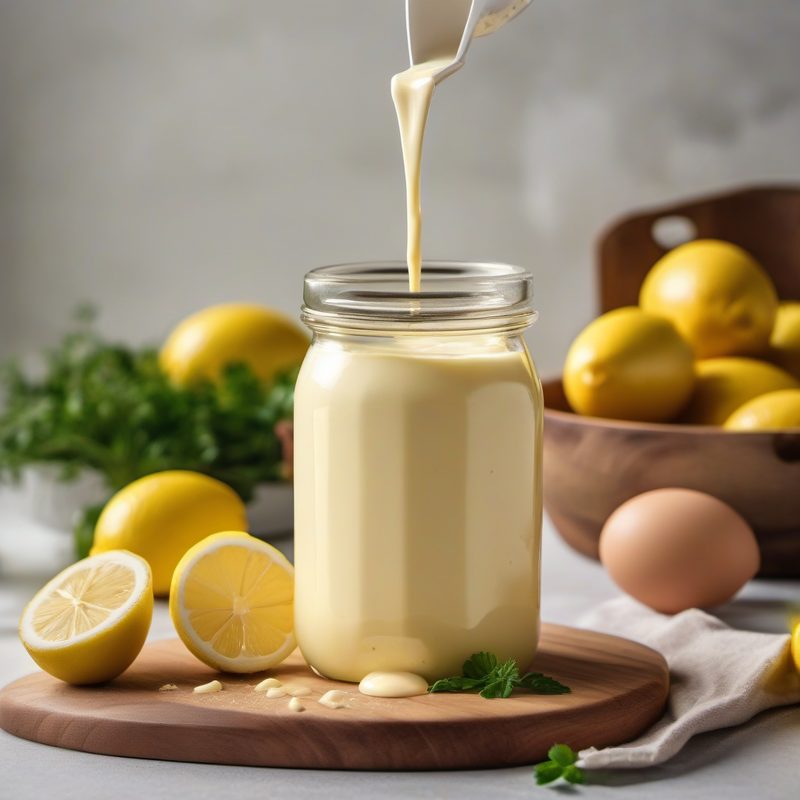
Immersion Blender Mayonnaise
Every home cook knows the anxiety of a broken emulsion — but this cold-start immersion blender method eliminates all risk, producing a luscious, spoonable mayonnaise in under 30 seconds with zero whisking, no gradual oil drizzling, and no need for a helper.
| Amount | Ingredient |
|---|---|
| Jar too wide | The blender can't force enough contact between egg and oil Use a jar no more than 6–7 cm (2½–2¾ in) in diameter — a standard 500 ml (2-cup) jar works perfectly |
| Moving the blender too early | Lifts unemulsified oil into the egg, causing thin, runny mayonnaise Keep the blender pressed to the bottom for a full 10–15 seconds until you see white opacity |
| Lifting the blender too fast | Leaves streaks of unemulsified oil on top Lift 1 inch (2.5 cm) every 3–4 seconds — slower than you think necessary |
| Using a stale egg | Weakened proteins cannot form a stable emulsion Use eggs with a pack date within 2 weeks; do the float test — if it stands upright, it's too old |
| Over-seasoning with lemon | Too much acid can break the emulsion by denaturing egg proteins Add lemon juice only at the start; adjust salt afterward, not more acid |
| Not washing the blender head between batches | Residual oil or egg from a previous batch interferes with fresh emulsification Wash and dry the blender head thoroughly, then rechill it before reuse |
Classic mayonnaise demands patience — a slow, steady stream of oil whisked into egg yolks while praying the emulsion holds. This recipe flips the script entirely. By starting with every ingredient straight from the refrigerator, including the oil and even the blender head, the emulsion forms almost instantly at the bottom of the jar before you ever lift the blender. The science is simple: cold ingredients thicken the emulsion faster and more stably, while the immersion blender's sheer mechanical force at close range bonds egg and oil before they have a chance to separate. What emerges is a mayonnaise so thick, glossy, and stable that it rivals the best artisanal brands — and it takes longer to chill the ingredients than to make the sauce itself.
Use level tablespoons and standard US measuring cups.
- Immersion blender
- Tall jar or beaker (500 ml / 2-cup capacity, just wider than blender head diameter)
- Fine-mesh sieve (optional, for straining egg)
- Small spatula
- Airtight container for storage
- Chill all components — 2 hours minimum. Place the immersion blender head, the bottle of oil, and the lemon juice in the refrigerator for at least 2 hours. Keep the egg in the fridge until the moment you begin. Pro tip: Place the jar you'll use in the fridge too — a cold jar helps maintain the emulsion temperature.
- Combine all ingredients in the jar (30 seconds). Crack the cold egg into the cold jar. Pour the cold oil over the egg, then add the cold lemon juice and the salt. Do not stir — the ingredients should settle in distinct layers, with the egg at the bottom. Pro tip: If you're nervous about freshness, strain the egg through a fine-mesh sieve to remove any thick chalaza strands.
- Position blender at the very bottom (10 seconds). Insert the immersion blender all the way to the bottom of the jar, pressing the head flat and firmly against the base. The blender head should sit directly over the egg. Do not tilt or move it. Pro tip: Tilt the jar slightly if needed to ensure the blender head is fully submerged — air gaps cause splattering.
- Blend on high without moving — 10 to 15 seconds. Turn the blender to full speed and hold it stationary at the bottom. Watch the bottom layer transform from translucent yellow to a thick, opaque white. This is the emulsion forming. Pro tip: Don't peek by lifting the blender — keep it pressed down until you see the white emulsion through the side of the jar.
- Slowly lift the blender through the remaining oil — 15 to 20 seconds. Once the bottom is fully emulsified and thick, begin lifting the immersion blender upward at a rate of about 1 inch (2.5 cm) every 3 to 4 seconds while it continues running. This draws the unemulsified oil into the already-formed emulsion. Continue until all oil has been incorporated and the mayonnaise is uniformly thick and glossy. Pro tip: If you lift too fast, unemulsified oil will sit on top — lower the blender back into it and lift again more slowly.
- Adjust seasoning and finish (30 seconds). Taste the mayonnaise and adjust with additional salt or lemon juice as desired. If the texture is too stiff, whisk in 1 teaspoon of cold water to loosen. Transfer to an airtight container.
- As a spread for sandwiches, burgers, and wraps
- As a base for tuna salad, chicken salad, or egg salad
- As a dip for blanched vegetables, artichokes, or fries
- Swirled into deviled eggs or potato salad
- As the foundation for aiolis, remoulades, and tartar sauces
- Room-temperature ingredients cause broken emulsions. Always start with everything cold from the fridge — egg, oil, lemon juice, blender head, and jar. The cold temperature creates a tighter, more stable emulsion.
- Use a jar that fits snugly around the blender head. If the jar is too wide, the blender can't force the egg and oil together at close range. The clearance should be no more than 1 cm (½ inch) on each side.
- Do not move the blender during the first 10–15 seconds. Lifting or tilting early pulls unemulsified oil into the egg, causing separation. Hold it flat against the bottom.
- Neutral oil is essential for a clean mayonnaise. Extra-virgin olive oil adds bitter notes; if you want olive oil flavor, replace no more than 25% of the neutral oil with a mild olive oil.
- A very fresh egg makes a difference. Fresh eggs emulsify more readily because their proteins are more intact. Check the pack date — within 2 weeks is ideal.
- If the mayonnaise is too thin, you lifted too fast. Pour it back into a clean jar, add one more cold egg yolk (not whole egg), and blend from the bottom again. This rescues almost any broken mayonnaise.
- Let the mayonnaise rest for 10 minutes before serving. The emulsion continues to set as it sits, developing a thicker, creamier texture.
| Mistake | Why It Hurts | The Fix |
|---|
- Garlic Aioli (Aioli): Add 1 small clove of garlic, grated to a paste on a microplane, to the jar with the egg before blending.
- Lemon-Herb Mayonnaise: Add 1 tablespoon finely chopped fresh parsley, 1 teaspoon fresh dill, and 1 teaspoon Dijon mustard after blending, folding gently.
- Spicy Chipotle Mayonnaise: Add 1 to 2 teaspoons chipotle pepper in adobo sauce (finely minced) plus 1 teaspoon lime juice after blending.
- Truffle Mayonnaise: Replace 1 tablespoon of the neutral oil with white truffle oil, and fold in 1 teaspoon of truffle paste after blending.
- Wasabi Mayonnaise: Whisk 1 to 2 teaspoons of wasabi paste (or ½ teaspoon wasabi powder) into the finished mayonnaise with 1 teaspoon rice vinegar.
- Saffron Mayonnaise: Steep a generous pinch of saffron threads in the lemon juice for 10 minutes before adding to the jar — gives a golden color and floral aroma.
- Vegan Aquafaba Mayonnaise: Replace the egg with 3 tablespoons of cold chickpea aquafaba (the liquid from a can of chickpeas). Blend exactly as directed.
| Method | Details |
|---|---|
| Refrigerator | Transfer to an airtight container and refrigerate for up to 5 days. Do not freeze. |
| Best Before | Use within 3 days for optimal texture; after 5 days the emulsion may begin to weep slightly |
| Reviving | If the mayonnaise separates slightly after refrigeration, whisk vigorously with 1 teaspoon of cold water to re-emulsify |
| Not suitable for freezing | Freezing destroys the emulsion entirely — the mayonnaise will break irreparably upon thawing |
- Champagne or Prosecco Brut — the fine bubbles and crisp acidity cut through the richness of the mayonnaise
- Verdicchio dei Castelli di Jesi — lean, almondy white with enough structure to stand up to garlic aioli variations
- Pinot Grigio from Friuli — clean, mineral-driven, and neutral enough to complement without overpowering
- Dry sherry (Fino or Manzanilla) — the salty, briny notes are a surprising but perfect match with herb or saffron mayonnaises
| Calories | Protein | Fat | Carbs | Fiber |
|---|---|---|---|---|
| 120 per tbsp (15 ml) | 0.5 g | 13 g | 0 g | 0 g |
Q: Can I use this method with olive oil instead of neutral oil?
A: Yes, but limit olive oil to 25% of the total oil. Extra-virgin olive oil contains polyphenols that can turn bitter when emulsified at high speed. Use mild, buttery olive oil (not Tuscan or grassy styles) for the best result.
Q: My mayonnaise came out very thin — can I fix it?
A: Yes. Pour the thin mixture into a clean, cold jar. Add one additional cold egg yolk (not a whole egg — just the yolk). Place the immersion blender at the bottom and blend again. This almost always rescues a broken or thin emulsion.
Q: Can I reduce the oil for a lighter mayonnaise?
A: The ratio of 1 egg to 210 g (1 cup minus 1 tbsp) oil is the minimum oil for a stable emulsion. Reducing the oil will produce a thinner, less stable sauce. For a lighter option, use the full amount but fold in 2 to 3 tablespoons of Greek yogurt after blending.
Q: Why does my mayonnaise taste flat?
A: Cold temperature dulls flavor perception. Let the mayonnaise sit at room temperature for 10 minutes before serving. Also check your salt — a pinch is often not enough; a generous ¼ teaspoon fine salt balances the richness.
Q: Can I double this recipe?
A: Yes, but use a wider jar and expect a slightly longer blending time. Double all ingredients and use a 1-liter (4-cup) jar. Blend at the bottom for 20 seconds, then lift slowly over 25 to 30 seconds.
- Classic Homemade Mayonnaise (Volume 1, Recipe #4)
- Aioli Provençal (Volume 1, Recipe #12)
- Tartar Sauce (Volume 2, Recipe #92)
- Remoulade Sauce (Volume 2, Recipe #93)
- Caesar Dressing (Volume 1, Recipe #18)
- Rémoulade de Céleri-rave (Volume 3, Recipe #45)
Recipe from "The Italian Kitchen" by Vita Milanese — Volume 2: Sunday Sauce
Recipe from The Italian Kitchen by Vita Milanese — Volume 2 · Sunday Sauce. Discover all volumes on the ebook page.