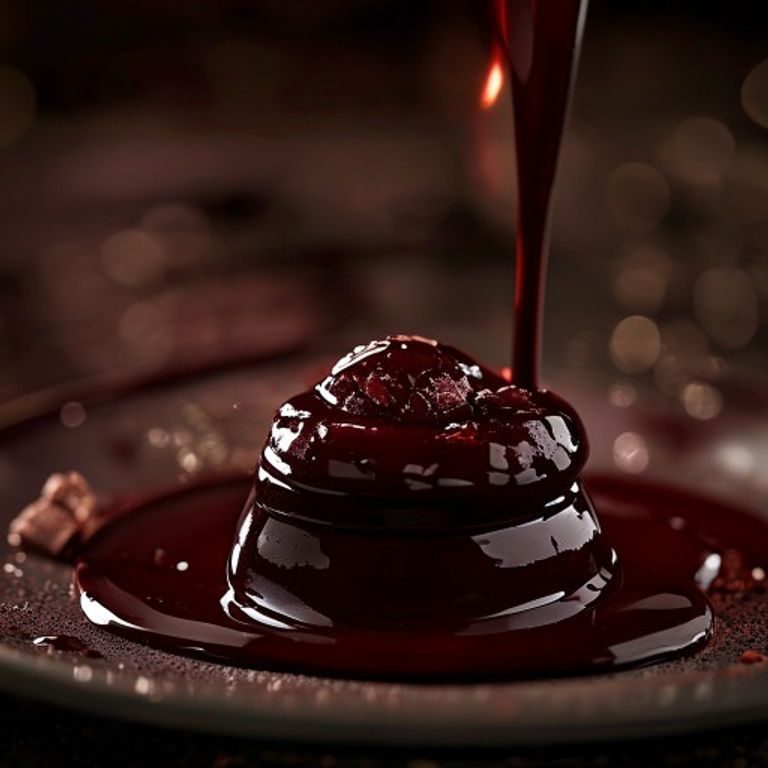
Red Wine Chocolate Sauce
A bold, savory-sweet sauce born from an unexpected pairing: a full-bodied Chianti red wine reduced to its concentrated essence, then enriched with dark chocolate, milk chocolate, and cold butter to create a glossy, deeply flavorful condiment that walks the line between Italian agrodolce and French sauce au chocolat. It is the kind of sauce that sounds improbable on paper — chocolate and red wine, together in a savory context — yet tastes revelatory: rich but not heavy, sweet but not sugary, complex but remarkably simple to make.
| Amount | Ingredient |
|---|---|
| Freezer | Freezes well for up to 2 months. Pour into ice cube trays (each cube is about 2 tablespoons / 30 ml — perfect for single servings), freeze until solid, transfer cubes to a freezer-safe bag. Thaw in the refrigerator overnight or at room temperature for 30 minutes. Reheat gently as described above. The emulsion may separate slightly after freezing — a vigorous whisk or an immersion blender blitz restores it. |
| Make-Ahead Tip | The wine reduction (step 1) can be prepared up to 3 days ahead. Strain and store the cooled reduction in an airtight container in the refrigerator. When ready to finish the sauce, reheat the reduction to a gentle simmer, then proceed from step 2. This is the ideal workaround for dinner parties — the active finish takes only 5 minutes. |
This sauce comes from a spectacular Gronda-era dish — Sous Vide Lamb Fillet with Herb Crust, Potato Cream, and Tomato Tuile — where the red wine chocolate sauce is the quiet star that holds everything together. There is nothing gimmicky about it. A bottle of Chianti (or another robust, dry Italian red wine with good acidity and firm tannins) is simmered down to one-third of its original volume, concentrating the wine's fruit, structure, and minerality into a dense, almost syrupy reduction. Dark chocolate (70% cacao) and a smaller amount of milk chocolate are whisked in off the heat, their cocoa solids and sugar melding with the wine's concentrated character. Finally, a knob of ice-cold butter is emulsified in — just enough to add a silky sheen and a faint richness that rounds off every edge without making the sauce greasy. The result is a mahogany-dark, glossy sauce that pours like velvet: intensely wine-forward, subtly chocolaty, with a warm, lingering finish that complements red meats, game, roasted vegetables, and even aged cheeses. It is simultaneously familiar and surprising — a condiment that earns its place in any ambitious cook's repertoire.
Ingredient notes: The wine is the foundation of this sauce — its character determines the final flavor more than any other ingredient. Choose a dry, full-bodied Italian red with good acidity, moderate tannins, and concentrated dark fruit flavors. A Chianti Classico (preferably DOCG, from the classic region, not a basic entry-level bottling) is ideal: its Sangiovese-driven acidity, cherry and plum notes, and savory, earthy undertones provide the perfect canvas for the chocolate. A Chianti Riserva, a Rosso di Montalcino, a Montepulciano d'Abruzzo, or a Nero d'Avola also work beautifully. Avoid fruit-forward, jammy, or heavily oaked wines (many New World Cabernets, over-extracted Zinfandels, or bargain-priced red blends) — they produce a muddy, one-dimensional sauce. Do not use "cooking wine" under any circumstance; use a wine you would happily drink. The two types of chocolate are deliberate: dark chocolate provides the deep cocoa structure and bitterness that anchor the sauce; milk chocolate adds a touch of dairy sweetness and a smoother, rounder mouthfeel. Using only dark chocolate results in a harsher, more astringent sauce; using only milk chocolate produces something closer to dessert. The ratio of roughly 3:1 dark to milk is the sweet spot. The cold butter is the final emulsifier — it must be ice-cold so it emulsifies into the warm reduction without melting and separating. Cut it into small cubes just before adding.
- Small saucepan (preferably stainless steel or enameled, 1.5–2 litre / 1½–2 quart capacity)
- Fine-mesh sieve or chinois
- Heatproof mixing bowl (stainless steel or glass)
- Flexible rubber spatula or heatproof whisk
- Small knife and cutting board (for chopping chocolate)
- Measuring cup or kitchen scale
- Glass squeeze bottle or small airtight jar for storing (optional)
- Kitchen thermometer (optional, for precision on the reduction)
- Reduce the wine (20–25 minutes). Pour the 500 ml of Chianti into the saucepan. Place over medium-high heat and bring to a brisk simmer — the surface should be active with small, energetic bubbles, not a rolling boil. Reduce the heat to medium-low and maintain a steady, gentle simmer. Let the wine reduce until it measures approximately 170 ml (⅓ of its original volume). This will take 20–25 minutes depending on your pan width and stovetop. The reduction is ready when the liquid has the viscosity of a thin syrup — it should coat the back of a spoon in a translucent, even film. To test visually: tilt the pan and watch the liquid's behavior; it should run more slowly than water, with a slight syrupy resistance. For precision, pour the reduced wine into a measuring cup — you should have about 170 ml / ⅔ cup. If you overshoot (too little liquid), add a splash of fresh wine to bring it back to volume. If you undershoot (too much liquid, too thin), return the pan to the heat for a few more minutes. The reduced wine should smell intensely of concentrated fruit with a pleasant acidity, no harsh alcohol vapor remaining.
- Strain the reduction (1 minute). Set the fine-mesh sieve over the heatproof mixing bowl. Pour the hot reduced wine through the sieve to catch any sediment or tartrate crystals that may have formed during reduction. Most quality wines produce minimal sediment, but a quick strain guarantees a perfectly clear, smooth sauce. If you used an inexpensive wine or an older bottle with sediment, this step is essential.
- Melt and emulsify the chocolate (2–3 minutes). While the reduced wine is still very hot (just off the boil), add both the finely chopped dark chocolate and milk chocolate to the bowl. Let it sit undisturbed for 30 seconds to allow the residual heat to begin melting the chocolate. Then whisk gently in a circular motion, starting from the center and widening outward, until the chocolate is fully melted and the mixture is smooth, glossy, and completely homogeneous. The hot wine reduction should be enough to melt the chocolate entirely without needing to return the bowl to the stove. If some chocolate solids remain after 60 seconds of whisking, place the bowl over a pot of barely simmering water (bain-marie) for 15–20 seconds, remove, and whisk again. Do not apply direct heat to the chocolate-wine mixture, which can seize or scorch the chocolate. The sauce at this stage will look dark, fluid, and slightly matte.
- Emulsify the cold butter (1 minute). Add the 4 ice-cold butter cubes, one at a time, whisking vigorously after each addition until the butter is fully incorporated before adding the next. The sauce will transform: it will lighten in color from opaque dark brown to a rich, glossy mahogany, and the texture will shift from fluid to luxuriously silky — thick enough to coat a spoon but still pourable. The cold butter must be added one cube at a time, with full emulsification after each piece. If you dump all the butter in at once, the temperature drops too quickly, the emulsion breaks, and the sauce turns greasy. The final sauce should be beautifully smooth and glossy, with no oil slicks or grainy spots. If the sauce looks separated or greasy, whisk in 1 teaspoon of cold water — the water can help re-emulsify a borderline sauce.
- Season and finish (30 seconds). Add a small pinch of fine sea salt and whisk once more. Taste the sauce on a clean spoon (be careful — it is still hot). It should taste intensely wine-forward: concentrated cherry and dark berry notes from the Chianti, a deep but restrained cocoa bitterness from the dark chocolate, a subtle dairy sweetness from the milk chocolate, a silky richness from the butter, and a clean, lingering finish where no single element dominates. Adjust with another tiny pinch of salt if the sauce tastes flat or the wine's acidity feels sharp. Salt is the secret to making the chocolate taste like chocolate and the wine taste like wine — do not skip it. But use a micro-pinch: this sauce is meant to be a supporting condiment, not a salted caramel. The salt should vanish into the background, supporting without announcing itself.
- Serve immediately or hold. The sauce is at its peak within the first 30 minutes, when the emulsion is freshest and the flavors are most vibrant. If holding for later, see Storage & Leftovers below. A brief rest of 5–10 minutes allows the flavors to marry — the chocolate and wine meld together into a single, harmonious note that is greater than the sum of their parts.
- Serving Suggestions — The Complete Gronda Dish. This sauce was born for the Sous Vide Lamb Fillet with Herb Crust (see below), but it is far from a one-trick condiment. Here is how to build the full dish, followed by other inspired uses.
Sous Vide Lamb Fillet with Herb Crust, Potato Cream, Tomato Tuile, and Red Wine Chocolate Sauce (serves 4):
- Sous vide lamb: Season a 600 g (1¼ lb) lamb fillet (or 2–3 smaller fillets) with salt, pepper, and a sprig of rosemary. Vacuum-seal and cook at 54°C (129°F) for 2 hours for medium-rare. Transfer to an ice bath to stop cooking. Refrigerate overnight or up to 24 hours. Before serving, sear in a hot pan with a knob of butter for 1 minute per side until deeply browned.
- Herb crust: Blend 50 g melted butter, 50 g frozen white bread (cubed), and 20 g mixed fresh herbs (rosemary, thyme, parsley, marjoram) in a food processor until a coarse paste forms. Roll the paste between two sheets of parchment paper to 2–3 mm thickness. Freeze for 1 hour. Cut into rectangles matching the lamb fillet shapes. Bake at 180°C (350°F) for 6–7 minutes until golden and crisp.
- Potato cream: Boil 2 large Yukon Gold or Russet potatoes until tender. Pass through a ricer or food mill. Stir in 30 ml (2 tbsp) heavy cream, 30 g (2 tbsp) unsalted butter, and 30 g (⅓ cup) finely grated Parmigiano-Reggiano. Season with salt and a pinch of white pepper. Keep warm.
- Tomato tuile: Mix 7.5 g (½ tbsp) melted butter, 25 g (3 tbsp) all-purpose flour, 22.5 g (about ¾ large) egg white, and 1 tsp triple-concentrated tomato paste into a smooth batter. Spread paper-thin on a silicone baking mat. Bake at 180°C (350°F) for 6–7 minutes. While still warm, drape over a rolling pin or bottle to curve — the tuile will hold its shape as it cools.
- Plating: Spoon a generous dollop of potato cream onto each plate. Rest the herb-crusted lamb fillet on top. Drizzle the red wine chocolate sauce around the plate (not over the herb crust, which should stay crisp). Lean the tomato tuile against the lamb. Finish with a sprinkle of flaky sea salt and fresh micro-herbs.
Beyond the Lamb Dish: This sauce is spectacular drizzled over grilled or roasted beef tenderloin, venison loin, or duck breast; spooned over a seared ribeye or New York strip; served alongside roasted root vegetables (parsnips, carrots, celeriac); used as a finishing sauce for braised short ribs or osso buco; or even drizzled over a wedge of aged Parmigiano-Reggiano or Pecorino Toscano with a drizzle of aged balsamic.
- The wine is the sauce — choose wisely. The entire flavor of the finished sauce depends on the character of the wine you reduce. Open the bottle, pour a glass, and taste it. If you would not enjoy drinking a glass of it on its own, do not use it for the sauce. A good Chianti Classico with Sangiovese's characteristic acidity and cherry-cranberry notes creates a sauce with structure, brightness, and complexity. A flat, flabby, or overly oaked wine creates a flat, flabby sauce.
- Do not rush the reduction. Reducing 500 ml of wine to ⅓ of its volume takes 20–25 minutes at a gentle simmer. Rushing this step at high heat drives off alcohol too quickly, hardens the tannins, and produces a harsh, bitter reduction. A slow, patient reduction concentrates flavor; a fast one concentrates bitterness.
- Chop the chocolate finely. Finely chopped chocolate (about the size of coarse breadcrumbs) melts instantly when it hits the hot wine reduction. Large chunks take too long to melt, cool the reduction too much, and produce a lumpy, uneven sauce. Use a sharp chef's knife — grating or food-processing works but creates fine dust that can clump.
- Cold butter is a non-negotiable finishing step. The 30 g of ice-cold butter emulsifies into the sauce, adding gloss, body, and a velvety texture. It does not make the sauce taste buttery — it makes the sauce taste luxurious. Do not skip it, do not use soft or melted butter, and do not add more than 30 g or the sauce will be greasy.
- Temperature matters for the emulsion. The reduced wine must be very hot (just off a simmer, about 85–90°C / 185–195°F) when you add the chocolate — hot enough to melt the chocolate without needing to reheat. If the reduction has cooled below 75°C (165°F), the chocolate will not melt completely and the butter will not emulsify properly. If this happens, warm the bowl gently over a bain-marie.
- The sauce thickens as it cools. The sauce at warm serving temperature should be loose and glossy, like a thin béchamel. It will thicken considerably as it cools to room temperature and even more in the refrigerator — this is normal and expected. Thin it with a few drops of warm water or fresh broth when reheating.
- Make ahead for best flavor. This sauce is even better the next day — the flavors of the wine and chocolate meld overnight into a seamless, mellow whole. The emulsion may separate slightly upon reheating (see Storage table for the fix), but the depth of flavor more than compensates.
- Scale with caution. This recipe makes 250 ml, which is enough for 4–6 servings as a drizzle or 8–10 servings as a small spoonful. If scaling up, keep the same ratio of 5:1 wine to (dark + milk chocolate) and 3:1 dark-to-milk chocolate ratio. Larger volumes take slightly longer to reduce. The butter-to-chocolate ratio does not change: 30 g butter per 130 g total chocolate.
| Mistake | Why It Hurts | The Fix |
|---|---|---|
| Using cheap or poor-quality wine | The sauce tastes thin, harsh, or one-dimensional — the wine's flaws are concentrated 3× during reduction | Use a wine you would happily drink; Chianti Classico, Rosso di Montalcino, or Montepulciano d'Abruzzo are reliable choices |
| Over-reducing the wine (too little liquid) | The sauce is overly concentrated, bitter, and syrupy — the wine's tannins become harsh and the chocolate cannot balance them | Check volume at 18 minutes; if you overshoot, add 30–50 ml fresh wine to dilute back and simmer for 1 minute to re-incorporate |
| Under-reducing the wine (too much liquid) | The sauce is thin, watery, and wine-forward without body — the chocolate and butter cannot emulsify in a thin liquid | Return the bowl to a saucepan and simmer gently, whisking, until reduced to the correct syrupy consistency |
| Adding the chocolate to cool wine | The chocolate seizes, clumps, or refuses to melt, creating a grainy, unemulsified sauce | Rescue by placing the bowl over a bain-marie and whisking gently until smooth; do not apply direct heat |
| Adding all the butter at once | The emulsion breaks — the sauce turns greasy and separates into an oily layer and a watery layer | Whisk in 1 teaspoon of cold water vigorously; if the sauce stays broken, pour it into a blender, add 1 tablespoon hot water, and blend on high for 15 seconds |
| Using too much butter | The sauce becomes greasy, heavy, and opaque rather than glossy and elegant | Stick to exactly 30 g (2 tbsp) per 500 ml wine / 130 g chocolate; do not improvise |
| Adding sugar or honey | The sauce becomes cloyingly sweet and loses the savory balance that makes it special | Trust the sugars in the wine and the milk chocolate — they provide exactly enough sweetness; resist the urge to sweeten |
| Serving the sauce too hot | The flavors are harsh and alcohol-forward; the chocolate and wine have not married | Let the sauce rest off the heat for 3–5 minutes before serving — the temperature drop allows the flavors to integrate |
| Using a heavily oaked or jammy wine | The sauce tastes like sawdust and jam — the oak tannins and overripe fruit clash with the chocolate's subtle bitterness | Stick to medium-bodied, high-acid Italian reds; avoid American or Australian Cabernets, Zinfandels, and heavily oaked blends |
| Variation | How To |
|---|---|
| Game-Style Red Wine Chocolate Sauce | Replace the milk chocolate with 30 g of dark chocolate (total 130 g dark chocolate, 0 g milk chocolate) and add 1 sprig of fresh rosemary and 1 strip of orange zest to the wine during the final 5 minutes of reduction. Strain them out before adding the chocolate. The rosemary's piney, resinous notes and the orange's bright citrus cut through rich game meats like venison, wild boar, or duck. |
| Smoky Red Wine Chocolate Sauce | Before reducing the wine, smoke the Chianti over smoldered applewood or cherrywood chips for 10 minutes (use a stovetop smoker or a foil-pouch method). Alternatively, add ¼ teaspoon of smoked paprika or a single chipotle pepper (rehydrated, seeded, and minced) with the chocolate. The subtle smokiness is extraordinary with grilled steak, roasted lamb, or barbecued pork ribs. |
| Balsamic Red Wine Chocolate Sauce | Replace 50 ml of the Chianti with 50 ml of aged balsamic vinegar from Modena (traditional, not the cheap commercial grade). Reduce as directed. The balsamic adds a sweet-tart, syrupy complexity and an almost raisiny depth that pairs spectacularly with braised beef, roasted duck, or aged Parmigiano-Reggiano. |
| Coffee-Infused Red Wine Chocolate Sauce | Add ½ teaspoon of instant espresso powder (or the grounds from 1 shot of freshly pulled espresso) along with the chocolate. The coffee amplifies the dark chocolate's roasted notes and deepens the wine's earthy character without announcing itself. Spectacular with beef, lamb, and chocolate desserts (no, seriously — try it over vanilla gelato). |
| Miso Red Wine Chocolate Sauce | Whisk in 1 tablespoon of white (shiro) miso paste with the butter. The miso's savory umami and gentle salinity create an almost magical synergy with the wine and chocolate — deeply savory, hauntingly complex. Pair with grilled lamb chops, roasted duck breast, or charred eggplant. |
| Spiced Red Wine Chocolate Sauce | Add to the wine during reduction: 1 star anise, 1 cinnamon stick (broken), 3 black peppercorns, and 1 strip of orange zest (no pith). Strain before adding the chocolate. The warm, aromatic spices evoke a mulled-wine character that is extraordinary with roasted game, slow-cooked lamb shoulder, or a festive Christmas roast. |
| Red Wine Chocolate Sauce without Milk Chocolate | Replace the 30 g of milk chocolate with 30 g of additional dark chocolate (total 130 g dark chocolate, 70% cacao) and add 1 tablespoon (15 ml) of heavy cream with the butter. The cream provides the dairy sweetness and roundness that the milk chocolate would have contributed, while the extra dark chocolate produces a more intense, more bitter, more adult sauce — excellent with beef short ribs, venison, or grilled portobello mushrooms. |
| Storage Method | Details |
|---|
This is a rich, wine-forward sauce that needs wines with enough structure and acidity to stand up to its intensity — and perhaps enough residual sugar or heft to harmonize with the chocolate's subtle bitterness.
- Chianti Classico (Tuscany, Italy) — The same wine in the sauce, served alongside in a glass. A Chianti Classico with at least 2–3 years of bottle age (look for the 2019, 2020, or 2021 vintages) has the ideal balance of Sangiovese acidity, cherry fruit, and savory earthiness. The synergy is remarkable — the wine in the glass amplifies the wine in the sauce, creating a seamless, resonant pairing.
- Rosso di Montalcino or Brunello di Montalcino (Montalcino, Tuscany) — Rosso di Montalcino is the younger, more approachable sibling of Brunello, with similar Sangiovese Grosso character but less tannin and more accessible fruit. A young Rosso (3–5 years old) has the cherry-berry fruit and bright acidity to match the sauce. If serving lamb, a Brunello is a spectacular splurge.
- Barbera d'Alba or Barbera d'Asti (Piedmont, Italy) — Barbera's naturally high acidity, low tannins, and concentrated dark cherry and blackberry flavors make it a surprisingly excellent match for chocolate-accented sauces. The bright acidity cuts through the sauce's richness, while the dark fruit echoes the wine reduction.
- Nero d'Avola (Sicily) — A full-bodied, deeply colored Sicilian red with ripe black cherry, plum, and spice notes and velvety tannins. Its generous fruit and moderate structure stand up to the sauce without competing — a natural pairing for lamb, beef, or aged pecorino.
- Montepulciano d'Abruzzo (Abruzzo, Italy) — A robust, slightly rustic red with dark fruit, leather, and earthy undertones. Its firm structure and slightly bitter finish complement the dark chocolate's bitterness without clashing — an excellent, affordable everyday match.
- Amarone della Valpolicella (Veneto, Italy) — For a truly indulgent pairing, Amarone's intensely concentrated dried-cherry, raisin, and chocolate notes mirror the sauce's flavor profile in a richer, more opulent register. This is a special-occasion wine for a special-occasion dish.
- For cocktail drinkers: A Manhattan (rye whiskey, sweet vermouth, Angostura bitters, Luxardo cherry) — the whiskey's warmth, vermouth's herbal complexity, and cherry's sweetness echo the sauce's wine-and-chocolate character. A Negroni (gin, Campari, sweet vermouth) — the bitter Campari and herbal gin provide a bracing counterpoint that cuts through the sauce's richness.
- For non-alcoholic: A pomegranate and black tea spritzer — strong brewed black tea (cooled), pomegranate juice, a squeeze of lemon, and sparkling water over ice. The tea's tannins and the pomegranate's tart fruit echo the wine's structure without alcohol. Alternatively, a Verjus Spritz (verjuice — the pressed juice of unripe wine grapes — topped with sparkling water and a twist of lemon) provides the acidity and grape character of wine without the alcohol.
| Per Serving (about 2 tablespoons / 30 ml) | |
|---|---|
| Calories | 142 |
| Protein | 1.5 g |
| Fat | 9 g |
| Carbohydrates | 10 g |
| Fiber | 1.5 g |
| Sugar | 6 g |
Nutrition values are approximate and based on a 30 ml (2 tablespoon) serving, using a 500 ml bottle of Chianti Classico reduced to ⅓, 100 g of 70% dark chocolate, 30 g of milk chocolate, and 30 g of unsalted butter. Actual values will vary depending on the specific wine, chocolate brands, and cacao percentages. The majority of calories come from the reduced wine's natural fruit sugars and the chocolate's cocoa butter. This sauce is naturally gluten-free and vegetarian. It contains dairy (butter) and may contain traces of soy lecithin (common in commercial chocolate) — check your chocolate labels if these are concerns.
What is Red Wine Chocolate Sauce (Salsa al Cioccolato e Vino Rosso)?
It is a savory Italian-style sauce made by reducing a full-bodied red wine (traditionally Chianti) to one-third of its volume, then emulsifying the concentrated reduction with dark and milk chocolate and cold butter. The result is a glossy, mahogany-dark condiment that is intensely wine-forward with subtle cocoa notes — not sweet, not dessert-like, but a complex, savory-sweet sauce designed for red meats, game, roasted vegetables, and aged cheeses. It originated in modern Italian fine-dining kitchens (notably from the Gronda era of recipe development), where chefs began pairing chocolate with wine reductions as a savory counterpart to red meat — a technique that mirrors the ancient Mexican mole tradition but with a purely Italian sensibility.
Can I make this sauce with white wine?
Not recommended. White wine lacks the tannins, body, and dark fruit character that give the sauce its structure and compatibility with chocolate. A white wine reduction would produce a thin, acidic, unbalanced sauce — the chocolate would dominate unpleasantly, and the wine character would be lost. If you need a chocolate sauce for poultry or fish, consider the Miso variation (which works with lighter meats) or a classic mole recipe instead.
Can I use this sauce for desserts?
The wine and dark chocolate create a naturally bittersweet, savory-accented sauce that sits firmly in the savory camp. It would work as a sophisticated drizzle over a dark chocolate tart, vanilla gelato, or poached pears — but it is not a dessert sauce in the traditional sense. If you want a dessert-oriented version, replace half the wine with orange juice, add 2 tablespoons of honey, and skip the butter. That said, the original version over vanilla gelato with a pinch of flaky salt is a genuinely spectacular, unconventional dessert.
What if I don't have Chianti? What other wines work?
Any dry, full-bodied, high-acid red wine with moderate tannins and concentrated dark fruit works. Excellent alternatives: Rosso di Montalcino, Barbera d'Alba, Barbera d'Asti, Montepulciano d'Abruzzo, Nero d'Avola, Primitivo (not the over-ripe, high-alcohol versions), a young Rioja Crianza (Tempranillo), or even a Pinot Noir from a warmer climate (Sonoma Coast, Central Otago) if you want a lighter, brighter, more fruit-forward sauce. Avoid: Cabernet Sauvignon (too tannic and oaky), Zinfandel (too jammy), Syrah/Shiraz (too peppery and heavy), and anything labelled "cooking wine" or "table wine."
What about the alcohol — does it all cook off?
Reducing 500 ml of wine to one-third of its volume over 20–25 minutes of simmering removes most — but not all — of the alcohol. Studies show that simmering for 15+ minutes retains roughly 5–10% of the original alcohol content, which translates to about 1–2% ABV in the finished sauce (similar to a very low-alcohol beer). If you need to eliminate alcohol entirely, replace the wine with an equal volume of high-quality non-alcoholic red wine. Brands like Leitz Eins Zwei Zero (German), Belle & Co., or Fre produce dealcoholized reds that work surprisingly well — they retain the grape character, acidity, and tannins without the ethanol.
Can I make a larger batch for gifting or entertaining?
Yes. Double or triple the recipe using the same ratios: for each 500 ml of wine, use 100 g dark chocolate, 30 g milk chocolate, 30 g butter, and a pinch of salt. The reduction time scales up slightly (a double batch takes about 30–35 minutes). The sauce pours beautifully into 120 ml (4 oz) glass jars or 250 ml (8 oz) swing-top bottles. It makes an extraordinary homemade gift for the cook who has everything — attach a serving suggestion tag that says "Drizzle over roasted lamb, beef tenderloin, or grilled steak."
How do I fix a sauce that tastes too boozy or harsh?
If the finished sauce has a sharp, alcoholic, or harsh character, it was either (a) reduced too quickly at too high a heat, or (b) made with a wine that was too tannic or alcoholic. The fix: add 1 tablespoon of unsalted butter (softened) and 1 teaspoon of honey or maple syrup, whisk vigorously, and taste. The extra fat rounds off the harsh edges, and the small amount of sugar balances the bitterness. Do not add cream — it will turn the sauce into a completely different character (a creamy hot-chocolate-style sauce, which might be delicious but is not this recipe).
Can I make this sauce vegan?
Yes, with one modification: replace the butter with 30 ml (2 tablespoons) of coconut oil (refined, for a neutral flavor) or a high-quality vegan butter (Miyoko's, Naturli, or Flora Plant). Add the vegan fat in the same manner as the butter — cold, one piece at a time, whisking to emulsify. The texture will be slightly less silky and the gloss slightly more matte, but the flavor will be nearly identical. Use a vegan dark chocolate (check labels — many dark chocolates are naturally vegan) and a vegan milk chocolate alternative.
- Sous Vide Lamb Fillet with Herb Crust (Volume 8)
- Roasted Rack of Lamb with Rosemary and Garlic (Volume 8)
- Grilled Ribeye Steak with Chimichurri (Volume 7)
- Braised Beef Short Ribs with Red Wine (Volume 7)
- Osso Buco alla Milanese (Volume 6)
- Venison Loin with Juniper and Rosemary (Volume 8)
- Roasted Root Vegetables with Thyme (Volume 4)
- Aged Parmigiano-Reggiano with Balsamic Glaze (Volume 3)
Recipe adapted from the Gronda-era Sous Vide Lamb Fillet with Herb Crust and Chocolate Sauce — Volume 2: Sunday Sauce
Recipe from The Italian Kitchen by Vita Milanese — Volume 2 · Sunday Sauce. Discover all volumes on the ebook page.