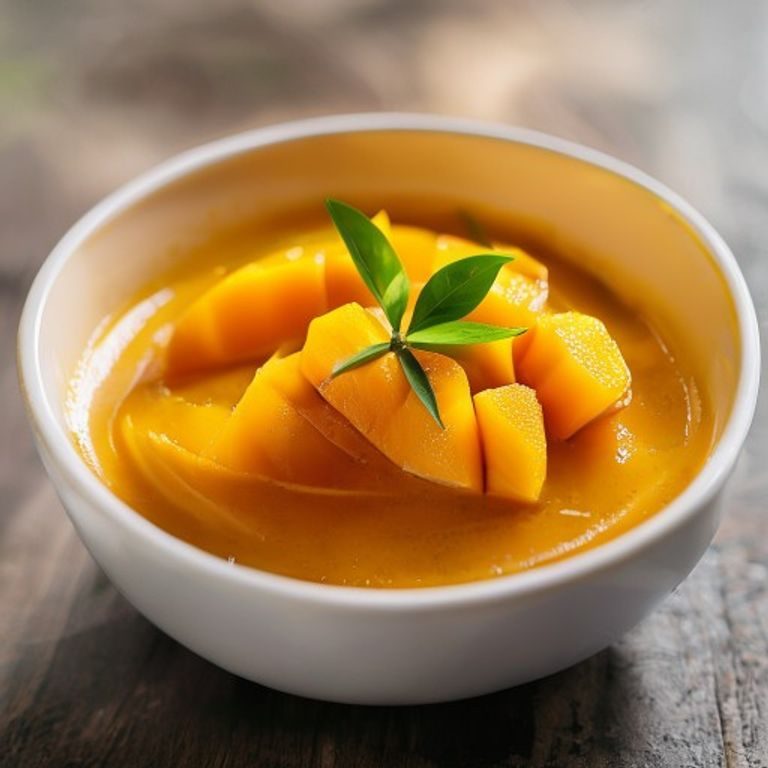
Mango Sauce
A silky, sun-bright sauce made from nothing but ripe mango, fruity olive oil, salt, and pepper—blended smooth, strained to velvet, and ready in 10 minutes. Spoon it over sous vide pork roast, grilled chicken, or seared fish for a burst of tropical sweetness that transforms any weeknight dinner into something exceptional.
| Amount | Ingredient |
|---|---|
| 1 | large, ripe mango (preferably Ataulfo/Champagne or Kent variety, about 300–350 g / 10–12 oz before peeling) |
| 3 tbsp (45 ml) | extra-virgin olive oil, preferably fruity and medium-intensity |
| ¼ tsp (1.5 g) | fine sea salt, plus more to taste |
| 2–3 turns | freshly ground black pepper |
There is no cooking, no chopping, no simmering—just one perfectly ripe mango, a good olive oil, and a blender. The mango is the whole show here: its natural sweetness, its heady tropical fragrance, its sunny orange-gold color. A fruity extra-virgin olive oil adds body and a gentle peppery finish, while a pinch of salt sharpens every note and a few cracks of black pepper provide the faintest warmth. The sauce is then passed through a fine-mesh sieve to catch any fibrous strands, yielding a texture as smooth as heavy cream. The result is a condiment of almost shocking simplicity—bright, elegant, and versatile enough to work with pork, poultry, fish, shellfish, or even drizzled over a plate of ripe heirloom tomatoes and burrata. This is the kind of sauce that disappears before you have time to compliment it, and the only hard part is waiting for your mango to ripen.
Ingredient notes: The mango is everything—it must be fully ripe, fragrant, and yielding to gentle pressure. Unripe or underripe mangoes are too tart and fibrous to make a smooth sauce; overripe mangoes with brown spots will taste fermented. Ataulfo (Champagne) mangoes are ideal because they are naturally less fibrous, extremely sweet, and have a creamy, buttery texture that blends into an exceptionally smooth sauce. Kent and Haden varieties also work well. Tommy Atkins mangoes (the most common supermarket variety) are more fibrous and may require more thorough straining—choose another variety if you can. The olive oil should be a fruity, medium-intensity oil that you enjoy on its own—a grassy, buttery oil from Sicily, Puglia, or Greece complements the mango's tropical character beautifully. Avoid peppery, aggressively bitter oils that would compete with the fruit. Use a fine flake salt (Maldon, fleur de sel) or a fine sea salt for clean, even seasoning.
- Sharp chef's knife and cutting board
- Vegetable peeler or paring knife
- High-speed blender or immersion blender with tall cup
- Fine-mesh sieve (strainer)
- Flexible rubber spatula
- Small bowl or liquid measuring cup (to catch the strained sauce)
- Glass squeeze bottle or airtight jar for serving/storing
- Prepare the mango (5 min). Wash and dry the mango. Stand it upright on a cutting board with the narrow edge facing you. Using a sharp chef's knife, slice off the two cheeks (the broad, flat sides) by cutting just to either side of the central pit—you want as much flesh as possible. Peel the skin off each cheek using a vegetable peeler or paring knife. Trim any remaining flesh from around the pit. Discard the pit and skin. Cut the mango flesh into rough 2-inch (5 cm) chunks. A ripe mango should yield easily to the knife. If the flesh is hard and the knife meets resistance, the mango is not ready—set it aside at room temperature for another day or two. If the pit clings tenaciously to the flesh, you have cut too close; angle your knife slightly outward next time to leave a thin border of flesh around the pit.
- Blend the sauce (3 min). Transfer the mango chunks to a blender or tall cup (for immersion blender). Add the extra-virgin olive oil, salt, and a few cracks of black pepper. Blend on high speed until completely smooth and uniform—about 30 to 45 seconds. The sauce should be a brilliant, opaque orange-gold with a thick but pourable consistency, like a thin purée or a creamy vinaigrette. If the sauce seems too thick to blend smoothly, add 1 tablespoon of cold water and blend again. Do not add extra oil unless you want a richer, more emulsion-like texture—the mango itself contains plenty of natural juice.
- Strain the sauce (2 min). Set a fine-mesh sieve over a small bowl or liquid measuring cup. Pour the blended mango sauce through the sieve. Using a flexible rubber spatula, press and stir the sauce against the mesh in a firm, circular motion, scraping the underside of the sieve frequently, until only the fibrous solids remain. Discard the solids. Straining is essential even with low-fiber mango varieties—it removes any residual stringy fibers and ensures a silky, luxurious texture worthy of a fine-dining plate. Be patient and thorough; the spatula work takes only 2 minutes and makes the difference between a good sauce and a great one.
- Season and adjust (1 min). Taste the strained sauce. It should be intensely mango-forward—sweet, fragrant, and fruity—with the olive oil providing a subtle, grassy background and the salt sharpening every flavor. Adjust seasoning: add another pinch of salt if the sweetness feels flat, or another turn of pepper if you want a touch of warmth. The sauce should not taste savory or oily—it should taste like the essence of ripe mango, elevated by a whisper of salt and olive oil. If the sauce tastes flat or one-dimensional, a squeeze of fresh lime juice (about ½ teaspoon) can brighten it without compromising the mango character.
- Serve immediately or store. Transfer the sauce to a glass squeeze bottle or an airtight jar. The sauce is at its best within the first hour, when the mango is brightest and the olive oil is freshest. If serving later, see Storage & Leftovers below. The sauce will darken slightly as it sits—this is natural oxidation and does not affect the flavor.
- Serving Suggestions. The classic pairing from the original Italian recipe is sous vide pork roast (lonza di maiale): season a 600 g (1¼ lb) pork loin with rosemary, oregano, and garlic powder; vacuum-seal with a knob of butter; cook at 144°F (62°C) for 2½ hours; chill in an ice bath; refrigerate 24 hours; slice and sear in the rendered cooking juices before serving on a pool of mango sauce. Beyond pork, this sauce is spectacular with grilled chicken thighs or breasts, pan-seared salmon or sea bass, grilled shrimp or scallops, roasted pork tenderloin or pork chops, seared duck breast, fried or grilled tofu, or simply drizzled over a plate of burrata and heirloom tomatoes with a sprinkle of flaky salt and microgreens.
- Ripeness is non-negotiable. An underripe mango produces a tart, fibrous, cloudy sauce that no amount of blending can fix. An overripe mango (soft, wrinkled skin, fermented smell) produces a dull, boozy sauce. The mango should yield to gentle palm pressure (not fingertip pressure, which bruises the fruit) and smell intensely sweet and floral at the stem end. If the mango is not ready, leave it on the counter at room temperature for 1–3 days. Do not refrigerate an unripe mango—cold stops the ripening process.
- Choose the right mango variety. Ataulfo (Champagne) mangoes are the gold standard: small, flat, golden-yellow, with thin skin, virtually no fibers, and a creamy, intensely sweet flesh. Kent mangoes (green with a red blush) are also excellent: large, juicy, and low-fiber. Haden mangoes (red with green and yellow patches) have a more classic tropical, slightly tangy flavor but can be somewhat fibrous. Avoid Tommy Atkins (red-green, oval) unless it is your only option—they are the most fibrous.
- Straining is mandatory, not optional. Even low-fiber mango varieties have thin, thread-like fibers that catch in your teeth. A fine-mesh sieve and a spatula eliminate every last strand. Do not skip this step—it is the difference between a restaurant-quality sauce and a homemade one.
- Do not over-season. Mango is naturally sweet and aromatic. Salt should be used sparingly—just enough to sharpen the sweetness and balance the olive oil. Too much salt makes the sauce taste savory and muddy. Start with ¼ teaspoon and add more in tiny increments.
- Olive oil quality matters. Use a fruity, medium-intensity extra-virgin olive oil that you enjoy eating raw. A grassy, buttery Sicilian or Pugliese oil complements the mango's tropical notes. A harsh, peppery Tuscan oil will clash. A neutral oil (grape seed, avocado) will work but produces a less interesting sauce.
- Texture tweak: For a thinner, more drizzle-friendly sauce, add 1 to 2 tablespoons of cold water and blend again. For a richer, more vinaigrette-like emulsion, increase the olive oil to 4 tablespoons (60 ml) and blend on high—the extra oil creates a thicker, glossier, more stable emulsion.
- Make ahead: This sauce is best made the same day, but it holds well for 24 hours. The color will dull from brilliant orange to a deeper amber, and the mango flavor will mellow slightly. Stir well before serving.
| Mistake | Why It Hurts | The Fix |
|---|---|---|
| Using an underripe mango | The sauce is tart, fibrous, pale, and lacks the natural sweetness that defines the sauce | Wait 1–3 days at room temperature until the mango yields to gentle palm pressure and smells intensely sweet at the stem end |
| Using an overripe mango | The sauce tastes fermented, flat, and slightly alcoholic—the sugars have begun to convert | Buy mangoes at the peak of ripeness and use them within 1 day; do not use mangoes with wrinkled skin or brown, weepy spots |
| Skipping the straining step | The sauce is fibrous and stringy—fine strands of mango fiber catch in the teeth and ruin the silky texture | Always strain through a fine-mesh sieve with a spatula; it takes 2 minutes and is the single most important step for texture |
| Adding too much olive oil | The sauce becomes greasy, heavy, and oily—the mango flavor is buried under the fat | Use exactly 3 tablespoons (45 ml) for a single mango; add more only if you want a richer, vinaigrette-like texture |
| Using a bitter or peppery olive oil | The oil clashes with the sweet, delicate mango, producing an aggressive, unpleasant aftertaste | Use a fruity, buttery, medium-intensity extra-virgin olive oil—taste the oil alone before adding it |
| Over-salting | The sauce tastes savory, muddled, and unpleasantly salty rather than bright and fruity | Start with ¼ teaspoon fine sea salt and add in tiny increments; taste after each addition |
| Blending too long or on too high a speed | Over-blending can incorporate too much air, making the sauce frothy and pale rather than dense and glossy | Blend on high for 30–45 seconds only—just until completely smooth. If the sauce is frothy, let it rest for 2–3 minutes and stir gently before serving |
| Not tasting and adjusting | The sauce may be perfectly seasoned for one mango and under-seasoned for another—mangoes vary in sweetness | Always taste the finished sauce and adjust salt, pepper, or a squeeze of lime before serving |
| Variation | How To |
|---|---|
| Spicy Mango Sauce | Add ½ small red chili (bird's eye or serrano, seeded if you prefer less heat) to the blender with the mango. The fruity heat of fresh chili is a spectacular counterpoint to the sweet mango and works beautifully with pork, shrimp, or grilled fish. |
| Mango-Lime Sauce | Replace 1 tablespoon of olive oil with 1 tablespoon (15 ml) of freshly squeezed lime juice. Add the finely grated zest of ½ lime as well. The bright, tart lime cuts through the mango's sweetness and adds a refreshing citrus lift—excellent with fish tacos, ceviche, or grilled shrimp. |
| Mango-Ginger Sauce | Add a 1-inch (2.5 cm) piece of fresh ginger, peeled and roughly chopped, to the blender. The warm, pungent, slightly spicy ginger complements the mango's tropical sweetness and adds a sophisticated layer of flavor—spectacular with pork, duck, or roasted carrots. |
| Mango-Coconut Sauce | Replace the olive oil with 3 tablespoons (45 ml) of full-fat coconut milk (shaken well). The coconut adds a lush, tropical creaminess and a subtle sweetness that amplifies the mango. Use a neutral oil (1 tablespoon / 15 ml) if the sauce needs a smoother blend. Excellent with grilled shrimp, white fish, or roasted sweet potatoes. |
| Creamy Mango-Curry Sauce | Add ½ teaspoon of mild curry powder (or garam masala) and 2 tablespoons (30 ml) of full-fat Greek yogurt to the blender. The warm spices and tangy yogurt transform the sauce into something savory and complex—a brilliant pairing with roasted chicken, lamb chops, or cauliflower steaks. |
| Mango-Herb Sauce | Add 10 g (⅓ cup packed) of fresh cilantro leaves (or basil, or mint—or a mix) to the blender with the mango. The herbal freshness brightens the sauce and adds complexity. Cilantro is the classic pairing for Latin- and Southeast Asian-inspired dishes; basil works beautifully with Italian-style preparations. |
| Smoked Mango Sauce | Before blending, smoke the peeled mango cheeks over smoldering wood chips (applewood or cherrywood) for 5 minutes, or add a pinch (⅛ teaspoon) of smoked paprika to the blender. The subtle smoky notes are extraordinary with grilled pork chops, beef brisket, or halloumi. |
| Mango-Vanilla Sauce | Split a 2-inch (5 cm) piece of vanilla bean, scrape the seeds into the blender with the mango, and add the empty pod to the strained sauce for 30 minutes before discarding. The floral, aromatic vanilla amplifies the mango's natural sweetness and perfume—elegant with seared scallops, lobster, or a simple panna cotta. |
| Storage Method | Details |
|---|---|
| Refrigerator | Store in an airtight glass jar or squeeze bottle for up to 2 days. The sauce will darken from bright orange to a deeper amber as the mango oxidizes—this is natural and does not affect the flavor. Stir well before serving. Bring to room temperature for 15 minutes before using to restore the best texture and flavor intensity. Do not refrigerate for more than 2 days—the mango will begin to ferment and the sauce will lose its bright, fresh character. |
| Freezer | Mango sauce freezes reasonably well for up to 1 month. Portion into ice cube trays (each cube is about 1 tablespoon / 15 ml—perfect for single servings), freeze until solid, then transfer the cubes to a freezer-safe bag. Thaw individual cubes in the refrigerator (about 1 hour) or at room temperature (about 15 minutes). Stir well after thawing—the texture may be slightly less silky after freezing, but a quick re-blend or vigorous whisk will restore it. Do not freeze for longer than 1 month; the flavor degrades noticeably beyond that. |
| Make-Ahead Tip | You can peel and cube the mango up to 6 hours ahead and store the cubes in an airtight container in the refrigerator. Do not blend the sauce more than 24 hours ahead—the fresh, bright mango flavor is at its peak within the first few hours after blending. |
This bright, tropical sauce calls for wines and drinks that can match its sweetness and fruit-forward character without being overwhelmed.
- Vermentino di Sardegna (Sardinia, Italy) — A crisp, mineral-driven white with citrus and green apple notes and a subtle saline finish that cuts through the mango's sweetness beautifully. The acidity keeps the pairing fresh and balanced.
- Grüner Veltliner (Austria) — A dry, peppery white with bright citrus and green pear notes and a signature white peppercorn finish that stands up to the mango's tropical character. The gentle spice is a wonderful complement.
- Sauvignon Blanc (Loire Valley or Friuli) — A grassy, herbaceous, zesty white with gooseberry and citrus notes. The acidity and herbaceous edge provide a clean counterpoint to the sweet, lush mango.
- Albariño (Rías Baixas, Spain) — A bright, salty, citrus-forward white with peach and Melon notes and a distinct minerality. The salinity is a brilliant match for mango sauce served with seafood or grilled fish.
- Off-dry Riesling (Germany, Kabinett) — A touch of residual sweetness in the wine mirrors the mango's natural sugars without clashing. The high acidity keeps the pairing from becoming cloying—a classic sweet-savory combination.
- Rosé de Provence (France) — A dry, pale, savory rosé with red berry, herb, and mineral notes. The delicate fruit and crisp finish bridge the gap between the sauce's sweetness and a grilled pork or chicken main course.
- For cocktail drinkers: A Dark and Stormy (the ginger beer's spice and lime cut through the mango; the rum adds warmth) or a Margarita (tequila, lime, agave—the citrus and salt rim echo the mango sauce's profile).
- For non-alcoholic: A sparkling water with a splash of lime and a pinch of sea salt—the bubbles, acidity, and salt refresh the palate between bites of mango-sauced pork or fish.
| Per Serving (about 3 tablespoons / 50 ml) | |
|---|---|
| Calories | 98 |
| Protein | 0.5 g |
| Fat | 7 g |
| Carbohydrates | 10 g |
| Fiber | 1 g |
Nutrition values are approximate and based on a 3-tablespoon (50 ml) serving, using one medium Ataulfo mango and 3 tablespoons of extra-virgin olive oil. Actual values will vary depending on mango size, variety, and olive oil brand. The majority of calories come from the olive oil; the mango contributes natural sugars and vitamin C. This sauce is naturally vegan, dairy-free, and gluten-free.
What is Mango Sauce (Salsa di Mango)?
It is a simple, no-cook Italian-style sauce made by blending a single ripe mango with extra-virgin olive oil, salt, and pepper, then straining it through a fine-mesh sieve for a silky, velvety texture. It originated in Italian kitchens that pair tropical fruit with pork or fish—a sunny, unexpected condiment that proves Italian cooking is far more than tomatoes and basil. It is served with roasted or grilled meats (especially pork), seafood, or simply drizzled over fresh cheese and tomatoes.
Can I make this sauce without a blender?
Yes. Mash the mango flesh through a fine-mesh sieve using a flexible spatula (this takes about 5 minutes of steady pressing), then whisk the resulting purée with the olive oil, salt, and pepper in a bowl until smooth and emulsified. The texture will be slightly less silky than a blender version, but the flavor is identical. A mortar and pestle also works—pound the mango chunks to a paste, then stir in the oil and seasonings.
What if I cannot find a ripe mango? Can I use frozen mango?
Yes, but with caveats. Thaw frozen mango chunks completely in the refrigerator, then drain off any excess liquid before blending (frozen mango releases more water than fresh). You may need to use slightly less olive oil (about 2 tablespoons / 30 ml instead of 3) to account for the extra moisture. The flavor will be less intensely tropical and the texture may be slightly thinner. Avoid frozen mango with added sugar or syrup—look for "frozen mango chunks" with mango as the only ingredient.
What is the best cut of pork to serve with this sauce?
The classic pairing from the original Italian recipe is lonza di maiale (pork loin), prepared sous vide at 144°F (62°C) for 2½ hours, chilled, sliced, and seared in its own cooking juices. Beyond sous vide, any lean, mild pork cut works beautifully: pork tenderloin (seared and roasted), pork chops (grilled or pan-seared), or a boneless pork loin roast (slow-roasted). The sauce's sweet, fruity character is a natural counterpoint to pork's mild, slightly sweet meat.
Can I use this sauce as a marinade?
Yes—it makes an excellent marinade for chicken, pork, shrimp, or firm white fish. Marinate for 30 minutes to 2 hours in the refrigerator (not longer, as the olive oil and salt can begin to cure the exterior of the meat). Reserve a portion of the sauce before marinating to serve as a finishing sauce alongside the cooked meat. Do not reuse the marinade that has been in contact with raw meat.
How can I tell if a mango is perfectly ripe without cutting it open?
Three tests: (1) Gently squeeze the mango in the palm of your hand—it should yield slightly, like a ripe avocado, without feeling mushy or soft in any single spot. Do not press with your fingertips, which bruises the fruit. (2) Smell the stem end—a ripe mango smells intensely sweet, floral, and tropical. No smell means it is not ready; a sour, fermented smell means it is overripe. (3) Look at the color—for Ataulfo mangoes, the skin should be a uniform golden yellow with no green patches. For Kent and Haden, the green areas should be yielding to yellow or orange-red patches. Tommy Atkins mangoes can be ripe even when mostly green—rely on the squeeze and smell tests.
What if I want a savory, less sweet sauce?
Reduce the mango by half (use only ½ mango) and add 1 tablespoon (15 ml) of white balsamic vinegar or lime juice and a pinch of cayenne pepper. This produces a more balanced, savory-sweet sauce that works as a salad dressing or a dip for spring rolls.
- Roasted Pork Loin with Herb Crust (Volume 8)
- Sous Vide Pork Tenderloin (Volume 8)
- Grilled Pork Chops with Rosemary and Garlic (Volume 8)
- Pan-Seared Salmon with Citrus Salsa (Volume 10)
- Burrata with Heirloom Tomatoes and Basil (Volume 3)
- Grilled Chicken Thighs with Lemon and Oregano (Volume 7)
- Spicy Mango Salsa with Shrimp Ceviche (Volume 10)
Recipe from "The Italian Kitchen" by Vita Milanese — Volume 2: Sunday Sauce
Recipe from The Italian Kitchen by Vita Milanese — Volume 2 · Sunday Sauce. Discover all volumes on the ebook page.