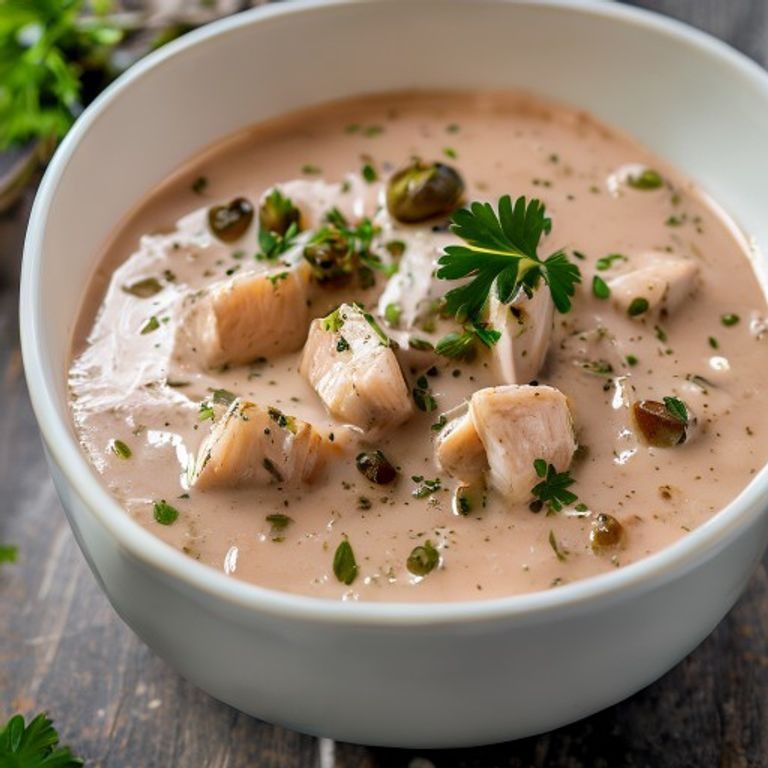
Tuna Sauce
A luscious, creamy emulsion of hard-boiled eggs, oil-packed tuna, briny capers, and anchovies — the iconic Piedmontese sauce that transforms simple cold veal into the legendary vitello tonnato, yet equally at home as a savory spread on crostini or a dip for vegetables.
| Amount | Ingredient |
|---|---|
| 2 large | eggs |
| 200 g (7 oz) | oil-packed tuna, drained |
| 5 g (1 tsp) | salt-packed capers, rinsed |
| 3 | anchovy fillets in oil |
| 150 ml (⅔ cup) | meat broth (chicken or beef), room temperature |
| Salt to taste | |
| Caper berries, for garnish (optional) |
Salsa tonnata is one of the great paradoxes of Italian cooking: a sauce made from tuna that tastes nothing like fish. Hailing from the Piedmont region of northwestern Italy, this velvety, pale-gold sauce is a staple of summer entertaining, served alongside poached or roasted veal in the classic vitello tonnato presentation. The genius lies in its construction — hard-boiled eggs provide the creamy, mayonnaise-like body without the fuss of raw-egg emulsification, while oil-packed tuna and anchovies contribute deep, savory umami that is somehow anonymous yet unmistakably savory. Capers add pops of briny brightness, and a touch of meat broth thins the sauce to a luxurious, dolloping consistency. It is a make-ahead marvel that only improves after a day in the refrigerator.
Ingredient notes: Use the best oil-packed tuna you can find — Italian tonno sott'olio in olive oil (like Rio Mare or As do Mar) is ideal. The tuna should be drained well but not squeezed dry; a little residual oil helps the emulsion come together. Salt-packed capers are preferred over brine-packed for their superior texture and flavor, but brine-packed capers (rinsed and drained) can be substituted. The anchovy fillets dissolve into the sauce and contribute essential umami — they do not make the sauce taste fishy. Use a good-quality, low-sodium meat broth (chicken is traditional, but beef broth adds deeper savor). If using store-bought broth, choose a brand with clean flavor and no MSG overload.
- Small saucepan (for eggs)
- Medium bowl (ice water bath)
- Food processor or large mortar and pestle
- Chef's knife
- Cutting board
- Measuring cups and spoons
- Rubber spatula
- Fine-mesh strainer (optional, for smoother sauce)
- Airtight container for storage
- Hard-boil the eggs (12 minutes). Place the eggs in a small saucepan and cover with cold water by at least 1 inch (2.5 cm). Bring to a rolling boil over high heat. As soon as the water reaches a full boil, cover the pot, remove from the heat, and let stand for exactly 9 minutes. Meanwhile, prepare a bowl of ice water. After 9 minutes, transfer the eggs to the ice water bath and let cool completely, about 5 minutes. Peel the eggs. Pro tip: Use eggs that are at least 5 to 7 days old — fresh eggs are harder to peel cleanly. Plunging the boiled eggs into an ice bath stops the cooking instantly and prevents the dreaded green ring around the yolk. Peel under cold running water for the cleanest results.
- Combine the base ingredients (2 minutes). In a food processor fitted with the metal blade, combine the peeled hard-boiled eggs, drained tuna, rinsed capers, and anchovy fillets. If using a mortar and pestle, roughly chop the eggs, tuna, and anchovies before adding them to the mortar — this reduces the pounding time. Pro tip: Cut the hard-boiled eggs into quarters before adding to the food processor — it helps the machine break them down more evenly. Make sure the capers are thoroughly rinsed to remove excess salt.
- Process or pound until smooth (2 to 3 minutes). Process the mixture in the food processor in short pulses, scraping down the sides of the bowl with a rubber spatula every 15 to 20 seconds, until the mixture is completely smooth and uniform in texture — no visible chunks of egg white or tuna should remain. This should take about 1 minute of total processing time. If using a mortar, pound and grind the ingredients with a circular, pressing motion, rotating the mortar, until a smooth paste forms — this takes about 3 to 5 minutes of steady work. Pro tip: Be patient with the processing. The sauce should be as smooth as possible — any remaining egg-white lumps will feel chalky in the finished sauce. If the mixture seems too dry to process smoothly, add 1 tablespoon of the broth to help it along.
- Incorporate the broth (1 minute). With the food processor running, slowly drizzle in the room-temperature meat broth through the feed tube. Process until the sauce is creamy, smooth, and has a thick, dolloping consistency — it should be spreadable but not runny, similar to a thick mayonnaise. If using a mortar, add the broth a tablespoon at a time, stirring vigorously with the pestle after each addition until fully incorporated. Pro tip: The broth must be at room temperature — cold broth will cause the sauce to seize and become stiff. The amount of broth is a guideline; add enough to reach a consistency that is creamy and spreadable but still holds its shape when spooned. Start with 120 ml (½ cup) and add more as needed.
- Season (30 seconds). Taste the sauce and add salt only if needed. The tuna, anchovies, and capers all contribute significant salt, so you may need very little or none at all. Process or stir to combine. Pro tip: Before seasoning, remember that the sauce will be served cold — chilling dulls salt perception, so the sauce should taste just slightly saltier than you want the final result to be. A few grinds of black pepper are a nice addition. Some Piedmontese cooks add a squeeze of lemon juice; try it and see if you like the brightness.
- Chill (at least 1 hour). Transfer the sauce to an airtight container. Refrigerate for at least 1 hour before serving, preferably 4 hours or overnight. During this rest, the flavors meld and deepen, and the sauce firms up to its proper serving consistency. Pro tip: This sauce improves dramatically with time. Make it a day ahead — the tuna and anchovy flavors will soften and integrate, and the sauce will be perfectly chilled and firm for slicing and serving over vitello tonnato.
- Serve (2 minutes). Remove the sauce from the refrigerator 10 to 15 minutes before serving to take off the chill (it should be cool, not refrigerator-cold). Stir well. If the sauce is too thick after chilling, stir in 1 to 2 teaspoons of room-temperature broth or water to loosen it. Garnish with caper berries if desired.
- Over thinly sliced cold poached or roasted veal (vitello tonnato) — the classic Piedmontese presentation
- As a spread on crostini or bruschetta, topped with a caper berry
- As a dip for crudités (celery, carrot sticks, bell pepper strips, fennel slices)
- Stuffed into hard-boiled egg halves as an elevated appetizer
- As a sauce for cold poached salmon or tuna
- Spread on sandwiches in place of mayonnaise — especially good with turkey, roast beef, or grilled vegetables
- Dolloped on grilled or roasted vegetables (asparagus, zucchini, bell peppers)
- As a filling for cherry tomatoes or small bell pepper boats
- Swirled into potato salad for a creamy, savory twist
- Hard-boiled eggs create a stable, foolproof emulsion. Unlike raw-egg mayonnaise, this sauce uses cooked eggs — there is no risk of broken emulsion or food-safety concerns. The cooked yolks provide intense creaminess and a natural thickening power that raw yolks cannot match.
- Use a food processor for the smoothest results. While a mortar and pestle is traditional and produces a sauce with more texture and character, a food processor makes a silky-smooth sauce in seconds. For a more rustic, artisanal texture, use the mortar.
- Room-temperature broth is essential. Cold broth will cause the emulsified fats in the egg-tuna paste to seize, resulting in a stiff, grainy sauce. Room-temperature broth (70°F to 75°F / 21°C to 24°C) incorporates smoothly and maintains the creamy texture.
- Let the sauce rest overnight. Tuna sauces made and served immediately taste flat and one-dimensional. After 4 hours in the refrigerator — and especially after 24 hours — the flavors bloom, the texture firms perfectly, and the sauce becomes something greater than the sum of its parts.
- Quality of tuna matters enormously. This sauce is only as good as the tuna you use. Cheap, dry, stringy tuna makes a disappointing sauce. Invest in good oil-packed tuna packed in olive oil — it is the single most important ingredient.
- The anchovies are not optional. They melt into the background, providing savory depth (umami) that makes the sauce taste complex and meaty. Skip them and the sauce will taste flat and one-dimensional.
- Caper berries make a beautiful, functional garnish. Their mild, briny crunch provides a perfect textural and visual contrast to the smooth, creamy sauce. You can also use regular capers, drained and patted dry.
| Mistake | Why It Hurts | The Fix |
|---|---|---|
| Overcooking the eggs | Green ring around the yolk, chalky texture that will not process smooth | Cook eggs exactly 9 minutes from boil, then plunge into ice water immediately |
| Using cold broth straight from the refrigerator | The sauce seizes and becomes stiff, grainy, and unspreadable | Bring broth to room temperature before adding — about 30 minutes on the counter |
| Not draining the tuna thoroughly | Excess oil thins the sauce and makes it greasy rather than creamy | Drain tuna well and pat lightly with paper towels if needed |
| Under-processing the sauce | Chunks of egg white or tuna create a lumpy, unpleasant texture | Process until completely smooth — scrape bowl and process again if necessary |
| Oversalting | The sauce becomes inedibly salty because tuna, anchovies, and capers all contribute salt | Taste before adding any salt; use low-sodium broth to give yourself more control |
| Using brine-packed capers without rinsing | The sauce is excessively salty and pickled-tasting | Rinse capers thoroughly in cold water and pat dry before using |
| Serving straight from the refrigerator | The sauce is too stiff and the flavors are muted and flat | Let the sauce sit at room temperature for 10 to 15 minutes before serving |
| Using water instead of broth | The sauce tastes thin and lacks savory depth | Use meat broth — chicken or beef — for the richest, most complex flavor |
- Lemon-Bright Tuna Sauce: Add 1 tablespoon of fresh lemon juice along with the broth. The acidity cuts through the richness and adds a bright, fresh note — excellent for summer vitello tonnato.
- Herb Tuna Sauce: Add 2 tablespoons of finely chopped fresh parsley and 1 tablespoon of chopped fresh tarragon or chives to the finished sauce. Stir gently to distribute.
- Spicy Tuna Sauce: Add ½ teaspoon of red pepper flakes or 1 small fresh red chili (seeds removed, minced) along with the tuna. The heat cuts the richness beautifully.
- Caper-Heavy Tuna Sauce: Increase the capers to 15 g (1 tablespoon) for a more aggressively briny, punchy sauce. This pairs well with roasted vegetables and grilled fish.
- Anchovy-Forward Tuna Sauce: Double the anchovy fillets to 6. The extra anchovy deepens the savory umami without making the sauce taste fishy — it just tastes more complex and meaty.
- Yogurt Tuna Sauce: Replace half the broth with plain full-fat Greek yogurt for a tangier, creamier sauce with a lighter texture. This version is especially good as a dip.
- Olive Oil Tuna Sauce: For a richer, fruitier sauce, add 2 tablespoons of extra-virgin olive oil to the food processor after the broth is incorporated. Pulse once or twice to emulsify.
- Vegetarian Tuna Sauce: Omit the anchovies and add 1 teaspoon of white miso paste and 1 teaspoon of soy sauce for umami. Use vegetable broth instead of meat broth.
| Storage Method | Details |
|---|---|
| Refrigerator | Store in an airtight container for up to 5 days. The sauce will thicken as it chills. |
| Best Before | Peak flavor is after 24 hours — the tuna, anchovy, and caper flavors meld and deepen beautifully. |
| Reviving | If too thick after chilling, stir in 1 to 2 teaspoons of room-temperature broth or water. If separated (unlikely but possible), whisk vigorously or re-process for 10 seconds. |
| Freezing | Not recommended — the egg-based emulsion will break and become watery upon thawing. |
| Make-Ahead | Ideal make-ahead sauce. Prepare up to 2 days in advance; the flavor only improves. |
This classic Piedmontese sauce pairs beautifully with the crisp, mineral-driven white wines of northern Italy, as well as light, chillable reds:
- Gavi di Gavi (Cortese) — The classic pairing for vitello tonnato. Crisp, citrusy, and mineral-driven, with enough acidity to cut through the creamy sauce without overwhelming the delicate tuna and veal flavors.
- Arneis (Roero) — Floral and pear-like with a fuller body that stands up to the richness of the sauce. A traditional Piedmontese match.
- Vermentino di Sardegna — Herbal and saline, with a subtle bitterness that complements the briny capers and anchovies in the sauce.
- Soave Classico (Garganega) — Clean, almond-scented, and elegant — a versatile white that works with every version of this sauce.
- Franciacorta Brut (Sparkling) — The bubbles and high acidity cleanse the palate between bites of rich sauce and tender veal. A festive, luxurious pairing.
- For a red option: A light, chilled Barbera d'Alba or Dolcetto di Dogliani — serve cool (55°F / 13°C) to contrast with the chilled sauce.
| Per Serving (about 2 tablespoons / 30 ml) | |
|---|---|
| Calories | 98 |
| Protein | 9 g |
| Fat | 6 g |
| Carbohydrates | 1 g |
| Fiber | 0 g |
| Sugar | 0.3 g |
Nutrition values are approximate and based on 2-tablespoon servings. Actual values may vary based on specific ingredients and exact measurements.
Can I make this sauce without a food processor?
Yes. A large mortar and pestle is the traditional tool for making salsa tonnata, and many Piedmontese home cooks still make it this way. Roughly chop the hard-boiled eggs, tuna, and anchovies before adding them to the mortar, then pound and grind with a circular, pressing motion until smooth. The texture will be slightly more rustic, which some people prefer. Alternatively, you can use an immersion blender in a tall jar — though the texture may be slightly airier than the traditional version.
What is vitello tonnato?
Vitello tonnato is the classic Piedmontese dish in which thinly sliced cold roasted or poached veal is napped with tuna sauce, then chilled and served as a summer main course or antipasto. The veal is typically cooked with white wine, aromatics, and vegetables, then cooled, sliced paper-thin, and arranged on a platter. The tuna sauce is spread over the top, and the dish is refrigerated for at least 4 hours (preferably overnight) before serving. It is garnished with capers, lemon wedges, and sometimes hard-boiled egg halves.
The sauce is too thick — how do I thin it?
Stir in room-temperature meat broth or water 1 teaspoon at a time until the desired consistency is reached. The sauce should be thick enough to hold its shape when spread but thin enough to coat a slice of veal in a smooth, even layer. If you accidentally thin it too much, whisk in 1 tablespoon of drained, mashed tuna to thicken it back up.
My sauce looks grainy — what went wrong?
Graininess is usually caused by one of three things: (1) the broth was too cold and caused the fats to seize, (2) the mixture was under-processed and contains visible egg-white or tuna chunks, or (3) the eggs were slightly overcooked. If the sauce is already made and grainy, try processing it for another 15 to 20 seconds with 1 teaspoon of room-temperature broth. If it remains grainy, the texture is still acceptable for spreading, though not as luxurious.
Can I use water instead of broth?
You can, but the sauce will be significantly less flavorful. The broth provides savory depth and body that water cannot replicate. If you are in a pinch, dissolve ¼ of a low-sodium bouillon cube in 150 ml of hot water and let it cool to room temperature before using.
How do I serve vitello tonnato?
Arrange thinly sliced cold roast or poached veal on a serving platter, overlapping the slices slightly. Spread the tuna sauce in a thick, even layer over the veal, leaving the edges of the meat visible. Cover with plastic wrap and refrigerate for at least 4 hours or overnight. Before serving, garnish with caper berries, lemon wedges, and fresh parsley. Serve cool (not ice-cold) as a main course with a green salad or as a generous antipasto.
Can I make this sauce with water-packed tuna?
Water-packed tuna produces a much drier, less flavorful sauce with a mealy texture. The oil in oil-packed tuna contributes body, richness, and flavor. If you must use water-packed tuna, add 2 tablespoons of extra-virgin olive oil to the food processor with the other ingredients to compensate.
- Vitello Tonnato (Classic Piedmontese Veal with Tuna Sauce)
- Classic Homemade Mayonnaise (Volume 2, Recipe #76)
- Immersion Blender Mayonnaise (Volume 2, Recipe #76)
- Tartar Sauce (Volume 2, Recipe #94)
- Classic French Vinaigrette (Volume 2, Recipe #96)
- Sicilian Pesto (Volume 2, Recipe #77)
- Anchovy Vinaigrette (Volume 2, Recipe #96 variation)
Recipe from "The Italian Kitchen" by Vita Milanese — Volume 2: Sunday Sauce
Recipe from The Italian Kitchen by Vita Milanese — Volume 2 · Sunday Sauce. Discover all volumes on the ebook page.