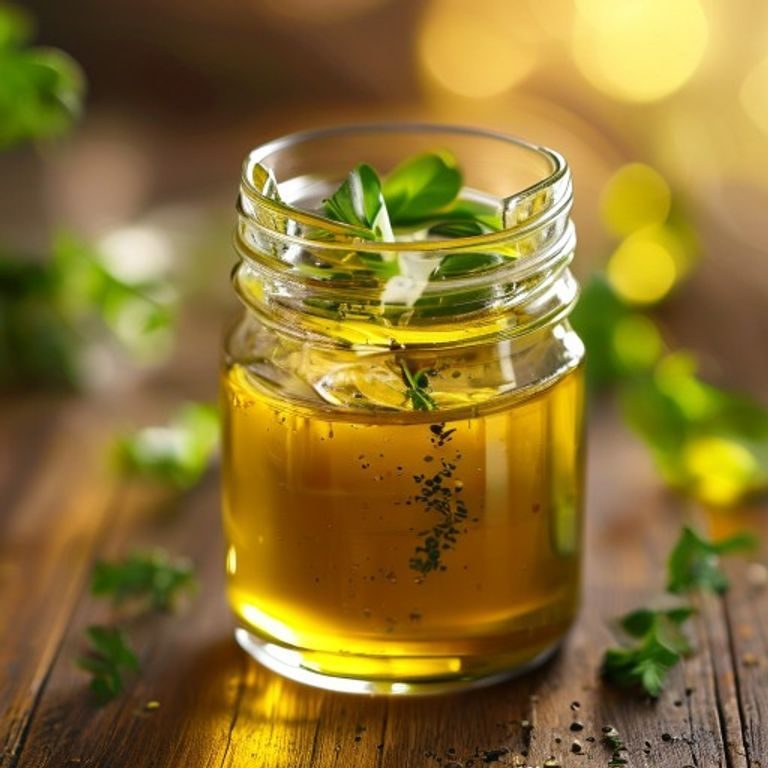
French-Style Vinaigrette Sauce
A uniquely creamy, Swiss-Italian vinaigrette that marries the tang of white wine vinegar with the richness of sunflower oil and the stabilizing power of a cornstarch-thickened broth — a shelf-stable, emulsified dressing that thinks it's a sauce, with a versatility that spans from salad bowls to cold meat platters.
| Amount | Ingredient |
|---|---|
| ½ | vegetable bouillon cube (low-sodium preferred) |
| 300 ml (1¼ cups) | water |
| 15 g (1 tbsp) | cornstarch |
| 1 large | egg (preferably pasteurized) |
| 150 ml (⅔ cup) | white wine vinegar |
| 400 ml (1⅔ cups) | sunflower oil (or other neutral oil) |
| 10 g (2 tsp) | Dijon mustard |
| 5 g (1 tsp) | kosher salt |
| 1 tsp | fresh lemon juice |
| 1 tsp | dried Provençal herbs (thyme, rosemary, oregano blend) |
This is not your standard vinaigrette. Hailing from the Italian-speaking regions of Switzerland (Ticino and Grisons), this "French-style" sauce (salsa francese) is a curious hybrid: part vinaigrette, part creamy emulsion, part thickened sauce. A base of vegetable broth thickened with cornstarch gives it body and stability — the cooked starch prevents the emulsion from separating, even after days in the refrigerator — while the egg, vinegar, and mustard provide the classic vinaigrette structure and tang. The result is a dressing that is thick enough to cling to every leaf of lettuce, creamy enough to double as a sauce for cold meats, and tangy enough to wake up any dish it touches. It is a workhorse condiment from the Swiss-Italian culinary tradition, and once you make it, you will find endless uses for it.
Ingredient notes: Use a good-quality white wine vinegar — the acidity is the backbone of this sauce. Sunflower oil is traditional for its neutral flavor, but any mild vegetable oil (canola, grapeseed, or avocado) works well. Do not use extra-virgin olive oil, which will overpower the delicate herb and vinegar notes. The egg acts as an emulsifier; using a pasteurized egg eliminates any safety concerns about raw egg in the finished sauce. The Provençal herbs can be a store-bought blend or a mix of dried thyme, rosemary, oregano, marjoram, and savory. If you only have fresh herbs, use 1 tablespoon of finely chopped fresh herbs (a mix of thyme and oregano leaves).
- Small saucepan
- Medium bowl
- Whisk
- Chef's knife
- Cutting board
- Measuring cups and spoons
- Liquid measuring cup (for drizzling oil)
- Immersion blender or stand blender (optional, for easier emulsification)
- Fine-mesh strainer (optional, for a smoother sauce)
- Airtight container or jar for storage
- Prepare the broth (3 minutes). In a small saucepan, bring the water to a simmer over medium-high heat. Crumble the vegetable bouillon cube into the water and stir until completely dissolved. Reduce the heat to low to keep the broth warm. Pro tip: Use a low-sodium bouillon cube if available — the finished sauce will also receive salt from the mustard and the seasoning step. Controlling the salt level from the start gives you more flexibility at the end.
- Thicken the broth (5 minutes). In a small bowl, whisk the cornstarch with 2 tablespoons of cold water until smooth to create a slurry. Pour the slurry into the warm broth while whisking constantly. Increase the heat to medium and bring the mixture to a gentle simmer, whisking continuously. Cook for 2 to 3 minutes, until the broth thickens to a thin, glossy, gravy-like consistency (it should coat the back of a spoon lightly). Remove from the heat and let cool completely to room temperature — this takes about 15 to 20 minutes. Stir occasionally to prevent a skin from forming. Pro tip: Do not rush the cooling. Adding a warm cornstarch mixture to the egg emulsion will cook the egg and cause the sauce to curdle. The broth must be at room temperature (below 85°F / 30°C) before proceeding. If you are short on time, place the saucepan in a bowl of ice water and stir until cooled.
- Build the emulsion base (2 minutes). In a medium bowl, whisk the egg vigorously with the white wine vinegar and Dijon mustard until the mixture is pale, frothy, and well-combined, about 30 to 45 seconds. The mustard acts as a secondary emulsifier, helping the egg bind the oil more effectively. Pro tip: Use a room-temperature egg for better emulsification. If your egg is cold from the refrigerator, place it in a bowl of warm water for 5 minutes before starting. The vinegar and egg mixture should be whisked thoroughly before any oil is added — a thorough base emulsification prevents broken sauce later.
- Emulsify the oil (4 to 5 minutes). While whisking the egg-vinegar mixture constantly and vigorously, begin drizzling the sunflower oil in a very slow, steady stream — about the thickness of a pencil lead. Whisk continuously, making sure each addition of oil is fully incorporated before adding more. As the emulsion forms (after about ¼ of the oil), the mixture will thicken noticeably and become pale and creamy. Continue whisking and drizzling until all the oil is incorporated and the mixture is thick, glossy, and mayonnaise-like. If your arm gets tired, switch to an immersion blender or stand blender on low speed for the remaining oil. Pro tip: The most common mistake is adding the oil too quickly. A slow, steady drizzle is essential — if the oil pools on the surface before it is whisked in, the emulsion will break. If the sauce becomes too thick to whisk easily, add 1 teaspoon of cold water to loosen it before continuing with the remaining oil.
- Add the cooled broth (1 minute). Once all the oil is emulsified and the sauce is thick and creamy, switch to a gentle stirring motion. Slowly drizzle the cooled cornstarch-thickened broth into the sauce while stirring gently but continuously. The broth will thin the sauce slightly and give it a silky, pourable consistency. Stir until the broth is fully incorporated and the sauce is uniform in color and texture. Pro tip: Add the broth in a slow stream, not all at once, and stir gently rather than whisking vigorously. Whisking too hard at this stage can break the delicate oil-in-water emulsion that the broth has just stabilized.
- Season (1 minute). Add the salt, fresh lemon juice, and dried Provençal herbs. Whisk gently to combine. Taste the sauce and adjust the seasoning. It should be tangy, herbaceous, and savory, with a balanced acidity that brightens without overwhelming. If it tastes flat, add a few drops more lemon juice or a pinch more salt. If it tastes too sharp, let it rest for 10 minutes — the flavors will mellow as the sauce sits. Pro tip: The dried herbs will continue to rehydrate and release their flavor as the sauce sits. If you are using fresh herbs, add them just before serving to preserve their brightness. The sauce should be slightly more acidic and salty than you think necessary — chilling dulls both acidity and saltiness.
- Chill and rest (at least 30 minutes). Transfer the sauce to an airtight container or a jar with a tight-fitting lid. Refrigerate for at least 30 minutes before using. During this rest, the cornstarch-thickened broth firms up slightly, giving the sauce its signature creamy, clinging texture, and the herb flavors meld with the vinegar and oil. Pro tip: The sauce will thicken noticeably as it chills. If it becomes too thick after refrigeration, stir in 1 to 2 teaspoons of cold water or a splash of white wine vinegar to thin it to the desired consistency.
- Serve (1 minute). Remove the sauce from the refrigerator 10 to 15 minutes before serving to take the chill off. Stir well before using. Drizzle over salads, cold meats, or roasted vegetables.
- As a classic green salad dressing (especially with frisée, arugula, or mesclun)
- Over cold roast beef, roasted chicken, or turkey slices
- As a sauce for cold asparagus, green beans, or artichokes
- Drizzled over boiled eggs or egg salad
- As a dip for crudités (raw vegetables)
- Over warm roasted potatoes or potato salad
- Alongside grilled fish or cold poached salmon
- As a dressing for grain salads (farro, quinoa, barley)
- The cornstarch-broth base is the secret to shelf stability. Traditional vinaigrettes separate within hours. This sauce's cornstarch-thickened broth creates a stable matrix that holds the emulsion together for days — the sauce stays creamy and emulsified in the refrigerator for up to a week.
- Cool the broth completely before adding. This is the single most important rule. Warm broth will cook the egg, curdling the sauce into a grainy, separated mess. Room temperature is essential.
- A slow, steady oil drizzle is non-negotiable. Rushing the oil addition is the number one cause of broken emulsions. A steady stream about the width of a toothpick, with constant whisking, is the correct pace.
- Let the sauce rest. The flavors need time to meld and the cornstarch needs time to fully hydrate and thicken. The sauce improves dramatically after 1 hour of chilling and is best after 4 hours.
- Provençal herbs are the signature. The blend of thyme, rosemary, and oregano gives this sauce its distinctive character. If you are making your own blend, toast the dried herbs in a dry skillet for 30 seconds before adding — it releases their essential oils and makes them more fragrant.
- Adjust thickness to your preference. For a thicker, creamier sauce (closer to mayonnaise), use ⅔ of the broth. For a thinner, more pourable dressing, use all the broth. The recipe default gives you a creamy, pourable sauce.
- The mustard does double duty. Dijon mustard adds both flavor (tangy, slightly spicy) and structure (the natural emulsifiers in mustard stabilize the oil-in-water emulsion). Do not skip it.
| Mistake | Why It Hurts | The Fix |
|---|---|---|
| Adding warm broth to the emulsion | Cooks the egg and curdles the sauce, creating a grainy, separated mess | Cool the thickened broth completely to room temperature before adding |
| Adding oil too quickly | The emulsion breaks — the sauce turns thin, oily, and separated | Slow down to a drop-by-drop drizzle; if already broken, start over with a fresh egg and slowly whisk the broken mixture into it |
| Using extra-virgin olive oil | The strong, peppery olive flavor overwhelms the delicate herb and vinegar notes | Use a neutral oil like sunflower, canola, or grapeseed |
| Skipping the cornstarch-broth base | The vinaigrette separates quickly and lacks the signature creamy, clingy texture | The cornstarch-broth base is what makes this sauce unique — do not skip it |
| Over-whisking after adding the broth | The emulsion breaks from excessive agitation | Stir gently after adding the broth — switch from whisking to stirring |
| Not dissolving the bouillon completely | Gritty spots of concentrated bouillon create uneven seasoning | Whisk the bouillon into the water until completely dissolved before adding cornstarch |
| Using too much vinegar | The sauce is mouth-puckeringly sour and harsh | Taste and adjust; if over-vinegared, add 1 tablespoon of neutral oil and ½ teaspoon of sugar to balance |
| Forgetting to season | The sauce tastes flat and one-note despite all the work | Season generously with salt, lemon, and herbs — this sauce can handle bold seasoning |
- Garlic & Herb Vinaigrette: Add 1 small minced garlic clove (grated on a Microplane) to the egg-vinegar base. The garlic infuses the entire sauce with a gentle savory heat.
- Shallot Vinaigrette: Add 1 finely minced shallot (about 1½ tablespoons) to the finished sauce. Let rest for 15 minutes for the shallot to mellow and release its flavor.
- Honey-Mustard Vinaigrette: Whisk 1 tablespoon of honey into the finished sauce along with the salt and herbs. The sweetness balances the acidity beautifully.
- Creamy Herb Vinaigrette: Stir in 2 tablespoons of finely chopped fresh herbs (parsley, chives, tarragon, or a mix) just before serving. Fresh herbs add brightness and color.
- Anchovy Vinaigrette: Mash 2 anchovy fillets into a paste and whisk into the egg-vinegar base before adding oil. The anchovy adds deep, savory umami without tasting fishy.
- Lemon Vinaigrette: Substitute the white wine vinegar with fresh lemon juice. The result is brighter, fruitier, and less acidic — excellent with delicate greens or fish.
- Spicy French Vinaigrette: Add ½ teaspoon of Dijon mustard extra (1½ teaspoons total) and ¼ teaspoon of cayenne pepper or Aleppo pepper flakes for a gentle, warm finish.
- Gluten-Free French Vinaigrette: Ensure the bouillon cube is certified gluten-free (many commercial bouillon cubes contain wheat starch). The cornstarch is naturally gluten-free.
| Storage Method | Details |
|---|---|
| Refrigerator | Store in an airtight container or jar for up to 7 days. The sauce will thicken as it chills and may separate slightly; a vigorous stir or shake will re-emulsify it. |
| Best Before | Peak flavor is after 4 to 24 hours — the herbs fully infuse and the cornstarch reaches its maximum thickening potential. |
| Reviving | If too thick, stir in 1 to 2 teaspoons of cold water or white wine vinegar. If separated, shake vigorously in a sealed jar or whisk to re-emulsify. |
| Freezing | Not recommended — the egg-based emulsion will break and become grainy upon thawing. |
| Make-Ahead | Ideal make-ahead condiment. Prepare up to 3 days in advance; the flavor improves with time. |
This versatile sauce pairs with the same wines you would serve with salads, cold meats, or roasted vegetables:
- Sauvignon Blanc (Loire or Friuli) — The grassy, citrusy notes mirror the vinegar and lemon in the sauce, while the acidity cuts through the oil.
- Pinot Grigio (Alto Adige) — Clean, crisp, and mineral-driven — a neutral partner that lets the herbs and vinegar shine.
- Vermentino di Sardegna — Herbal and saline, with a subtle bitterness that complements the Provençal herbs in the sauce.
- Chasselas (Switzerland) — Switzerland's signature white grape; light, floral, and elegant, with enough acidity to balance the dressing without overpowering delicate greens.
- Rosé de Provence — Dry, pale, and savory, with red fruit notes and a herbal character that harmonizes beautifully with the Provençal herb blend.
- For a red option: A light, chilled Beaujolais or a Swiss Blauburgunder (Pinot Noir) — serve cool to complement salads and cold meats.
| Per Serving (about 2 tablespoons / 30 ml) | |
|---|---|
| Calories | 112 |
| Protein | 0.3 g |
| Fat | 12 g |
| Carbohydrates | 1 g |
| Fiber | 0 g |
| Sugar | 0.2 g |
Nutrition values are approximate and based on 2-tablespoon servings. Actual values may vary based on specific ingredients and exact measurements.
Is it safe to use raw egg in this sauce?
This recipe uses a raw egg yolk as an emulsifier. For maximum safety, use pasteurized eggs, which are heat-treated to kill bacteria without cooking the egg. Pasteurized eggs are available at most supermarkets. If you cannot find them, you can pasteurize eggs at home by placing them (in their shells) in a bowl of 140°F (60°C) water for 3 minutes, then immediately transferring to cold water. Alternatively, use an immersion blender to emulsify the sauce with a pasteurized liquid egg product.
Can I make this sauce without egg?
Yes, though the texture will be different. Omit the egg and increase the cornstarch-thickened broth by 60 ml (¼ cup). The sauce will still emulsify with the mustard acting as the primary emulsifier, but it will be slightly less creamy and rich. You can also add 1 tablespoon of aquafaba (chickpea can liquid) as an egg substitute — it emulsifies beautifully.
My sauce separated in the refrigerator — is it ruined?
No, this is normal. The cornstarch-thickened broth creates a stable base, but over time the oil and water phases can separate slightly. Simply shake the jar vigorously or whisk the sauce briefly to re-emulsify. If it separates completely and won't recombine, place it in a bowl and use an immersion blender to bring it back together.
What is the difference between this sauce and a classic vinaigrette?
Classic vinaigrette is a simple mixture of oil and vinegar (usually 3:1 ratio) that is whisked together just before serving. It separates within minutes. This French-style sauce uses an egg yolk as an emulsifier (like mayonnaise), plus a cornstarch-thickened broth that stabilizes the emulsion and gives the sauce a creamy, clingy texture that simple vinaigrettes cannot achieve. It is closer to a creamy Italian dressing than a classic French vinaigrette.
Can I use this sauce hot?
This sauce is designed to be served cold or at room temperature. Heating the sauce will destabilize the egg-based emulsion and thin the cornstarch thickener, resulting in a thin, separated sauce. If you want a warm sauce, make a fresh batch without the raw egg.
The sauce is too thick — how do I thin it?
Stir in cold water, white wine vinegar, or lemon juice 1 teaspoon at a time until the desired consistency is reached. Do not use oil to thin the sauce — adding more oil will make it thicker, not thinner. The sauce should be thick enough to cling to salad leaves but pourable enough to drizzle from a spoon.
- Classic Homemade Mayonnaise (Volume 2, Recipe #76)
- Immersion Blender Mayonnaise (Volume 2, Recipe #76)
- Dijon Vinaigrette (Volume 2, Recipe #96)
- Lemon-Herb Yogurt Sauce (Volume 2)
- Classic French Salad Dressing (Volume 1)
- Tartar Sauce (Volume 2, Recipe #94)
Recipe from "The Italian Kitchen" by Vita Milanese — Volume 2: Sunday Sauce
Recipe from The Italian Kitchen by Vita Milanese — Volume 2 · Sunday Sauce. Discover all volumes on the ebook page.