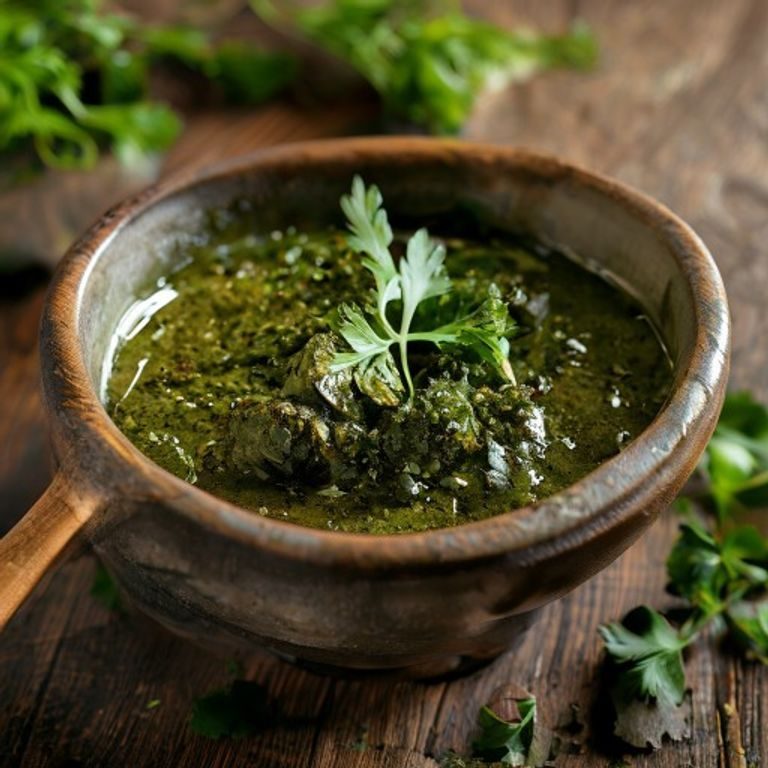
Chimichurri Sauce, Mediterranean Style
A bright, herbaceous, Mediterranean take on the classic Argentine sauce — made in a mortar like pesto, with spring onion, fresh parsley, dried oregano, cayenne, Amalfi lemon, and white balsamic vinegar for a citrusy, slightly spicy condiment that electrifies grilled meats, especially skirt steak, ribs, and the classic Italian "diaframma" cut.
| Amount | Ingredient |
|---|---|
| Capers and Anchovy | Add 1 tablespoon of rinsed capers and 2 anchovy fillets (finely chopped) to the mortar with the aromatics for a deeply savory, umami-rich chimichurri — excellent on grilled swordfish or tuna |
| Smoked Paprika | Substitute the cayenne with 1 teaspoon of smoked paprika (dulce or picante) for a warm, smoky character that pairs beautifully with grilled chicken or pork |
| Sumac and Pomegranate | Add 1 teaspoon of sumac and 1 tablespoon of pomegranate molasses (reduce the white balsamic to 2 teaspoons) for a tangy, slightly sweet Middle Eastern-inspired version |
| Herb-Forward | Add 10 g of fresh basil leaves and 10 g of fresh mint along with the parsley for a complex, multi-herb sauce |
| Roasted Garlic | Substitute the raw garlic with 4 cloves of roasted garlic (cooled and mashed) — no need to pound in the mortar, simply stir in with the lemon juice |
This is chimichurri as imagined by an Italian cook — less oil-heavy than the Argentine original, brighter and more citrus-forward, with the clean punch of white balsamic vinegar and the floral fragrance of Amalfi lemon zest and juice. Where the Argentine version relies on a trinity of fresh herbs and a food processor, this Mediterranean interpretation is built in a mortar and pestle, pounded like a pesto, yielding a coarser, more rustic texture with distinct flecks of green parsley and white scallion against the deep green of oregano and dried chili. A single clove of garlic, a spring onion in place of shallot, and a whisper of cayenne for warmth rather than full-blown heat keep the sauce balanced and approachable. The result is a condiment that is equally at home on a grilled ribeye, a plate of roasted friggitelli peppers, or spooned over a simple tomato and basil salad — versatile, vibrant, and made in under 10 minutes.
Ingredient notes: Use the freshest flat-leaf parsley you can find — limp or yellowing parsley will produce a dull, flat sauce. The spring onion (scallion) is a key difference from the Argentine version; use the white and light green parts only, as the dark green tops can be bitter. Dried oregano is traditional here — do not substitute fresh oregano, as the dried herb's concentrated, slightly earthy intensity is part of the Mediterranean character. Amalfi lemons are prized for their intense floral aroma, lower acidity, and sweeter juice; if you cannot find them, use a regular organic lemon — the zest is especially important, so avoid waxed supermarket lemons. White balsamic vinegar is milder and less sweet than traditional dark balsamic, providing gentle acidity without discoloring the sauce; if unavailable, substitute white wine vinegar or champagne vinegar. Cayenne pepper adds a subtle warmth rather than aggressive heat — adjust to your tolerance. Use a fruity, medium-intensity extra-virgin olive oil — one that is grassy and pleasant on its own, not overly bitter or harsh. A mortar and pestle is the traditional tool here, but a mini food processor works in a pinch — just pulse, do not purée.
- Mortar and pestle (preferred) or mini food processor
- Chef's knife and cutting board
- Citrus zester or Microplane
- Citrus juicer or reamer
- Measuring spoons
- Small rubber spatula
- Airtight storage jar or container
- Prepare the aromatics (3 min). Finely chop the spring onion and garlic. Using a sharp chef's knife, slice the spring onion into thin rings, then chop crosswise until fine. Mince the garlic to a fine paste with a pinch of salt, using the flat of your knife blade to smear it against the cutting board. Finely chop the parsley leaves — do not include the stems, which can be tough and bitter.
- Build the base in the mortar (2 min). Add the chopped spring onion, garlic, and a generous pinch of salt to the mortar. Grind and pound with the pestle in a circular motion until the mixture forms a coarse, aromatic paste — about 30 seconds of steady work. The salt acts as an abrasive, helping break down the fibers and release the aromatics' essential oils.
- Add the parsley and herbs (2 min). Add the chopped parsley, dried oregano, and cayenne pepper to the mortar. Continue pounding and grinding in a circular motion, folding the mixture with the pestle occasionally, until the parsley is broken down into small, visible flecks and the herbs are evenly distributed — about 1 minute. The sauce should be a coarse, textured paste, not a smooth purée. The mortar-and-pestle method is what gives this chimichurri its distinctive rustic texture — do not rush this step. The rhythmic grinding releases essential oils that no food processor can replicate.
- Add the lemon and vinegar (1 min). Add the lemon zest, lemon juice, and white balsamic vinegar to the mortar. Stir vigorously with the pestle to combine. The mixture will loosen and become more sauce-like as the liquids are incorporated. Taste at this point — it should be bright, herbal, and gently spicy.
- Emulsify with olive oil (2 min). Slowly drizzle in the extra-virgin olive oil while stirring constantly with the pestle in a circular motion, as if making a pesto. Continue stirring until the oil is fully incorporated and the sauce is glossy, emulsified, and spoonable — about 1 minute of steady stirring. Drizzling the oil slowly while stirring is essential for a stable emulsion. If you pour it all at once, the oil will float on top rather than binding with the herbs and acids.
- Season and rest (optional, 10 min). Add the remaining salt, stir once more, and taste. Adjust salt or lemon juice as needed. For the best flavor, let the chimichurri rest at room temperature for 10 minutes before serving — this brief rest allows the dried oregano to rehydrate and bloom, and the lemon zest to infuse the oil. Serve immediately or store for later use.
- Serving Suggestions. Serve over grilled skirt steak, bavetta, or the classic Italian "diaframma" cut (beef diaphragm, similar to outside skirt). Spoon over grilled ribs, pork chops, or lamb chops. Drizzle over roasted or grilled friggitelli peppers. Use as a finishing sauce for grilled chicken or fish. Spoon over a simple tomato and basil salad. Serve alongside crusty bread as a dipping sauce. Dollop onto grilled vegetables (zucchini, eggplant, bell peppers). Stir into plain yogurt for a quick creamy sauce.
- Use a mortar and pestle — it makes a real difference. The rhythmic grinding action releases essential oils from the herbs and aromatics differently than a food processor blade, producing a more aromatic, textured sauce. This is the defining technique of the Mediterranean version.
- Amalfi lemons are worth seeking out. Their floral, less acidic character is perfect for this sauce. If using regular lemons, reduce the juice slightly (about 2 teaspoons instead of 1 tablespoon) to avoid overwhelming the other flavors.
- Do not skip the dried oregano. It is the signature herb of the Mediterranean version, providing an earthy, slightly floral depth that fresh oregano cannot replicate. Crumble it between your palms before adding to release its oils.
- Go easy on the cayenne. The goal is a gentle warmth in the background, not spicy heat. Start with ¼ teaspoon and add more to taste — you can always increase, but you cannot take it out.
- Let it rest before serving. The 10-minute rest at room temperature is the single easiest thing you can do to improve this sauce. The dried oregano needs time to rehydrate, and the lemon zest needs time to perfume the oil.
- Adjust the texture to your liking. This is a rustic, coarse sauce by design — you want visible flecks of parsley and spring onion. If it seems too thick, add another teaspoon of olive oil or lemon juice. If too thin, add a bit more chopped parsley and pound it in.
- Make extra — you will use it all. This sauce disappears fast. Double the recipe if serving a crowd.
| Mistake | Why It Hurts | The Fix |
|---|---|---|
| Using a food processor on high speed | Creates a smooth, pasty purée that loses the rustic, textured character of the Mediterranean version | Use a mortar and pestle, or if using a food processor, pulse only 5-6 times in short bursts |
| Skipping the spring onion | Shallot or regular onion changes the flavor profile entirely — spring onion (scallion) provides a milder, fresher allium note | Use only the white and light green parts of a fresh spring onion |
| Using fresh oregano instead of dried | Fresh oregano is too mild and grassy — it cannot provide the concentrated, earthy depth that defines this sauce | Always use dried oregano, crumbled between your palms |
| Forgetting the lemon zest | The zest carries the essential oils and floral aroma of the Amalfi lemon — without it, the sauce lacks its signature brightness | Always zest the lemon before juicing it; use a Microplane for the finest zest |
| Using dark balsamic vinegar | Dark balsamic is too sweet and syrupy — it will discolor the sauce and overwhelm the delicate herbs | Use white balsamic vinegar, or substitute white wine vinegar or champagne vinegar |
| Adding all the oil at once | The oil separates from the herb paste, resulting in a greasy, broken sauce | Drizzle the oil in slowly while stirring the mortar — this builds a stable emulsion |
| Not resting the sauce | The dried oregano has no time to rehydrate, and the flavors remain flat and separate | Always let the finished sauce rest for at least 10 minutes at room temperature |
| Variation | How To |
|---|---|
| Spicy Mediterranean | Add ½ fresh red chili (bird's eye or serrano), finely chopped, along with the spring onion and garlic in the mortar — the fresh chili adds a fruity, floral heat that the dried cayenne cannot provide |
| Storage Method | Details |
|---|---|
| Refrigerator | Store in an airtight container or jar for up to 5 days. The olive oil will solidify and the herbs may darken slightly — this is normal. Bring to room temperature for 15 minutes and stir well before serving. The flavor peaks after 24 hours. |
| Freezer | Freeze in an ice cube tray (about 1 tablespoon per cube) for up to 1 month. Transfer frozen cubes to a zip-top freezer bag. Thaw individual cubes at room temperature (about 10 minutes) and stir well before using. |
| Shelf life | Best within 3 days for maximum freshness. The parsley will begin to lose its bright green color after 3-4 days in the refrigerator — this is cosmetic. Discard if the sauce develops off-odors, mold, or if the herbs turn brown and slimy. |
This bright, citrusy, herbaceous sauce calls for wines that can match its acidity and herbal intensity without overpowering its delicate Mediterranean character.
- Vermentino (Sardinia or Tuscany) — The perfect white pairing. Saline, herbal, and crisp, with a subtle bitterness that echoes the lemon zest and oregano.
- Fiano di Avellino (Campania) — Floral, honeyed, and medium-bodied, with enough structure to stand up to the garlic and cayenne while complementing the Amalfi lemon's floral notes.
- Pecorino (Abruzzo or Marche) — Bright acidity, green apple, and herbaceous notes that mirror the parsley and oregano. Excellent with chimichurri-dressed grilled fish or chicken.
- Etna Rosso (Sicily, Nerello Mascalese) — A light, mineral-driven red with red fruit, herbal notes, and gentle tannins — light enough not to overwhelm the sauce, structured enough for grilled skirt steak.
- Rosé di Cirò (Calabria) — A dry, savory rosé with herbal and saline notes that bridge the gap between the sauce's Mediterranean character and grilled meats.
- For beer drinkers: A crisp Italian lager (Peroni, Moretti), a Belgian witbier, or a Greek Mythos — all light, refreshing, and clean enough to let the chimichurri shine.
| Per Serving (about 1½ tablespoons / 25 ml) | |
|---|---|
| Calories | 90 |
| Protein | 0.5 g |
| Fat | 9 g |
| Carbohydrates | 2 g |
| Fiber | 0.5 g |
Nutrition values are approximate and based on a 1½-tablespoon serving (4 servings per batch). Actual values will vary based on olive oil brand and exact measurements. The majority of calories come from the extra-virgin olive oil.
What makes this "Mediterranean" chimichurri different from the Argentine original?
The core philosophy changes: the Argentine version is heavy on fresh herbs and red wine vinegar, made in a food processor. The Mediterranean version uses a mortar and pestle like pesto, substitutes spring onion for shallot, uses dried oregano and cayenne instead of cumin and coriander, and replaces red wine vinegar with white balsamic and Amalfi lemon for a brighter, more citrus-forward profile. The texture is coarser and more rustic — pounded, not puréed.
Can I make this without a mortar and pestle?
Absolutely. Use a mini food processor and pulse in short bursts (5-6 one-second pulses) until the mixture is finely chopped but not puréed — you want visible flecks of parsley and spring onion. Alternatively, chop everything by hand with a sharp chef's knife for the most rustic texture. The maceration step (grinding the aromatics with salt) is less effective without a mortar, so let the chopped aromatics sit in the lemon juice and vinegar for 5 minutes before adding the oil to soften their bite.
What is "diaframma" and where do I find it?
Diaframma (beef diaphragm or outside skirt) is a long, flat cut from the cow's diaphragm muscle — similar to skirt steak but often more tender and flavorful. It is highly prized in Italian grilling for its loose grain, which soaks up marinades and sauces beautifully. Ask your butcher for "outside skirt" or "bavetta" (the Italian name). In a pinch, skirt steak, flank steak, or flat iron steak are excellent substitutes.
How long does this chimichurri last in the refrigerator?
Up to 5 days in an airtight container. The fresh parsley will darken slightly after 2-3 days — this is cosmetic and does not affect the flavor. If the sauce develops off-odors or the herbs turn brown and slimy, discard it. The flavor actually improves after 24 hours as the dried oregano rehydrates and the lemon zest infuses the oil.
Can I use this sauce as a marinade?
Yes — it makes an excellent marinade for any grilled meat, especially skirt steak, chicken thighs, or lamb chops. Marinate for 30 minutes to 2 hours at room temperature (not longer, as the acid from the lemon juice and vinegar can begin to "cook" the exterior of the meat). Reserve some fresh chimichurri to serve as a finishing sauce alongside the grilled meat.
What are friggitelli peppers and how do I prepare them?
Friggitelli (also called Italian frying peppers or sweet Italian peppers) are long, thin, pale green peppers with a mild, sweet flavor and thin skin. They are traditionally sautéed or grilled whole in olive oil until blistered and tender, then seasoned with salt. To prepare: heat 2 tablespoons of olive oil in a skillet over high heat, add 200 g of whole friggitelli, and cook for 5-7 minutes, turning occasionally, until blistered and softened. Season with flaky salt and serve alongside the chimichurri-dressed meat.
- Tomato Salad with Sambal Sauce (Volume 2)
- Classic Argentine Grilled Steak (Volume 3)
- Grilled Chicken Thighs with Lemon & Oregano (Volume 2)
- Roasted Friggitelli Peppers with Garlic & Herbs (Volume 2)
- Herb Marinated Grilled Pork Chops (Volume 2)
- Classic French Carrot Sauce (Volume 2)
Recipe from "The Italian Kitchen" by Vita Milanese — Volume 2: Sunday Sauce
Recipe from The Italian Kitchen by Vita Milanese — Volume 2 · Sunday Sauce. Discover all volumes on the ebook page.