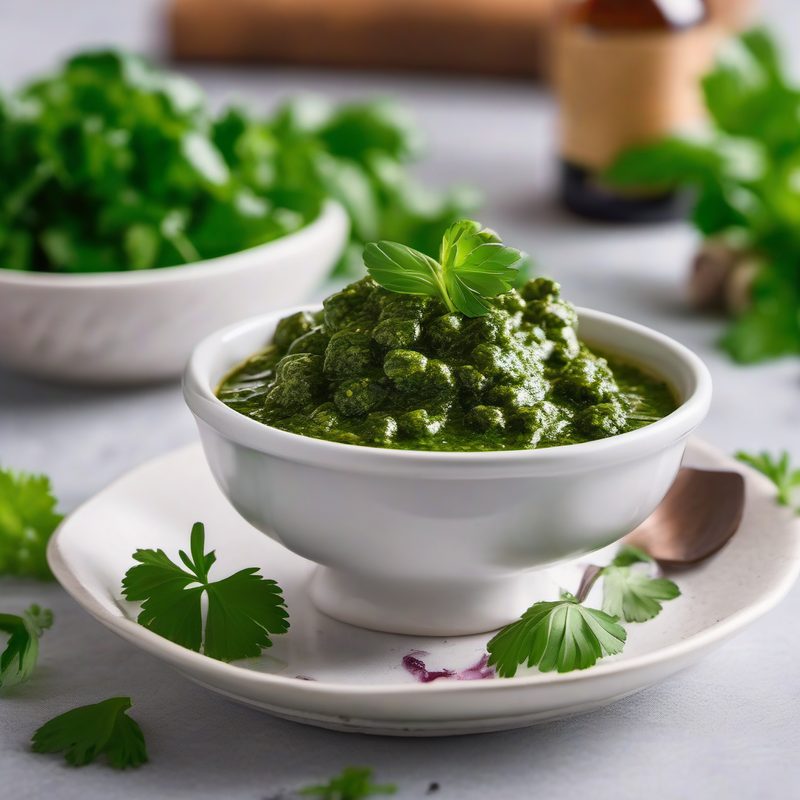
Chimichurri Sauce
A bright, herbaceous, garlicky Argentine chimichurri that brings the steakhouse experience home in under 10 minutes — fresh parsley, basil, and cilantro are blitzed with shallot, garlic, red wine vinegar, and olive oil into a vibrant, spoonable sauce that transforms grilled meats, roasted vegetables, and even simple bread into something extraordinary.
| Amount | Ingredient |
|---|---|
| 3 cloves | garlic, roughly chopped |
| 1 medium (about 40 g) | shallot, roughly chopped |
| 1 tbsp (15 ml) | red wine vinegar |
| 1 tbsp (15 ml) | freshly squeezed lemon juice |
| ½ cup (30 g) | packed fresh parsley leaves (curly or flat-leaf) |
| ½ cup (25 g) | packed fresh basil leaves |
| ¼ cup (15 g) | packed fresh cilantro leaves |
| ¼ cup (60 ml) | extra-virgin olive oil |
| ½ tsp (1 g) | ground coriander |
| ½ tsp (1 g) | ground cumin |
| ½ tsp (3 g) | kosher salt |
Chimichurri is to Argentine grilling what ketchup is to American fries — the indispensable, irreplaceable companion that elevates every bite. This version leans into a trinity of fresh herbs (parsley for earthiness, basil for sweetness, cilantro for brightness), balanced by the gentle pungency of shallot and garlic macerated in red wine vinegar and lemon juice. The result is a chimichurri that is more complex and more elegant than the traditional single-herb version, yet still unmistakably Argentine in its bold, acidic, herb-forward character. A touch of ground coriander and cumin adds warmth and depth without overpowering the fresh herbs, while extra-virgin olive oil ties everything together in a loose, emulsified sauce that coats every surface it touches. Use it as a marinade for skirt steak, a finishing sauce for grilled chicken or fish, a drizzle over roasted vegetables, or simply as a bread dip — it is one of the most versatile sauces in the kitchen.
Ingredient notes: Use the freshest herbs you can find — limp or yellowing herbs will produce a dull, flat sauce. Flat-leaf (Italian) parsley is preferred for its clean, peppery flavor, but curly parsley works in a pinch. Do not substitute dried herbs; chimichurri's soul is in its fresh, vibrant herbaceousness. A good-quality extra-virgin olive oil makes a real difference here — choose one that is fruity and grassy rather than bitter or overly peppery. Ground coriander and cumin should be fresh (no more than 6 months old) for the best aromatic intensity.
- Food processor (mini or full-size)
- Chef's knife and cutting board
- Small bowl
- Measuring cups and spoons
- Rubber spatula
- Citrus juicer or reamer
- Airtight storage container or jar
- Macerate the aromatics (10 min). In a small bowl, combine the chopped garlic, chopped shallot, red wine vinegar, and lemon juice. Stir to coat. Let sit for 10 minutes at room temperature. This brief maceration softens the harsh bite of the raw garlic and shallot, mellowing them into a sweet, gentle pungency that will not overwhelm the herbs.
- Blend the herbs and aromatics (2 min). Transfer the garlic-shallot-vinegar mixture to a food processor. Add the packed parsley leaves, basil leaves, and cilantro leaves. Pulse 8 to 10 times (1-second pulses) until the herbs are finely chopped but not puréed — you want visible flecks of herbs, not a smooth paste. Stop and scrape down the sides of the bowl with a rubber spatula halfway through.
- Emulsify with olive oil (1 min). With the food processor motor running, slowly drizzle in the extra-virgin olive oil through the feed tube in a thin, steady stream. This should take about 1 minute. The sauce will thicken and emulsify as the oil is incorporated, becoming glossy and cohesive.
- Season and finish (1 min). Stop the processor. Add the ground coriander, ground cumin, and kosher salt. Pulse 2 or 3 more times just to combine. Do not over-process — the sauce should retain some texture.
- Rest before serving (optional, 15 min+). Transfer the chimichurri to a bowl or jar. For the best flavor, let it rest at room temperature for 15 to 30 minutes before serving, allowing the herbs to absorb the vinegar and oil and the spices to bloom. The sauce is excellent immediately but truly magical after a short rest.
- Serving Suggestions. Serve as a finishing sauce over grilled steak (skirt, flank, ribeye, or sirloin), grilled chicken thighs or breasts, grilled fish (salmon, swordfish, halibut), or roasted lamb chops. Drizzle over roasted vegetables (zucchini, bell peppers, eggplant, potatoes). Use as a marinade for any of the above proteins — marinate for 30 minutes to 2 hours before grilling. Spoon over grilled bread or crusty baguette slices for an instant appetizer. Stir into cooked grains (quinoa, farro, rice) for an herbaceous grain bowl. Dollop onto tacos, burrito bowls, or tostadas.
- Maceration is not optional. The 10-minute soak of garlic and shallot in vinegar and lemon juice is the single most important step — it transforms their raw, aggressive bite into a sweet, mellow pungency. Skipping this step results in a harsh, garlic-bomb chimichurri.
- Pulse, do not purée. Chimichurri should be a textured, spoonable sauce with visible herb flecks, not a smooth purée. Over-processing creates a pasty, muddy-looking sauce that lacks the bright, clean flavor of a properly made chimichurri.
- Let it rest. The sauce improves exponentially with even 15 minutes of rest. The herbs release their essential oils, the vinegar mellows, and the spices bloom. Make it at least 15 minutes before you plan to serve.
- Use the best olive oil you have. Chimichurri is an oil-forward sauce — the olive oil is a primary flavor, not just a medium. A fruity, grassy, medium-intensity extra-virgin olive oil will make the sauce sing. Avoid cheap, bitter, or overly peppery oils.
- Adjust the acid to taste. Chimichurri should be bright and tangy but not mouth-puckering. If the sauce tastes harsh after resting, add a teaspoon more olive oil to balance. If it tastes flat, add a teaspoon more red wine vinegar or lemon juice.
- Fresh herbs only. Dried herbs will never rehydrate into the vibrant, grassy sauce that defines chimichurri. This is a fresh-herb sauce, period.
- Make it ahead. The flavor of chimichurri deepens and improves over 24 hours in the refrigerator. Bring it to room temperature (about 20 minutes) and stir well before serving, as the olive oil will solidify when cold.
| Mistake | Why It Hurts | The Fix |
|---|---|---|
| Skipping the maceration step | Raw garlic and shallot dominate the sauce with harsh, bitter heat | Always let garlic and shallot sit in vinegar/lemon juice for 10 minutes before blending |
| Over-processing the herbs | Creates a pasty, muddy-green sauce that lacks texture and brightness | Pulse just 8-10 times — you want visible herb flecks, not a purée |
| Using dried herbs | The sauce will be dusty, flat, and entirely lacking the freshness that defines chimichurri | Use only fresh parsley, basil, and cilantro — this sauce is defined by its fresh green character |
| Adding olive oil too quickly or all at once | The oil stays separate from the herbs rather than emulsifying, resulting in a greasy, separated sauce | Drizzle the oil in a thin, steady stream with the motor running — this takes about 1 minute |
| Using low-quality olive oil | The sauce tastes greasy, bitter, or flat — the oil is a primary flavor component | Use a fruity, grassy, medium-intensity extra-virgin olive oil |
| Not seasoning enough | The chimichurri tastes flat and one-dimensional — salt and spices are essential to balance the acid and herbs | Start with ½ tsp salt, taste after resting, and adjust. The salt is crucial for balance |
| Serving it ice-cold straight from the fridge | The olive oil solidifies and the flavors become muted and dull | Always bring chimichurri to room temperature (about 20 minutes) and stir well before serving |
- Spicy Chimichurri: Add 1 small red Fresno or serrano chile (seeded and roughly chopped) to the food processor along with the herbs for a bright, clean heat.
- Smoky Chimichurri: Substitute 1 teaspoon of smoked paprika for the ground coriander and cumin for a deep, smoky, barbecue-tinged version that pairs beautifully with grilled chicken or pork.
- Mint Chimichurri: Replace the cilantro with an equal amount of fresh mint leaves for a cooler, brighter version that is spectacular with lamb.
- Nutty Chimichurri: Toast 2 tablespoons of pine nuts or slivered almonds and add them to the food processor during the pulsing phase for a richer, more textured sauce.
- Creamy Chimichurri: Stir in 2 tablespoons of Greek yogurt or sour cream just before serving for a creamy, tangy variation that doubles as a dip.
- Cilantro-Lime Chimichurri: Omit the basil, double the cilantro, and replace the lemon juice with an equal amount of fresh lime juice for a zesty, south-of-the-border version.
- Roasted Garlic Chimichurri: Substitute the raw garlic with 6 cloves of roasted garlic (cooled and mashed) for a sweeter, mellower, almost buttery garlic flavor. Do not macerate the roasted garlic — just add it directly to the food processor.
| Storage Method | Details |
|---|---|
| Refrigerator | Store in an airtight container or jar for up to 1 week. The olive oil will solidify and the herbs will darken slightly — this is normal. Bring to room temperature and stir well before serving. The flavor deepens over the first 24 hours. |
| Freezer | Freeze in an ice cube tray for up to 1 month. Once frozen, transfer the cubes to a zip-top freezer bag. Thaw individual cubes as needed at room temperature (about 15 minutes) or in the refrigerator overnight. Stir well before using — some separation is normal. |
| Shelf life | The fresh herbs will begin to lose their vibrancy after 5-7 days in the refrigerator. If the sauce develops off-smells or the herbs turn dark brown or slimy, discard and make a fresh batch. |
This bright, herbaceous sauce pairs naturally with grilled meats and vegetables, but here are specific wine recommendations:
- Malbec (Argentina) — The classic pairing. The bold, dark fruit and smoky tannins of Argentine Malbec are a perfect match for chimichurri's herbal, acidic character. Serve with grilled steak.
- Bonarda (Argentina) — A lighter, fruitier red with soft tannins that won't compete with the herbs. Excellent with chimichurri-dressed chicken or pork.
- Sauvignon Blanc (Loire Valley or Chile) — The grassy, herbaceous notes in the wine mirror the parsley and cilantro in the sauce, while the high acidity cuts through the olive oil.
- Vermentino (Sardinia) — A bright, saline white that stands up to the garlic and vinegar. Particularly good with chimichurri-topped fish or seafood.
- Rosé (Provence or Patagonia) — A dry, herbaceous rosé bridges the gap between red and white, making it a versatile choice when chimichurri is served with a mixed grill.
| Per Serving (about 2 tablespoons / 30 ml) | |
|---|---|
| Calories | 110 |
| Protein | 0.5 g |
| Fat | 10 g |
| Carbohydrates | 3 g |
| Fiber | 1 g |
Nutrition values are approximate and based on a 2-tablespoon serving. Actual values will vary based on olive oil brand, herb density, and exact measurements. The majority of calories come from the extra-virgin olive oil.
Can I make chimichurri without a food processor?
Absolutely — finely mince the garlic, shallot, and herbs by hand with a sharp chef's knife, then whisk in the vinegar, lemon juice, olive oil, and spices. The texture will be slightly chunkier and more rustic, which many prefer. The maceration step is the same either way.
How long does chimichurri last in the refrigerator?
Up to 1 week in an airtight container. The fresh herbs will lose some of their bright green color and become darker — this is cosmetic and does not affect the flavor. If the sauce develops off-odors, mold, or slimy texture, discard it.
Can I freeze chimichurri?
Yes — chimichurri freezes surprisingly well. Freeze in an ice cube tray (about 2 tablespoons per cube), then transfer the cubes to a freezer bag. Thaw individual cubes as needed. The texture will be slightly less vibrant than fresh, but the flavor is still excellent.
What is the best cut of steak for chimichurri?
Skirt steak is the classic Argentine choice — its loose grain soaks up the chimichurri beautifully, and its beefy flavor stands up to the bold herbs and vinegar. Flank steak, hanger steak, and ribeye are also excellent choices.
Can I use this chimichurri as a marinade?
Yes — it makes a fantastic marinade for any grilled meat. Marinate for 30 minutes to 2 hours at room temperature (not longer, as the acid can begin to "cook" the exterior of the meat, making it mushy). Reserve some fresh chimichurri to serve as a finishing sauce alongside the grilled meat.
- Classic Argentine Grilled Steak (Volume 3)
- Grilled Chicken Thighs with Lemon & Oregano (Volume 2)
- Roasted Vegetables with Chimichurri (Volume 2)
- Grilled Swordfish with Salsa Verde (Volume 1)
- Herb Marinated Grilled Pork Chops (Volume 2)
Recipe from "The Italian Kitchen" by Vita Milanese — Volume 2: Sunday Sauce
Recipe from The Italian Kitchen by Vita Milanese — Volume 2 · Sunday Sauce. Discover all volumes on the ebook page.