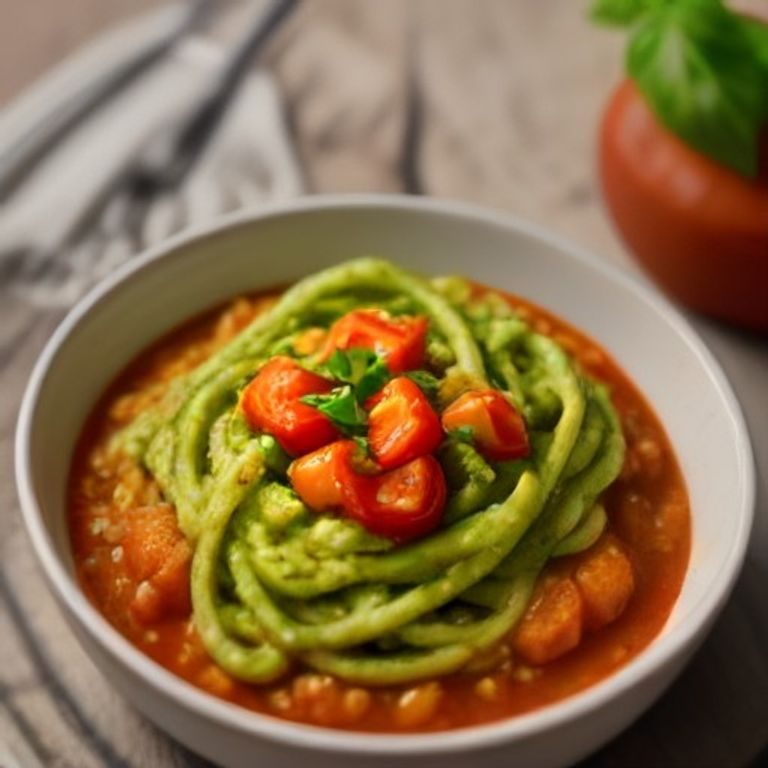
Pesto Calabrese (Pesto calabrese)
Forget everything you know about green basil pesto — this is Calabria's answer to the sauce jar, a slow-simmered, sunbaked blend of sweet Tropea onions, Roma tomatoes, roasted red peppers, and creamy ricotta, punched up with pecorino and chili, ready to transform any pasta, grilled meat, or crusty bread into a southern Italian feast.
| Amount | Ingredient |
|---|---|
| 4 (about 500 g / 1 lb) | Roma tomatoes (pomodori ramati), ripe |
| 1 large (about 200 g / 7 oz) | red bell pepper |
| 1 medium (about 150 g / 5 oz) | Tropea onion (or other sweet red onion) |
| 250 g (1 cup) | fresh sheep's-milk ricotta |
| 100 g (1 cup) | Pecorino Romano, finely grated |
| 4 tbsp (60 ml) | extra-virgin olive oil |
| 1 pinch (about ¼ tsp) | red pepper flakes or Calabrian peperoncino, or to taste |
| 1 tsp | dried oregano (preferably Calabrian or Sicilian), added just before serving |
| to taste | salt |
| to taste | freshly ground black pepper |
This is the pesto of the Mezzogiorno — no mortar and pestle required, no fresh basil leaves, no expensive pine nuts. In Calabria, where the sun is relentless and the peppers grow sweet and the chili peppers grow fierce, pesto means something altogether different from the green Genovese standard. Here, the sauce starts with a soffritto of Tropea onions — those prized, deep-purple sweet onions grown on the volcanic soils of Calabria's Tyrrhenian coast — cooked down with ripe Roma tomatoes and red bell peppers until the vegetables surrender into a thick, fragrant cream. A pass through a food mill or a quick buzz with an immersion blender transforms the cooked vegetables into a velvety base. Then comes the enrichment: fresh sheep's-milk ricotta stirred in for body and lushness, sharp pecorino for salt and bite, and a pinch of peperoncino for the signature Calabrian heat. Fresh oregano, added only at the last moment, provides a floral, herbaceous finish. The result is a sauce that is simultaneously rustic and refined — deeply savory, faintly sweet, creamy without being heavy, and carrying just enough heat to remind you where it comes from. Toss it with pasta (preferably something short and twisted like cavatappi or gemelli, which trap the chunky-creamy sauce in every crevice), spoon it over grilled swordfish or chicken, or simply eat it with a hunk of bread and a glass of red wine. This is Calabria in a bowl.
Ingredient notes: Tropea onions (cipolla di Tropea) are the heart of this sauce — they are sweeter and milder than standard red onions, with a distinct purple color and a delicate, almost floral sweetness. If you cannot find them, use the sweetest red onion available or a Vidalia onion. Roma tomatoes (pomodori ramati) are preferred for their meaty, low-moisture flesh; plum or San Marzano tomatoes work beautifully as substitutes. The ricotta should be fresh, high-quality sheep's-milk ricotta — look for it at Italian grocers or specialty markets. Cow's-milk ricotta works in a pinch but will produce a thinner, less tangy sauce. Pecorino Romano is the canonical choice here — its sharp, salty bite stands up to the sweet vegetables and creamy ricotta. Do not substitute Parmigiano-Reggiano; the flavor profile is wrong for this application. The peperoncino (Calabrian chili) is non-negotiable for authenticity — use dried Calabrian chili flakes if available, or standard red pepper flakes. Dried oregano should be added at the very end, just before serving; adding it during cooking will make it bitter. Fresh oregano can be substituted but use 1 tablespoon of fresh leaves, finely chopped.
- Large chef's knife and cutting board
- Large skillet or wide saucepan (at least 30 cm / 12-inch diameter)
- Food mill (passaverdure) or immersion blender
- Mixing bowl
- Wooden spoon or silicone spatula
- Measuring cups and spoons
- Fine-mesh sieve (optional, for silky ricotta)
- Citrus juicer (optional, if using fresh oregano)
- Prepare the vegetables (10 min). Wash all vegetables. Peel the onion and slice it into thin half-rings. Core the red bell pepper, remove seeds and white pith, and cut it into rough 2 cm (¾ inch) chunks. Core the Roma tomatoes and cut them into rough quarters — no need to peel or seed them; the food mill will handle that.
- Cook the soffritto (5 min). In a large skillet or wide saucepan, heat the extra-virgin olive oil over medium heat. Add the sliced onion and cook, stirring occasionally, until softened and translucent but not browned — about 4 to 5 minutes. The Tropea onion should release its sweetness without taking on color.
- Cook the vegetables (20 min). Add the chopped red bell pepper and tomatoes to the pan. Season with a generous pinch of salt and a few grinds of black pepper. Increase the heat to medium-high, bring to a gentle simmer, then reduce the heat to medium-low. Cook, stirring occasionally, until all the vegetables are completely soft and the tomatoes have broken down into a thick, jammy consistency — about 20 minutes. The oil should separate slightly from the vegetables toward the end of cooking.
- Purée the vegetables (5 min). Remove the skillet from the heat. Pass the cooked vegetables through a food mill (passaverdure) fitted with the medium disk, catching the purée in a mixing bowl. The food mill will separate the tomato skins and pepper fibers, leaving a perfectly smooth, silky cream. Alternatively, use an immersion blender directly in the skillet and blitz until completely smooth — this is faster but will include the skins (still delicious, just slightly less refined in texture).
- Incorporate the ricotta and cheese (3 min). While the vegetable purée is still warm, add the fresh ricotta. For the silkiest result, pass the ricotta through a fine-mesh sieve before adding it; otherwise, simply spoon it in and stir vigorously. Add the grated Pecorino Romano and the pinch of peperoncino. Stir until the ricotta and cheese are fully incorporated and the sauce is homogeneous. Taste and adjust salt and pepper. The sauce should be thick, creamy, and deeply savory with a gentle, building heat.
- Finish with oregano (1 min). This step is critical and must be done only at the moment of serving: stir in the dried oregano. Adding oregano too early will cause it to become bitter and lose its aromatic punch. Once the oregano is stirred in, the sauce is ready.
- Serve immediately (1 min). Toss the hot pesto with freshly cooked pasta (reserving about ½ cup / 120 ml of pasta water to loosen the sauce if needed), or spoon it over grilled meats, fish, or roasted vegetables. The sauce can also be served at room temperature as a spread or dip.
- Use the best ricotta you can find. This is a ricotta-forward sauce, and the quality of the ricotta is what determines whether the final result is lush and velvety or thin and grainy. Fresh ricotta from an Italian deli or specialty market is ideal — it should be moist, creamy, and slightly sweet, with a visible fine curd. Grocery-store ricotta is often too dry or too wet; if that is all you can find, drain it in a fine-mesh sieve set over a bowl for 30 minutes before using.
- Do not rush the vegetable cooking time. The 20-minute simmer is essential for the vegetables to fully soften and concentrate their flavors. If the vegetables are not completely tender before puréeing, the sauce will have a watery, raw-vegetable taste rather than the deep, sweet, concentrated flavor of properly cooked soffritto.
- A food mill produces the best texture. While an immersion blender is faster, a food mill (passaverdure) removes the tomato skins and pepper fibers, resulting in a silky, refined sauce. If you do not have a food mill and are using an immersion blender, consider peeling the tomatoes (score an X on the bottom, blanch in boiling water for 30 seconds, then transfer to ice water) before chopping — this removes the skins that would otherwise remain as unpleasant chewy bits in the final sauce.
- Taste and adjust the peperoncino. The heat level of Calabrian chili varies significantly by brand and batch. Start with ¼ teaspoon of red pepper flakes and work upward. The heat should be present and noticeable — a warm, fruity tingle on the tongue — but should not overwhelm the sweetness of the vegetables and the creaminess of the ricotta.
- Oregano goes in at the very end. This is the most common mistake. Dried oregano is fragile — its volatile oils dissipate and turn bitter when exposed to prolonged heat. Stir it in just before tossing with pasta or spooning over your dish, and you will taste the difference immediately: bright, floral, almost minty, rather than dusty and bitter.
- Reserve pasta water. If serving with pasta, always reserve about ½ cup (120 ml) of the starchy pasta cooking water before draining. Stir it into the sauce to loosen it to a silky, coating consistency — it helps the sauce cling to the pasta and binds everything together.
| Mistake | Why It Hurts | The Fix |
|---|---|---|
| Using standard red onions instead of Tropea | Standard red onions are sharper and more sulfurous — they will dominate the sauce's sweetness | Seek out Tropea onions at Italian grocers; substitute Vidalia or Walla Walla sweet onions, or soak sliced red onion in ice water for 15 minutes to mellow the bite |
| Adding oregano too early | Dried oregano becomes bitter and astringent when cooked for more than a minute or two | Stir in the dried oregano only at the very end, just before serving — or sprinkle it fresh on top of each plate |
| Using old or low-quality ricotta | Grainy, watery, or sour ricotta will ruin the sauce's creamy texture and delicate flavor | Buy fresh ricotta the same day you plan to make this sauce; drain any excess liquid before using |
| Over-blending with an immersion blender | Turning the sauce into a baby-food-smooth purée eliminates the pleasant, rustic texture that makes this sauce interesting | Blend just until smooth — stop while there is still the faintest bit of texture remaining |
| Not cooking the vegetables long enough | Under-cooked vegetables produce a thin, watery sauce with raw, green pepper flavors | Cook until the oil visibly separates from the vegetables and the mixture has reduced and thickened — about 20 minutes |
| Using Parmigiano instead of Pecorino | Parmigiano is nutty and mild; Pecorino is sharp and salty — the sauce needs Pecorino's boldness to stand up to the ricotta's creaminess | Always use Pecorino Romano for this recipe — the salt and tang are structural to the sauce |
| Peeling the bell pepper | The red bell pepper's skin softens during cooking and adds fiber and body — peeling it removes that benefit and is unnecessary | Leave the pepper skin on; the food mill will separate it if desired, and the immersion blender will purée it fine enough |
- Pesto Calabrese with Burrata: Substitute half the ricotta with fresh burrata (chopped, creamy interior and all) for an even richer, more decadent sauce.
- Smoky Pesto Calabrese: Grill the red bell pepper whole over an open flame or under a broiler until the skin is charred and blackened. Let it steam in a covered bowl for 10 minutes, then peel off the skin and remove the seeds before adding to the soffritto. The smoky, charred flavor transforms the sauce into something altogether deeper.
- Pesto Calabrese with Olives and Capers: Add 2 tablespoons of chopped Gaeta or Kalamata olives and 1 tablespoon of rinsed salted capers (or 2 teaspoons of brine-packed capers) to the finished sauce for a briny, puttanesca-inspired twist.
- Nutty Pesto Calabrese: Toast 40 g (⅓ cup) of blanched almonds or pine nuts and grind them with a pinch of salt before stirring into the finished sauce — this adds body and a subtle nuttiness that complements the sweet peppers and tomatoes.
- Herb-Forward Version: Replace the dried oregano with a mix of fresh oregano, fresh thyme, and fresh marjoram (about 1 tablespoon total, finely chopped) added at the very end.
- Roasted Vegetable Pesto Calabrese: For deeper flavor, roast the bell pepper, tomatoes, and onion at 200°C (400°F) for 25 minutes instead of cooking them on the stovetop — toss with olive oil and salt, roast until soft and lightly caramelized, then proceed with the puréeing step.
- Vegan Pesto Calabrese: Substitute the ricotta with 200 g (¾ cup) of raw cashew cream (soaked cashews blended with water until silky) and use a high-quality vegan Pecorino-style cheese or 2 tablespoons of nutritional yeast. The texture will be slightly different but the sauce remains delicious.
- Pesto Calabrese alla Crudaiola: For a completely raw, no-cook version (in the style of crudaiola sauce), blend raw tomatoes, raw bell pepper, raw onion, ricotta, pecorino, and chili in a food processor — the result is fresher and brighter but lacks the depth of the slow-cooked original.
| Storage Method | Details |
|---|---|
| Refrigerator | Store in an airtight container for up to 4 days. The sauce will thicken as it sits; thin it with a splash of warm water, pasta water, or olive oil when reheating. |
| Freezer | Freeze in a freezer-safe container for up to 3 months. The ricotta may separate slightly upon thawing, so whisk vigorously or re-blend after thawing. Portion into ½-cup (120 ml) portions for easy use. |
| Make-Ahead (vegetable base only) | Cook and purée the vegetable base (steps 1–4) up to 3 days ahead; store covered in the refrigerator. When ready to serve, reheat the vegetable base gently, then proceed with incorporating the ricotta, pecorino, chili, and oregano (steps 5–6). Do not freeze after adding ricotta — the texture degrades. |
This bold, creamy, gently spicy sauce calls for wines that can handle the trifecta of sweet roasted vegetables, tangy ricotta, and chili heat without withering.
- Cirò Rosso (Calabria, Italy) — The definitive pairing. Calabria's most famous red, made from the Gaglioppo grape, is medium-bodied with bright red cherry, dried herbs, and a subtle earthy minerality that mirrors the sauce's own character. Chill it slightly (15–18°C / 58–64°F) for the best experience.
- Primitivo (Puglia, Italy) — Ripe, juicy black fruit with a hint of spice and a soft, plush texture — Primitivo's natural sweetness and medium tannins are a perfect match for the sweet peppers and creamy ricotta.
- Nero d'Avola (Sicily, Italy) — Sicilian Nero d'Avola is dark-fruited, savory, and moderately tannic, with a distinct herbal edge that complements the oregano and peperoncino without competing.
- Frappato (Sicily, Italy) — Light-bodied, fragrant, and low-tannin, with bright strawberry and floral notes — chill it slightly and serve it alongside the sauce for a refreshing, elegant contrast.
- Aglianico (Campania/Basilicata, Italy) — For a more powerful pairing: Aglianico's high acidity, firm tannins, and dark, smoky complexity stand up beautifully to the richness of the ricotta and the heat of the chili. Decant for at least 30 minutes before serving.
- Rosé di Cirò (Calabria, Italy) — A bone-dry rosé made from Gaglioppo grapes, with strawberry, citrus, and a saline minerality — perfect for summer serving when the sauce is paired with grilled fish or vegetables.
- For beer drinkers: A Nastro Azzurro or Peroni lager (clean, crisp, refreshing), a Italian-style pilsner, or a Belgian witbier with its citrusy, slightly spicy notes.
- For cocktails: A Negroni (the herbal bitterness of Campari and vermouth is a brilliant foil for the sweet peppers and creamy ricotta), a Garibaldi (Campari and fresh orange juice — bright, bitter, effervescent), or a Spritz Aperol.
| Per Serving (about 125 g / ½ cup) | |
|---|---|
| Calories | 248 |
| Protein | 12 g |
| Fat | 17 g |
| Carbohydrates | 13 g |
| Fiber | 3 g |
Nutrition values are approximate and based on 4 servings of sauce (about 125 g / ½ cup each). Actual values will vary depending on the fat content of the ricotta, the specific Pecorino Romano used, and the amount of olive oil absorbed during cooking. The sauce is naturally low in carbohydrates and high in protein from the dairy.
What is Pesto Calabrese, exactly?
It is a cooked sauce from the Calabria region of southern Italy made from sautéed tomatoes, red bell peppers, and Tropea onions, puréed until smooth, then enriched with fresh ricotta and Pecorino Romano and finished with dried oregano and chili. Unlike Genovese pesto, it contains no basil and no nuts, and it is always cooked before serving. The word "pesto" here refers to the general Italian concept of a pounded or blended sauce, not to the specific basil-and-pine-nut preparation from Liguria.
Can I use this sauce on pasta? What shapes are best?
Absolutely — pasta is the most common use. Short, twisted, or ridged shapes are ideal because they trap the chunky-creamy sauce: cavatappi, gemelli, fusilli, casarecce, trofie, or orecchiette all work beautifully. If using long pasta like spaghetti or linguine, make sure to reserve extra pasta water (at least 1 cup / 240 ml) to loosen the sauce into a silky coating consistency.
Can I make this sauce without a food mill?
Yes. Use an immersion blender or a standard blender. If using a standard blender, let the cooked vegetables cool for 5 minutes first, then blend in batches, filling the blender no more than half full and holding the lid firmly with a kitchen towel — hot liquids expand and can blow the lid off. For the smoothest result with a blender, peel the tomatoes before cooking (blanch in boiling water for 30 seconds, then transfer to ice water — the skins slip right off).
Is this sauce spicy?
It has a gentle, warming heat — not a fiery burn. Calabrian cuisine is known for its love of peperoncino, but the heat here is balanced by the sweet vegetables and creamy ricotta. If you are sensitive to spice, start with just a pinch (⅛ teaspoon) of red pepper flakes; if you want more fire, use ½ teaspoon or stir in a spoonful of Calabrian chili oil (Olio Santo) at the end.
Can I serve this sauce cold or at room temperature?
Yes. Pesto Calabrese is delicious at room temperature as a spread on bruschetta, crostini, or panini, or as a dip for raw vegetables. If serving cold, pull it from the refrigerator 30 minutes before serving to take the chill off and let the flavors open up. It also works beautifully as a picnic sauce.
What meat or fish does this sauce pair with?
Grilled swordfish (spada) is the classic Calabrian pairing — the sauce's sweetness and creaminess complement the meaty, firm fish perfectly. It is also excellent with grilled chicken, pork chops, lamb chops, or seared tuna. For a vegetarian meal, serve it over roasted eggplant, zucchini, or bell peppers, or stirred into a bowl of hearty grains like farro or barley.
- Sicilian Pesto (Pesto alla siciliana, Volume 2, Recipe #77)
- Calabrian Chili Oil (Olio santo calabrese, Volume 2, Recipe #53)
- Almond Pesto (Pesto di mandorle, Volume 2, Recipe #32)
- Ricotta and Sun-Dried Tomato Pesto (Volume 2, Recipe #33)
- Arugula Pesto (Pesto di rucola, Volume 2, Recipe #59)
- Pizza Pesto Ricotta Stuffed Crust (Volume 2, Recipe #29)
- Parmigiano Cream Sauce (Volume 2, Recipe #39)
Recipe from "The Italian Kitchen" by Vita Milanese — Volume 2: Sunday Sauce
Recipe from The Italian Kitchen by Vita Milanese — Volume 2 · Sunday Sauce. Discover all volumes on the ebook page.