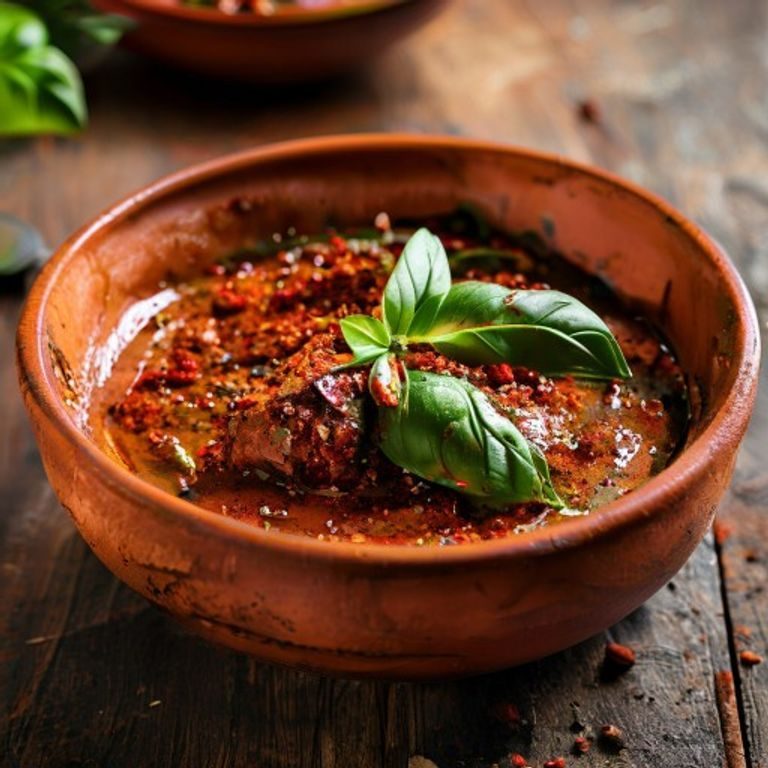
Pesto alla Calabrese with 'Nduja
While the classic Calabrian pesto is a creamy, ricotta-enriched vegetable sauce, this version takes a sharp turn into the fiery, pork-laced territory of 'nduja — spreadable, spicy Calabrian salumi melted into a silky purée of roasted bell peppers, sweet Tropea onions, and jammy cherry tomatoes, finished with fresh basil for a bright, herbaceous finish.
| Amount | Ingredient |
|---|---|
| Using watery ricotta without draining | Excess whey thins the sauce and dilutes the 'nduja's intensity Drain ricotta in a fine-mesh sieve lined with cheesecloth for 15 to 30 minutes before using |
This is the pesto that barbecue pits and Sunday pasta bowls share in common — a deeply savory, smoky-spicy sauce that starts with a slow soffritto of Tropea onions and bell peppers before cherry tomatoes join the party to soften and concentrate into a sweet-tart base. Once the vegetables have surrendered to the heat, a scrap of 'nduja is stirred in (just enough to lend its signature fermented-chili funk and porky depth without overwhelming the peppers), along with fresh basil for a moment of green brightness. The whole mixture is blitzed smooth with an immersion blender, then enriched with fresh cow's-milk ricotta and semi-aged Pecorino Calabrese — a milder, sweeter pecorino than its Roman cousin — and finished with a dusting of oregano. The result is a pesto that walks the line between velvety and punchy, creamy and fiery, equally at home tossed with cavatelli, slathered on a grilled pork chop, or spooned onto warm focaccia. Like the best Calabrian cooking, it is unapologetically bold, stunningly simple, and impossible to resist.
FOR THE PESTO:
Ingredient notes: 'Nduja is the star of this recipe — it is a soft, spreadable salumi from Calabria made with pork shoulder and belly, Calabrian peperoncino, and spices. It has a distinctive fermented-chili funk and a meltingly soft texture that dissolves into hot sauces. Look for it at Italian grocers or specialty meat shops; it is usually sold in a casing or in a jar. If you cannot find 'nduja, substitute 2 Calabrian peperoncini (dried or jarred, finely chopped) for the heat, though you will lose the porky depth. Pecorino Calabrese semi-stagionato is a mild, slightly sweet sheep's-milk cheese aged for about 4 to 6 months — less salty and less sharp than Pecorino Romano, with a subtle nuttiness. If unavailable, substitute Pecorino Romano but reduce the quantity to 50 g (½ cup) as it is saltier. Use cow's-milk ricotta (ricotta vaccina) here — it is milder and creamier than sheep's-milk ricotta, which lets the spices and 'nduja take center stage. The bell peppers should be ripe and sweet; a mix of red and yellow adds visual appeal, but all red works beautifully. Cherry tomatoes should be sweet and ripe — if they are not in season, use the best sweet cherry tomatoes you can find or substitute 200 g of well-drained canned cherry tomatoes.
- Large chef's knife and cutting board
- Large skillet or wide saucepan (at least 30 cm / 12-inch diameter)
- Immersion blender (or standard blender, with caution for hot liquids)
- Mixing bowl
- Wooden spoon or silicone spatula
- Measuring spoons
- Fine-mesh sieve (optional, for silky ricotta)
- Airtight plastic container (for storage)
- Prepare the vegetables (10 min). Wash all vegetables. Peel the onion and slice it into thin half-rings. Core the bell peppers, remove seeds and white pith, and cut them into rough 2 cm (¾ inch) chunks. Halve the cherry tomatoes. Pick the basil leaves from the stems and set aside. Pro tip: Using a mix of red and yellow bell peppers gives the finished sauce a warmer, more complex color than all-red peppers alone.
- Cook the soffritto (5 min). Coat the bottom of a large skillet or wide saucepan with olive oil (about 2 tablespoons) and heat over medium heat. Add the sliced onion and cook, stirring occasionally, until softened and translucent — about 4 to 5 minutes. The Tropea onion should soften without taking on any color. Pro tip: Tropea onions are naturally sweeter than standard red onions — do not rush this step. Properly sweated onions are the foundation of the sauce's sweetness.
- Cook the peppers and tomatoes (20 min). Add the chopped bell peppers to the pan. Cook for 2 minutes, stirring, then add the halved cherry tomatoes. Season with a generous pinch of salt — this helps draw moisture from the tomatoes. Increase the heat to medium-high, bring to a gentle sizzle, then reduce the heat to medium-low. Cook, stirring occasionally, until all the vegetables are completely soft, the tomatoes have collapsed, and the mixture has reduced to a thick, jammy consistency — about 18 to 20 minutes. The oil should begin to separate slightly from the vegetables toward the end of cooking. Pro tip: If the vegetables start to stick or dry out before they are soft, add a splash of water — this deglazes the pan and helps the peppers cook through without browning.
- Add 'nduja, basil, and rest (3 min). Remove the skillet from the heat. Add the 'nduja (breaking it into small pieces as you drop it in — it will melt almost instantly in the residual heat) and the fresh basil leaves. Stir until the 'nduja has dissolved into the vegetables and the basil has wilted. Let the mixture sit and cool for 2 to 3 minutes — this brief rest is essential for the flavors to meld and for the mixture to cool enough to blend safely. Pro tip: 'Nduja melts like butter into hot food — there is no need to cook it. Simply stir it into the hot vegetables and watch it disappear, leaving behind its unmistakable spicy, porky, fermented character.
- Purée the sauce (3 min). Using an immersion blender, blitz the vegetable mixture directly in the skillet until completely smooth and creamy. Scrape down the sides once or twice to ensure everything is incorporated. The sauce should be velvety and uniform, the color of a Calabrian sunset. Pro tip: If using a standard blender, let the mixture cool for 5 minutes first, then blend in batches, filling the blender no more than half full and holding the lid firmly with a folded kitchen towel — hot liquids expand and can blow the lid off.
- Incorporate the ricotta, cheese, and oregano (2 min). While the purée is still warm, add the fresh cow's-milk ricotta. For the silkiest result, pass the ricotta through a fine-mesh sieve before adding; otherwise, simply spoon it in and stir vigorously until fully incorporated. Add the finely grated Pecorino Calabrese and stir until melted and smooth. Taste and adjust salt — remember that Pecorino Calabrese is less salty than Pecorino Romano, so you may need more salt than expected. Gently stir in the dried oregano at the very end.
- Chill and rest (at least 1 hour, or overnight). Transfer the pesto to an airtight plastic container and refrigerate for at least 1 hour before using — the flavors deepen and marry as the sauce cools. For best results, refrigerate overnight (up to 24 to 36 hours). Before using, let the pesto come to room temperature for about 1 hour and stir well. Pro tip: The resting time is not optional — this pesto, like many cooked Calabrian sauces, tastes dramatically better after a night in the fridge as the 'nduja's spices, the peppers' sweetness, and the cheese's saltiness meld into a single, harmonious flavor.
- Serve (2 min). Toss the room-temperature pesto with freshly cooked pasta (reserving about ½ cup / 120 ml of pasta water to loosen the sauce if needed). Short, twisted pasta shapes like cavatelli, gemelli, or fusilli are ideal — their ridges and curves trap the chunky-creamy sauce. Alternatively, use as a spread on grilled bread, a sauce for grilled meats, or a dip for raw vegetables.
- The resting time is essential. This pesto tastes markedly better after resting overnight in the refrigerator. The flavors of the 'nduja, peppers, and cheese need time to meld into a cohesive whole. If you must serve it immediately, it will still be delicious — but it will be even better the next day.
- Do not rush the vegetable cooking time. The 20-minute simmer is what transforms raw peppers and tomatoes into a concentrated, jammy base. Under-cooked vegetables will produce a thin, watery sauce with raw, green-pepper flavors. Cook until the oil visibly separates from the vegetables and the mixture has reduced and thickened.
- 'Nduja is already seasoned — taste before adding extra salt. 'Nduja is made with salt, spices, and fermented chilies, so it contributes significant saltiness and heat to the sauce. Add salt sparingly during cooking and adjust only at the end, after the 'nduja has been incorporated and you can taste the full effect.
- Adjust the 'nduja to your heat tolerance. Ten grams (about 2 teaspoons) of 'nduja gives the sauce a definite but not overwhelming heat — a warm, spreading tingle on the tongue. If you want a subtler 'nduja presence, reduce to 5 g (1 teaspoon). If you want it ragingly spicy, double the 'nduja to 20 g (1½ tablespoons). You can also supplement with a pinch of Calabrian peperoncino or a drizzle of olio santo.
- Use the right ricotta. Cow's-milk ricotta (ricotta vaccina) is deliberately chosen here — it is milder, creamier, and less tangy than sheep's-milk ricotta, which means it does not compete with the 'nduja and peppers. If you only have sheep's-milk ricotta, use 80 g (⅓ cup) instead of 100 g to keep the balance. Always drain excess whey from the ricotta before using.
- Oregano goes in at the very end. Stirring oregano into a hot sauce too early can make it bitter. Fold it in after the sauce has been removed from heat, just before transferring to the storage container, and the flavor will be bright, floral, and fragrant rather than dusty and astringent.
- Reserve pasta water. If serving with pasta, always reserve about ½ cup (120 ml) of the starchy pasta cooking water before draining. Stir it into the sauce to loosen it to a silky, coating consistency that clings perfectly to the pasta.
| Mistake | Why It Hurts | The Fix |
|---|---|---|
| Using standard red onions instead of Tropea | Standard red onions are sharper and more sulfurous — they will dominate the sauce's sweetness | Seek out Tropea onions at Italian grocers; substitute Vidalia or Walla Walla sweet onions, or soak sliced red onion in ice water for 15 minutes to mellow the bite |
| Adding 'nduja too early (during cooking) | Prolonged heat causes the 'nduja's fat to render out and separate, and the fermented chili flavor becomes harsh and one-dimensional | Stir 'nduja in only after removing the pan from heat — the residual warmth is enough to melt it into the sauce |
| Not cooking the vegetables long enough | Under-cooked peppers and tomatoes produce a thin, watery sauce with raw, vegetal flavors and no sweetness | Cook until the oil visibly separates from the vegetables and the mixture has the consistency of a chunky jam — about 20 minutes total |
| Over-blending the sauce | Turning the sauce into a baby-food-smooth purée eliminates the pleasant, velvety-but-rustic texture | Blend just until smooth — stop when the sauce is uniform and creamy but still has the faintest bit of body |
| Using Pecorino Romano instead of Pecorino Calabrese | Romano is saltier and sharper, which can throw off the balance with the 'nduja's already salty character | If substituting Pecorino Romano, reduce the quantity to 50 g (½ cup) and taste before adding extra salt |
| Adding oregano too early | Dried oregano becomes bitter and astringent when cooked for more than a minute or two | Stir in the dried oregano only at the very end, after removing the sauce from heat |
| Variation | How To |
|---|---|
| Classico Pesto Calabrese (no 'nduja) | Omit the 'nduja entirely and replace the cherry tomatoes with 4 ripe Roma tomatoes, cored and chopped. Increase the ricotta to 150 g (⅔ cup). See Volume 2, Recipe #105 for the full classic version. |
| Smoky 'Nduja Pesto | Grill or broil the bell peppers whole until the skins are charred and blackened. Let steam in a covered bowl for 10 minutes, then peel off the skin and remove seeds before adding to the soffritto. The smoky char deepens the 'nduja's porky character beautifully. |
| Extra-Fermented Version | Add 1 tablespoon of the oil from a jar of Calabrian peperoncini sott'olio (chilies preserved in oil) along with the 'nduja for an extra punch of fermented chili flavor. |
| Ricotta Forte Pesto | Substitute half the fresh cow's-milk ricotta with ricotta forte (also called ricotta infornata or ricotta stagionata — a fermented, pungent Calabrian ricotta). The result is intensely funky, complex, and absolutely not for the faint of heart. |
| Nduja and Walnut Pesto | Add 30 g (¼ cup) of toasted walnuts, roughly chopped, when blending for a nutty, textured variation that echoes the 'nduja's rustic character. |
| Grilled Vegetable Version | Grill the bell peppers and onion slices on a hot grill or grill pan for 3 to 4 minutes per side before chopping and proceeding with the recipe. The charred, smoky flavor amplifies the 'nduja's barbecue-like qualities. |
| Vegan 'Nduja-Style Pesto | Omit the 'nduja, ricotta, and pecorino. Substitute 'nduja with 1 tablespoon of Calabrian chili paste or harissa mixed with 1 teaspoon of smoked paprika and 1 tablespoon of tomato paste. Replace the ricotta with 100 g (scant ½ cup) of raw cashew cream and use 2 tablespoons of nutritional yeast in place of pecorino. The result is vegan, spicy, and surprisingly rich. |
| Method | Details |
|---|---|
| Refrigerator | Store in an airtight plastic container for up to 36 hours. The sauce will thicken as it sits; thin it with a splash of warm water, pasta water, or olive oil before serving. Bring to room temperature for about 1 hour before using. |
| Make-Ahead (ideal use) | This pesto is designed to be made ahead — the flavors develop and improve during refrigeration. Make it up to 36 hours in advance, refrigerate in an airtight plastic container, and bring to room temperature for 1 hour before serving. |
| Freezer | Freeze in a freezer-safe container for up to 2 months. The ricotta may separate slightly upon thawing — whisk vigorously or re-blend after thawing, and stir in 1 tablespoon of warm water or olive oil to restore the creamy texture. |
| Reheating | Reheat gently in a saucepan over low heat, stirring frequently. Add a splash of pasta water or olive oil to loosen if needed. Do not microwave — it will cause the ricotta to seize and become grainy. |
This bold, savory, gently spicy sauce with its unmistakable 'nduja character calls for wines that can handle heat, pork fat, and sweet roasted peppers without flinching.
- Cirò Rosso (Calabria, Italy) — The definitive pairing. Calabria's most famous red, made from the Gaglioppo grape, is medium-bodied with bright red cherry, dried herbs, and a subtle earthy minerality that mirrors the sauce's own character. The moderate tannins and bright acidity cut through the ricotta's creaminess and stand up to the 'nduja's spice. Serve slightly chilled (15–18°C / 58–64°F).
- Nero d'Avola (Sicily, Italy) — Dark-fruited, savory, and moderately tannic, with a distinct herbal edge that complements the oregano and 'nduja's fermented heat. Its plush, sun-drenched character is a natural match for the sweet peppers.
- Primitivo (Puglia, Italy) — Ripe, juicy black fruit with a hint of spice and a soft, plush texture — Primitivo's natural sweetness and medium tannins are a perfect foil for the fiery 'nduja and creamy ricotta. A touch of residual sugar helps tame the heat.
- Aglianico del Vulture (Basilicata, Italy) — For a more powerful pairing: Aglianico's high acidity, firm tannins, and dark, smoky, almost tarry complexity stand up beautifully to the 'nduja's pork fat and fermented chili. Decant for at least 30 minutes before serving.
- Rosé di Cirò (Calabria, Italy) — A bone-dry rosé made from Gaglioppo grapes, with strawberry, citrus, and a saline minerality — perfect for summer serving when the pesto is paired with grilled fish or vegetables. The rosé's bright acidity cuts through the richness while its fruit notes complement the peppers' sweetness.
- For beer drinkers: A Nastro Azzurro or Peroni lager (clean, crisp, refreshing), a Calabrian-style amber ale (the maltiness pairs beautifully with the 'Nduja), or a Belgian dubbel (dark, malty, with notes of dark fruit and spice that echo the sauce's complexity).
| Per Serving (about 125 g / ½ cup) | |
|---|---|
| Calories | 262 |
| Protein | 12 g |
| Fat | 19 g |
| Carbohydrates | 13 g |
| Fiber | 3 g |
Nutrition values are approximate and based on 4 servings of sauce (about 125 g / ½ cup each). Actual values will vary significantly depending on the fat content of the 'nduja, the specific ricotta and pecorino used, and the amount of olive oil absorbed during cooking. The sauce is naturally low in carbohydrates and moderate in protein.
What exactly is 'nduja and where do I find it?
'Nduja (pronounced en-DOO-yah) is a soft, spreadable salumi from the Calabria region of southern Italy, made from pork shoulder and belly, salt, and a generous amount of Calabrian peperoncino. It has the texture of a very soft salami — almost paste-like — and is intensely spicy, smoky, and fermented. Look for it at Italian grocery stores, specialty meat shops, or online. It is typically sold in a sausage-like casing (which you remove before using) or in a jar. Once opened, it can be stored in the refrigerator for up to a month. The most authentic brands come from Spilinga, a town in Calabria famous for its 'nduja production.
Can I make this without 'nduja?
Yes — in fact, the classic version of Pesto Calabrese (Volume 2, Recipe #105) is made without 'nduja. For a quick substitute, use 2 Calabrian peperoncini (dried or jarred, finely chopped) or 1 teaspoon of Calabrian chili paste, plus 1 tablespoon of finely chopped pancetta or guanciale (rendered until crispy and stirred in at the end) to replicate the porky depth.
What pasta shapes work best with this pesto?
Short, twisted, or ridged shapes are ideal because they trap the creamy, chunky sauce in every crevice: cavatelli, gemelli, fusilli, trofie, casarecce, and orecchiette all work beautifully. If using long pasta like spaghetti or linguine, reserve extra pasta water (at least 1 cup / 240 ml) to loosen the sauce into a silky coating consistency — and toss vigorously to ensure every strand is coated.
Is this sauce very spicy?
It has a warm, building heat — not a searing burn. The 'nduja contributes a fermented chili spice that is more complex and savory than raw chili heat, and it is balanced by the sweet peppers and creamy ricotta. If you are sensitive to spice, start with 5 g (1 teaspoon) of 'nduja instead of 10 g. If you want more fire, increase to 20 g (1½ tablespoons) or supplement with a drizzle of olio santo (Calabrian chili oil).
Can I serve this sauce cold or at room temperature?
Yes — in fact, it is traditionally served at room temperature. This is the whole point of the make-ahead method: the pesto is made, refrigerated overnight, then brought to room temperature before serving. It is delicious tossed with warm pasta, spread on grilled bread, or served as a dip. Never serve it straight from the refrigerator — the cold dulls the flavors and stiffens the ricotta.
What meats does this pesto pair with?
The natural pairing is anything grilled. The 'nduja's porky, smoky-spicy character makes this pesto a natural companion for grilled pork chops, pork tenderloin, or sausages. It is also excellent with grilled swordfish (a classic Calabrian pairing), grilled chicken thighs, lamb chops, or beef patties. For a vegetarian meal, serve it over grilled eggplant, zucchini, bell peppers, or roasted potatoes.
- Pesto Calabrese (Classic, without 'nduja, Volume 2, Recipe #105)
- Calabrian Chili Oil (Olio santo calabrese, Volume 2, Recipe #53)
- Sicilian Pesto (Pesto alla siciliana, Volume 2, Recipe #77)
- Almond Pesto (Pesto di mandorle, Volume 2, Recipe #32)
- Arugula Pesto (Pesto di rucola, Volume 2, Recipe #59)
- Parmigiano Cream Sauce (Volume 2, Recipe #39)
- Roasted Red Pepper Cream Sauce (Volume 2, Recipe #80)
Recipe from "The Italian Kitchen" by Vita Milanese — Volume 2: Sunday Sauce
Recipe from The Italian Kitchen by Vita Milanese — Volume 2 · Sunday Sauce. Discover all volumes on the ebook page.