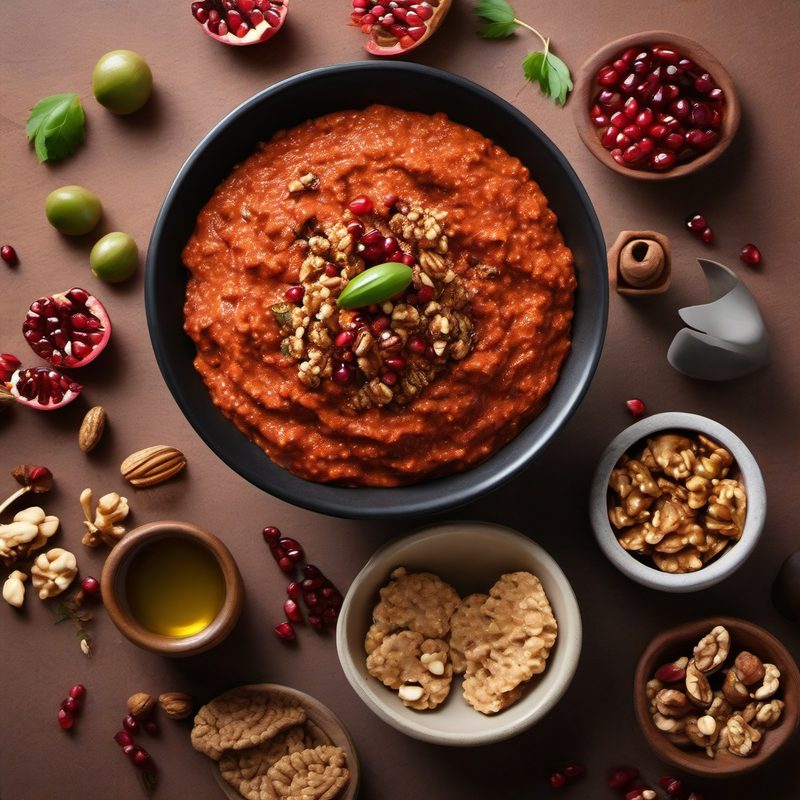
Muhammara (Syrian Red Pepper and Walnut Dip with Black Garlic)
Muhammara is the dip you didn't know you were missing — a deeply savory, subtly sweet Syrian classic of roasted red peppers and walnuts, elevated here by the unexpected addition of black garlic, whose fermented, molasses-like depth transforms an already compelling spread into something truly haunting and unforgettable.
| Amount | Ingredient |
|---|---|
| 2 slices | sandwich bread, toasted |
| 4 | red bell peppers |
| 65 g (2/3 cup) | walnut halves |
| 2 cloves | black garlic |
| 15 ml (1 tbsp) | lemon juice |
| 15 ml (1 tbsp) | pomegranate molasses (optional but recommended) |
| to taste | ground cumin |
| to taste | salt |
| 30 ml (2 tbsp) | extra-virgin olive oil, plus more for serving |
| to taste | chili flakes (Aleppo pepper preferred) |
Originating in Aleppo, Syria, muhammara (Arabic for "reddened") is a cornerstone of Levantine meze. Traditional versions rely on roasted red peppers, walnuts, bread crumbs, and Aleppo pepper for warmth and color. This version introduces black garlic — aged, fermented garlic bulbs whose cloves have turned black, soft, and sweet — adding a layer of umami complexity that plays perfectly against the peppers' smokiness and the walnuts' tannic bitterness. The result is a dip that is at once rustic and refined: creamy but textured, sweet but savory, mild but mesmerizing. Serve it with warm pita, crudités, or as a sauce for grilled meats, and watch it disappear.
Use level tablespoons and standard US measuring cups.
- Baking sheet lined with parchment paper
- Large bowl and plastic wrap (for steaming peppers)
- Knife and cutting board
- Box grater or food processor (for bread crumbs)
- Food processor
- Rubber spatula
- Serving bowl
- Roast the peppers — 40 minutes. Preheat the oven to 350°F (175°C). Place the whole red bell peppers on a parchment-lined baking sheet. Roast for 40 minutes, turning once halfway through, until the skins are deeply blistered and charred in spots and the peppers have softened and collapsed slightly. Pro tip: Don't rush this step — under-roasted peppers retain their raw, grassy flavor and won't peel cleanly. The skin should separate easily from the flesh when you nudge it with a knife.
- Steam and peel the peppers — 10 minutes. Transfer the hot peppers to a large bowl and cover tightly with plastic wrap. Let them steam for 10 minutes — the trapped steam loosens the skin further. When cool enough to handle, peel off the charred skin with your fingers (it should slip off in large sheets). Remove the stems and seeds. Cut the peeled peppers into rough chunks. Pro tip: Work over the bowl to catch any released juices — those juices are packed with roasted flavor and should be added back to the dip. Don't rinse the peppers under water, or you'll wash away the smoky oils.
- Toast the bread and walnuts — 5 minutes. While the peppers are steaming, toast the bread slices until golden and crisp. Grate them on the large holes of a box grater (or pulse in the food processor) to make fine crumbs. Measure ½ cup (about 25 g) of crumbs. In a dry skillet over medium heat, toast the walnut halves for 3 to 4 minutes, stirring frequently, until fragrant and lightly browned. Pro tip: Toasted walnuts taste dramatically different from raw ones — the heat releases their oils and transforms their flavor from astringent to rich and buttery. Watch them closely; they burn in seconds.
- Process the base — 2 minutes. In a food processor, combine the roasted pepper chunks (and any accumulated juices), toasted bread crumbs, toasted walnuts, black garlic cloves, lemon juice, pomegranate molasses (if using), ½ teaspoon ground cumin, ½ teaspoon salt, ¼ teaspoon chili flakes (or Aleppo pepper), and olive oil. Pro tip: Black garlic can be sticky — peel each clove and mash it with the side of your knife before adding it to the processor to ensure even distribution.
- Process until smooth but textured — 1 minute. Run the food processor continuously for 30 to 45 seconds, scraping down the sides once, until the mixture is smooth and cohesive but still shows small flecks of walnut and pepper. The texture should be scoopable — similar to hummus but a bit looser. Pro tip: If the muhammara seems too thick, add 1 tablespoon of olive oil or cold water and pulse again. The dip should hold its shape on a spoon but not be stiff.
- Adjust seasoning — 1 minute. Taste and adjust with more salt, cumin, lemon juice, or chili flakes. The muhammara should be savory, slightly sweet from the peppers and black garlic, nutty from the walnuts, with a gentle warmth from the chili. The pomegranate molasses adds a subtle sweet-tart complexity — if you omitted it, consider a tiny squeeze of extra lemon juice for brightness. Pro tip: Like many dips, muhammara's flavor deepens and melds after an hour at room temperature. It should taste slightly more assertive now than you want it to be at serving.
- Serve — immediately or at room temperature. Transfer to a serving bowl, use the back of a spoon to create a shallow well in the center, and drizzle generously with good olive oil. Sprinkle with a pinch of Aleppo pepper or chili flakes and a few crushed walnuts on top.
- As a dip with warm pita bread, flatbread, or crusty bread
- Alongside a meze spread with hummus, baba ghanoush, and tzatziki
- Spooned over grilled chicken, lamb kofta, or beef kebabs
- As a sauce for falafel wraps or shawarma sandwiches
- Spread on toasted sourdough and topped with crumbled feta and fresh mint
- Served with crudités — carrot sticks, cucumber spears, radishes, and bell pepper strips
- Dolloped onto roasted vegetables — cauliflower, eggplant, or sweet potatoes
- Black garlic is the key differentiator here. Regular garlic would add sharp, pungent heat that competes with the peppers; black garlic adds deep, molasses-like sweetness and umami that amplifies the roastiness. Look for it at specialty markets, Asian grocers, or online. If unavailable, use 2 cloves of roasted regular garlic (roast at 350°F for 25 minutes in foil).
- Pomegranate molasses is optional but transformative. It adds a sweet-tart complexity that brightens the dip without making it fruity. If you don't have it, increase the lemon juice to 1½ tablespoons and add ½ teaspoon of honey or date syrup.
- Aleppo pepper is traditional but not essential. Its fruity, medium heat is perfect for muhammara. Substitute with ½ teaspoon sweet paprika plus a pinch of cayenne, or use Urfa biber for a smoky, raisiny alternative.
- Toast everything you can. Roasted peppers, toasted walnuts, toasted bread — the cumulative effect of all that toasting is a dip with enormous depth of flavor. There is no shortcut.
- Room temperature is the correct serving temperature. Muhammara straight from the fridge tastes muted and stiff. Let it sit at room temperature for 20 to 30 minutes before serving.
- The dip improves with rest. Like hummus, muhammara benefits from at least 1 hour of rest at room temperature for the flavors to meld. Make it a few hours ahead if you can.
- Don't over-process. The hallmark of great muhammara is its pleasingly rustic texture — you should see tiny flecks of walnuts and pepper. A completely smooth purée is too refined and loses the nutty contrast.
| Mistake | Why It Hurts | The Fix |
|---|---|---|
| Not roasting the peppers enough | Raw, grassy flavor and skins that won't peel cleanly | Roast for a full 40 minutes until skins are deeply blistered and flesh is soft |
| Rinsing the peeled peppers under water | Washes away the smoky, concentrated roasted flavor and juices | Peel over the bowl and return any collected juices to the dip |
| Using raw walnuts | Astringent, tannic taste that makes the dip bitter and harsh | Toast walnuts in a dry skillet until fragrant and golden — this transforms their flavor |
| Over-processing the dip | Becomes a smooth, heavy paste; loses the textural contrast of walnut pieces | Process only until cohesive but still slightly chunky — about 30 to 45 seconds |
| Using stale bread | Absorbs moisture unevenly and can make the dip pasty or gluey | Use fresh-ish bread toasted to crisp; grate into fine crumbs for even absorption |
| Skipping the pomegranate molasses | The dip lacks brightness and can taste one-dimensionally sweet or smoky | Add at least 1 tablespoon of lemon juice for acidity, plus a touch of honey for sweetness |
| Adding too much olive oil | The dip becomes greasy and the walnut flavor is overwhelmed | Start with 2 tablespoons and add more only if needed for texture |
- Classic Muhammara (No Black Garlic): Omit the black garlic and add 1 regular garlic clove (minced) plus 1½ tablespoons of pomegranate molasses for a more traditional Aleppine version.
- Smoky Muhammara: Add 1 teaspoon of smoked paprika and ½ teaspoon of ground sumac to the food processor. The sumac's lemony tartness brightens the smoky depth.
- Spicy Muhammara: Increase the chili flakes to 1 teaspoon and add ½ teaspoon of cayenne pepper. For extra heat and color, include 1 tablespoon of Aleppo pepper flakes.
- Muhammara with Yogurt: Swirl 3 tablespoons of full-fat Greek yogurt into the finished dip for a creamier, tangier version that's milder and more approachable.
- Herb Muhammara: Add 10 g (½ cup loosely packed) fresh parsley leaves and 5 g (¼ cup) fresh mint leaves to the food processor. This brightens the dip considerably and makes it feel fresher.
- Roasted Garlic Muhammara: Replace the black garlic with 4 cloves of roasted garlic (squeezed from their skins). Roast alongside the peppers — wrap in foil and add to the oven for the last 25 minutes.
- Cumin-Lemon Muhammara: Double the cumin to 1 teaspoon and add the zest of ½ lemon. The citrus oils and warm cumin create a brighter, more aromatic dip.
| Method | Details |
|---|---|
| Refrigerator | Store in an airtight container for up to 5 days |
| Best Before | Peak flavor is at 2 to 4 hours; improves overnight as flavors meld — best within 2 days |
| Reviving | Let sit at room temperature for 20 minutes, stir well, add a splash of olive oil if needed |
| Freezing | Freeze in an airtight container for up to 2 months; thaw in the refrigerator overnight |
| Freezing Note | The texture may become slightly grainy after freezing due to the walnuts; stir vigorously and add 1 tablespoon of olive oil to restore creaminess |
- Cinsault or Grenache Rosé (Lebanon or Bekaa Valley) — the perfect partner: fruity, light, and slightly spicy, matching muhammara's warmth without overpowering it
- Kekik Bağ Bozumu (Turkey) — a native Turkish red, medium-bodied with herbal notes that echo the cumin and chili
- Assyrtiko (Greece) — the high-acid white from Santorini cuts through the walnut oil and refreshes the palate
- Rkatsiteli (Republic of Georgia) — an ancient amber wine with tannic structure and dried fruit notes that complement the peppers' sweetness
- Arak or Ouzo (Lebanon / Greece) — an anise-flavored spirit served with ice and water; the licorice notes are unexpectedly perfect with walnut and pomegranate molasses
| Calories | Protein | Fat | Carbs | Fiber |
|---|---|---|---|---|
| 85 per ¼ cup (60 ml) serving | 2 g | 6 g | 7 g | 2 g |
Q: Can I use jarred roasted red peppers instead of roasting my own?
A: You can, but the result will be noticeably inferior. Jarred peppers are preserved in brine or vinegar, which makes them sour and waterlogged. Roasting fresh peppers gives you deep, smoky sweetness and concentrated flavor that jarred peppers simply cannot match. If you must use jarred, drain and pat them very dry, and reduce or omit the lemon juice.
Q: What is black garlic and where do I find it?
A: Black garlic is fresh garlic that has been aged for weeks under controlled heat and humidity (the Maillard reaction and fermentation work together). The result is cloves that are black, soft, and sweet — like garlic candy, with notes of molasses, tamarind, and balsamic vinegar. Find it at specialty food stores, Asian markets, or online. It keeps for months in a cool, dark place.
Q: Can I make muhammara without bread crumbs?
A: Yes. Traditional muhammara uses bread crumbs as a thickener, but you can substitute with 30 g (¼ cup) of almond flour, 20 g (¼ cup) of rolled oats (pulsed to a powder in the processor), or 1 tablespoon of the walnut pieces ground to a paste before adding the rest. The texture will vary slightly but the flavor will still be excellent.
Q: My muhammara is too thick — how do I fix it?
A: Add 1 to 2 tablespoons of cold water, lemon juice, or olive oil and pulse again. The dip should be scoopable — thicker than a sauce but looser than a paste. If it's stiff enough to hold a spoon upright, it needs more liquid.
Q: Is muhammara gluten-free?
A: As written (using bread from wheat), no. To make it gluten-free, substitute the bread crumbs with gluten-free bread crumbs or almond flour. Double-check that your pomegranate molasses and black garlic are certified gluten-free, as cross-contamination is rare but possible.
Q: Can I use regular garlic instead of black garlic?
A: Yes, but it will be a different dip. Use 1 small clove of regular garlic, minced, and add it to the food processor. You may want to increase the pomegranate molasses to 1½ tablespoons to compensate for the lost sweetness. For a gentler garlic flavor, roast the regular garlic clove (wrapped in foil at 350°F for 25 minutes) before adding.
- Hummus (Volume 2, Recipe #80)
- Baba Ghanoush (Volume 2, Recipe #81)
- Tzatziki (Volume 2, Recipe #78)
- Roasted Red Pepper Cream Sauce (Volume 2, Recipe #80)
- Falafel (Volume 1, Recipe #55)
- Pita Bread (Volume 1, Recipe #34)
Recipe from "The Italian Kitchen" by Vita Milanese — Volume 2: Sunday Sauce
Recipe from The Italian Kitchen by Vita Milanese — Volume 2 · Sunday Sauce. Discover all volumes on the ebook page.