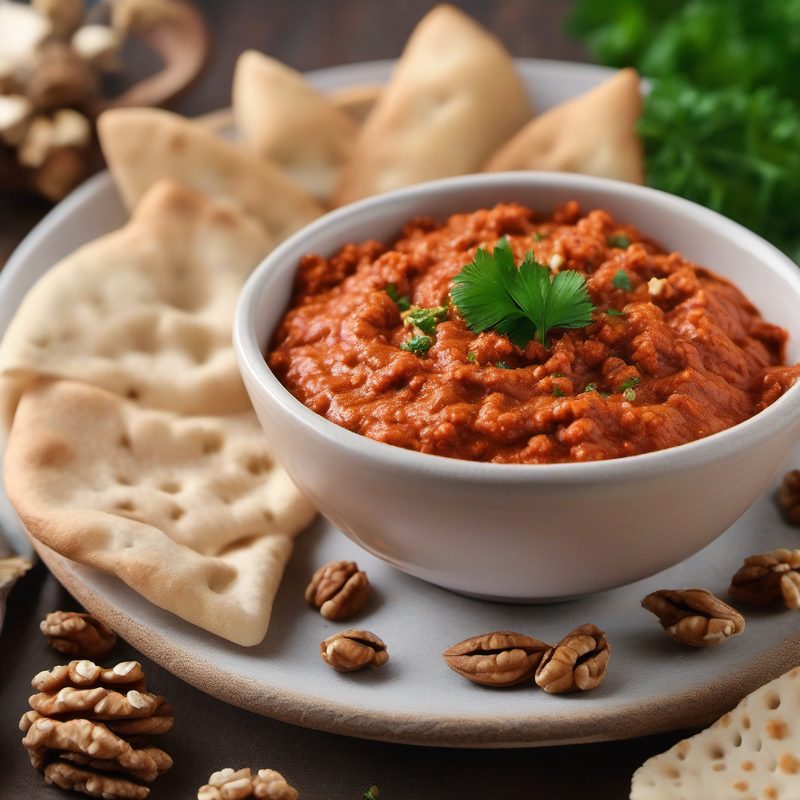
Muhammara (Red Pepper and Walnut Dip)
The classic Aleppine muhammara is a masterclass in transformation — humble ingredients of roasted red peppers, walnuts, and bread are blitzed into a dip so velvety, so balanced, so compelling that it rivals hummus as the star of any meze table, with a fraction of the effort.
| Amount | Ingredient |
|---|---|
| 50 g (2 slices) | white bread, crusts removed |
| 70 g (2/3 cup) | walnut halves |
| 1 clove | garlic |
| 3 | red bell peppers |
| ½ | lemon, juiced (about 15 ml / 1 tbsp) |
| 1 tsp | chili flakes (Aleppo pepper preferred) |
| 1 tsp | salt |
| 30 ml (2 tbsp) | extra-virgin olive oil |
This is the traditional version of muhammara, the beloved Syrian dip whose name means "reddened." Unlike the black-garlic variation elsewhere in this volume, this recipe stays true to the Aleppine original: roasted red peppers provide sweetness and smoke, toasted walnuts contribute richness and tannic structure, and bread crumbs bind everything into a luscious, spreadable consistency. The high-heat roasting method here — 450°F — creates deeper char and more concentrated flavor in less time than lower-temperature roasting, while the brief steaming step ensures the skins slip off effortlessly. The result is a dip that is simultaneously rustic and luxurious: creamy, nutty, gently warm from chili flakes, and brightened by lemon. Serve it with good bread, fresh vegetables, or alongside grilled meats, and you'll understand why Syria's gift to the world of dips deserves a permanent place in your repertoire.
Use level tablespoons and standard US measuring cups.
- Baking sheet lined with parchment paper
- Large bowl and plastic wrap (for steaming peppers)
- Knife and cutting board
- Small skillet (for toasting walnuts)
- Food processor
- Rubber spatula
- Airtight container for storage
- Roast the peppers at high heat — 15 minutes. Preheat the oven to 450°F (230°C). Cut the red bell peppers in half through the stem, remove the stems and seeds, and place them cut-side down on a parchment-lined baking sheet. Press down gently to flatten. Roast for about 15 minutes, until the skins are deeply blistered and blackened in spots and the flesh is tender. Pro tip: The cut-side-down method concentrates the heat and creates a deep, smoky char that you simply can't achieve at lower temperatures or with peppers left whole. The exposed flesh caramelizes directly against the hot pan.
- Steam and peel — 10 minutes. Transfer the hot peppers to a large bowl and cover tightly with plastic wrap. Let steam for 10 minutes — the trapped steam loosens the skins so they slip off effortlessly. When cool enough to handle, peel off the charred skin with your fingers. Discard the skin. Pro tip: Do not rinse the peppers. The smoky oils on the surface are flavor gold. A few tiny bits of charred skin left behind add character, not bitterness — don't obsess over perfection.
- Toast the bread and walnuts — 5 minutes. While the peppers steam, toast the bread slices in a toaster or under the broiler until golden and crisp on both sides. Break the toasted bread into small pieces. In a dry skillet over medium heat, toast the walnut halves for 3 to 4 minutes, stirring constantly, until fragrant and lightly browned. Remove from the skillet immediately to prevent burning. Pro tip: The walnuts should smell distinctly nutty and look a shade darker. Raw walnuts taste astringent and can make the dip bitter — toasting is non-negotiable.
- Process the base — 2 minutes. In a food processor, combine the peeled roasted peppers, toasted bread pieces, toasted walnuts, garlic clove, lemon juice, chili flakes, and salt. Pulse 8 to 10 times until the mixture is coarsely chopped and starting to come together. Pro tip: Add the garlic whole — the processor will mince it evenly. If you're sensitive to raw garlic, remove the green germ from the center of the clove before adding.
- Add olive oil and emulsify — 1 minute. With the food processor running, drizzle in the olive oil through the feed tube. Continue processing for 20 to 30 seconds, until the dip is smooth, creamy, and cohesive. Stop while there is still visible texture from the walnuts — a completely smooth purée loses the nutty contrast that makes muhammara distinctive. Pro tip: Adding the oil while the processor runs creates a true emulsion, giving the dip a silky, luxurious mouthfeel that you can't achieve by adding the oil all at once.
- Season to taste — 1 minute. Taste the muhammara and adjust seasoning. It should be savory, nutty, gently sweet from the peppers, and mildly warm from the chili flakes. Add more salt, lemon juice, or chili flakes as needed. If the dip tastes flat, a pinch more salt is usually the answer. Pro tip: The dip should be slightly more seasoned than you think necessary — chilling dulls flavors, and the bread absorbs salt as it rests.
- Chill — at least 1 hour. Transfer the muhammara to an airtight container and refrigerate for at least 1 hour before serving. This resting period is not optional — it allows the bread to fully hydrate and soften, the garlic to mellow, and all the flavors to meld into a harmonious whole. The texture will transform from a coarse, loose paste to a thick, spreadable dip. Pro tip: If you can wait, 4 hours of chilling yields even better results. Overnight is best — the muhammara becomes significantly creamier and more cohesive.
- Serve — 1 minute. Remove from the refrigerator 15 to 20 minutes before serving to take the chill off. Transfer to a serving bowl, drizzle with olive oil, and garnish with a sprinkle of chili flakes and a few chopped walnuts.
- As a dip with warm pita bread, lavash, or crusty sourdough
- Alongside a mezze spread: hummus, baba ghanoush, tabbouleh, and stuffed grape leaves
- Spooned over grilled lamb chops, chicken thighs, or kofta kebabs
- As a sauce for falafel, shawarma, or halloumi wraps
- Spread on crostini with crumbled feta, pomegranate seeds, and fresh mint
- Dolloped onto roasted sweet potatoes, cauliflower steaks, or grilled eggplant
- Used as a savory spread for sandwiches and burgers in place of mayonnaise or ketchup
- High heat is the secret to the best roasted peppers. Roasting at 450°F with peppers cut-side down creates a deep, complex char in just 15 minutes — far more flavorful than the 40-minute low-and-slow method. The direct contact with the hot pan caramelizes the pepper flesh, adding sweetness you can't get any other way.
- The chilling step is not optional. Warm muhammara is a coarse, loose paste. Chilled muhammara is a thick, spreadable dip. The bread needs time to absorb the pepper juices and the flavors need time to marry. One hour minimum, four hours better, overnight best.
- Toast everything. Toasted walnuts, toasted bread — the cumulative effect of toasting is a dip with layers of roasted, nutty flavor. Don't skip either step.
- Aleppo pepper is ideal but not required. It has a fruity, medium heat and a subtle saltiness. Substitute with ½ teaspoon sweet paprika plus ¼ teaspoon cayenne, or use 1 teaspoon of Urfa biber for a smoky, raisiny character.
- The perfect texture is scoopable, not pourable. Muhammara should hold its shape on a pita chip but not be stiff. If it's too thick after chilling, stir in a tablespoon of cold water or lemon juice.
- Quality olive oil matters here. It's only two tablespoons, but it's the last ingredient added and the first thing you taste and smell. Use a fruity, medium-intensity extra-virgin olive oil — not the peppery Tuscan kind, which can clash with the walnuts.
- White bread is traditional, but any crustless bread works. A basic supermarket sandwich loaf is fine. Avoid whole-grain or seeded breads, which add competing flavors and a coarse texture. Sourdough without crust is excellent.
| Mistake | Why It Hurts | The Fix |
|---|---|---|
| Roasting peppers whole at low temperature | Less char, less smoke, less sweetness; skins are harder to peel | Cut peppers in half, place cut-side down, roast at 450°F for 15 minutes |
| Not steaming the peppers after roasting | Skins stick stubbornly, forcing you to scrape (and lose flesh) or rinse (and lose flavor) | Cover hot peppers with plastic wrap for 10 minutes — the steam loosens skins effortlessly |
| Using untoasted walnuts | Astringent, tannic, and slightly bitter — the dip will taste harsh | Toast in a dry skillet for 3 to 4 minutes until fragrant and golden |
| Adding all the oil at once | The dip will not emulsify properly and can separate or feel greasy | Drizzle oil slowly while the processor runs for a silky, stable emulsion |
| Skipping the chilling step | The dip is loose, pasty, and the flavors are harsh and unintegrated | Chill for at least 1 hour — the texture firms up and the flavors meld dramatically |
| Over-processing into a smooth purée | Loses the distinctive nutty texture that defines quality muhammara | Stop while there is still visible walnut texture — about 20 to 30 seconds of continuous processing |
| Not removing bread crusts | Crusts add a hard, uneven texture that won't break down in the processor | Trim crusts completely before toasting |
- Spicy Muhammara: Double the chili flakes to 2 teaspoons and add ¼ teaspoon of cayenne pepper. For authentic Aleppine heat, use 1 tablespoon of Aleppo pepper flakes.
- Pomegranate Muhammara: Add 1 tablespoon of pomegranate molasses along with the lemon juice. The sweet-tart complexity is a classic addition that brightens the dip significantly.
- Smoky-Sweet Muhammara: Add 1 teaspoon of smoked paprika and 1 tablespoon of date syrup or honey. This version leans into the sweet-smoky character of the peppers.
- Herb Muhammara: Add 15 g (¾ cup loosely packed) fresh parsley and 10 g (½ cup loosely packed) fresh mint leaves to the food processor in step 4. Pulse until the herbs are finely chopped with the base.
- Yogurt Muhammara: After chilling, fold in 3 tablespoons of full-fat Greek yogurt for a creamier, tangier dip. Excellent with grilled vegetables.
- Walnut-Free Muhammara: Substitute the walnuts with 70 g (½ cup) of toasted almonds or 60 g (½ cup) of shelled pistachios. The texture and flavor will change, but the result is still delicious.
- Roasted Garlic Muhammara: Add 3 cloves of roasted garlic (wrap in foil, roast at 450°F for 20 minutes alongside the peppers) to the food processor. Squeeze the soft cloves from their skins before adding.
| Method | Details |
|---|---|
| Refrigerator | Store in an airtight container for up to 5 days |
| Best Before | Peak flavor is after overnight chilling (24 hours) — flavors continue to meld for up to 3 days |
| Reviving | Let sit at room temperature for 20 minutes, stir well; if too thick, add 1 tablespoon cold water and stir |
| Freezing | Freeze in an airtight container for up to 2 months; thaw in the refrigerator overnight |
| Freezing Note | After thawing, the texture may separate slightly — stir vigorously and add a teaspoon of olive oil to re-emulsify |
- Lebanese Cinsault Rosé — light, fruity, with a subtle spice note that mirrors the Aleppo pepper
- Turkish Kızılcık Şarabı (Cranberry Wine) — a tart, fruity, low-alcohol wine that cuts through the walnut richness
- Crémant d'Alsace Brut — the bubbles and bright acidity refresh the palate between bites of rich, nutty dip
- Moschofilero (Greece) — aromatic, citrusy, and floral, with enough body to stand up to the peppers and walnuts
- Arak (Lebanon) or Tsipouro (Greece) — anise-flavored spirits served ice-cold; the licorice notes create an unexpectedly beautiful harmony with walnuts
| Calories | Protein | Fat | Carbs | Fiber |
|---|---|---|---|---|
| 80 per ¼ cup (60 ml) serving | 2 g | 6 g | 6 g | 2 g |
Q: Can I use jarred roasted red peppers?
A: You can, but the dip will lack the deep, smoky character that makes muhammara special. Jarred peppers are processed with citric acid or vinegar and packed in brine, making them sour and waterlogged. Fresh-roasted peppers have concentrated sweetness and genuine smokiness. If time is truly short, drain jarred peppers well, pat them dry, and roast them briefly under the broiler (5 minutes, cut-side up) to restore some charred flavor.
Q: My muhammara tastes bitter — what went wrong?
A: Three possible causes: (1) The walnuts were not toasted enough (or at all) — untoasted walnuts have harsh tannins. (2) The peppers were over-charred — blackened skin is fine, but if the flesh itself is burnt, it will be bitter. (3) The olive oil was too peppery — use a milder, fruity extra-virgin olive oil next time.
Q: Can I make this without bread to keep it gluten-free?
A: Yes. Substitute the bread with 30 g (¼ cup) of almond flour or 20 g (¼ cup) of rolled oats (pulsed to a powder in the food processor before adding the other ingredients). Alternatively, use 1 tablespoon of the walnuts ground to a paste to act as a binder. The texture will be slightly different but still delicious.
Q: How do I make muhammara less oily?
A: The 2 tablespoons of olive oil in this recipe are already moderate. If you want to reduce further, cut the oil to 1 tablespoon and replace it with 1 tablespoon of cold water. Drizzle the water in slowly while the processor runs, just as you would the oil. The dip will be slightly less luxurious but still creamy.
Q: Can I add more garlic?
A: Absolutely. Muhammara can handle 2 to 3 garlic cloves if you love garlic. For a mellower flavor, roast the extra cloves with the peppers (wrap in foil for the last 10 minutes of roasting). For maximum punch, add them raw. If adding raw garlic beyond 1 clove, consider removing the green germ (the small sprout in the center) to reduce harshness.
Q: Does muhammara freeze well?
A: Yes, reasonably well for up to 2 months. The flavor holds up beautifully, but the texture may become slightly grainy after freezing and thawing due to the walnuts. To restore, let thaw in the refrigerator, then stir vigorously and add 1 teaspoon of olive oil to re-emulsify. Freeze in small portions so you only thaw what you need.
- Muhammara with Black Garlic (Volume 2, Recipe #89)
- Hummus (Volume 2, Recipe #80)
- Baba Ghanoush (Volume 2, Recipe #81)
- Tzatziki (Volume 2, Recipe #78)
- Roasted Red Pepper Cream Sauce (Volume 2, Recipe #80)
- Falafel (Volume 1, Recipe #55)
Recipe from "The Italian Kitchen" by Vita Milanese — Volume 2: Sunday Sauce
Recipe from The Italian Kitchen by Vita Milanese — Volume 2 · Sunday Sauce. Discover all volumes on the ebook page.