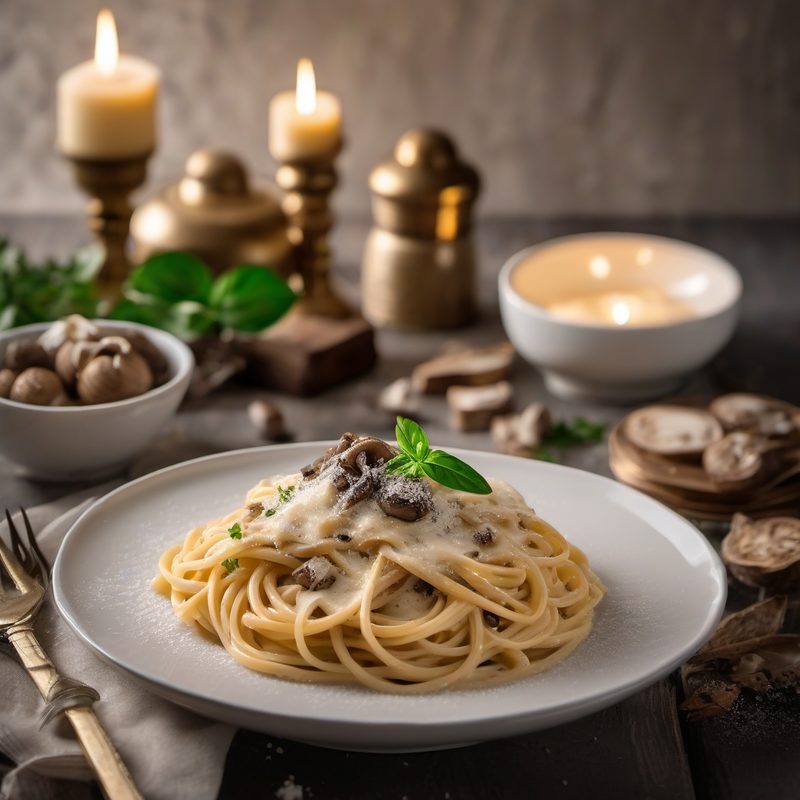
Porcini Spaghetti Parmesan Bechemel
Al dente spaghetti enveloped in a velvety Parmesan béchamel and crowned with golden sautéed porcini mushrooms — a luxurious, earthy, and comforting primo that transforms a classic French white sauce into a distinctly Italian celebration of autumn's finest fungus.
| Amount | Ingredient |
|---|---|
| Whole milk | 500 ml (2 cups) Full-fat (3.25–4%) builds a richer, more stable béchamel than skim or low-fat; do not substitute |
| Unsalted butter | 50 g (3½ tbsp) Divided: 30 g for béchamel, 20 g for sautéing mushrooms |
| All-purpose flour | 50 g (6 tbsp / ⅓ cup + 1 tbsp) For the roux; unbleached all-purpose yields the most neutral, consistent thickening |
| Parmigiano-Reggiano | 100 g (3½ oz), finely grated About 1 heaping cup finely grated; grate just before using — pre-grated contains anti-caking agents that can make the sauce grainy |
| Garlic cloves | 2 medium (about 8 g each) Thinly sliced or finely minced |
| Fresh flat-leaf parsley | 3 tbsp (10 g), finely chopped For garnish; plus a few whole leaves for the final platter |
| Freshly grated nutmeg | ¼ tsp Freshly grated from whole nutmeg is incomparably more aromatic than pre-ground |
| Kosher salt | 2 tbsp (30 g) For pasta water; plus additional ½ tsp for seasoning |
| Black pepper | ¾ tsp Freshly ground, divided |
> This recipe marries two culinary traditions: the Italian reverence for porcini mushrooms (Boletus edulis) — the king of the forest, harvested in the autumn woodlands of Tuscany, Piedmont, and Umbria — with the French-born béchamel, here Italianized through a generous infusion of Parmigiano-Reggiano and a whisper of nutmeg. The result is a pasta dish that is simultaneously elegant and rustic: the silky, cheese-fortified béchamel clings to every strand of spaghetti, while the earthy, garlicky porcini provide a meaty, umami-rich counterpoint. Unlike cream-based sauces, which can taste heavy and one-dimensional, the béchamel base is built on milk and roux, yielding a sauce that is rich but not cloying, smooth but with body — the perfect canvas for the deep, woodsy flavour of porcini.
🏷 Category
Primi piatti (First Courses) — Pasta Bianca (White Pasta) / Cucina di Terra (Land Cuisine)
🥘 Special Equipment
- Large pot (6–8 qt / 6–8 L) — for pasta
- Medium heavy-bottomed saucepan (2–3 qt / 2–3 L) — for béchamel
- Large heavy-bottomed skillet or sauté pan (12-inch / 30 cm) — for mushrooms and final assembly
- Colander
- Whisk (preferably a flat-bottomed or French whisk)
- Wooden spoon or silicone spatula
- Chef's knife and cutting board
- Box grater or Microplane — for Parmesan
- Measuring cups and spoons
- Small bowl — for rehydrating dried porcini (if using)
- Fine-mesh sieve (if using dried porcini, to strain the soaking liquid)
> Ingredient note on porcini mushrooms: Fresh porcini (Boletus edulis) are a seasonal delicacy, available from late summer through autumn (August–October in the Northern Hemisphere). Look for specimens that are firm, dense, and dry to the touch — avoid slimy or spongy caps. The cap should be a rich chestnut brown, the stem thick and bulbous, and the pore surface (under the cap) should be pale cream to olive-yellow, never dark or wet. If fresh porcini are unavailable, high-quality dried porcini (funghi porcini secchi) are an excellent substitute — they actually deliver a more concentrated, intense flavour. Rehydrate 40 g dried porcini in 250 ml (1 cup) of warm (not boiling) water for 20 minutes, then drain through a fine-mesh sieve lined with a paper towel (reserve the soaking liquid — it's liquid gold). Rinse the rehydrated porcini briefly to remove any residual grit, then coarsely chop. The strained soaking liquid can be used in place of 120 ml (½ cup) of the milk in the béchamel for an even deeper mushroom flavour.
🔧 Before You Begin
- Prepare the mushrooms (if using fresh): Gently brush the fresh porcini clean with a soft mushroom brush or a damp paper towel — do not rinse under running water, as porcini are like sponges and will absorb water, diluting their flavour and making them steam rather than sear. Trim the very bottom of the stem if woody or dirty. Slice the caps and stems into ¼-inch (6 mm) thick slices, then cut any large pieces into bite-sized chunks. Keep the slices uniform in thickness for even cooking.
- Prepare the mushrooms (if using dried): Place 40 g (1.4 oz) dried porcini in a small bowl and cover with 250 ml (1 cup) warm water (about 40°C / 105°F — tap-warm, not hot). Let soak for 20 minutes. Line a fine-mesh sieve with a paper towel and strain the soaking liquid into a liquid measuring cup. Reserve this golden-brown liquid. Rinse the rehydrated porcini briefly under cold water to remove any residual grit, then coarsely chop. Reserve 120 ml (½ cup) of the strained soaking liquid to replace an equal volume of milk in the béchamel.
- Grate the Parmesan: Finely grate 100 g (3½ oz) of Parmigiano-Reggiano using a Microplane or the fine side of a box grater. The finer the grate, the more seamlessly it will dissolve into the hot béchamel.
- Prepare the parsley: Wash, dry, and finely chop the flat-leaf parsley. Set aside.
- Prep the aromatics: Thinly slice or finely mince the garlic cloves. Set aside.
- Grate the nutmeg: If using whole nutmeg, grate ¼ teaspoon using a Microplane or nutmeg grater. Whole nutmeg keeps indefinitely; ground nutmeg loses its volatile oils within weeks.
- Pasta water: Fill a large pot with 4–5 quarts (4–5 L) of cold water and bring to a rolling boil. Salt only after boiling — salting cold water extends the time to boil.
- Warm the serving bowls: Place 4 shallow pasta bowls in a low oven (170°F / 75°C) or in a sink of hot water to warm. Béchamel-based sauces cool rapidly on contact with cold dishes.
📏 Key Ratios
| Ratio | Value | Purpose |
|---|---|---|
| Milk-to-flour | 500 ml milk : 50 g flour (10:1 by volume) | The standard "medium-thick" béchamel ratio — thick enough to coat the pasta generously without being pasty or gloppy |
| Butter-to-flour | 30 g butter : 50 g flour (0.6:1 by weight) | A slightly lean roux (classically equal parts) — intentional, because the Parmesan adds fat and richness later; excess butter would make the sauce greasy |
| Parmesan-to-béchamel | 100 g Parmesan : 500 ml milk (1:5 by volume) | Enough to deeply infuse the sauce with nutty, savoury umami without overwhelming the delicate béchamel base or competing with the porcini |
| Mushroom-to-pasta | 200 g porcini : 350 g spaghetti (~0.57:1 by weight) | Generous enough that every forkful includes at least one piece of mushroom; the earthy porcini chunks punctuate the creamy sauce |
| Porcini-to-garlic | 200 g mushrooms : 2 cloves garlic | Subtle garlic presence — garlic should support the porcini, not dominate it; the mushrooms' delicate flavour is easily overwhelmed |
> Why this works: The 10:1 milk-to-flour ratio (by volume) produces a béchamel that is thick enough to coat the back of a spoon but still fluid enough to wrap around spaghetti strands without clumping. Unlike a heavy cream sauce (which can feel greasy and tends to break when tossed with pasta), the roux-stabilized béchamel forms an emulsion that is both thermally stable and naturally adhesive — the gelatinized starch molecules in the roux bind the milk fat and proteins into a homogeneous, creamy matrix that clings to the pasta's surface. The 100 g of Parmesan (roughly 1 heaping cup, finely grated) adds not just flavour but additional emulsifying power: the casein proteins in aged Parmesan act as natural emulsifiers, reinforcing the sauce's ability to coat the pasta evenly without separating.
📝 Instructions
Step 1: Build the Parmesan Béchamel (10 minutes)
- In a medium heavy-bottomed saucepan, melt 30 g (about 2 tbsp + 1 tsp) of the butter over medium heat. Swirl the pan to coat the bottom and sides — this prevents scorching when the flour hits.
- Once the butter is fully melted and begins to foam (but not brown — about 30 seconds), add the 50 g (6 tbsp) of all-purpose flour all at once. Immediately begin whisking vigorously in a figure-eight pattern to incorporate the flour into the butter. The mixture should form a smooth, pale golden paste — this is the roux.
- Continue whisking the roux for 1 full minute over medium heat. The roux should bubble gently but not darken beyond a pale straw colour. This brief cooking eliminates the raw flour taste while preserving the roux's thickening power — a longer, darker cook (blond or brown roux) would reduce thickening capacity and introduce toasted flavours that clash with the delicate béchamel and mushrooms.
- Add the milk in a slow, steady stream while whisking constantly. Begin with just 120 ml (½ cup) of milk — whisk vigorously to incorporate it into the roux before adding more. The mixture will seize into a thick paste at first; this is normal. Keep whisking until smooth, then add another 120 ml (½ cup) of milk and whisk until fully incorporated. Continue adding the remaining milk in 120 ml increments, whisking between each addition until the sauce is smooth before adding the next.
> If using dried porcini soaking liquid: Replace 120 ml (½ cup) of the milk with the reserved strained porcini soaking liquid. Add this as one of the incremental additions in place of a milk addition. The result will be a deeper, earthier béchamel with a beautiful pale brown hue.
- Once all the milk (and/or porcini liquid) has been incorporated, increase the heat to medium-high and bring the sauce to a gentle simmer, whisking frequently — about 3–4 minutes. The sauce will thicken noticeably as it approaches a simmer. Once you see the first lazy bubbles break the surface, reduce the heat to low.
- Let the béchamel cook at a bare simmer for 2 minutes, whisking occasionally, to fully gelatinize the starch and eliminate any floury residue. The sauce should coat the back of a spoon thickly — when you draw a finger across the coated spoon, the line should hold cleanly without the sauce running back together.
- Remove the saucepan from the heat. Add the finely grated Parmigiano-Reggiano and ¼ teaspoon freshly grated nutmeg. Whisk until the cheese is fully melted and the sauce is smooth, glossy, and pale golden — about 30 seconds. Taste and adjust with ½ teaspoon kosher salt and ¼ teaspoon freshly ground black pepper. Keep covered off the heat while you proceed with the mushrooms and pasta (the residual heat will keep it warm; if it thickens too much, whisk in a splash of the hot pasta water before tossing).
> The keys to a perfect Parmesan béchamel: (1) Add the milk slowly — dumping it all at once creates lumps that are nearly impossible to whisk out. (2) Cook the roux for exactly 1 minute — undercooked and the sauce tastes like raw flour; overcooked and it loses thickening power. (3) Add the Parmesan off the heat — high heat causes the cheese proteins to seize and turn the sauce grainy or stringy.
Step 2: Sauté the Porcini (6 minutes)
- While the béchamel rests, place a large heavy-bottomed skillet or sauté pan over medium-high heat. Add the remaining 20 g (about 1½ tbsp) of butter. Swirl as it melts and begins to foam — about 30 seconds.
- Once the butter is foaming but not browning (the milk solids should be pale golden, not brown), add the sliced or chopped porcini mushrooms in a single layer. Do not crowd the pan — if the mushrooms overlap, they will steam rather than sear, and you will lose the coveted golden-brown crust that concentrates their flavour.
- Let the mushrooms cook undisturbed for 2 minutes. They will release moisture initially and begin to sizzle as the water evaporates. Resist the urge to stir too early — the browning happens once the surface moisture has evaporated.
- After 2 minutes, stir the mushrooms and add the sliced garlic. Continue sautéing, stirring occasionally, for another 2–3 minutes, until the porcini are deeply golden-brown at the edges and tender throughout. The garlic should be fragrant and just beginning to turn golden — do not let it burn, which would introduce acrid bitterness.
- Reduce the heat to low and season the mushrooms with ¼ teaspoon salt and ¼ teaspoon freshly ground black pepper. Stir in 1 tablespoon of the chopped parsley. Remove from heat and set aside near the stovetop.
> Chef's note on porcini browning: Fresh porcini have a high water content (about 85–90%). The key to proper browning is patience — don't stir for the first 2 minutes. The sizzling sound should be active and energetic, not a dull simmer. If the mushrooms are releasing too much liquid and the pan seems soupy, increase the heat slightly to encourage rapid evaporation. The final colour should be a rich, caramelized golden-brown with darker edges — this indicates the Maillard reaction has occurred, creating hundreds of new flavour compounds that deepen the mushroom's earthy character.
Step 3: Cook the Spaghetti (8 minutes)
- Add the spaghetti to the boiling salted water. Stir immediately to prevent strands from sticking to each other or the pot bottom.
- Cook according to package directions until 1 minute short of al dente — typically 7–8 minutes for dried spaghetti. The pasta will finish cooking in the béchamel sauce, so it must be slightly underdone at this stage.
- Before draining, reserve 1 cup (240 ml) of pasta cooking water in a heatproof measuring cup. The starchy water is essential for adjusting the sauce consistency at the final toss.
- Drain the spaghetti in a colander (do not rinse). Shake vigorously to shed excess water — too much clinging water will dilute the béchamel. Work quickly; hot pasta absorbs the sauce best.
Step 4: Toss and Assemble (2 minutes)
- Return the skillet with the sautéed porcini to medium-low heat. Add the drained spaghetti to the skillet with the mushrooms. Using tongs, toss gently to distribute the mushrooms throughout the pasta — about 30 seconds.
- Pour the Parmesan béchamel over the spaghetti. Using tongs, toss and fold gently but thoroughly for 60–90 seconds, allowing the sauce to coat every strand evenly. The béchamel should cling to the pasta in a smooth, glossy blanket, with bits of porcini visible throughout.
- Adjust the consistency: If the sauce seems too thick (pasta appears clumpy and heavy), add a splash of the reserved pasta cooking water (about 2–3 tablespoons at a time) and toss until the sauce loosens and flows freely around the pasta. The starchy water helps maintain the emulsion and prevents the béchamel from breaking. The ideal consistency is "nappe" — the sauce should coat the pasta generously without pooling excessively at the bottom of the pan.
- Taste and adjust seasoning: you may need a small pinch of salt (remember, the Parmesan is already salty) and a final grind of black pepper.
- Remove from heat. The residual heat will continue to gently warm the sauce without risking curdling from overly high heat.
Step 5: Serve (2 minutes)
- Using tongs, divide the spaghetti among 4 warm shallow bowls, twisting each portion into a neat nest. Ensure each serving gets a good share of the porcini pieces — they should be visible and abundant on top of and throughout the pasta.
- Spoon any remaining béchamel from the skillet over each portion. The sauce should pool gently at the bottom of each bowl.
- Garnish with the remaining 2 tablespoons of chopped parsley and an extra generous dusting of finely grated Parmigiano-Reggiano — about 1 tablespoon per serving.
- Finish with a final grind of black pepper and, if desired, a light drizzle of extra-virgin olive oil (about 1 teaspoon per serving). The oil is optional but adds a fruity, peppery top note that contrasts beautifully with the creamy sauce.
- Serve immediately. Béchamel-based sauces will continue to thicken as they cool and can develop a skin on top if left standing. The dish waits for no one.
🍽 Plating & Presentation
- Per serving: A compact nest of spaghetti in the centre of a warm shallow rimmed bowl, enveloped in a pale golden-cream béchamel. The porcini pieces should be distributed throughout the pasta and also clearly visible on top — each serving should have 6–8 distinct pieces of mushroom. The béchamel should pool slightly at the bottom of the bowl but the pasta itself should be well-coated, glossy, and not swimming in sauce.
- Garnish: A generous shower of finely grated Parmigiano-Reggiano (creates a snow-white crown), fresh flat-leaf parsley (bright green flecks against the cream sauce), and a final grind of black pepper. Optional: a very light drizzle of grassy extra-virgin olive oil around the rim of the bowl.
- Recommended tableware: White or cream-coloured shallow rimmed pasta bowls — the contrast between the pale golden sauce, the dark amber-brown porcini, the white Parmesan, and the bright green parsley creates a clean, elegant, forest-toned presentation. Earth-toned ceramic (terracotta or slate) also works beautifully, echoing the mushrooms' woodland origin.
- Visual note: The sauce should be thick enough to cling to the pasta but fluid enough that the strands separate easily when lifted with a fork. No clumping. No greasy separation. The mushrooms should be golden-brown and caramelized, not grey and steamed.
💡 Troubleshooting
| Problem | Likely Cause | Solution |
|---|---|---|
| Béchamel is lumpy | Flour added too quickly or milk added too fast without whisking | Strain the sauce through a fine-mesh sieve into a clean bowl, pressing with a spatula. Whisk smooth and continue. For next time: add milk in small increments and whisk vigorously between each addition |
| Béchamel is too thick | Too much flour relative to milk, or sauce cooked too long | Whisk in a splash of reserved pasta water or milk (2 tbsp at a time) until the desired consistency is reached. If the sauce has been sitting covered, the starch may have set further — reheat gently while whisking and adding liquid |
| Béchamel is too thin | Roux undercooked (flour not fully gelatinized) or too little flour | Continue simmering the sauce for 2–3 more minutes, whisking, to allow the starch to fully hydrate. If still thin, mix 1 tbsp cornstarch with 2 tbsp cold milk and whisk into the simmering sauce |
| Sauce is greasy/oily | Too much butter in the roux, or Parmesan added over high heat (causing fat separation) | Remove from heat immediately and whisk vigorously to re-emulsify. Add 1 tsp of cold milk or pasta water and whisk hard. Prevent next time by using the correct butter-to-flour ratio and adding Parmesan off the heat |
| Parmesan is stringy or grainy in the sauce | Sauce was too hot when cheese was added (above 82°C / 180°F), or pre-grated cheese was used | The sauce cannot be rescued — the cheese proteins have denatured and coagulated. For next time: remove the béchamel from heat before adding cheese; use only freshly grated Parmigiano-Reggiano (not pre-shredded with anti-caking agents) |
| Porcini are grey, soggy, and steamed instead of golden-brown | Pan was overcrowded or heat was too low | Remove the mushrooms, increase heat to high, and try again in batches. Mushrooms must be in a single layer with room between pieces. Never salt mushrooms before browning — salt draws out moisture and prevents searing |
| Porcini taste bland or watery | Old or poorly stored mushrooms, or they were rinsed under water | Fresh porcini should be firm, not spongy. Brush clean — never wash. If already cooked and bland, there is no remedy. Next time, buy firmer, fresher specimens |
| Pasta is dry and clumpy after tossing | Not enough béchamel, or sauce was too thick, or insufficient tossing time | Add 2–3 tablespoons of reserved pasta water and toss vigorously for 30 seconds over low heat. The starch in the water will loosen the sauce and help redistribute it |
| Pasta is too salty | Over-salted pasta water combined with salty Parmesan | Reduce pasta water salt to 1 tbsp (15 g) per 5 quarts. Taste the béchamel before adding extra salt — the Parmesan contributes significant sodium |
| Sauce has formed a skin before serving | Béchamel exposed to air while resting | Cover the sauce directly with plastic wrap pressed onto the surface (the "cartouche" technique) or place a tight-fitting lid on the pan. If already skinned, remove the skin carefully with a spoon and whisk the remaining sauce smooth |
🧠 The Science of Parmesan Béchamel
The seemingly simple béchamel — butter, flour, milk — is a masterclass in starch chemistry and emulsion physics. Understanding how it works unlocks the secret to a sauce that is flawlessly smooth, stable, and clingy.
The Roux: Starch in Fat Suspension
When butter (a fat) is heated with flour (a matrix of starch granules, proteins, and cellulose), two things happen:
- Starch granule coating: The melted butter coats each individual starch granule, preventing them from clumping together when liquid is added. This is the primary reason the roux must be made before adding milk — if you added flour directly to hot milk, the granules would hydrate and swell before they could be separated, forming lumps.
- Gelatinization onset: The heat (100°C / 212°F at roux temperature) partially disrupts the crystalline structure of the starch granules, making them more receptive to water absorption when the milk is added.
The Addition of Milk: Controlled Gelatinization
When milk is added gradually to the roux, the following sequence occurs:
- Initial thickening (first 120 ml): The milk hits the hot fat-flour mixture, and the starch granules immediately begin absorbing water and swelling. The mixture seizes into a thick paste — this is the starch granules expanding to many times their original volume in a confined space.
- Progressive dilution: As more milk is whisked in, the swollen starch granules become dispersed throughout the liquid. The continuous whisking prevents them from settling or clumping, keeping them in suspension.
- Full gelatinization at simmer (about 85–90°C / 185–194°F): At this temperature, the starch granules absorb maximum water, swell to their full capacity (about 10–15 times their original size), and finally rupture, releasing long-chain amylose and amylopectin molecules into the surrounding liquid. These molecules form a three-dimensional gel network that traps the milk's water and fat droplets — this is the "body" of the béchamel.
The Role of Parmesan
Parmigiano-Reggiano is not merely a flavouring — it is an active structural component of the sauce:
- Casein micelles: The primary proteins in Parmesan (caseins) act as natural emulsifiers. Their surface-active properties help stabilize the fat-in-water emulsion of the béchamel, preventing the butterfat from separating.
- Calcium phosphate: Parmesan is rich in calcium phosphate, which interacts with the starch gel network to create a firmer, more resilient texture. This is why a béchamel with Parmesan has more "backbone" than a plain béchamel of the same thickness.
- Free amino acids: The intense umami of Parmesan comes from free glutamic acid, created during the 24+ months of aging. These amino acids are immediately available to the palate — they do not need to be broken down by cooking, which is why Parmesan added at the end provides such a concentrated flavour hit.
- The graininess trap: If Parmesan is added to a sauce above 82°C (180°F), the casein proteins denature and coagulate into stringy or grainy curds, exactly like overheating milk. This is why the béchamel must be removed from the heat before the cheese is whisked in — the residual heat is sufficient to melt the cheese without denaturing its proteins.
Why Béchamel Beats Cream
Many mushroom pasta recipes call for heavy cream. The béchamel approach is superior for three scientific reasons:
- Starch stabilization: A béchamel's starch gel network is mechanically stable — it won't break or separate when tossed with pasta. Heavy cream (which has no starch) relies solely on its own fat content for body; under the friction and heat of pasta tossing, cream sauces can "break" into oily and watery phases.
- Heat tolerance: Béchamel can be simmered, held, and reheated without breaking. Cream sauces require gentle heat and immediate service — aggressive heat causes the milk fat globules to coalesce and separate.
- Cling factor: The starch molecules in béchamel physically adhere to the rough surface of bronze-drawn spaghetti. Cream, being purely fat and protein, slides off more easily — this is why cream-based pasta sauces often pool at the bottom of the bowl while béchamel-based sauces stay on the pasta.
> In the language of food science: Bechamel is an amylose-gel network reinforced with casein micelles and butterfat droplets — a triple-stabilized emulsion. Heavy cream is simply a fat-in-water emulsion with no structural scaffold. For pasta, which demands a sauce that clings and withstands mechanical tossing, the béchamel's structural integrity is a decisive advantage.
🧪 Variations
- Truffle-infused porcini (tartufo e porcini): Add 1 tablespoon of white or black truffle oil (or 5–10 g of fresh shaved black truffle) to the mushrooms in the final 30 seconds of sautéing. A drizzle of truffle oil over the finished dish adds an extra layer of luxury. This is a popular autumn special in Piedmontese trattorie.
- Funghi misti (mixed mushroom medley): Substitute half the porcini with a mix of other wild or cultivated mushrooms: 100 g porcini + 50 g shiitake + 50 g oyster mushrooms. Each mushroom variety contributes a different texture and flavour profile — shiitake for smoky depth, oyster for delicate sweetness, porcini for the classic earthy base.
- Spaghetti al forno (baked): After tossing the pasta with béchamel and porcini, transfer to a buttered 9×13-inch baking dish. Top with an additional 50 g of grated Parmigiano-Reggiano mixed with 30 g of coarse breadcrumbs. Bake at 200°C (400°F) for 15 minutes until bubbly and golden-brown on top. A crisped, gratinée version that is especially satisfying in cold weather.
- Pancetta e porcini: Add 100 g (3½ oz) diced pancetta or guanciale to the skillet 2 minutes before adding the mushrooms. Render until crispy, then add the porcini. The rendered pork fat adds a savoury, smoky depth that complements the earthy mushrooms — this is common in the northern Italian regions of Lombardy and Trentino.
- Noci e porcini (walnuts and porcini): Add 50 g (½ cup) of coarsely chopped toasted walnuts to the skillet with the sautéed porcini. Toss for 30 seconds to warm and coat. The walnuts add a pleasant crunch and a nutty, slightly tannic note that echoes the Parmesan's nuttiness. An Umbrian touch.
- Zafferano (saffron béchamel): Steep a generous pinch (about 20 threads) of saffron in 2 tablespoons of warm milk for 10 minutes, then add this infused milk along with the rest of the milk when making the béchamel. The saffron turns the sauce a brilliant golden-yellow and adds a honeyed, floral complexity that pairs beautifully with the earthy porcini. This variation is popular in Lombardy and the Swiss-Italian border region.
- Gluten-free version: Substitute the all-purpose flour in the roux with an equal weight of rice flour or a gluten-free all-purpose blend. The technique is identical, though gluten-free flours may require slightly more whisking to achieve a smooth consistency. Use gluten-free spaghetti (corn/rice blend works best for texture). Note that the sauce will have a slightly shorter structure (less elastic) without gluten, but will remain creamy and clingy.
- Lighter version (senza burro): Substitute the butter in the béchamel with 30 ml (2 tbsp) of extra-virgin olive oil (for a healthier fat profile) and use 2% milk instead of whole milk. The result is a thinner, less rich sauce — compensate by reducing the milk by 60 ml (¼ cup) and adding 1 extra tablespoon of flour. The olive oil adds a fruity, peppery note that is actually quite pleasant with the porcini.
> Cheese note: Parmigiano-Reggiano is the only cheese for this dish. Its granular, crystalline texture, nutty-savoury flavour, and excellent melting properties are unmatched. Grana Padano (a less-aged cousin) can substitute in a pinch, though it is less complex. Pecorino Romano is too salty and sharp — it would overwhelm the delicate porcini. Pre-grated "Parmesan" in a green can is not a substitute — it contains anti-caking agents that will make the sauce grainy.
🥗 Suggested Sides
- Insalata di rucola e Parmigiano (arugula and Parmesan salad): Fresh arugula dressed with lemon juice, extra-virgin olive oil, salt, and pepper, topped with thin shavings of Parmigiano-Reggiano. The peppery bite of the arugula and the sharp acidity of the lemon cut through the rich, creamy béchamel.
- Fagiolini al burro (buttered green beans): Tender-crisp green beans tossed with a little melted butter and a pinch of salt. The clean, vegetal flavour provides a simple counterpoint to the rich, earthy pasta.
- Carciofi alla romana (Roman-style artichokes): Artichokes braised with garlic, mint, olive oil, and white wine. The slight bitterness of artichokes is a classic Italian pairing with rich, creamy pasta dishes — the bitterness acts as a palate cleanser.
- Bruschetta con pomodoro (tomato bruschetta): Grilled crusty bread rubbed with garlic and topped with diced ripe tomatoes, basil, and a drizzle of olive oil. The bright acidity of the tomatoes refreshes the palate between creamy forkfuls of pasta.
- Spinaci saltati (sautéed spinach with garlic): Fresh spinach quickly wilted in olive oil with a clove of garlic. The mild, slightly sweet spinach is a classic pairing with any mushroom dish — the greens echo the forest-floor earthiness of the porcini.
- Finocchio gratinato (fennel gratin): Thinly sliced fennel baked with a light béchamel and breadcrumbs. The anise-flavoured fennel mirrors the aromatic notes in the Parmesan and creates a thematic through-line with the béchamel technique.
🍷 Wine Pairing
| Wine | Why |
|---|---|
| Barbera d'Alba or Barbera d'Asti | The classic Piedmontese pairing — bright acidity cuts through the creamy béchamel, while the red fruit (cherry, raspberry) and earthy undertones harmonize with the porcini. Serve cool (16°C / 60°F), not at room temperature |
| Nebbiolo Langhe | Lighter and more approachable than Barolo, with rose petal, tar, and red berry notes. The tannins are gentle enough to not clash with the creamy sauce, and the earthy, truffle-like undertones mirror the porcini |
| Pinot Nero (Alto Adige) | Elegant and silky, with red fruit and subtle earthy, forest-floor notes — the mushroom-friendly side of Pinot Noir. Its high acidity and low tannin make it an excellent match for cheese-based sauces |
| Chianti Classico (Sangiovese) | The Tuscan answer — bright cherry, violet, and a distinct Tuscan earthiness. The acidity (Sangiovese's signature) cuts through the béchamel's richness like a knife. Choose a young, unoaked version |
| Franciacorta Rosé (sparkling) | For a celebratory version — the bubbles and high acidity scrub the palate clean between each creamy, umami-laden bite. The red berry notes from the Pinot Nero component echo the fruit in the dish's earthy profile |
| Verdicchio dei Castelli di Jesi (white) | An unexpected but brilliant white pairing — Verdicchio's hallmark bitter almond finish and high acidity stand up to the creamy sauce, while its green apple and citrus notes provide freshness. Serve chilled (8–10°C / 46–50°F) |
| Gewürztraminer (Alto Adige) | For the saffron béchamel variation — the wine's lychee, rose, and spice notes are a stunning match with saffron's honeyed floral character. Off-dry examples work best, balancing the dish's richness without cloying |
| Perder, none (alcohol-free): A mild, earthy rooibos or chaga mushroom tea served warm — the woody, slightly sweet, earthy notes mirror the porcini without competing. Or a sparkling mineral water with a twist of lemon for palate cleansing |
Wine to avoid: Oak-heavy wines (Californian Chardonnay, oaky Rioja) — the vanilla and toast notes clash with the béchamel's creamy simplicity. Big, tannic reds (young Barolo, Brunello, Bordeaux) — tannins interact with dairy proteins in an unpleasantly astringent and metallic way. Sweet wines (any residual sugar) — the sugar fights with the savoury-savoury umami of the Parmesan and porcini.
> The rule: The wine should mirror the dish's structure — creamy sauces want wines with bright acidity to cut the richness, while earthy mushrooms want wines with their own earthy, forest-floor character. The béchamel acts as a bridge, its dairy fat softening tannins and its starch absorbing acidity, making this a remarkably wine-flexible dish.
📚 Original Source & Background
- Italian name: Spaghetti con besciamella di parmigiano e funghi porcini
- English name: Porcini Spaghetti with Parmesan Béchamel
- Region/Heritage: Northern and Central Italy — This dish represents a beautiful fusion of culinary traditions. The béchamel (besciamella in Italian) entered Italian cuisine through the kitchens of Emilia-Romagna and Lombardy, where French-influenced court cooking of the 17th and 18th centuries merged with local ingredients. The sauce was originally called balsamella or salsa colla (glue sauce) in early Italian cookbooks, notably Vincenzo Corrado's Il cuoco galante (1773), before being adopted and refined as besciamella. The use of Parmigiano-Reggiano to fortify it is a distinctly Emilian refinement — in Bologna, béchamel is the foundation of lasagne alla bolognese and cannelloni.
- Porcini connection: The pairing of pasta with porcini mushrooms is deeply rooted in Italian cucina di bosco (forest cooking), particularly in the mountainous regions of Piedmont, Lombardy, Trentino, and Tuscany. Porcini season (late summer through autumn) is celebrated with sagre (festivals) throughout Italy, where fresh porcini are grilled, fried, sautéed, and preserved in olive oil. The marriage of porcini with a creamy béchamel rather than a tomato-based sauce reflects the northern Italian preference for white (bianca) pasta preparations — which allow the pure, earthy flavour of the mushrooms to take centre stage.
- Evolution: While béchamel is traditionally paired with baked pastas (lasagne, cannelloni, gratinée pastas), the innovation of using it as a sauce for long pasta (spaghetti or fettuccine) is a more modern development, reflecting the contemporary Italian trend toward lighter, more refined versions of classic cucina povera dishes. The combination of béchamel, Parmesan, and mushrooms is sometimes called besciamella ai funghi in Italian restaurants, and variations appear in the repertoires of notable Italian chefs including Gianfranco Chiera (of the Michelin-starred Ristorante Gianfranco Chiera in Verona) and the late Gualtiero Marchesi, who was famous for his elegant, French-Italian hybrid creations.
- Recipe position: 438 in the cookbook series
- Season: Late summer through late autumn (August–November) — the fresh porcini season in the Northern Hemisphere. The dish can be made year-round with dried porcini, which are available in any well-stocked Italian grocery; the dried version actually has a more intense, concentrated flavour than fresh.
- Cultural note: In Italy, this is considered a piatto unico (single-dish meal) when served in generous portions, or a primo piatto (first course) when served in smaller portions followed by a meat or fish secondo. It is particularly popular as a Sunday lunch dish in autumn, when families gather to enjoy the season's bounty.
> As the great Italian food writer Pellegrino Artusi (author of the seminal "La Scienza in Cucina e l'Arte di Mangiar Bene," 1891) might have said: "La besciamella è il collante della cucina italiana — unisce, lega, addolcisce. Con i porcini, diventa un abbraccio d'autunno." (Béchamel is the glue of Italian cuisine — it unites, binds, softens. With porcini, it becomes an autumn embrace.)
📊 Nutrition (per serving)
| Calories | Protein | Fat | Carbs | Fiber |
|---|---|---|---|---|
| 645 | 24 g | 24 g | 82 g | 4 g |
Note: Nutritional values are estimates based on the listed ingredients with whole milk, unsalted butter, and Parmigiano-Reggiano. Actual values will vary depending on exact cheese brand, milk fat percentage, and portion size. The majority of calories come from the spaghetti (carbohydrate base), followed by the Parmesan and butter (fat sources). The porcini mushrooms are low in calories (about 20 kcal per 100 g) but rich in B vitamins, copper, selenium, and potassium. The béchamel contributes calcium and protein from the milk and cheese.
❓ FAQ
Can I use dried porcini instead of fresh, and how does it change the dish?
Yes, and many Italian cooks actually prefer dried porcini for pasta sauces. Use 40 g (1.4 oz) dried porcini rehydrated in 250 ml (1 cup) warm water for 20 minutes. The dried mushrooms have a more concentrated, intense flavour — almost like a mushroom stock cube. Reserve the soaking liquid and replace 120 ml (½ cup) of the milk in the béchamel with the strained liquid. The resulting sauce will be a deeper, earthier, brownish hue rather than the pale cream of the fresh-porcini version. Key difference: dried porcini need to be thoroughly rinsed after rehydrating to remove any grit, and they are chewier (less tender) than fresh.
Can I make the béchamel ahead of time?
Yes. The béchamel can be made up to 2 days in advance. Transfer to a container, press plastic wrap directly onto the surface (to prevent a skin from forming), and refrigerate. To reheat: place in a saucepan over low heat and whisk constantly, adding a splash of milk or pasta water to loosen it, until smooth and hot. Do not microwave — the uneven heating will cause the starch gel to break and the sauce to become grainy.
My béchamel turned out lumpy. What went wrong?
Three common causes: (1) The flour was added too quickly to the butter without being fully incorporated before the milk was added, (2) the milk was added all at once rather than gradually, or (3) the heat was too high, causing the flour to seize into clumps before it could be whisked smooth. To fix a lumpy béchamel: strain it through a fine-mesh sieve into a clean bowl, pressing with a rubber spatula. The strained sauce will be perfectly smooth. For next time, add the milk in 120 ml (½ cup) increments, whisking until smooth between each addition.
Can I use a different pasta shape?
Yes, but long pasta is traditional and optimal. Fettuccine, tagliatelle, pappardelle (fresh egg pasta works particularly well — the porous surface grabs the béchamel beautifully), or even penne rigate (the ridges catch the sauce) are all good choices. Avoid delicate shapes like angel hair (capellini) or very short pastas like ditalini — they don't provide enough surface area for the sauce or the mushroom pieces. If using fresh egg pasta, reduce the cooking time to 2–3 minutes and skip the "undercook" step (fresh pasta doesn't need to finish cooking in the sauce).
Can I freeze the assembled dish?
Not recommended. Béchamel-based sauces are prone to breaking when thawed and reheated — the starch gel network collapses upon freezing and thawing, resulting in a watery, separated sauce. The texture of the cooked mushrooms also suffers significantly. If you have leftovers, refrigerate them for up to 2 days and reheat gently in a skillet with a splash of milk or pasta water, tossing constantly. The sauce will not be as silky as freshly made, but it will be acceptable.
Why nutmeg? It's such a small amount — does it really matter?
Freshly grated nutmeg is the quiet genius of this dish. In classical Italian and French sauce-making, nutmeg is the traditional seasoning for béchamel — and with good reason. The volatile oils in nutmeg (primarily myristicin, elemicin, and safrole) have an affinity for dairy fats; they release a warm, subtly sweet, slightly musky aroma that enhances the milk's natural sweetness and rounds out the buttery, cheesy richness of the sauce. Without nutmeg, the béchamel tastes flat and one-dimensional. With it, the sauce gains a fragrant, almost floral complexity that lingers on the palate. Use just ¼ teaspoon — enough to be sensed but not enough to be identified. Freshly grated is essential; pre-ground nutmeg has already lost most of its volatile oils.
The béchamel seems too thin when I toss it with the pasta. What should I do?
The béchamel will initially seem thin when first tossed with hot pasta because the starch molecules are still hydrating and the gelatinous network is still forming. Wait 30–45 seconds of tossing — the sauce will thicken as it cools slightly and as the starch continues to absorb liquid from the pasta water. If it is still too thin after a full minute of tossing, return the skillet to low heat and cook for 30–60 seconds longer, tossing constantly, until the sauce thickens to the desired consistency. The residual heat will continue the gelatinization process.
Can I add cream to the béchamel for extra richness?
You can, but it's generally unnecessary and can actually destabilize the sauce. Whole milk and butter already provide ample richness. Adding cream increases the fat-to-starch ratio, which can interfere with the starch gel network and cause the sauce to feel greasy rather than creamy. If you want a richer sauce, use an extra 25 g of grated Parmigiano-Reggiano instead — the cheese adds both richness and flavour without compromising the sauce's structure.
What's the best way to reheat leftovers?
The béchamel will have set into a thick, almost solid gel in the refrigerator. Reheat in a skillet over medium-low heat with 2–3 tablespoons of milk or pasta water. Toss constantly with tongs, breaking up the gelled sauce and allowing it to re-liquefy. Do not microwave. This dish is best fresh, but leftovers can be revived to about 80% of their original quality.
Is this dish suitable for vegetarians?
Yes, entirely. This recipe contains no meat, fish, or animal-derived products beyond dairy. The Parmigiano-Reggiano traditionally uses calf rennet (animal-derived), so strict vegetarians should seek a certified vegetarian Parmesan-style cheese (many are now made with microbial or vegetable rennet). Check the label.
🏷️ Search Tags
"La besciamella è come una tela bianca: da sola sembra semplice, ma con gli ingredienti giusti diventa un capolavoro. I porcini sono i colori d'autunno." — Anonimo cuoco italiano
(Béchamel is like a blank canvas: alone it seems simple, but with the right ingredients it becomes a masterpiece. Porcini are the colours of autumn.)
Recipe from The Italian Kitchen by Vita Milanese — Volume 1 · Pasta Perfetto. Discover all volumes on the ebook page.