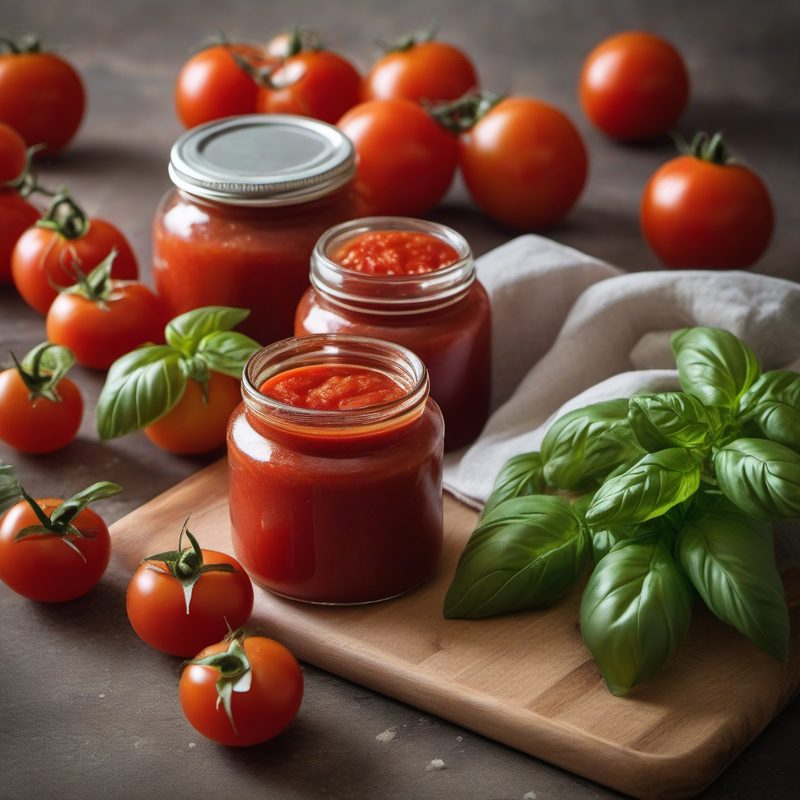
Tomato Passata
1. Why This Recipe Works
Tomato passata—smooth, uncooked tomato purée—is the quiet backbone of Italian cooking, appearing in everything from Neapolitan pizza sauce to slow-simmered ragù. The best passata is not cooked down into a thick sauce but rather gently reduced to concentrate the tomato's natural sweetness, then left with a light, velvety texture that lets the fruit's acidity and umami shine. We wanted a foolproof method for making passata at home that rivals the quality of artisan Italian imports. Using ripe San Marzano tomatoes—known for their dense flesh, few seeds, and balanced sweet-tart flavor—is the first step. Blanching and shocking the tomatoes makes peeling effortless, and passing them through a food mill (or a very brief blitz in a blender) preserves a subtle texture that labels the finished passata as homemade, not industrial. A gentle simmer with fresh basil and salt concentrates the purée by about one-third, yielding a rich, versatile base that can be canned, refrigerated, or frozen for year-round use.
2. Yield
Makes about 4 to 5 cups (1 to 1.2 liters)
3. Total Time
Active time: 30 minutes
Total time: 1 hour 15 minutes
- 2 kg (4.4 lb) San Marzano tomatoes, ripe but firm
- 4 to 6 fresh basil leaves
- 1½ tsp salt (or to taste)
5. Before You Begin
Select tomatoes that are deep red, fragrant, and slightly soft to the touch but not mushy. Underripe tomatoes will produce a passata that is overly acidic and lacks sweetness. You will need a large pot for blanching, an ice bath, and a food mill or a blender. A food mill (with the medium or fine disc) is strongly preferred; it separates skins and seeds while preserving the pulp's texture. If using a blender, be careful not to over-process—passata should retain a faint graininess, not be whipped into a foam. Sterilize your jars if you plan to can the passata for long-term storage; otherwise, it can be refrigerated or frozen.
- San Marzano Tomatoes: These plum tomatoes from the Sarno Valley near Naples are the gold standard for passata. They have thick, meaty walls, few seeds, and a natural sweetness balanced by bright acidity. If unavailable, substitute Roma tomatoes (any variety) or another plum-type tomato. Do not use beefsteak or slicing tomatoes—they are too watery and will yield a thin, bland passata.
- Fresh Basil: Genovese basil is traditional, but any sweet basil variety works. Avoid Thai basil or lemon basil, which have distinct flavors that do not belong in a neutral passata. Dried basil (½ teaspoon) can be used in a pinch, but fresh is far superior.
- Salt: Use a fine sea salt or kosher salt. The salt not only seasons the passata but also helps draw out moisture during simmering, speeding the reduction. Start with 1½ teaspoons and adjust to taste.
7. Key Equipment
- Large pot (8-quart or larger) for blanching
- Large bowl filled with ice and water (ice bath)
- Slotted spoon or spider skimmer
- Food mill with medium disc (preferred), or a blender
- Large heavy-bottomed pot or Dutch oven for simmering (5 to 6 quarts)
- Wooden spoon or heatproof silicone spatula
- Sterilized glass jars with new lids (4 half-pint jars, 2 pint jars, or 1 quart jar), or freezer-safe containers
- Canning funnel (optional)
- Ladle
- Clean kitchen towels
8. Step-by-Step Instructions
- Prepare the tomatoes: Inspect each tomato and discard any that show signs of mold, rot, or heavy bruising. Wash the tomatoes thoroughly under cold running water. Remove the stems by twisting them off or cutting a small cone around the stem base.
- Cut the tomatoes: Using a sharp paring knife, cut each tomato in half lengthwise (from stem end to blossom end). This exposes the interior and ensures even blanching.
- Blanch the tomatoes: Bring a large pot of water to a rolling boil. Prepare an ice bath in a large bowl. Working in batches of 5 to 6 tomato halves, lower them into the boiling water using a slotted spoon. Blanch for 30 to 60 seconds, until the skins begin to wrinkle and peel back at the cut edges.
- Shock the tomatoes: Immediately transfer the blanched tomatoes to the ice bath using the slotted spoon. Let them cool for 1 to 2 minutes, until they are cool enough to handle. The skins should slip off easily.
- Peel the tomatoes: Remove the tomatoes from the ice bath and peel off the skins with your fingers or a paring knife. Discard the skins. If any skins remain firmly attached, return the tomato to the boiling water for an additional 15 to 20 seconds.
- Process the tomatoes: Pass the peeled tomatoes through a food mill fitted with the medium disc. Set the mill over a large bowl and process until only skins and seeds remain in the hopper. Alternatively, transfer the peeled tomatoes to a blender and pulse 3 to 5 times (1-second pulses) until the tomatoes are broken down but still slightly chunky — do not blend continuously, as this will incorporate air and create a frothy, sauce-like texture.
- Simmer the passata: Transfer the processed tomato purée to a large, heavy-bottomed pot. Add the fresh basil leaves and salt. Bring to a gentle simmer over medium heat, then reduce the heat to low to maintain a steady, lazy bubble.
- Reduce and thicken: Cook the passata, stirring occasionally with a wooden spoon, until it has reduced by about one-third and thickened to a velvety, sauce-like consistency, 30 to 40 minutes. The passata should coat the back of a spoon but still be pourable. Taste and adjust salt.
- Remove the basil: Use tongs or a slotted spoon to remove and discard the basil leaves (they have given their flavor).
- Jar or freeze the passata: If canning, ladle the hot passata into sterilized jars, leaving ½ inch (1 cm) headspace. Wipe the rims clean, seal with new lids, and process in a boiling-water bath for 35 minutes (pint jars) or 40 minutes (quart jars). If refrigerating or freezing, let the passata cool completely before transferring to airtight containers.
9. Storage
- Refrigerator: Store in an airtight container for up to 1 week.
- Freezer: Store in freezer-safe containers or zip-top freezer bags for up to 6 months. Leave ½ inch headspace for expansion. Thaw overnight in the refrigerator before using.
- Canned (water-bath processed): Store in a cool, dark place for up to 1 year. Refrigerate after opening and use within 1 week.
10. Make Ahead / Leftovers
Passata is the ultimate make-ahead pantry staple. Make a double batch at the height of tomato season and freeze or can it for winter use. Leftover passata (even just a few tablespoons) can be stirred into soups, stews, braised beans, or scrambled eggs. It also makes an excellent quick pizza sauce straight from the jar—just spread on dough and top as desired.
11. Serving Suggestions
- Use as a base for pizza margherita or Neapolitan-style pizza.
- Stir into a soffritto (sautéed onion, carrot, and celery) as the foundation for ragù alla bolognese, spaghetti al pomodoro, or lasagna.
- Spoon over fresh mozzarella with basil and a drizzle of olive oil for a simple insalata caprese with sauce.
- Use as a cooking liquid for braised meats, meatballs, or eggplant parmigiana.
- Dilute with a little pasta water and toss with al dente pasta, finishing with grated Parmigiano-Reggiano and fresh basil.
- Serve as a dipping sauce for grilled bread, panini, or arancini.
12. Recipe Variations
- Roasted Tomato Passata: Before processing, spread the peeled tomatoes on a baking sheet, drizzle with olive oil, and roast at 400°F (200°C) for 20 minutes. Continue with step 6 for a deeper, caramelized flavor.
- Herbed Passata: Add 2 sprigs of fresh oregano or 1 sprig of fresh rosemary along with the basil during simmering. Remove before jarring.
- Garlic Passata: Add 3 peeled and lightly smashed garlic cloves to the pot during the last 15 minutes of simmering. Remove before jarring.
- Spicy Passata (Passata Arrabbiata): Add 1 dried red chili pepper or ½ teaspoon Calabrian chili paste during the last 15 minutes of simmering.
- No-Cook Passata: Omit the simmering step entirely. After processing, season the raw passata with salt, basil, and a drizzle of extra-virgin olive oil. Refrigerate and use within 3 days. This yields a brighter, more tomato-forward flavor, ideal for fresh pasta sauces and gazpacho.
13. Science of the Recipe
Blanching tomatoes serves two purposes. First, the hot water causes the thin, waxy cuticle layer to expand and separate from the flesh, making the skin easy to remove. Second, the brief heat exposure inactivates enzymes (primarily polygalacturonase and pectin methylesterase) that would otherwise break down the tomato's pectin structure over time, turning a raw purée into a watery, separated mess. The subsequent simmer concentrates the passata through evaporation while simultaneously driving off volatile compounds that contribute to raw, "green" tomato flavors, leaving behind a sweeter, more savory purée. The addition of salt at the beginning of simmering is intentional: salt dissolves into the tomato's free water and raises the boiling point of the liquid fraction, increasing the rate of evaporation and shortening the reduction time.
14. Troubleshooting
- Passata is too watery: Continue simmering uncovered, stirring frequently, until reduced to the desired consistency. If the flavor becomes too concentrated, do not add water—instead, add a splash of tomato juice or a pinch of sugar to restore balance.
- Passata is too thick: Stir in 2 to 3 tablespoons of water, vegetable broth, or the liquid drained from canned whole tomatoes until the desired consistency is reached.
- Passata is too acidic: Add ½ teaspoon of sugar or a pinch of baking soda (¼ teaspoon per 4 cups). Stir well and taste. The baking soda will neutralize acidity but should be used sparingly to avoid a soapy flavor.
- Passata tastes flat or one-dimensional: The tomatoes may not have been ripe enough. Stir in 1 to 2 teaspoons of tomato paste to boost umami, or add ½ teaspoon of sugar and a squeeze of lemon juice to brighten the flavor.
- Passata separated in the jar (watery layer on top): This is natural. Simply stir the passata before using. To prevent separation in future batches, do not over-process in the blender (which incorporates air) and ensure a full 30- to 40-minute simmer to properly integrate the tomato solids and liquids.
- Canned jars did not seal: Refrigerate and use within 1 week, or transfer to freezer-safe containers and freeze.
15. Nutritional Information (per ½-cup serving)
- Calories: 35
- Total Fat: 0.3 g
- Saturated Fat: 0 g
- Cholesterol: 0 mg
- Sodium: 350 mg (varies with added salt)
- Total Carbohydrates: 8 g
- Dietary Fiber: 2 g
- Sugars: 5 g
- Protein: 2 g
- Vitamin A: 15% DV
- Vitamin C: 25% DV
- Potassium: 8% DV
16. Related Recipes
- #7 New York Style Pizza Sauce
- #33 Basic Tomato Sauce (Salsa di Pomodoro)
- #71 Oven-Roasted Tomato Sauce
- #85 Slow-Simmered Sunday Gravy (Sugo della Domenica)
- #87 Basic Marinara Sauce
17. Test Kitchen Notes
- We tested this recipe with both food-milled and blender-processed tomatoes. The food mill consistently produced a superior passata with a pleasant, slightly grainy texture and a deeper red color. Blender processing, even with just 3 to 5 pulses, introduced tiny air bubbles that lightened the color and created a frothy layer during simmering. If you must use a blender, use the "pulse" function only and stop the moment the tomatoes break down.
- The 30- to 40-minute simmer range accounts for differences in tomato water content. Very ripe, juicy tomatoes may need the full 40 minutes; firmer, drier tomatoes may be ready in 30. Judge by visual appearance and mouthfeel, not the clock.
- We prefer to remove the basil leaves after simmering rather than leaving them in the jar. Basil left in contact with the passata for extended periods develops a slightly bitter, hay-like flavor.
- For the brightest, most tomato-forward passata, use the no-cook variation (see Variations). This is especially excellent for uncooked preparations such as pizza margherita or spaghetti al pomodoro crudo.
18. Recipe Source
Developed by the Sunday Sauce Test Kitchen. Based on traditional methods from the Campania region of Italy, where passata has been a pantry staple for generations.
Recipe from The Italian Kitchen by Vita Milanese — Volume 2 · Sunday Sauce. Discover all volumes on the ebook page.