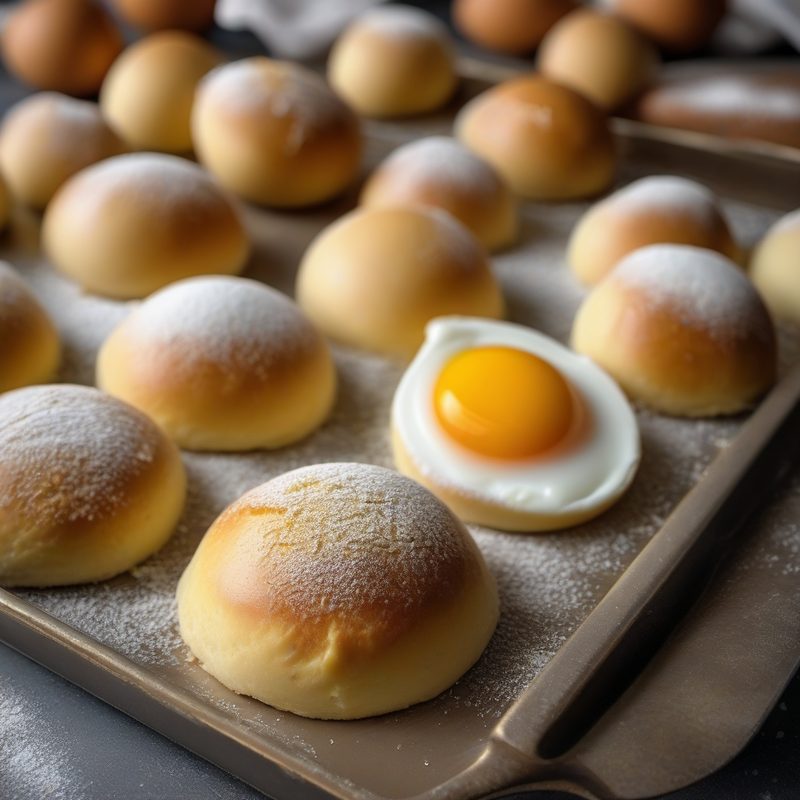
Sweet Leavened Dough
Category: Pane, Dolci
Yield: 1 large batch (approx. 1.1 kg dough)
Active Time: 25 minutes
Total Time: 2 hours 25 minutes (includes rising)
Equipment: Large mixing bowl, wooden spoon or stand mixer with dough hook, plastic wrap or clean kitchen towel, baking sheets (if baking immediately)
Why This Recipe Works
Pasta lievitata dolce is the foundational sweet leavened dough of Italian pastry — a versatile, enriched dough used for everything from brioche to cornetti (Italian croissants), bombe (filled doughnuts), zeppole di San Giuseppe, and countless regional filled pastries. Unlike lean bread dough, this dough is enriched with butter, eggs, sugar, and milk, yielding a tender, plush crumb with a subtle sweetness that supports jam, custard, chocolate, or ricotta fillings. The key to success lies in two factors: properly activating the yeast with warm (not hot) milk and a pinch of sugar to prove it's alive before mixing, and a thorough knead (10 minutes by hand, 6–8 by machine) to develop enough gluten to trap the gases that give this enriched dough its light, airy texture. The lemon zest and vanilla provide a gentle aromatic lift that reads as "baked sweet" rather than overtly dessert-like.
- Flour (500 g / 3⅓ cups): All-purpose flour (10–11% protein) or Italian "00" flour works best. Bread flour (12–13% protein) can be used for a chewier result. Avoid cake flour — it lacks the gluten strength to support the enrichment.
- Sugar (100 g / ½ cup): Granulated white sugar. This contributes sweetness and also feeds the yeast; don't reduce drastically or fermentation will slow and the crumb will be denser.
- Milk (200 ml / ¾ cup plus 1 tbsp): Whole milk is ideal for richness. Warm to 105–110°F (40–43°C) — too hot kills the yeast, too cool delays activation.
- Butter (100 g / 7 tbsp): Unsalted European-style (82% butterfat) preferred. Must be softened to room temperature — cold butter won't incorporate fully and will produce a greasy, uneven crumb.
- Eggs (2 large): Room temperature. Cold eggs will chill the dough and slow fermentation. Lightly beat before adding.
- Fresh yeast (25 g) or active dry yeast (7 g / 2¼ tsp): Fresh yeast (compressed cake) gives a slightly more aromatic rise; active dry is more convenient and shelf-stable. If using instant yeast (rapid-rise), reduce to 5 g (1½ tsp) and skip the dissolving step — mix directly with the flour.
- Vanilla extract (1 tsp): Pure vanilla extract, not imitation. Adds depth and rounds the sweetness.
- Lemon zest (from 1 medium lemon): Use a Microplane or fine grater — avoid the white pith, which is bitter.
- Salt (pinch, about ½ tsp fine sea salt): Essential for balancing sweetness and strengthening gluten structure.
- 500 g (3⅓ cups) all-purpose or "00" flour
- 100 g (½ cup) granulated sugar
- 200 ml (¾ cup plus 1 tbsp) whole milk, warmed to 105–110°F
- 100 g (7 tbsp) unsalted butter, softened
- 2 large eggs, room temperature, lightly beaten
- 25 g fresh cake yeast or 7 g (2¼ tsp) active dry yeast
- 1 tsp pure vanilla extract
- 1 tsp finely grated lemon zest (from 1 lemon)
- ½ tsp fine sea salt
Before You Begin
Take the butter and eggs out of the refrigerator 1–2 hours before starting to ensure they come to room temperature. The success of an enriched dough depends heavily on all ingredients being at similar, moderate temperatures. Warm the milk gently in a small saucepan or microwave (in 15-second bursts, stirring between) until it reaches 105–110°F (40–43°C) — it should feel comfortably warm, not hot, on your inner wrist. If using fresh yeast, check that it is soft, fragrant, and light beige; discard if it is dry, dark, or crumbly.
Instructions
- Activate the yeast: In a small bowl, combine the warm milk with 1 tsp of the sugar (from the 100 g total) and crumble in the fresh yeast (or sprinkle the active dry yeast). Stir gently and let stand for 5–10 minutes until foamy and bubbly. If no foam appears, the yeast is dead — start over with fresh yeast.
- Mix dry ingredients: In a large mixing bowl (or the bowl of a stand mixer), whisk together the flour, remaining sugar, and salt until evenly distributed. Make a well in the center.
- Combine wet ingredients: In a separate small bowl or liquid measuring cup, lightly beat the eggs with the vanilla extract and lemon zest.
- Form the dough: Pour the foamy yeast mixture and the egg mixture into the well of the dry ingredients. Stir with a wooden spoon or the dough hook attachment on low speed (speed 1–2) until a shaggy dough forms — about 1 minute.
- Incorporate the butter: Add the softened butter in 3–4 pieces, one at a time, mixing until each piece is mostly absorbed before adding the next. The dough will look oily and ragged at this point — this is normal.
- Knead (by hand): Turn the dough out onto a lightly floured surface and knead for 10 minutes, using the heel of your hand to push the dough away from you, then fold it back over itself. The dough will be sticky at first but will become smooth, supple, and slightly tacky as gluten develops. Sprinkle very small amounts of flour only if absolutely necessary to prevent sticking — too much flour will make the dough heavy.
Alternative — knead by machine: Attach the dough hook and knead on medium-low speed (speed 2–3) for 6–8 minutes. The dough should clean the sides of the bowl and feel elastic when pulled.
- Windowpane test: Pinch off a small piece of dough and gently stretch it between your fingers. If it stretches into a thin, translucent membrane without tearing (the "windowpane"), the gluten is sufficiently developed. If it tears easily, knead 2 minutes more and test again.
- First rise: Shape the dough into a smooth ball. Place it in a lightly oiled bowl, turning once to coat the surface. Cover tightly with plastic wrap or a damp kitchen towel. Let rise in a warm, draft-free place (75–80°F / 24–27°C) until doubled in volume, 1½–2 hours. (A turned-off oven with the light on makes an ideal proofing spot.)
- Punch down and shape: Gently punch down the risen dough to release gas. Turn it out onto a lightly floured surface and shape as desired — roll into a rectangle for filled pastries, cut into rounds for buns, or portion for bombe and cornetti.
- Second rise (if applicable): If making shaped pastries (e.g., filled rolls, cornetti), place the shaped pieces on parchment-lined baking sheets, cover loosely with oiled plastic wrap, and let rise 30–45 minutes until puffy. (For dough that will be refrigerated or frozen, skip this step — see "Storage and Make-Ahead.")
- Bake (as applicable): For most sweet pastries made from this dough, bake at 350°F (175°C) for 18–25 minutes, or until golden brown and internal temperature reaches 190°F (88°C). Exact times depend on shape and size. If brushing with egg wash (1 egg beaten with 1 tbsp milk), do so just before baking for a glossy, deep-golden crust.
Storage and Make-Ahead
- Refrigerator: After the first rise, punch down the dough, wrap tightly in plastic wrap, and refrigerate for up to 24 hours. The cold slows fermentation and develops flavor. Let the refrigerated dough sit at room temperature for 30 minutes before shaping and proceeding with the second rise.
- Freezer: After the first rise, punch down, wrap tightly in a double layer of plastic wrap and then foil, and freeze for up to 1 month. Thaw overnight in the refrigerator, then let come to room temperature before shaping.
- Baked goods: Store baked items in an airtight container at room temperature for up to 3 days. Reheat briefly in a 300°F (150°C) oven for 5 minutes to refresh.
Recipe Variations
- Chocolate variation: Knead in 100 g (½ cup) mini chocolate chips or finely chopped dark chocolate after the butter is fully incorporated.
- Dried fruit variation: Knead in 80 g (½ cup) golden raisins or dried currants and 60 g (⅓ cup) chopped candied orange peel.
- Whole grain variation: Substitute 120 g (¾ cup) of the all-purpose flour with whole wheat flour. The dough will be slightly denser; increase knead time by 2 minutes.
- Dairy-free variation: Replace milk with warm water or oat milk, and replace butter with 100 g (7 tbsp) vegan butter or coconut oil (softened). The texture will be less tender but still pleasant.
- Anise variation: Add 1 tsp anise seeds or ½ tsp anise extract with the vanilla. Particularly traditional for zeppole and Sicilian holiday pastries.
- Reduced sugar variation: Reduce sugar to 60 g (¼ cup plus 1 tbsp). The dough will brown less and the yeast activity may slow slightly; extend rise time by 15–20 minutes.
Troubleshooting
- Dough is too sticky to knead: Resist the urge to add large amounts of flour. Enriched doughs are naturally stickier than lean doughs. Lightly oil your hands and the work surface instead. If it remains unworkable after 5 minutes of kneading, add flour 1 tbsp at a time.
- Dough didn't rise: The yeast may have expired, the milk may have been too hot (killed the yeast) or too cool (inactive), or the room may have been too cold. Proof the yeast separately next time before adding. In a pinch, place the bowl in a warm oven (turned off with light on) to encourage rising.
- Dough is dense / heavy after baking: Over-flouring during kneading, insufficient kneading (weak gluten), or not enough rise time. Weigh your flour for accuracy next time.
- Butter leaking out during kneading: The butter was too cold or was added too quickly. Make sure butter is truly softened (pliable but not melted) and add in small pieces.
- Crumb is greasy: The dough temperature rose too high during kneading (above 80°F / 27°C), causing the butter to separate. Use cold milk next time if your kitchen is warm, or chill the dough for 20 minutes midway through kneading.
Using This Dough
Sweet leavened dough is the starting point for many iconic Italian pastries:
- Cornetti: Roll into a large rectangle, cut into triangles, and roll up from the wide end into crescents. Fill with apricot jam, Nutella, or pastry cream before rolling.
- Bombe (filled doughnuts): Portion into 50–60 g balls, deep-fry at 350°F (175°C) for 3–4 minutes, then inject with pastry cream or chocolate custard.
- Filled buns: Shape into rounds, place on a baking sheet, indent the center before the second rise, and fill with jam or ricotta after baking.
- Zeppole di San Giuseppe: Shape into rings, deep-fry, dust with powdered sugar, and fill with pastry cream and a cherry.
- Brioche loaves: Shape into a loaf pan (buttered and floured), let rise 1 hour, and bake at 350°F (175°C) for 30–35 minutes.
Nutritional Information (per 50 g / approx. ⅛ of batch)
- Calories: 165
- Total Fat: 7 g
- Saturated Fat: 4 g
- Cholesterol: 40 mg
- Sodium: 85 mg
- Total Carbohydrates: 22 g
- Dietary Fiber: 0.5 g
- Total Sugars: 7 g
- Protein: 4 g
Note: Nutritional values are estimates and will vary based on specific ingredients used and final application (filling, topping, frying vs. baking).
Recipe position 323 — Pasta lievitata dolce (Sweet Leavened Dough). Foundational Italian enriched dough for pastries, category Pane / Dolci.
Recipe from The Italian Kitchen by Vita Milanese — Volume 1 · Pasta Perfetto. Discover all volumes on the ebook page.