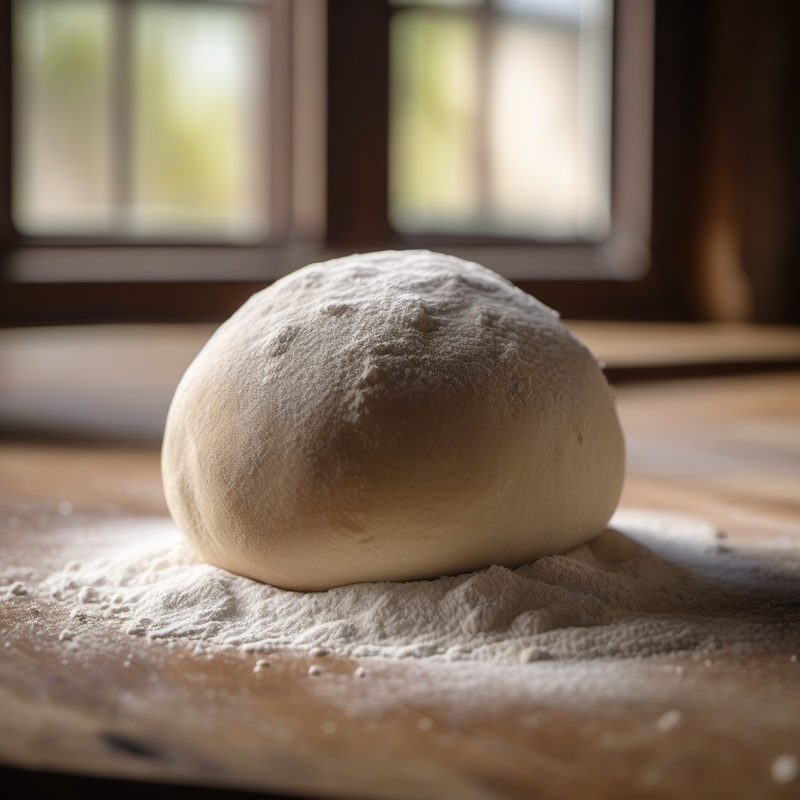
Pizza Dough
A supple, elastic pizza dough with a subtle golden hue from semolina flour — crisp on the outside, chewy within, and ready in about 3 hours with minimal hands-on work. No preferment, no poolish, no project: just a straightforward, reliable dough that bakes into a crust worth every minute of the rise.
| Amount | Ingredient |
|---|---|
| Garlic & Black Pepper | Add 1 tsp garlic powder and 1 tsp freshly cracked black pepper to the flour. |
| Slightly Sweet Crust | Dissolve 1 tablespoon sugar or honey in the warm water before adding. Helps browning and adds a subtle sweetness. |
| Sourdough | Replace the instant yeast with 150 g active sourdough starter. Reduce flour to 2½ cups (330 g) and water to ¾ cup (180 ml). Adjust as needed — sourdough hydration varies by starter. |
| Gluten-Free | Use a gluten-free all-purpose blend (with xanthan gum). Expect a wetter, stickier dough that won't stretch — press it directly onto parchment paper instead. |
🥘 Equipment
- Stand mixer with dough hook
- Large bowl
- Kitchen scale (preferred) or measuring cups
- Plastic wrap or damp kitchen towel
- Rubber spatula
- Bench scraper
- Baking sheet
- Pizza stone or steel (optional, for baking)
- Pizza peel (optional)
📋 Preparation
Step 1 — Mix the Dry Ingredients
In the bowl of a stand mixer, whisk together the all-purpose flour, semolina flour, salt, and instant yeast until evenly combined. Make sure the salt and yeast are well distributed — direct contact between salt and yeast can slow fermentation if left sitting too long.
Step 2 — Form the Dough
Add the warm water and olive oil. Fit the mixer with the dough hook and mix on low speed (KitchenAid speed 2) until a shaggy, ragtag mass forms and no dry flour remains — about 1 minute. Stop the mixer and scrape down the sides of the bowl with a rubber spatula.
The dough will look rough and uneven at this stage. That's exactly right.
Step 3 — Knead
Increase speed to medium-low (speed 4) and knead for 10 minutes. The dough should gradually pull away from the sides of the bowl, become smooth, supple, and feel elastic when touched. It should spring back slowly when you press it with a finger.
| If the dough… | Then… |
|---|---|
| Sticks stubbornly to the bottom of the bowl | Add flour 1 tablespoon at a time and knead 30 seconds |
| Feels stiff and dry; the mixer strains | Add warm water 1 tablespoon at a time and knead 30 seconds |
| Rides up the dough hook instead of staying on the bowl | Scrape it down and reduce speed slightly |
To check doneness, pinch off a small piece and gently stretch it between your fingers. If it stretches into a thin, translucent membrane without tearing — the windowpane test — the gluten is fully developed.
Step 4 — First Rise
Turn the dough onto a lightly floured surface and shape into a tight ball by pulling the edges toward the center and pinching to seal. Place the ball in a lightly oiled large bowl, turning once to coat the entire surface. Cover tightly with plastic wrap (or a damp kitchen towel) and set in a warm, draft-free spot.
Let rise until doubled in size — about 2 hours. The dough should feel puffy, aerated, and show visible bubbles when you gently press the surface.
No warm spot? Place the covered bowl in a turned-off oven with the oven light on. That steady 80–90°F (27–32°C) microclimate is ideal. If your kitchen is cold (below 68°F / 20°C), expect the rise to take closer to 3 hours.
Step 5 — Divide and Rest
Turn the risen dough onto a lightly floured surface. Don't punch it down — handle it gently to preserve the air bubbles. Using a bench scraper, divide the dough into 4 equal pieces (about 220 g each).
Shape each piece into a tight ball: pull the edges from all sides toward the center, pinch to seal, then flip seam-side down and cup your hand over it, rotating in small circles on the unfloured surface to create surface tension.
Place the balls on a lightly floured baking sheet, leaving at least 2 inches between them. Cover loosely with plastic wrap and let rest for 30 minutes. This rest relaxes the gluten, making the dough cooperative and easy to stretch without springing back.
Step 6 — Stretch and Top
Working one ball at a time, place on a lightly floured surface. Press into a flat disc with your fingertips, then stretch from the center outward, leaving a slightly thicker rim (about ½ inch) for the crust. Use one of two methods:
- Hand-stretch (easier): Press and stretch with your fingertips, rotating the disc as you go.
- Gravity stretch (classic Neapolitan technique): Pick up the disc, let it hang from your knuckles, and rotate hand over hand. Gravity does the work.
Stretch to a 10–12 inch circle (about ¼ inch thick in the center, ½ inch at the rim). Transfer to a floured pizza peel or a sheet of parchment paper, top as desired, and bake immediately.
If the dough resists and shrinks back, let it rest for 5 more minutes and try again. Patience now prevents frustration later.
🧑🍳 Chef's Tips
- Semolina is the secret weapon: The fine semolina flour adds a subtle nutty flavor and a beautiful golden color — plus, semolina is far less sticky than all-purpose flour, so it's ideal for dusting your work surface and peel.
- Water temperature matters: Use warm water at 105–110°F (40–43°C). If you don't have a thermometer, it should feel pleasantly warm on the inside of your wrist — like a comfortable bath, not hot-tub hot. Too hot kills the yeast; too cold slows it to a crawl.
- Scale > cups for dough: Pizza dough is the one recipe where a kitchen scale genuinely changes the outcome. Flour settles and compacts differently in every measuring cup; 3 cups could be anywhere from 360 g to 480 g. A 15% variance in flour weight directly changes hydration and texture. Use the gram weights for consistent results every time.
- No stand mixer? Knead by hand for 12–15 minutes on a lightly floured surface. Use the heel of your hand to push the dough away, fold it back over itself, give it a quarter turn, and repeat. The finished dough should be smooth, supple, and slightly tacky — it should stick to your palm if you press it, but peel away cleanly.
- Cold ferment = better flavor: After the first rise, refrigerate the dough balls overnight (up to 48 hours). The slow cold fermentation develops deeper, more complex flavor as the yeast and enzymes work at a leisurely pace. Bring to room temperature for 30 minutes before stretching.
- Baking hot is non-negotiable: A home oven at 475–500°F (245–260°C) with a preheated stone or steel for at least 45 minutes is the closest you'll get to a pizza oven. If you don't have a stone, bake on a preheated inverted baking sheet.
❌ Common Mistakes
| Mistake | Why It Hurts | The Fix |
|---|---|---|
| Cold water | Yeast activity slows dramatically; the rise takes 4+ hours or stalls entirely. | Use water at 105–110°F (40–43°C). |
| Over-flouring the work surface | Excess flour gets absorbed into the dough, creating a tough, dry crust. | Use the minimum flour needed — a light dusting. Better yet, use semolina for dusting; it doesn't absorb into the dough the way all-purpose does. |
| Rushing the rest (Step 5) | The dough fights back — it snaps into a smaller disc instead of staying stretched. Gluten hasn't relaxed yet. | Rest for the full 30 minutes. Set a timer. |
| Punching the risen dough | You knock out all the precious air bubbles that give the crust its open, airy crumb. | Gently deflate by pressing with your fingertips. Coax, don't conquer. |
| Stretching with a rolling pin | You compress the air bubbles and overwork the gluten, producing a flat, cracker-like crust. | Stretch with your hands only. The uneven thickness is a feature, not a bug — it creates the classic puffy rim. |
| Cold dough straight from the fridge | Cold gluten is stiff and brittle; the dough tears easily and won't stretch evenly. | Always bring refrigerated dough to room temperature (about 30 minutes) before stretching. |
💡 Variations
| Variation | How To |
|---|---|
| Whole Wheat | Replace 1 cup (130 g) all-purpose flour with whole wheat flour. Add 2–3 tablespoons extra warm water — whole wheat absorbs more moisture. |
❄️ Storage
| Method | Details |
|---|---|
| Fridge (cold ferment) | After dividing and shaping into balls (Step 5), wrap each ball tightly in plastic wrap and refrigerate for up to 48 hours. Bring to room temperature 30 minutes before stretching. |
| Freezer (raw dough) | Wrap each ball tightly in plastic wrap, then a layer of aluminum foil, and freeze for up to 3 months. Thaw overnight in the refrigerator, then bring to room temperature. |
| Freezer (baked crusts) | Par-bake the stretched crusts for 4 minutes at 475°F (245°C). Cool completely, wrap in plastic wrap and foil, and freeze for up to 1 month. Top and finish baking directly from frozen, adding 3–4 minutes to the bake time. |
🍷 Wine Pairing
- Chianti Classico (Tuscany) — High acidity and sour cherry notes cut through the olive oil and complement a simple Margherita beautifully. The tannins are firm but not aggressive.
- Barbera d'Alba (Piedmont) — Bright, juicy red with low tannins and soaring acidity; the classic Piedmontese partner for any red-sauced pizza. It refreshes the palate with every sip.
- Vermentino (Sardinia/Liguria) — Crisp, dry white with herbal notes and a saline finish. Perfect with a white pizza (no tomato), seafood toppings, or a simple marinara.
- Lambrusco (Emilia-Romagna, secco) — The bubbles scrub the palate of grease; the fruity, low-tannin profile stands up to pepperoni, sausage, or mushroom pizza without overwhelming it.
- Nero d'Avola (Sicily) — Ripe dark fruit and a hint of spice; a hearty, medium-bodied red that pairs naturally with cured-meat or eggplant-topped pizzas.
- Prosecco (Veneto, brut) — The classic aperitivo fizz works brilliantly here, especially with vegetable or seafood pizzas. Chill well and serve in a fluted glass for maximum effect.
📊 Nutrition (per serving — 1 dough ball, ~220 g)
| Calories | Protein | Fat | Carbs | Fiber |
|---|---|---|---|---|
| 380 | 10 g | 6 g | 72 g | 3 g |
🏷️ Search Tags
Recipe from "The Italian Kitchen" by Vita Milanese — Volume 1: Pasta Perfetto
Photos: vol1_29.png — MEDIA:/workspace/03_cookbook/volume1/vol1_29.png
Recipe from The Italian Kitchen by Vita Milanese — Volume 1 · Pasta Perfetto. Discover all volumes on the ebook page.