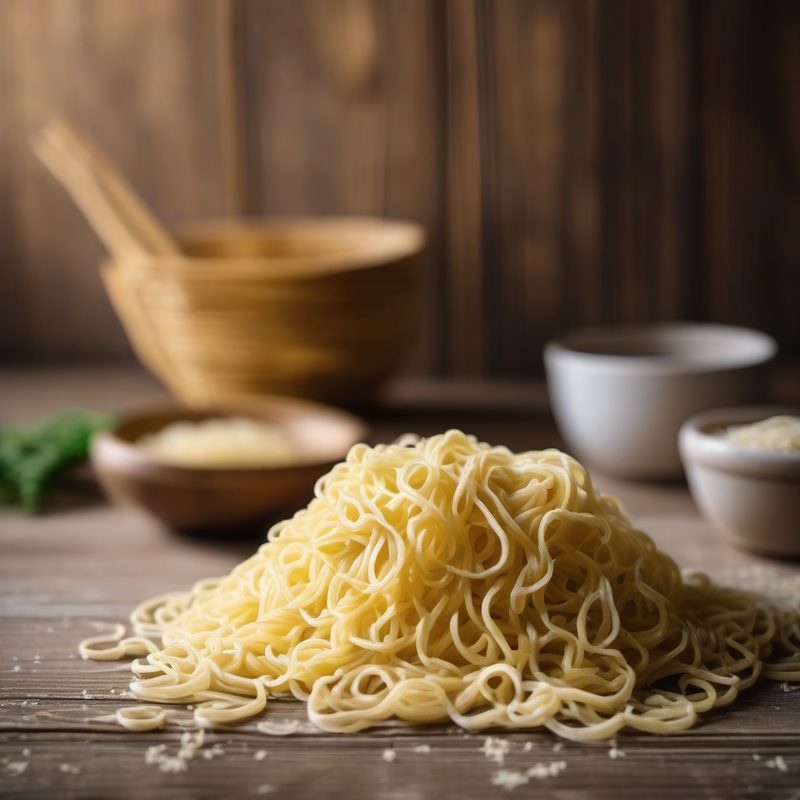
Fresh Ramen Noodles
Chewy, springy, and infinitely more rewarding than dried — these homemade ramen noodles are made with a clever trick: toasted yeast powder adds savory depth, while a brief rest relaxes the gluten for easy rolling. The dough comes together in minutes, and the noodles cook in under 4.
| Amount | Ingredient |
|---|---|
| 2 cups (250 g) | All-purpose flour |
| 1 tbsp | Toasted yeast (from above) |
| 1½ tsp | Fine sea salt |
| ½ cup (120 ml) | Warm water (about 110°F / 43°C) |
| 1 tbsp | Vegetable or neutral oil |
| as needed | Cornmeal, for dusting |
Active work: 20 min | Resting time: 30 min (inactive)
For the Toasted Yeast
For the Noodle Dough
🥘 Equipment
- Baking sheet
- Parchment paper
- Large mixing bowl
- Rolling pin
- Chef's knife or pizza cutter
- Colander
- Large pot (6-qt)
- Plastic wrap
- Airtight container
📋 Preparation
Step 1 — Toast the Yeast
Preheat the oven to 400°F (200°C) with a rack in the center position. Line a baking sheet with parchment paper.
Spread the active dry yeast in a thin, even layer over the parchment. Bake for 30 minutes, stirring once halfway through, until the yeast is deeply golden and fragrant. Do not let it darken beyond a toasted tan — burnt yeast turns bitter.
Remove from the oven and let cool completely on the baking sheet. Transfer to an airtight container. This toasted yeast keeps for weeks and doubles as a savory seasoning for soups and stir-fries.
Toasting deactivates the yeast, transforming it from a leavener into a natural flavor booster — think of it as homemade nutritional yeast with a richer, toastier profile.
Step 2 — Make the Dough
In a large mixing bowl, whisk together the flour, toasted yeast, and salt until evenly combined. Make a well in the center.
Pour the warm water and oil into the well. Using your fingers or a fork, gradually incorporate the flour into the liquid, working from the center outward, until a shaggy dough forms.
Turn the dough out onto a clean, unfloured work surface and knead for 8 to 10 minutes, until the dough is smooth, elastic, and springs back when pressed with a finger. If the dough feels too dry, add warm water 1 teaspoon at a time. If too sticky, dust your hands with flour rather than adding it to the dough.
The dough should feel firm but pliable — softer than fresh pasta dough but stiffer than bread dough.
Step 3 — Rest
Wrap the dough tightly in plastic wrap and let it rest at room temperature for 30 minutes. This relaxation step is non-negotiable: it allows the gluten to settle, making the dough easy to roll without snapping back.
Skipping the rest means fighting the dough every inch of the way. Thirty minutes transforms a stubborn lump into a cooperative sheet.
Step 4 — Roll and Cut
Lightly dust a clean work surface with cornmeal. Unwrap the rested dough and flatten it into a rough rectangle with your hands.
Using a rolling pin, roll the dough from the center outward, rotating it a quarter turn every few rolls, until it is very thin — about ⅛ inch (3 mm) thick, or even thinner if you can manage it. The thinner the sheet, the more delicate the noodle. Dust the surface and rolling pin with more cornmeal as needed to prevent sticking.
Let the rolled sheet air-dry on the counter for 5 minutes — this firms it up just enough for clean cuts.
Using a sharp chef's knife or pizza cutter, cut the dough crosswise into ¼-inch (6 mm) wide strips. Toss the cut noodles gently with a bit more cornmeal to prevent them from sticking together.
For a more rustic look, fold the sheet into a loose triple-fold before cutting (like folding a letter) — this gives you longer, more uniform strands.
Step 5 — Cook
Bring a large pot of generously salted water to a rolling boil. Add the fresh noodles and cook for 3 to 4 minutes, stirring gently to separate them as they hit the water. Fresh noodles cook fast — taste one at the 3-minute mark to check for doneness.
Drain immediately in a colander. Do not rinse unless you're using them in a cold dish — the starch on the surface helps sauce cling to the noodles.
🧑🍳 Chef's Tips
- Cornmeal is your anti-stick secret: Unlike flour, cornmeal doesn't turn into a paste when it gets damp. Use it generously on the work surface and on the cut noodles to keep everything from fusing into a clump.
- Water temperature matters: Warm water (around 110°F / 43°C) makes the dough supple and easy to knead. Cold water produces a stiff dough that's harder to work. Hot water can kill any trace activity left in the toasted yeast — though for flavor purposes, this isn't a concern.
- Double the batch, freeze the rest: Cut noodles freeze beautifully. Portion them into nests on a cornmeal-dusted baking sheet, freeze until solid (about 1 hour), then transfer to a freezer bag. Cook from frozen — no thawing — adding 1 extra minute to the boil time.
- Thinner is better: Ramen noodles should be slender and delicate. If you can roll the dough to 1/16 inch (1.5 mm), you'll have restaurant-quality noodles. Patience at the rolling pin pays off.
- Use in any broth: These noodles were made for ramen soup, but they're equally at home in a cold sesame noodle salad, stir-fry, or tossed with a simple soy-butter sauce.
❌ Common Mistakes
| Mistake | Why It Hurts | The Fix |
|---|---|---|
| Over-toasting the yeast | Burnt yeast is irredeemably bitter and ruins the dough's flavor. | Watch the oven closely in the last 5 minutes. The yeast should be deep golden, not brown. |
| Skipping the 30-minute rest | The dough fights back — it shrinks as you roll and refuses to stay thin. | Plastic-wrap and rest for the full 30 minutes. Set a timer; do not guess. |
| Rolling too thick | Thick noodles are doughy and heavy, not springy and delicate. | Roll until you can almost see through the dough — ⅛ inch or less. If you can't see your hand through it, keep rolling. |
| Crowding the pot | Noodles stick together and cook unevenly. | Use a 6-quart pot with at least 4 quarts of water. Stir immediately after adding noodles. |
| Overcooking | Fresh noodles go from perfectly tender to mushy in seconds. | Start tasting at 3 minutes. Drain the moment they're al dente. |
💡 Variations
| Variation | How To |
|---|---|
| Alkaline (kansui-style) noodles | Dissolve 1 teaspoon of baking soda in the warm water before mixing the dough. This raises the pH, giving the noodles the characteristic yellow color, springy texture, and distinct flavor of authentic ramen. |
| Whole-wheat ramen | Replace half the all-purpose flour with whole-wheat flour. The dough will be less elastic and the noodles more rustic, but the nutty flavor pairs beautifully with miso-based broths. |
| Green onion noodles | Knead 2 tablespoons of finely minced green onion (green parts only) into the dough during the last minute of kneading. The specks of green look striking against a dark broth. |
| Chili ramen noodles | Add 1 teaspoon of gochugaru (Korean chili flakes) or red pepper flakes to the flour mixture. The heat is subtle in the dough but blooms when cooked. |
| Gluten-free version | Substitute a gluten-free all-purpose blend (containing xanthan gum) for the flour. The dough will be more fragile; roll between two sheets of parchment paper and cut into wider (½-inch) noodles. Cook time reduces to 2–3 minutes. |
❄️ Storage
| Method | Details |
|---|---|
| Toasted yeast (pantry) | Store in an airtight container at room temperature for up to 1 month. |
| Fresh noodles (fridge) | Uncooked noodles keep in the fridge for up to 2 days. Dust well with cornmeal, wrap in plastic, and store in an airtight container. |
| Fresh noodles (freezer) | Freeze in portioned nests on a cornmeal-dusted baking sheet until solid (1 hour), then transfer to a freezer bag. Cook from frozen, adding 1 minute to the boil time. Keep for up to 3 months. |
💭 How to Use Your Homemade Ramen Noodles
These noodles are a foundation, not a finish. Here's how to put them to work:
- Classic shoyu ramen: Serve in a hot broth made from chicken stock, soy sauce, mirin, and a splash of sake. Top with sliced chashu pork, a soft-boiled egg, nori, and scallions.
- Miso ramen: Swirl 2 tablespoons of white or red miso paste into hot dashi or chicken broth. Top with corn kernels, butter, bean sprouts, and ground pork.
- Cold sesame noodles: Toss cooked and rinsed noodles with a sauce of tahini, soy sauce, rice vinegar, a pinch of sugar, and chili oil. Serve cold with cucumber ribbons and crushed peanuts.
- Simple soy-butter noodles: Toss hot, drained noodles with 1 tablespoon butter, 1 tablespoon soy sauce, and a pinch of black pepper. A five-minute meal that highlights the noodles themselves.
🍷 Wine Pairing
- Junmai Daiginjo Sake — The clean rice flavor and subtle fruitiness of premium sake complement the wheaty, savory notes of fresh ramen noodles without competing.
- Grüner Veltliner (Wachau) — White pepper and lime zest cut through rich broths; its crisp acidity cleanses the palate between bites.
- Riesling (Mosel, off-dry) — A touch of residual sweetness tames spicy broths and mirrors the subtle sweetness of freshly milled wheat.
- Lambrusco (Emilia-Romagna, secco) — The only red worth considering: chilled, fizzy, and fruity with enough structure to stand up to pork-based broths.
📊 Nutrition (per serving, estimated — noodles only, no broth)
| Calories | Protein | Fat | Carbs | Fiber |
|---|---|---|---|---|
| 210 | 6 g | 4 g | 38 g | 2 g |
🏷️ Search Tags
Photo reference: `vol1_28.png` — A bundle of thin, freshly cut ramen noodles dusted with cornmeal, coiled loosely on a floured wooden board with a rolling pin nearby.
Recipe from "The Italian Kitchen" by Vita Milanese — Volume 1: Pasta Perfetto
Recipe from The Italian Kitchen by Vita Milanese — Volume 1 · Pasta Perfetto. Discover all volumes on the ebook page.