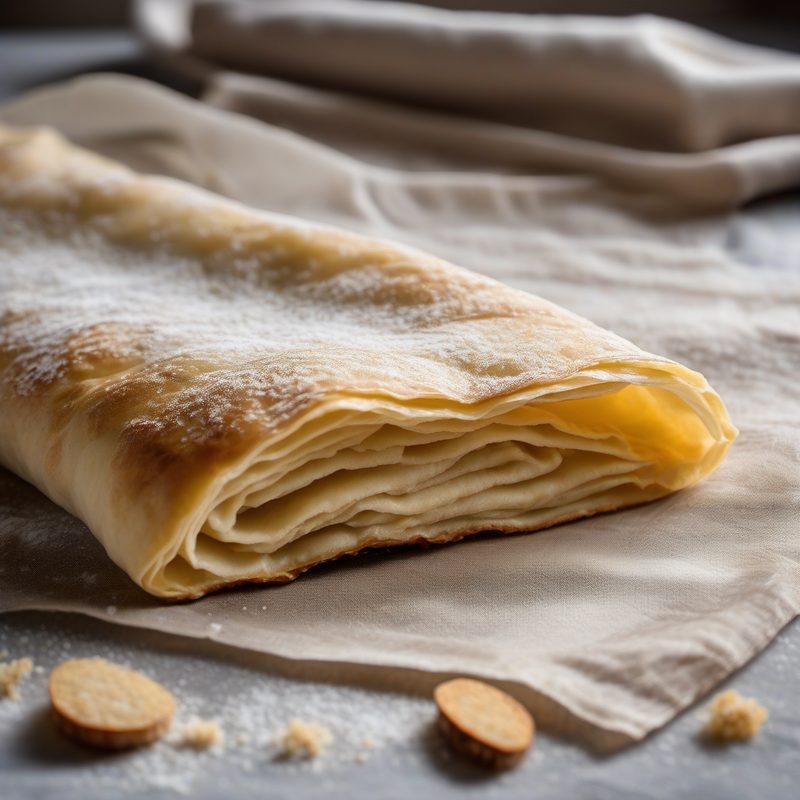
Strudel Dough
A silky, elastic, paper-thin stretched dough that is the soul of every classic Central European strudel — from apple (Apfelstrudel) to savory cabbage (Krautstrudel) — requiring only patience, a clean cloth, and the willingness to stretch a handful of humble ingredients into a gossamer sheet of remarkable tenderness and strength.
| Amount | Ingredient |
|---|---|
| 250 g (2 cups) | All-purpose flour (or tipo "00" flour), sifted |
| 1 large | Egg, room temperature |
| 3 tbsp (45 ml) | Neutral vegetable oil (sunflower, canola, or grapeseed), plus extra for brushing |
| 125 ml (½ cup) | Warm water (about 35–40°C / 95–105°F) |
| Pinch | Fine sea salt |
Pasta per strudel — Strudelteig in German, tészta in Hungarian — is one of the most elemental and impressive doughs in the European repertoire. It belongs to the family of stretched doughs (pastas stese), distinct from laminated doughs (puff pastry, Plunderteig) and rolled doughs (shortcrust, brioche). Its defining characteristic is that the dough is not rolled but stretched by hand — gently, patiently coaxing a small ball of silky elastic dough across the back of your hands and knuckles until it becomes translucent enough to read a newspaper through.
The ingredients could not be simpler: flour, egg, oil, warm water, salt. But the technique transforms this modest list into something extraordinary. The vigorous kneading (a full 10 minutes by hand) develops the gluten to an unusually high degree — much more than bread dough — creating a protein network so strong and elastic that the dough can be stretched to a thickness measured in micrometers without tearing. A single batch, barely 400 g of dough, can cover an entire tabletop.
This is the dough of the great Austro-Hungarian pastry tradition: the quintessential Apfelstrudel of Vienna, the Topfenstrudel (cheese strudel) of the coffee houses, the Krautstrudel of the farmhouses, the Mohnstrudel (poppy seed strudel) of the holiday table. It is also the dough of the Italian strudel di mele from the Südtirol/Alto Adige region, where the Austrian and Italian traditions meet. The oil — traditionally a neutral vegetable oil, though nut oils are used in some variations — keeps the dough supple and prevents it from drying out during the delicate stretching process.
This recipe yields approximately 400 g of dough, enough for one large strudel (about 60–70 cm long, serving 6–8 people). The active work is concentrated in the kneading (10 minutes) and stretching (10–15 minutes), bookended by a 1-hour rest that gives the gluten time to relax completely.
> \Bake time depends on the filling — a classic apple strudel typically bakes at 180–190°C (350–375°F) for 35–45 minutes until deep golden brown. The dough itself is complete after the 1-hour rest and can be used immediately, though it can also be wrapped and refrigerated for up to 24 hours before stretching.*
The simplicity of the ingredient list belies the technique. The flour should be sifted to aerate it and remove any lumps — a sifted flour absorbs water more evenly and produces a smoother dough. The egg provides structure and richness; it should be at room temperature so it doesn't cool the warm water. The oil plays two critical roles: it tenderizes the gluten network (preventing the stretched dough from becoming leathery) and keeps the dough surface from drying out during the lengthy stretching process. Do not substitute butter or olive oil for the neutral oil — butter contains water that would alter the hydration ratio, and olive oil's flavor is too assertive for this delicate dough. A good-quality sunflower or grapeseed oil, or the traditional olio di semi (seed oil) of Italian kitchens, is ideal. The water must be warm, not hot — warm water helps the gluten develop more readily during kneading. The salt, though just a pinch, is essential for gluten structure and flavor; do not omit it. Tipo "00" flour produces the most delicate, finest-textured strudel dough, while all-purpose flour yields a slightly more rustic but still excellent result. Do not use bread flour — its higher protein content makes the dough too elastic and difficult to stretch without tearing.
🥘 Equipment
- Large mixing bowl
- Fork or wooden spoon (for initial mixing)
- Digital kitchen scale (strongly recommended for precision)
- Clean kitchen towel or plastic wrap (for resting the dough)
- Large clean cotton or linen tablecloth (at least 80 × 80 cm / 32 × 32 inches) — essential for stretching
- Pastry brush (for oiling the dough)
- Small bowl (for extra oil)
- Scissors or a sharp knife (for trimming edges after stretching)
- Cooling rack or clean sheet pan
- Spatula or bench scraper
- Rolling pin (optional, for initial flattening)
The single most important piece of equipment is the cloth. A clean, smooth, lint-free cotton or linen tablecloth, large enough to drape over the edges of your worktable, is the traditional surface for stretching strudel dough. The cloth allows you to lift, rotate, and gently coax the dough outward without tearing. A flour-dusted pastry cloth (the kind used for rolling out pie dough) works well, as does a clean cotton bedsheet or a large linen dish towel. Avoid terry cloth, flannel, or any fabric with a textured or absorbent surface — the dough will stick. The cloth should be lightly floured before you begin.
📋 Preparation
Step 1 — Mix the Dough (5 minutes)
In a large mixing bowl, sift 250 g (2 cups) all-purpose flour with the pinch of fine sea salt. Make a well in the center.
In a small bowl or liquid measuring cup, whisk together 1 large egg (room temperature), 3 tbsp (45 ml) neutral vegetable oil, and 125 ml (½ cup) warm water until combined.
Pour the wet ingredients into the well of the flour mixture. Using a fork or wooden spoon, stir in a circular motion, gradually drawing the flour from the sides into the center until a shaggy, sticky dough forms.
The dough at this stage will look very rough and sticky — this is normal. The high hydration (the water-to-flour ratio is approximately 50% by volume, plus the liquid from the egg) creates a soft, slack dough that will tighten and become silky during kneading. Resist the urge to add extra flour; a sticky dough is a hydrated dough, and hydration is essential for the gluten development that makes the stretching possible. The oil already in the mixture will prevent it from becoming unmanageably sticky.
Step 2 — Knead Vigorously — The 10-Minute Transformation (10 minutes)
Turn the shaggy dough out onto a clean, unfloured work surface. Do not flour the surface — the dough will be sticky at first, but it will become smooth and non-sticky through the kneading process itself.
Knead the dough vigorously and continuously for a full 10 minutes. Use a push-turn-fold motion: push the dough away from you with the heel of your hand, fold it back over itself, rotate it a quarter turn, and repeat. Work with determination — this is not a gentle dough. You are building the strong, elastic gluten network that will allow the dough to be stretched paper-thin.
What to expect during the 10 minutes:
| Time | Texture | What You'll See |
|---|---|---|
| 0–2 min | Very sticky, rough, shaggy | Dough sticks to hands and surface; feels like wet clay |
| 2–4 min | Beginning to smooth; still sticky | Dough starts to come together; surface becomes less ragged |
| 4–6 min | Noticeably smoother; less sticky | Dough holds its shape better; feels supple rather than sticky |
| 6–8 min | Smooth and elastic; minimal stickiness | Dough springs back when pressed; stretches without tearing |
| 8–10 min | Very smooth, silky, and supple | Dough is glossy, elastic, and slightly tacky but not sticky |
At the end of 10 minutes, the dough should be smooth as silk, supple as a baby's skin, and elastic enough to stretch a little without tearing. It should feel alive in your hands — responsive, warm from the work, and glossy with the oil that has been fully incorporated.
This 10-minute kneading is the most important step in the entire recipe, and it is non-negotiable. The high gluten development is what makes paper-thin stretching possible: the gluten strands form a strong, flexible matrix that can be pulled to extreme thinness without breaking. Under-kneaded dough will tear during stretching, leaving you with a hole-ridden mess. If you are using a stand mixer: fit the dough hook and knead on medium-low speed (KitchenAid speed 2–3) for 6–7 minutes — the dough will be ready when it is smooth, elastic, and cleans the sides of the bowl. However, hand-kneading is traditional and gives you a better feel for the dough's readiness. Use a bench scraper to help collect and turn the dough during the first few minutes when it is stickiest. If after 10 minutes the dough is still sticky (this can happen in humid weather or with certain flours), add flour 1 teaspoon at a time and knead for 1 more minute — but only if truly necessary; most sticky doughs will resolve by the 8-minute mark.
Step 3 — Brush with Oil and Rest (2 minutes + 1 hour rest)
Form the kneaded dough into a smooth ball. Using a pastry brush, coat the ball all over with a thin layer of neutral vegetable oil — the oil prevents a skin from forming on the surface during the rest.
Place the oiled dough ball in a clean bowl. Cover tightly with plastic wrap (or a damp, clean kitchen towel — the towel must be damp, not wet, to prevent sticking).
Let the dough rest at room temperature for a full 1 hour.
The hour-long rest serves two essential purposes. First, it relaxes the gluten that you so vigorously developed during kneading — paradoxically, the dough needs to be both strong (to withstand stretching) and relaxed (to be stretchable). An over-tense gluten network will resist pulling and spring back. Second, it allows the flour to fully hydrate, resulting in a more supple, cooperative dough. Dough that has rested a full hour will stretch far more easily — and far thinner — than dough used immediately after kneading. The oil coating is critical: strudel dough left uncovered for even 10 minutes will develop a dry crust that creates weak spots during stretching. The temperature of your kitchen matters: in a warm kitchen (25°C / 77°F), the dough may be ready to stretch after 45 minutes; in a cool kitchen (18°C / 65°F), it may need up to 1½ hours. The dough should feel soft, supple, and slightly relaxed when you press it with a fingertip — it should not spring back assertively.
Step 4 — Prepare the Work Surface and Stretch the Dough (15–20 minutes)
This is the dramatic centerpiece of the strudel-making process — the moment when the small, dense ball of dough transforms into a translucent sheet that seems impossibly large.
Set up your workspace:
- Cover your kitchen table or work surface with a large clean cotton or linen tablecloth. The cloth should be large enough to hang over the edges of the table by at least 20–30 cm (8–12 inches) on all sides — you will be lifting and rotating the dough on this cloth.
- Lightly flour the cloth — dust it evenly with a thin layer of flour. Use your hands to spread the flour across the entire surface. Too much flour will dry the dough; too little will cause it to stick. The cloth should feel powdery but not caked.
- Place the rested dough in the center of the floured cloth. If the dough has contracted and feels firm, let it sit uncovered for 5 minutes to warm slightly — cold dough is less elastic.
- Using a rolling pin (or your hands), gently flatten the dough ball into a round or oval disc about ½ cm (¼ inch) thick and roughly 20 cm (8 inches) in diameter. The disc should be even in thickness.
The stretching process — step by step:
Begin stretching by working from the center outward, using the backs of your hands and your knuckles (not your palms). Traditional strudel-makers place both hands under the dough, palms down, and gently lift — the dough's own weight begins the stretching process.
- Start at the center. Slide both hands, palms down, under the center of the dough. Gently lift — the dough should begin to sag and stretch under its own weight. Slowly move your hands outward, using your knuckles and the backs of your fingers to gently stretch the dough in all directions.
- Work in a circular pattern. Move around the table, gently pulling the dough outward with the backs of your hands. The dough should be hanging over your hands like a thin, translucent curtain. Work slowly and patiently — rushing causes tears.
- Focus on thick spots. As the dough becomes thinner, you will notice thicker areas that are more opaque. Gently stretch these areas by placing the dough over the backs of your hands and gently pulling your hands apart — use the weight of the dough to do the work.
- Let gravity help. As the dough hangs down over the edges of the table, its own weight will continue to stretch it. Gently guide the overhanging dough by lifting it with the backs of your hands and moving outward.
- Check for thin spots. The goal is a uniform thickness — the dough should be translucent enough to read a newspaper through. Traditional strudel-makers consider it ready when you can see the pattern of the cloth through the dough. If you can see your hand through the dough, it is thin enough.
Signs that the dough is ready:
- It is uniformly translucent — you can see the cloth pattern clearly through it
- It hangs over the edges of the table by about 15–20 cm (6–8 inches) on all sides
- It is roughly rectangular-oval in shape, about 60–70 cm (24–28 inches) in diameter
- It is still intact, with no tears or holes
If a small tear appears: Don't panic. Gently patch it by pressing the edges together with your fingers. A small dab of oil on your fingertip helps seal the tear. Large tears can be patched with a small piece of dough trimmed from a thick edge — moisten the patch with a drop of water and press gently into place.
If the dough resists stretching in one area: Move to a different area and come back. The gluten may be tighter in one direction; working it gradually from all sides will eventually equalize the tension.
The stretching of strudel dough is one of the most tactile and meditative techniques in pastry. It cannot be rushed. A 10-minute stretch is fast; 15–20 minutes is more typical for a first attempt. The dough will tell you where it wants to go — follow its lead rather than forcing it. The backs of the hands are used (rather than the palms) because the palms are warmer and can make the dough sticky and greasy. If the dough starts to stick to the cloth, dust the cloth very lightly with more flour under the sticking area. If the dough starts to dry out on the surface, brush it very lightly with oil — a dry surface will crack and tear. The ideal ambient condition is a slightly cool, not-too-dry room. A humid day can make the dough sticky; a very dry day can cause it to crack. In dry conditions, you may need to work faster and keep the dough covered with a lightly dampened cloth between passes. The first time you see your hand through the dough — when the dough becomes that thin — is a moment of genuine pastry magic. Even experienced bakers pause to admire it.
Step 5 — Fill and Roll the Strudel (10 minutes — after stretching is complete)
The strudel dough must be filled immediately after stretching — it will begin to dry out within minutes.
- Brush the stretched dough all over with melted butter (about 2–3 tbsp, 30–45 g) or additional neutral oil. This layer of fat prevents the filling from making the dough soggy and adds flavor and richness.
- Spread the filling over the dough, leaving a 5 cm (2 inch) border on all sides. The filling should be distributed evenly but not too thickly — more than about 1 cm (½ inch) of filling makes rolling difficult and the strudel may burst during baking.
- Using the cloth to lift, fold the short edges of the dough over the filling (this seals the ends). Then, lifting the cloth with both hands, gently roll the strudel — the cloth does the work, not your hands. Tilt the cloth upward and let the dough roll over itself, encasing the filling in a spiral.
- Seal the roll by brushing the final edge with butter or oil and pressing gently to close.
- Transfer the rolled strudel to a parchment-lined baking sheet, seam-side down. If the strudel is too long for the baking sheet, gently curve it into a U-shape or horseshoe — this is traditional and does not affect baking.
- Brush the top with melted butter or egg wash (1 egg beaten with 1 tablespoon milk) for a golden, glossy crust.
- Bake at 180–190°C (350–375°F) for 35–45 minutes, until deep golden brown and the filling is bubbling at the seams.
The rolling technique is what makes strudel unique: the dough is so thin and delicate that you cannot roll it by hand without tearing it. The cloth acts as a rolling aid — you lift the cloth on one side, and the dough gently rolls itself around the filling in a loose, layered spiral. Each rotation creates another delicate layer of dough around the filling. When sliced, a properly rolled strudel reveals concentric rings of paper-thin dough alternating with filling — a beautiful cross-section that is as much a visual pleasure as a textural one. The classic fillings for this dough are the sweet Apfelstrudel (apples, raisins, cinnamon, sugar, breadcrumbs) and the savory Krautstrudel (sauerkraut, bacon, onion, caraway), but the dough welcomes almost any filling that is not too wet. The key to avoiding a soggy bottom: always include a layer of breadcrumbs (toasted in butter) between the dough and any moist filling — the breadcrumbs absorb excess moisture and create a crisp barrier.
🧑🍳 Chef's Tips
- The 10-minute kneading rule is absolute. Under-kneaded strudel dough will tear during stretching. If you are unsure whether the dough is ready, perform the windowpane test: pinch off a small piece of dough and gently stretch it between your fingers. If it stretches into a thin, translucent membrane without tearing, the gluten is sufficiently developed. If it tears or looks ragged, knead for 2 more minutes and test again.
- Use the backs of your hands, not your palms. Palms are warmer and can make the dough sticky and greasy. The backs of your hands — specifically your knuckles — are cooler and distribute the stretching pressure more evenly. Professional strudel-makers also remove rings and watches before stretching.
- Remove jewelry before stretching. Rings and bracelets can snag the delicate dough and cause tears. This is not just a practical tip — it is part of the traditional ritual of strudel-making.
- Work on a sturdy table at waist height. The stretching requires you to lean over the dough and walk around the table. A table that is too low will strain your back; one that is too high will make it difficult to see the dough's thickness. A standard kitchen counter or dining table is ideal.
- Use a cool work surface. A marble or granite countertop is ideal because it stays cool and prevents the dough from becoming greasy. If your work surface is wood or laminate, it will work fine — just make sure it's stable.
- If the dough tears, don't stop. Small tears can be patched (see Step 4). A few small tears in a large strudel sheet are invisible once rolled and baked. Only a catastrophic tear (larger than your hand) requires restarting, and even then, you can often patch it with trimmed dough.
- Keep the dough covered during the rest. The oil coating and the cover are both essential. If the dough develops a dry crust during resting, that crust will create weak spots during stretching. If you need to rest the dough longer than 1 hour (e.g., you're preparing it in advance), wrap it tightly in oiled plastic wrap and refrigerate for up to 24 hours. Bring it to room temperature (about 1 hour) before stretching.
- For first-time strudel-makers: start with a half recipe. Halve all ingredients: 125 g flour, ½ egg (beat the egg and use half), 1½ tbsp oil, 63 ml warm water, tiny pinch salt. A smaller sheet of dough is easier to manage and less intimidating. Once you've successfully stretched a half-recipe, the full recipe will feel natural.
- The dough is more forgiving than it looks. First-time strudel-makers often panic at the fragility of the stretched dough, but it is surprisingly resilient — the high gluten development gives it a strength that belies its gossamer appearance. A properly kneaded and rested dough will stretch far more than you expect.
- Cold leftovers make excellent strudel chips. Slice leftover baked strudel into 1 cm rounds, lay them on a baking sheet, and bake at 160°C (325°F) for 10–15 minutes until crisp. These make a wonderful snack or dessert crumble topping — like a strudel granola.
- A food processor can be used for the dough. Pulse the flour and salt 3 times. Add the egg, oil, and warm water. Pulse 8–10 times until a shaggy dough forms. Turn out onto a clean surface and knead by hand for 6–7 minutes (the food processor has partially developed the gluten). Proceed with the oil coating and 1-hour rest. The food processor method is faster but requires hand-kneading afterward to achieve the full gluten development — a food processor alone cannot develop the gluten as evenly as hand-kneading.
❌ Common Mistakes
| Mistake | Why It Hurts | The Fix |
|---|---|---|
| Dough is under-kneaded | Weak gluten network → dough tears during stretching | Knead a full 10 minutes. If dough tears, knead 2 more minutes. The windowpane test is your friend |
| Dough is over-floured during kneading | Excess flour dries out the dough → cracks form during stretching | Avoid adding extra flour during kneading. The dough should transition from sticky to smooth through kneading alone |
| Rest time is too short | Gluten hasn't relaxed → dough springs back and resists stretching | Rest a full 1 hour minimum. In cool kitchens, up to 1½ hours |
| Dough not coated with oil before resting | A dry skin forms on the surface → weak spots and tearing | Brush thoroughly with oil on all surfaces before covering |
| The cloth is not floured enough | Dough sticks to the cloth → impossible to stretch without tearing | Dust the cloth evenly with flour. If the dough sticks in one area, lift it gently and dust more flour underneath |
| The cloth is over-floured | Excess flour dries the dough → cracks and stiff patches | Use a light, even dusting. Brush off excess flour if the dough looks dusty |
| Stretching too fast or forcing the dough | Uneven tension → tears and holes | Stretch slowly and patiently. Let gravity do the work. Move to a different area if one spot resists |
| Using warm hands or palms | Heat makes the dough sticky and greasy → difficult to stretch evenly | Use the backs of your hands and knuckles. Run your hands under cold water and dry thoroughly before stretching |
| Filling is too wet | Soggy dough → strudel collapses during baking; bottom stays raw | Drain wet fillings well. Add a layer of toasted breadcrumbs between the dough and the filling to absorb moisture |
| Overfilling the strudel | Strudel bursts during baking; filling leaks out | Fillings should be no thicker than 1 cm (½ inch). Leave a 5 cm (2 inch) border on all sides |
| Filling the dough before brushing with butter/oil | Dough absorbs moisture from filling → becomes soggy | Always brush the stretched dough with melted butter or oil before adding any filling |
| Brushing the strudel with too little butter/oil before baking | Dry, pale crust; layers don't separate | Brush generously with melted butter or egg wash before baking. The fat promotes browning and creates a crisp, flaky crust |
| Oven temperature too low | Dough doesn't crisp → soggy, pale strudel | Bake at 180–190°C (350–375°F). For extra crispness, increase to 200°C (400°F) for the last 5 minutes |
| Slicing the baked strudel while hot | Filling runs out; structure collapses | Let the strudel rest on the baking sheet for 15–20 minutes after baking before slicing. Use a serrated knife with a gentle sawing motion |
💡 Variations
| Variation | How To |
|---|---|
| Whole Wheat Strudel Dough | Replace 75 g (½ cup + 1 tbsp) of the all-purpose flour with whole wheat flour. Add 1 tablespoon extra warm water. The dough will be slightly less elastic and more difficult to stretch paper-thin, but it has a lovely nutty flavor that pairs well with savory fillings (cabbage, mushroom, potato). Do not use more than 50% whole wheat flour — the bran interferes with gluten development. |
| Spelt Strudel Dough | Replace all the all-purpose flour with spelt flour (250 g). Spelt has a different gluten structure and produces a particularly tender, delicate strudel dough. Add 1 extra tablespoon of warm water. The dough stretches beautifully but requires a slightly gentler hand. |
| Semolina Strudel Dough | Replace 50 g (⅓ cup) of the all-purpose flour with fine semolina flour. The semolina adds a slight golden color and a subtle textural grit that is particularly welcome in savory strudels. Add 1 tablespoon extra warm water. |
| Nut-Oil Strudel Dough | Replace the neutral vegetable oil with walnut oil or hazelnut oil. The nut oil infuses the dough with a warm, toasty flavor that is exquisite with apple, pear, or poppy seed fillings. Walnut oil is the traditional choice for Apfelstrudel in parts of Austria and Südtirol. |
| Olive Oil Strudel Dough | Replace the neutral oil with a mild extra-virgin olive oil (fruity, not peppery). Use for savory strudels filled with spinach and ricotta, mushrooms, or roasted vegetables. The olive oil flavor should be noticeable but not dominant — choose a delicate Ligurian or lake Garda oil. |
| Butter Strudel Dough | Replace the 3 tbsp oil with 45 g (3 tbsp) melted unsalted butter, slightly cooled. The butter adds a richer flavor and a more golden color to the baked strudel. However, butter contains water (about 16%), so the dough may be slightly more tender and slightly less elastic. Add the butter at room temperature, not hot. |
| Egg-Free Strudel Dough | Omit the egg and increase the warm water to 150 ml (⅔ cup). The dough will be slightly less rich and less structured, but it will still stretch beautifully. Add 1 extra tablespoon of oil. This variation is useful for lighter, more delicate strudels or for those with egg allergies. |
| Saffron Strudel Dough | Steep a generous pinch of saffron threads in the warm water for 15 minutes before mixing the dough. The saffron gives the dough a magnificent golden color and a subtle, honeyed floral aroma. Traditional in festive Austrian Apfelstrudel and Hungarian rétes (strudel). |
| Lemon-Zest Strudel Dough | Add the finely grated zest of 1 large lemon to the flour before mixing. The bright citrus oils cut through the richness of butter-based fillings and add a fresh, aromatic note. Excellent for summer fruit strudels (cherry, apricot, plum). |
| Herb Strudel Dough (Savory) | Add 1 tablespoon finely chopped fresh herbs (thyme, sage, rosemary, or a mix) to the flour. Use for savory strudels: the herbs infuse the thin dough layers with fragrance. Particularly good with mushroom, spinach, or potato fillings. Reduce or omit if using a strongly flavored filling. |
| Sparkling Water Strudel Dough | Replace the warm water with warm sparkling water (still at 35–40°C). The carbonation creates a slightly more aerated, tender dough. This is a trick used in some Hungarian rétes recipes. The dough stretches slightly more easily and bakes up with a lighter, crisper texture. |
❄️ Storage & Make-Ahead
| Method | Details |
|---|---|
| Refrigerator (unbaked dough, before stretching) | After kneading, brushing with oil, and the 1-hour rest, wrap the dough tightly in oiled plastic wrap and refrigerate for up to 24 hours. Bring to room temperature (about 1 hour) before stretching. The rested dough will be even more relaxed and easier to stretch after an overnight refrigeration. Do not refrigerate for longer than 24 hours — the egg in the dough will begin to deteriorate and the dough may develop off flavors. |
| Freezer (unbaked dough, before stretching) | After kneading and the 1-hour rest, wrap the dough tightly in oiled plastic wrap, then in aluminum foil. Freeze for up to 2 months. Thaw overnight in the refrigerator, then bring to room temperature for 1 hour before stretching. Do not thaw at room temperature — the condensation can make the dough sticky. |
| Refrigerator (assembled, unbaked strudel) | Assemble the strudel on the baking sheet as directed, but do not brush with butter or egg wash. Cover loosely with plastic wrap and refrigerate for up to 4 hours. Brush with butter/egg wash just before baking. The unbaked filled strudel should not sit longer than 4 hours — the filling can make the bottom layers of dough soggy. |
| Freezer (assembled, unbaked strudel) | Assemble the strudel on a parchment-lined baking sheet, but do not brush with butter or egg wash. Place the baking sheet in the freezer until the strudel is frozen solid (about 3 hours). Transfer to a zipper-lock bag or wrap tightly in plastic wrap and foil. Freeze for up to 1 month. To bake: place the frozen strudel on a parchment-lined baking sheet, brush with butter or egg wash, and bake at 180°C (350°F) for 50–60 minutes — no need to thaw, but add 10–15 minutes to the bake time and cover loosely with foil if the top browns too quickly. |
| Refrigerator (baked strudel) | Baked strudel is best enjoyed on the day it is made — the crisp, flaky layers soften as the strudel sits. If you must store it, keep it loosely covered (not wrapped) at room temperature for up to 1 day. Do not refrigerate — the moisture in the refrigerator will turn the crisp dough into a soggy, leathery mess. Re-crisp in a 180°C (350°F) oven for 10 minutes. |
| Freezer (baked strudel) | Cool the baked strudel completely, then wrap tightly in plastic wrap and aluminum foil. Freeze for up to 1 month. To reheat: unwrap and place on a baking sheet in a 160°C (325°F) oven for 15–20 minutes until hot and crisp. Do not microwave — the dough will become tough and rubbery. |
| Make-ahead tip: pre-stretched dough sheets | Stretch the dough as directed, but instead of filling it, lay it flat on a floured cloth, roll it up gently in the cloth (like a jelly roll), and place it in a plastic bag. Refrigerate for up to 4 hours or freeze for up to 1 month. To use: unroll carefully, brush with butter, and fill. The dough may be slightly less elastic after refrigeration, so handle it gently. |
| Make-ahead tip: toasted breadcrumbs | The breadcrumb layer that goes between the dough and filling can be prepared up to 1 week in advance. Toast 100 g (1 cup) fresh breadcrumbs in 60 g (4 tbsp) butter over medium heat, stirring constantly, until deep golden brown. Cool completely and store in an airtight container at room temperature. |
🍷 Wine Pairing
| Wine | Why |
|---|---|
| Gewürztraminer (Alto Adige / Südtirol) | The quintessential strudel wine — aromatic, floral, with lychee and rose notes and a hint of spice. Its natural sweetness and intensity stand up beautifully to apple strudel with cinnamon and raisins without being overpowering. From the very region where Italian and Austrian pastry traditions meet. |
| Moscato d'Asti (Piedmont) | Sweet, lightly sparkling, and low in alcohol — the peachy, floral sweetness is a perfect match for sweet fruit strudels (apple, cherry, apricot, plum). The gentle bubbles cut through the butter-rich pastry layers. |
| Müller-Thurgau (Trentino-Alto Adige) | A lighter, more delicate aromatic white with floral and green apple notes. Its subtle sweetness and bright acidity mirror the apple filling of Apfelstrudel without competing. A beautiful, understated pairing. |
| Grüner Veltliner (Austria) | Austria's signature white grape — crisp, peppery, and mineral-driven. A dry Grüner Veltliner is the classic pairing for savory strudels (cabbage, mushroom, spinach). Its acidity and white pepper notes cut through the richness of bacon or cheese fillings. |
| Beerenauslese Riesling (Austria or Germany) | A late-harvest, intensely sweet Riesling with honeyed apricot and peach notes. Its luscious sweetness and high acidity make it a spectacular pairing for sweet nut strudels (poppy seed, walnut) or Topfenstrudel (cheese strudel with raisins). |
| Prosecco Superiore (Veneto) | Lively, floral, and gently fruity — the crisp effervescence cuts through the buttery layers like a palate cleanser. Works with both sweet and savory strudels. The bubbles add a celebratory note. |
| Schiava / Vernatsch (Alto Adige) | A light, fragrant red with red berry and almond notes, low tannins, and gentle acidity. Serve slightly chilled with savory cabbage strudel or mushroom strudel — the berry fruit complements the caraway and onion in Krautstrudel beautifully. |
| Blaufränkisch (Austria) | A medium-bodied red with dark cherry, pepper, and a touch of spice. Serve with savory meat-filled strudels — particularly those with game, beef, or pork fillings. The spice notes echo the black pepper and caraway often used in savory strudels. |
| Eiswein (Austria or Germany) | An intensely sweet, concentrated wine made from frozen grapes. Liquid gold — its honeyed, tropical fruit intensity is a transcendent pairing for a classic apple strudel with vanilla sauce. A dessert pairing for special occasions. |
| Vermouth Bianco (for savory strudels) | Aromatic, gently bitter, and herbaceous — the botanicals in white vermouth (chamomile, gentian, citrus peel) echo the herbal notes in savory strudels. Serve chilled as an aperitif alongside a Krautstrudel or Topfenstrudel. |
🥗 Suggested Accompaniments
- Vanilla sauce (Vanillesauce) or crème anglaise — A warm, silky vanilla custard poured over a slice of apple strudel is the classic Viennese presentation. The cool, creamy vanilla balances the warm, spiced apple and the crisp, buttery pastry. For the best result, infuse the milk with a split vanilla bean (or 1 teaspoon vanilla paste) and serve the sauce warm, not hot.
- Lightly whipped cream (Schlagobers) — Unsweetened or very lightly sweetened whipped cream is the traditional Austrian Apfelstrudel accompaniment. The cool, airy cream contrasts with the warm, dense strudel. Whip 200 ml (¾ cup) heavy cream with 1 teaspoon powdered sugar and a drop of vanilla extract until soft peaks form. Serve in a separate bowl so each guest can add their own.
- Powdered sugar — A generous dusting of powdered sugar over the baked strudel is the simplest and most traditional finish. The sugar creates a beautiful white blanket over the golden pastry and adds a touch of sweetness to each bite. Use a fine-mesh sieve and apply just before serving.
- Toasted slivered almonds — Scatter 50 g (½ cup) toasted slivered almonds over the filling of an apple strudel before rolling. The nuts add a welcome crunch and a toasty, warm flavor that complements the apples and cinnamon. Toast them in a dry pan over medium heat for 2–3 minutes until fragrant.
- Rum-soaked raisins — For the classic Apfelstrudel, soak 60 g (⅓ cup) raisins in 3 tablespoons dark rum (or apple juice) for 30 minutes before adding to the filling. The plumped, rum-scented raisins add bursts of sweetness and moisture. Drain them before using — do not add the soaking liquid to the filling.
- Lemon or orange zest in the filling — The finely grated zest of 1 lemon or orange added to the apple filling brightens the flavor and cuts through the sweetness. The citrus oils elevate the apples and prevent the filling from tasting one-dimensionally sweet.
- Vanilla ice cream — A scoop of good-quality vanilla ice cream alongside a warm slice of apple or pear strudel is a beloved modern accompaniment. The contrast of hot and cold, crisp and creamy, is irresistible.
- Caramel sauce — A drizzle of salted caramel sauce over apple strudel is a more indulgent alternative to vanilla sauce. The salt balances the sweetness; the caramel echoes the caramelized sugars of the baked apples.
- Sour cream (Schmand) or crème fraîche — A dollop of tangy, cool sour cream or crème fraîche is the traditional accompaniment for Topfenstrudel (cheese strudel) and savory strudels. The acidity cuts through the richness and provides a bright counterpoint.
- Pickles or cornichons (for savory strudel) — A few small pickles on the side of a savory cabbage or meat strudel provide a sharp, acidic contrast that cuts through the richness and refreshes the palate between bites.
- Fresh arugula with lemon vinaigrette (for savory strudel) — A simple, peppery green salad dressed with lemon juice, olive oil, salt, and pepper is the perfect side for any savory strudel. The acidity and bitterness balance the rich, buttery pastry.
📊 Nutrition (per ⅙ of total dough — approximately 67 g unbaked)
| Calories | Protein | Fat | Carbs | Fiber | Sugar |
|---|---|---|---|---|---|
| ~160 | 5 g | 5 g | 24 g | 0.8 g | 0.5 g |
Nutritional values are estimates for the unbaked dough (⅙ of the full ~400 g recipe — one serving of a 6-serving strudel). The dough itself is modest in calories: approximately 160 calories per serving before filling, with 5 g of fat (mostly from the oil and egg yolk) and 24 g of carbohydrates. The fat content is considerably lower than laminated or shortcrust pastries because strudel dough relies on oil only for tenderness, not for the buttery layering of puff or Danish pastry. The Protein comes primarily from the egg and flour; the egg contributes about 3 g of the 5 g total. The dough contains virtually no sugar (less than 0.5 g per serving) — any sweetness in the finished strudel comes entirely from the filling. The full recipe (6 servings before filling) contains approximately 960 calories and 30 g of fat. Once the strudel is filled and baked, the nutritional profile changes dramatically: an apple strudel filling (apples, sugar, raisins, breadcrumbs, butter) adds approximately 120–180 calories per serving, while a savory Krautstrudel (sauerkraut, bacon, onion) adds approximately 100–150 calories per serving. A Topfenstrudel (quark/cheese filling) adds approximately 130–170 calories per serving. Finished strudel servings typically range from 280 to 340 calories, depending on the filling. The full nutritional picture depends almost entirely on what you choose to put inside — the dough itself is lean, functional, and admirably modest for such a dramatic technique.
❓ Frequently Asked Questions
What's the difference between strudel dough and phyllo (filo) dough?
This is the most common question about strudel dough. While both are stretched paper-thin, they are fundamentally different. Strudel dough is made with flour, egg, oil, and warm water — a single, cohesive, elastic sheet that is stretched by hand and used as one large piece. Phyllo dough is made with flour, water, and a small amount of oil or vinegar (no egg) — it is rolled and stretched commercially into many thin sheets that are stacked and buttered separately. Phyllo is leaner (no egg, less oil) and more brittle than strudel dough. In practice: strudel dough is more forgiving to work with, has a richer flavor (thanks to the egg and more oil), and bakes up with a tender, slightly crisp texture. Phyllo bakes up shatteringly crisp and papery. They are not interchangeable in recipes — if a recipe calls for strudel dough, it expects a single, large, hand-stretched sheet that can support a substantial filling and be rolled into a log. If it calls for phyllo, it expects multiple stacked sheets that will be layered with butter or oil and cut into pieces. That said, in a pinch, you can substitute 6–8 sheets of phyllo (brushed with melted butter between each sheet) for one sheet of strudel dough — the result will be different but still delicious.
Why does my strudel dough keep tearing when I try to stretch it?
Tearing almost always means the dough was under-kneaded or under-rested. The two most common causes: (1) you didn't knead for the full 10 minutes — the gluten network is not strong enough to support the stretch; (2) the 1-hour rest was shortened or skipped — the gluten hasn't relaxed enough and resists stretching, causing tears. Other possible causes: the dough developed a dry skin during resting (you didn't oil it thoroughly enough), the cloth was not floured enough (the dough stuck and tore when you tried to lift it), or the dough was too cold (you didn't let it come to room temperature after refrigeration). If your dough tears repeatedly, gather it into a ball, knead it briefly to redistribute the gluten, oil it, and let it rest for another 30 minutes. Then try again with a well-floured cloth and a patient hand.
Can I make strudel dough in a bread machine or stand mixer?
Yes, both work well. For a stand mixer: fit the dough hook, combine all ingredients, and knead on medium-low speed (KitchenAid speed 2–3) for 6–7 minutes. The dough is ready when it is smooth, elastic, and cleans the sides of the bowl. For a bread machine: use the dough-only cycle. Add the wet ingredients first, then the flour and salt. Run the cycle (typically 15–20 minutes of kneading). The machine will develop the gluten effectively. In both cases, proceed with the oil coating and 1-hour rest. Hand-kneading, however, gives you greater control over the gluten development and helps you learn the feel of properly kneaded dough — it is worth doing by hand at least once.
Can I use this dough for strudels other than apple?
Absolutely. This dough is the universal strudel dough for both sweet and savory fillings. Classic sweet fillings include: Apfelstrudel (apple, raisins, cinnamon, sugar, breadcrumbs), Topfenstrudel (quark/cream cheese, raisins, lemon zest, sugar), Mohnstrudel (poppy seed paste, honey, rum-soaked raisins), Kirschstrudel (sour cherries, breadcrumbs, sugar, cinnamon), Nussstrudel (walnuts or hazelnuts, sugar, cinnamon, breadcrumbs), and Birnenstrudel (pears, ginger, almonds, sugar). Classic savory fillings include: Krautstrudel (sauerkraut, bacon, onion, caraway), Spinatstrudel (spinach, ricotta or feta, garlic, nutmeg), Fleischstrudel (ground meat, onion, herbs, breadcrumbs), Kartoffelstrudel (potato, onion, cheese, herbs), Pilzstrudel (mushrooms, shallots, thyme, cream), and Käse-Ham-Strudel (ham and cheese, mustard, pickles). Any filling that is not too wet — and that is bookended by a layer of toasted breadcrumbs — will work beautifully.
How thin does the dough really need to be?
Traditional strudel-makers say the dough should be thin enough to read a newspaper through. Practically speaking: the dough should be uniformly translucent — you should clearly see the pattern of the cloth through it. When you hold it up to the light (before it's on the cloth), you should see your hand through it. The final thickness is roughly equivalent to phyllo dough — about 0.1 to 0.2 mm (0.004 to 0.008 inches). If it's not quite that thin on your first attempt, don't worry. Even at 1 mm thick (about 5 times thicker than ideal), the dough will still produce a lovely, tender strudel. The paper-thin ideal is the goal, but an 80% successful stretch is still a delicious strudel.
Why did my baked strudel come out soggy on the bottom?
A soggy bottom usually means the filling was too wet or there wasn't a protective breadcrumb layer between the dough and the filling. Always: (1) drain any wet fillings thoroughly before using; (2) include a layer of toasted breadcrumbs (about 60 g / ½ cup) between the dough and the filling — the breadcrumbs absorb excess moisture; (3) brush the stretched dough with melted butter or oil before adding the filling and breadcrumbs — this creates a moisture barrier; (4) make sure your oven is fully preheated — a too-cool oven won't set the dough quickly enough, allowing it to absorb moisture from the filling before it crisps.
Can I roll the dough with a rolling pin instead of stretching by hand?
You can, but the result will be a different dough. Hand-stretching is what gives strudel dough its signature thinness and tenderness. A rolling pin can only take the dough to about 2–3 mm thickness before the gluten resists — this is about 10–15 times thicker than hand-stretched dough. A rolled-out strudel dough will produce a chewier, denser, less delicate strudel. It will still be edible and tasty, but it won't have the ethereal, layered quality of a hand-stretched strudel. If you absolutely cannot stretch by hand, roll the dough as thin as possible, let it rest for 10 minutes if it springs back, and roll again. Repeat until you achieve the thinnest possible sheet.
Why is my strudel dough shrinking as I try to stretch it?
This is a sign that the gluten hasn't rested enough. If the dough springs back dramatically when you try to stretch it, stop stretching. Gather it into a ball, brush it lightly with oil, cover it, and let it rest for another 20–30 minutes. The gluten needs more time to relax. After the additional rest, try again — the dough should respond much more cooperatively. A dough that stubbornly shrinks may also be a sign of too-high-gluten flour (bread flour). Next time, use all-purpose or tipo "00" flour.
How do I get a beautiful golden, glossy crust on my baked strudel?
The key is the pre-bake glaze. Before baking, brush the rolled strudel generously with one of the following: (1) melted butter — gives a rich golden color and a tender, flaky crust; (2) egg wash (1 egg beaten with 1 tablespoon milk or water) — gives a deep golden, glossy, almost lacquered finish; (3) melted butter + egg wash — brush first with melted butter, then with egg wash, for the best of both worlds: deep color and glossy sheen. After the strudel is baked, you can also brush it with warm apricot jam (strained) for an extra glossy, professional finish — this is the classic Abrikosermarmelade glaze used in Viennese pastry shops.
Can I double this recipe?
Yes. Double all ingredients proportionally: 500 g flour, 2 eggs, 6 tbsp (90 ml) oil, 250 ml warm water, pinch salt. You will need a larger work surface and a larger cloth — ideally a table at least 120 cm (48 inches) wide. The stretched dough will be enormous, easily covering a full dining table. This is traditional for large family gatherings and makes a strudel that serves 12–16 people. The kneading time in a stand mixer should be increased to 8–10 minutes; by hand, expect 12–15 minutes of vigorous kneading.
What can I do with leftover strudel dough scraps?
Don't discard the edges you trim from the stretched dough! Gathered and re-kneaded, the scraps can be re-rolled (after a 15-minute rest) into a smaller strudel, used as a topping for soups (cut into small squares and baked until crisp — like Frittaten or Suppeneinlage), or fried in oil until golden and dusted with powdered sugar and cinnamon for a quick, crunchy snack. In Austria, these fried dough scraps are called Strauben or Schmarren and are a beloved kitchen treat.
What's the best way to slice a baked strudel?
Use a serrated bread knife with a gentle sawing motion — do not press down or the layers will compress and the filling may squirt out. Let the strudel rest for 15–20 minutes after baking before slicing. For the cleanest slices, dip the knife in hot water and wipe it dry between each cut — the heat seals the cut edges slightly and prevents the layers from separating. A single strudel is typically cut into 6–8 slices, each about 4–5 cm (1½–2 inches) thick. Serve immediately.
Can I use this dough for dessert purses or individual strudels?
Yes. After stretching, cut the dough into 15 × 15 cm (6 × 6 inch) squares. Place a spoonful of filling in the center of each square, brush the edges with melted butter, and gather the corners together to form a purse, pinching to seal. Place on a parchment-lined baking sheet, brush with butter or egg wash, and bake at 190°C (375°F) for 20–25 minutes until golden and crisp. These individual strudel purses are elegant, portion-controlled, and easier to handle than a full-sized strudel. They are also an excellent make-ahead option: assemble and refrigerate for up to 4 hours before baking.
🔗 Related Recipes
- Apple Strudel — Strudel di Mele (#63) — The classic application of this dough. A full recipe for the traditional Viennese Apfelstrudel with spiced apples, raisins, and toasted breadcrumbs, using this very dough.
- Plunder/Danish Pastry Dough (#320) — The yeasted laminated dough that is the rich, buttery cousin of this stretched dough. Compare how lamination (butter block + folds) versus stretching (hand-pulled sheet) achieves different textures from similar flour-and-butter foundations.
- Basic Puff Pastry — Pasta Sfoglia (#125) — The classical French laminated dough, which shares with strudel dough the principle of building many thin layers — but through folding rather than stretching. A fascinating comparison in technique.
- Rough Puff Pastry Express (#307) — The fast, home-kitchen-friendly version of puff pastry. Less technique than classic puff, but still a world away from the hand-stretched strudel method.
- Basic Shortcrust Pastry — Pasta Frolla (#124) — The sweet, crumbly Italian shortcrust that is the roll-and-press counterpart to this stretch-and-roll dough. Both are fundamental preparations, but they could not be more different in texture.
- Pasta all'Uovo — Fresh Egg Pasta (#302) — The other classic egg-and-flour dough of Italian cuisine. Fresh pasta uses a similar ingredient list (flour, egg, oil, salt) but is rolled, not stretched, and is boiled, not baked. A beautiful demonstration of how technique transforms the same basic ingredients.
- Durum Wheat Pasta Dough (#306) — The gluten-sturdy, high-protein dough of dried pasta. Compare with the stretched strudel dough to see how protein content and kneading affect a dough's elasticity and final texture.
- Stuffed Roast with Spinach and Wild Garlic (#288) — A savory rolled preparation that uses a technique similar to strudel rolling — filling wrapped in a flat sheet and rolled into a log. The assembly method will feel familiar to strudel-makers.
- Krapfen / Berliner — Jam-Filled Doughnuts (#187) — Another Austrian pastry classic, this time fried rather than baked. The yeasted, enriched dough of Krapfen is the polar opposite of the lean, stretched strudel dough.
- Zucchini Lasagna (#466) — A layered, baked preparation that also uses thin sheets of dough (or vegetable substitutes in this case). The layering principle is shared with strudel, though the technique is entirely different.
🏷️ Search Tags
📸 Photo Reference
Photo reference: `vol1_321.png` — An overhead, mid-action shot on a large kitchen table draped with a generously floured white linen cloth. In the center, a pair of hands (just the forearms visible, sleeves rolled up) are shown from above, palms down, positioned under a nearly fully stretched strudel dough. The dough is a magnificent translucent oval, roughly 70 cm (28 inches) in diameter, so thin that the weave of the linen cloth is clearly visible through it in every direction. The hands are stretched slightly apart, fingers spread, with the dough draped over the backs of the knuckles — the classic stretching position. In the lower-left corner of the frame, a small bowl holds the remaining stretched dough trimmings, gathered into a neat ball and brushed with oil, resting for a second use. Beside it, a small ramekin of neutral oil with a pastry brush resting inside. In the upper-right corner, partially out of frame, the filling ingredients for a classic Apfelstrudel are visible: a bowl of sliced apples tossed with cinnamon and sugar, a smaller bowl of golden toasted breadcrumbs, a dish of rum-soaked raisins, and a sprinkle of slivered almonds on a cutting board. A glass measuring cup with the last few tablespoons of melted butter stands near the bowl. The wooden rolling pin is set aside, unused, emphasizing that this is a hand-stretched dough. The lighting is warm, natural daylight from a nearby window — late afternoon sun, casting soft, long shadows across the floured cloth and highlighting the gossamer texture of the stretched dough. The top edge of the dough catches the light, glowing with the oil brushed on during the rest, while an area near the center shows the faint refraction of light through the thinnest section — a rainbow-like shimmer that is the signature of properly stretched strudel dough. In the background, a teacup of coffee and a small vase with a single sprig of apple blossom sit on a sideboard, a quiet nod to the patience and craft of traditional pastry-making. A vintage kitchen scale with brass weights stands to one side, its balance showing empty but its presence underscoring the precision of the recipe. The mood is meditative, unhurried, and full of the quiet satisfaction of hands-on cooking — the image of a technique that has remained unchanged for centuries, passed from hand to hand, cloth to cloth, generation to generation.
Recipe from "The Italian Kitchen" by Vita Milanese — Volume 1: Pasta Perfetto 🥟
Recipe from The Italian Kitchen by Vita Milanese — Volume 1 · Pasta Perfetto. Discover all volumes on the ebook page.